Bingling Temple: A Buddhist Grotto Sanctuary in China
Site at a Glance
- Rating
- 4.3
- Popularity
- Very Low
- Country
- China
- Primary era
- Medieval
- Eras represented
- Classical, Medieval, Early Modern
- Civilizations
- Ming, Qing, Song, Tang, Yuan
- Site type
- Religious
- Remains
- Sanctuary
On this page12 sections
History
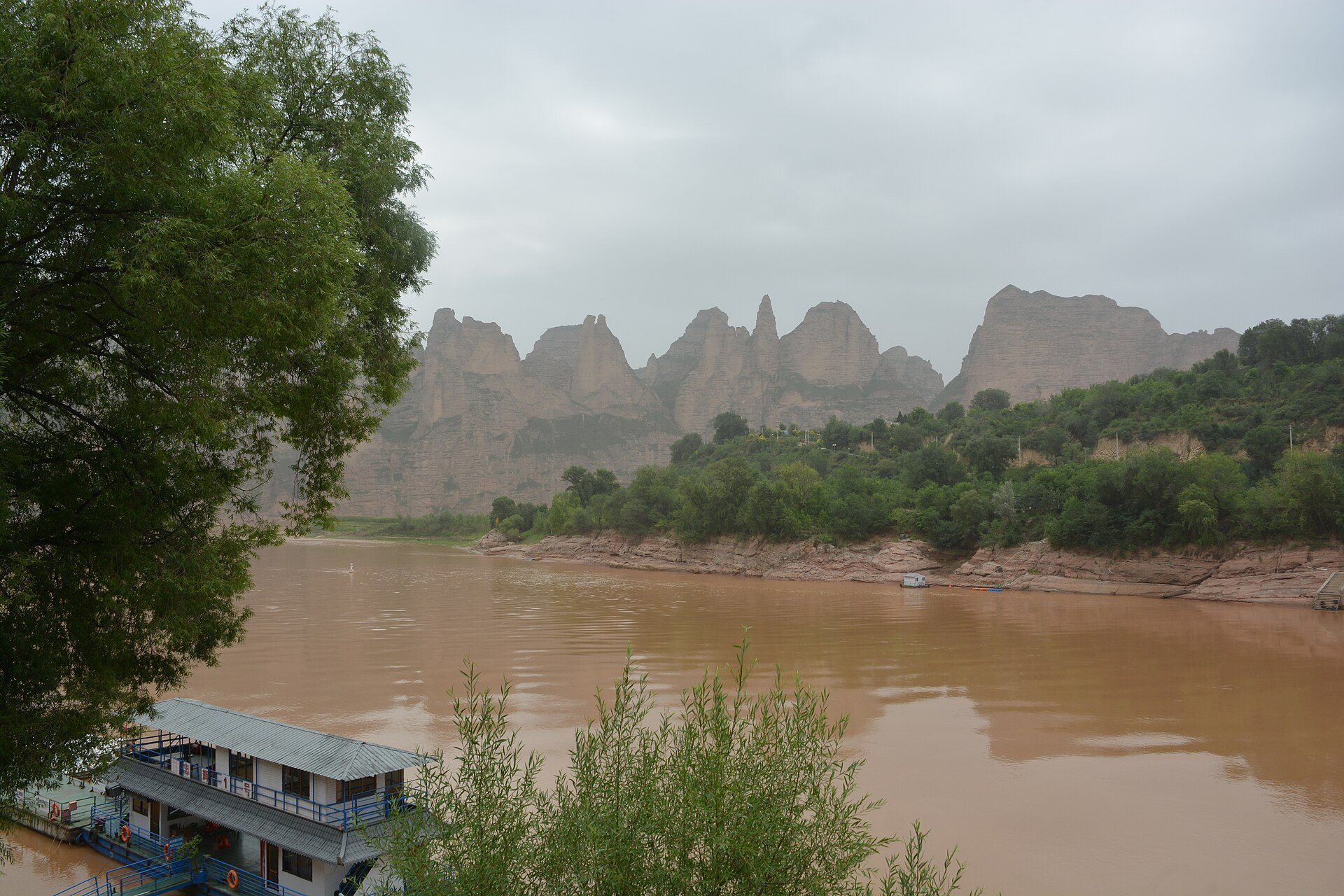
Bingling Temple is an ancient Mahayana Buddhist grotto sanctuary in Qinzhou District, Tianshui, China. Formed in natural caves and excavated cliff faces, it developed beside a branch of the Yellow River along a Silk Road route linking China with Central Asia and regions farther west. Mahayana, a major Buddhist tradition emphasizing universal enlightenment and the aid of bodhisattvas, shaped the sanctuary’s imagery and religious purpose.
Origins under the Western Qin
The beginnings of excavation are uncertain. Activity may have started in the late fourth century, although an earlier origin under the Western Jin dynasty in the third century has also been proposed. Bingling Temple became an established religious complex around AD 420 to 428, during the Jianhong era of the Western Qin, a Xianbei-led state in northwestern China during the politically divided Sixteen Kingdoms period. The earliest surviving inscription dates to AD 420.
The Qifu rulers of the Western Qin encouraged the sanctuary’s construction. Its earliest imagery and inscriptions belong to a period when Buddhist teachings and artistic forms were moving through the routes of northwestern China. Bingling’s imagery offered an early visual interpretation of influential Mahayana teachings and later provided an important precedent for sculpture at the Yungang and Longmen grottoes.
Successive dynasties and changing names
The complex continued to develop for more than a millennium. Grottoes were added or altered under the Northern Wei, Sui, Tang, Song, Yuan, Ming, and Qing dynasties, and the artistic styles of the surviving works reflect these successive periods. The site’s position between Central Asian and central Chinese artistic traditions is visible in connections with Khotan, Rawaq, Liangzhou, and Kucha.
Bingling Temple was known by several names. It was called the Tangshu Grottoes, a Qiang-language name meaning “ghost cave,” and became Longxing Temple during the Tang dynasty. During the Song dynasty it was known as Lingyan Temple, while the name Bingling Temple came into use in the Ming dynasty.
Damage, discovery, and heritage protection
Earthquakes, erosion, and looting damaged or destroyed many grottoes and works over the centuries. In April 1963, workers from the Gansu provincial office discovered Cave 169 and its dated inscription associated with Amitabha Buddha. The stone figure, dated AD 420, has been described as the earliest explicitly dated stone Buddhist figure found in an excavated sanctuary in present-day China.
Bingling Temple became a major nationally protected historical and cultural site of China in 1961. In 2014, it was included in the UNESCO World Heritage serial property “Silk Roads: the Routes Network of Chang’an-Tianshan Corridor,” which recognizes the site’s connection with the wider network of routes across Asia. Bingling Temple is a cave sanctuary rather than a single freestanding temple building, and its religious history is represented through successive grottoes, sculptures, paintings, and inscriptions.
Remains
Cliff-side layout and surviving works
The complex extends for about two kilometres through a loess landscape where high cliffs face one another across a gorge carved by a branch of the Yellow River. The grottoes occupy the northern side of the canyon, using natural caves and caverns along the cliff face. The surviving complex contains 183 caves, 694 stone statues, and 82 clay sculptures. Each cave functions as a small temple-like space containing Buddhist images, paintings, and wall decoration.
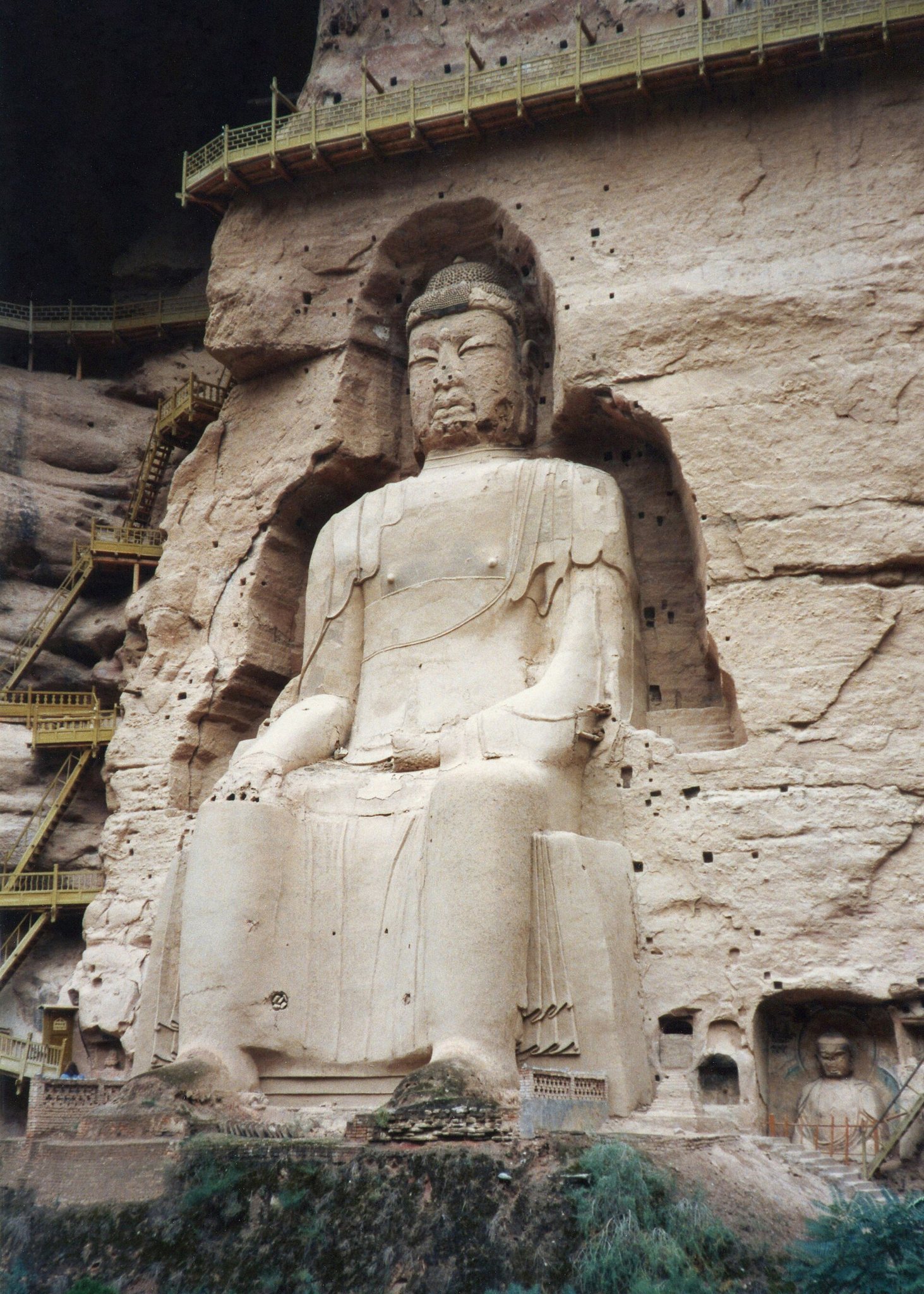
The grottoes culminate in a large natural cavern. Wooden walkways wind along the rock face toward cliff-side caves and the giant Maitreya Buddha, while the principal excavated sanctuary stands about 60 metres above the valley floor. Most sculptures were made by applying clay over armatures, although some were carved in stone. Painted surfaces, frescoes, murals, inscriptions, and Buddhist relief imagery remain across the complex.
Cave 169
Cave 169 is described as the largest cave in China. It measures approximately 18 metres high, 26 metres wide, and 8 metres deep. Its interior contains clay sculptures, generally modelled over armatures, together with stone sculpture, frescoes, murals, and inscriptions. The compositions are arranged relatively freely, suggesting that their execution did not follow a single predetermined plan. Several inscriptions connect some painted themes or models with Buddhist scriptures translated around AD 400 to 410.
Niche 6
Niche 6 contains a Buddha accompanied by two bodhisattvas, Mahayana figures who postpone final Buddhahood to aid other beings. The style is associated with Liangzhou and Kucha. The central figure is Wuliangshou, also called Amitayus, the Buddha of Infinite Life. Paintings in the niche include Buddhas of the ten directions, donors, members of the Qifu royal family, and important monks of the court. The imagery associated with Wuliangshou relates to the Smaller Sukhavativyuha Sutra.
The niche also preserves the Amitabha Buddha dated to AD 420, the earliest explicitly dated stone sculpture in the complex. Amitabha and Amitayus are closely related Buddha forms associated respectively with Infinite Light and Infinite Life. The figure has broad shoulders, a powerful torso, and a strongly geometric, weighty appearance.
Niche 7
Niche 7 on the northern wall preserves a standing Buddha from a triad. The figure is 2.45 metres high. Its left hand makes the giving gesture, while its right hand makes the fearlessness gesture. These Buddhist hand positions convey religious meanings through the arrangement of the hands.
Niche 23
Niche 23 contains five seated Buddhas whose style closely resembles Buddhist sculpture from Rawaq at Khotan. The figures have large halos and make the meditation gesture, another Buddhist hand position associated with religious meaning.
Other painted imagery
Paintings in Niches 10 to 13 include Buddhist deities, bodhisattvas, and a foreign-looking monk guiding women of the court toward Buddhist devotion. Inscriptions identify parts of the imagery. Other scenes show the debate between Manjusri and Vimalakirti, and Shakyamuni Buddha with Duobao. These subjects derive from the Mahayana Vimalakirti Sutra and Lotus Sutra.
The giant Maitreya Buddha
The giant Maitreya Buddha was carved during the Tang dynasty and rises more than 27 metres high. It forms a major part of the cliff-side sanctuary reached along the walkways that follow the rock face toward the large natural cavern.