Ming Palace: The Imperial Palace Complex of Nanjing
Site at a Glance
- Rating
- 4.2
- Popularity
- Very Low
- Country
- China
- Primary era
- Medieval
- Eras represented
- Medieval
- Civilizations
- Ming
- Site type
- Domestic
- Remains
- Palace
On this page14 sections
History
Ming Palace in Nanjing, China, was an imperial palace built outside Jiankang, the predecessor of Nanjing, during the early Ming dynasty. Zhu Yuanzhang, then known as the King of Wu, began construction in 1367 under the name “New Palace of the King of Wu,” and the complex was completed in 1368. The palace belonged to the Ming dynasty, the Chinese imperial dynasty that ruled from 1368 to 1644.
Foundation and expansion
After the palace was completed, Zhu Yuanzhang proclaimed the Ming dynasty and became its first emperor, the Hongwu Emperor. He renamed Jiankang Nanjing, meaning “southern capital.” During the following years, he focused much of his building activity on a planned “middle capital” at Fengyang, so the Nanjing palace underwent relatively little change at first.
Major work resumed in 1373. An extensive programme of expansion and refurbishment was completed in 1375, including the establishment of a Palace of Culture and a Palace of Military Heroes. Further expansion followed in 1392, strengthening the palace’s role as the centre of the early Ming court.
Succession and the move to Beijing
Hongwu died in 1398 and was succeeded by his grandson, the Jianwen Emperor. A civil war began when Zhu Di, Hongwu’s son and Jianwen’s uncle, challenged the new emperor. Zhu Di captured Nanjing in 1402 and became the Yongle Emperor, while Jianwen disappeared during a fire at the imperial palace.
Yongle transferred the main imperial residence to Beijing and formally moved the imperial capital there in 1420. Nanjing remained a reserve capital for almost three centuries, with its own reserve court and ministries. The Ming Palace was placed under the officials of the Imperial Household Department, the Qing institution responsible for managing the imperial household and its property.
Fire, destruction, and Qing rule
A series of fires damaged the palace, and much of the destruction was not repaired. In 1449, the three principal halls of the Outer Court burned down. The Outer Court was the formal ceremonial and governmental section of an imperial palace, and its three halls were never rebuilt. Further fires destroyed other parts of the complex.
In 1644, Li Zicheng’s rebel forces captured Beijing, helping to bring about the collapse of the Ming dynasty. After Beijing then fell to the Qing, the palace briefly became the seat of the Prince of Fu, who was crowned the Hongguang Emperor in an attempt to continue the Ming dynasty from Nanjing. By this time, only a small part of the complex remained intact, and Hongguang began rebuilding some sections.
Qing armies reached Nanjing in 1645. Hongguang fled, and the officials of the reserve court surrendered. Under Qing rule, the former imperial sector was garrisoned by the Manchu Eight Banners, hereditary military and administrative organizations used by the Qing government. The palace also became the yamen, or administrative headquarters, of two military commands.
During the Qing dynasty, the palace was progressively dismantled. Stones and carved elements were removed for use as construction materials and decoration in other projects. By the visits of the Kangxi and Qianlong emperors to Nanjing in the seventeenth and eighteenth centuries, the palace was already in ruins, and both emperors stayed elsewhere.
Taiping and Republican transformations
In the nineteenth century, the Taiping Heavenly Kingdom made Nanjing its capital during the Taiping Rebellion. Its leaders chose to build a new Palace of the Heavenly King instead of restoring the Ming complex. Large quantities of material were taken from the remaining palace structures. After the Taiping defeat, Qing troops razed the new palace in 1864 and erected government buildings in a traditional style on the site.
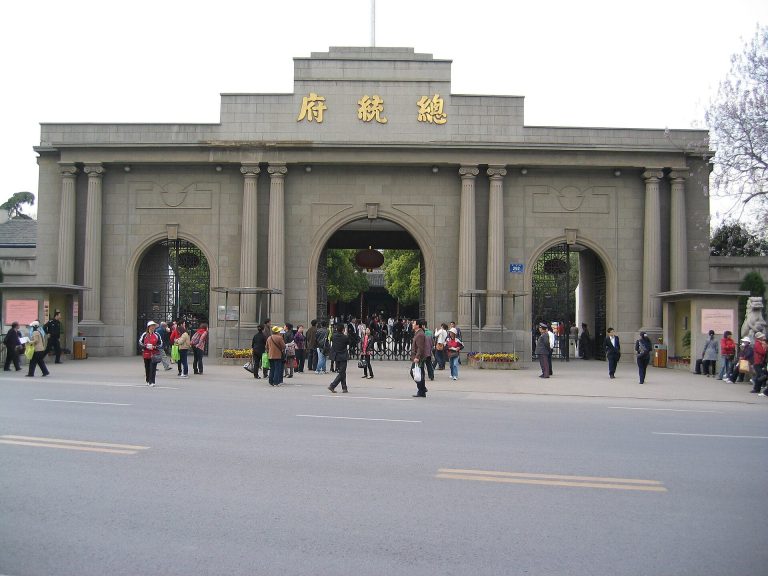
The Republic of China made Nanjing its capital in 1928 and converted one of the Qing government buildings into the Presidential Palace. A planned central administrative zone around the Presidential Palace was never completed. In 1929, East Zhongshan Road was built from east to west across the former palace complex, dividing it into northern and southern sections.
During the 1930s, offices for two Kuomintang bodies and the National Central Museum, now the Nanjing Museum building, were constructed in and around the northern section. The Kuomintang was the Nationalist political party that controlled the Republic of China during the 1920s and 1930s. The southern section became a small airstrip, whose construction led to the demolition of the two projecting wings of the Meridian Gate.
The former site of the three Outer Court halls was established as a commemorative park, while the area around the Meridian Gate was also made into a park. Other parts of the former complex are occupied by institutions including the Aeronautical and Aerospace University of Nanjing, the Archives of the Nanjing Military District, and the No. 2 Historical Archives of China.
Remains
The surviving remains of Ming Palace consist chiefly of masonry gate platforms, bridges, excavated foundations, isolated column elements, stone carvings, and other architectural components. They preserve parts of the palace’s principal north-south organization, while the commemorative park at the former Outer Court site and the park around the Meridian Gate mark important areas of the former complex.
Gate platforms and palace axis
Meridian Gate
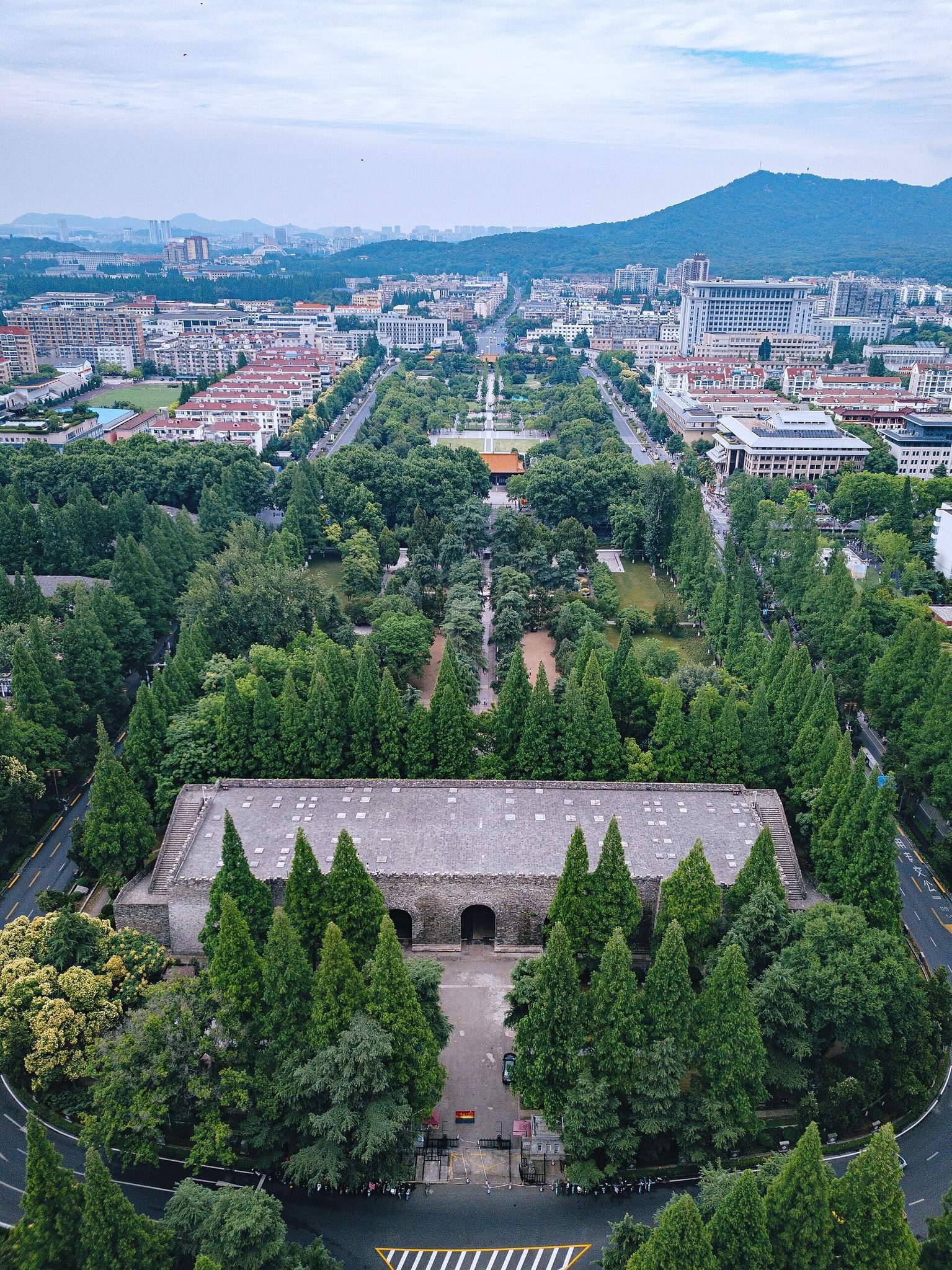
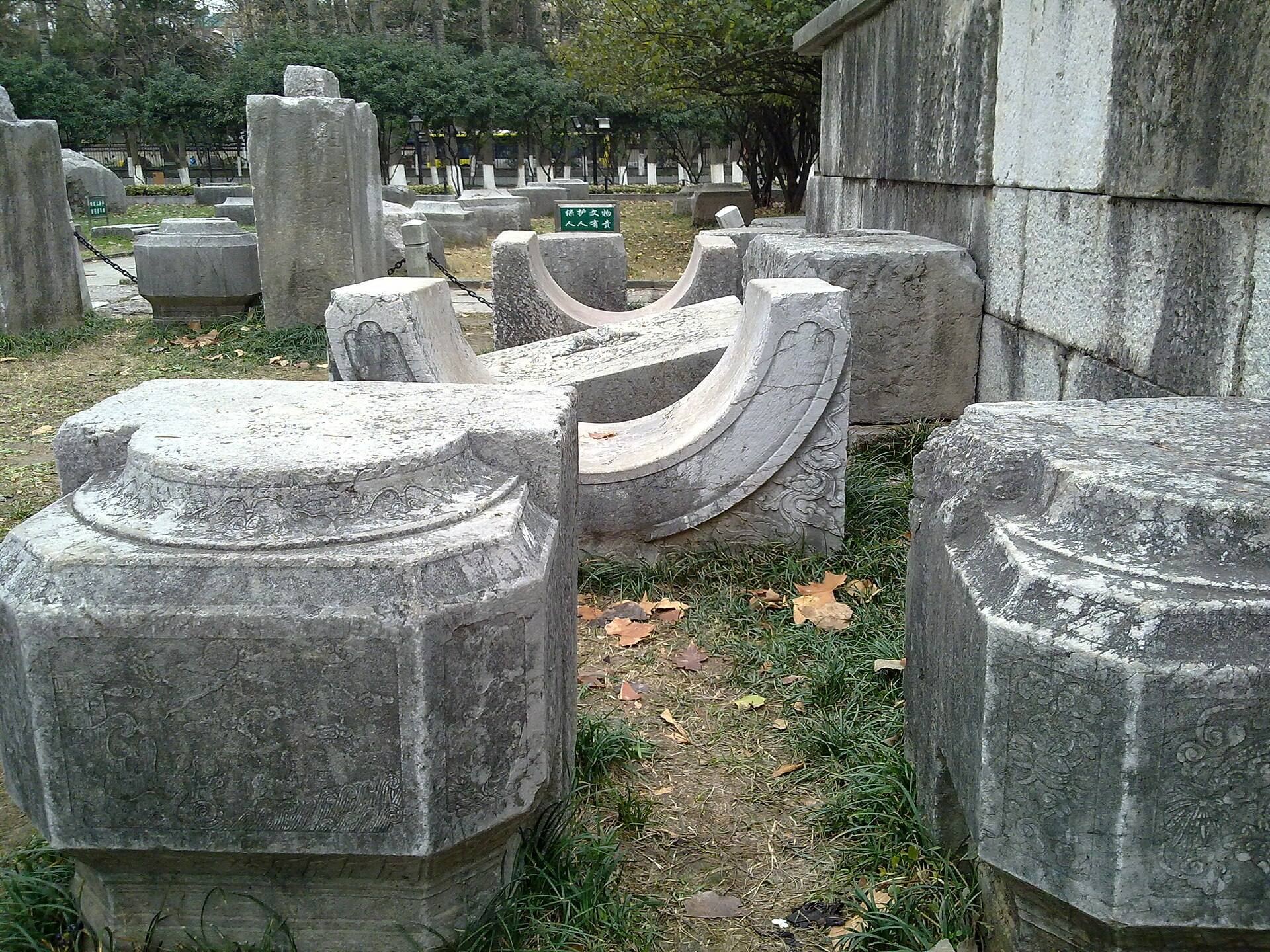
The Meridian Gate was the southern front gate of the palace. Its masonry gate platform survives, while the wooden gatehouse and the two projecting wings have been lost. The wings were demolished during the construction of the southern airstrip in the 1930s. Stone carvings and architectural components recovered from the former palace are arranged in the park around the gate for display.
Eastern and western gates
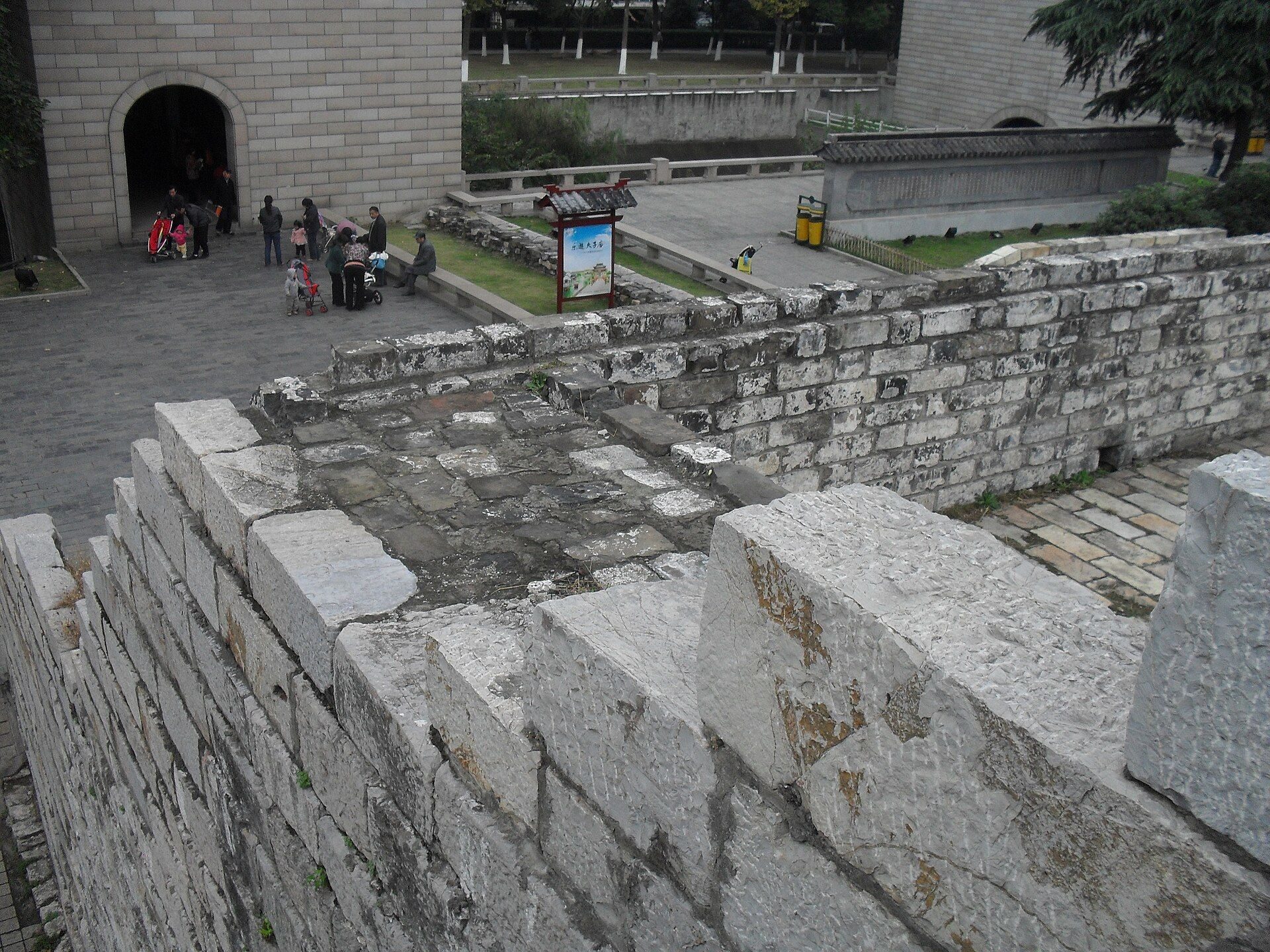
The platform of Donghua Gate, the eastern gate, remains among the principal masonry traces of the palace. Xi’an Gate, the outer western gate, is also represented by its surviving gate platform. These platforms preserve the bases of gate complexes whose wooden superstructures no longer form part of the surviving remains.
Golden Water bridges
The inner and outer Golden Water bridges survive on the palace’s main north-south axis. One stood just inside the front gate, while the other was positioned just outside it. Together, they retain part of the formal approach and organization of the imperial complex.
Foundations and carved elements
Palace foundations
Several palace foundations have been excavated across the former complex. They provide surviving structural traces of buildings whose upper parts have disappeared through fire, dismantling, and later redevelopment.
Stone architectural remains
Isolated column elements, stone carvings, and other architectural components survive from the palace. Many have been moved to the park surrounding the Meridian Gate, where they are arranged as part of the presentation of the former imperial site.
Former Outer Court area
The site of the three principal Outer Court halls is maintained as a commemorative park. The halls themselves were destroyed by fire in 1449 and were never rebuilt, but the park identifies the area that once formed the ceremonial seat of government within Ming Palace.