Jersikas pilskalns: A Medieval Latgalian Hillfort in Latvia
Site at a Glance
- Rating
- 4
- Popularity
- Very Low
- Country
- Latvia
- Primary era
- Medieval
- External website
- Open
- Eras represented
- Medieval
- Civilizations
- Unclassified
- Site type
- Military
- Remains
- Fortified Town
On this page12 sections
History
Jersikas pilskalns is a hillfort in Latvia, a fortified settlement established on an elevated site and strengthened with earthworks, associated with the medieval Latgalian center of Jersika. The fortress was built during the 10th or 11th century and became the administrative and spiritual center of Letija, or Latgale, as well as the residence of the rulers of Jersika. By the early 13th century, it was the center of the Jersika principality and controlled an important trading route along the Daugava.
Early occupation and Latgalian Jersika
Human activity at the site began long before the medieval settlement. Flint tools found at the hillfort date to the 8th millennium BC, while the earliest settlement layer dates to the 1st millennium BC. In total, archaeological investigation has identified ten settlement layers, with the latest evidence dating to the 14th century.
A major Latgalian cultural phase extended from the 10th century to the beginning of the 13th century. Jersika’s position on the right bank of the Daugava, opposite Dignāja, helped it control movement along the river. It also stood at a crossroads connecting Riga, Polotsk, and Pskov. Its importance probably grew as it became more closely connected to the Daugava than the earlier center at Dignāja, making river traffic easier to supervise.
The principality and the crusading campaigns
Jersika and its ruler Visvaldis, also known in medieval sources as Vissevalde, appear in the Chronicle of Henry of Livonia, a medieval Latin narrative of Christian conquest and political developments in Livonia, in connection with events of 1203. Visvaldis described Jersika as his paternal inheritance. The chronicle portrays it as a wealthy fortified city with gates and Orthodox churches containing bells and icons. It also mentions silver ornaments and purple goods in the ruler’s castle.
In 1209, Bishop Albert of Riga, a leading organizer of the German-led crusading expansion in the eastern Baltic, attacked and captured Jersika. The city was burned and plundered. It was later returned to Visvaldis under conditions of vassalage, and its defenses were restored. Crusading forces attacked again in 1214 and 1215; the assault of 1214 involved the plundering and burning of the castle.
Jersika also served as a place for political negotiation. In 1212, Bishop Albert and Prince Valdemārs of Polotsk concluded a friendship and trade agreement there. Polotsk relinquished its rights to Letija and Livonia in favor of the Bishopric of Livonia, an ecclesiastical territory centered on Riga, and the Daugava trade route was opened to German merchants. The agreement is known through its account in the chronicle.
Later medieval changes
After Visvaldis’s death, Bishop Nicholas of Riga granted half of the Jersika castle site and its rural appurtenances, rights, and tithes to the Livonian Order on 19 April 1239, with the consent of the cathedral chapter and vassals. The Livonian Order was a military religious institution that controlled territories and fortifications in Livonia. Jersika subsequently became a fortified position on the border between the Archbishopric of Riga and the Order.
A document from 1239 refers to Jersika as a hillfort or castle ruin rather than an active fortress, although habitation continued to some extent until the 14th century. The site was last mentioned in 1375, when a Lithuanian army crossed the Daugava nearby.
Investigation and protection
From the 19th century onward, researchers debated which site corresponded to the Jersika described in the medieval chronicle. Proposed locations included Lokstene near Stukmaņi Manor and a hillfort south of Līvāni. Excavations directed by Francis Balodis in 1939 supported the identification of the site in the Līvāni area. Further excavations took place between 1990 and 1997 under Ēvalds Mugurēvičs.
Jersikas pilskalns is protected as a state cultural monument of national significance under the designation “Jersika hillfort with ancient town.” It was placed under protection on 19 December 1998.
Remains
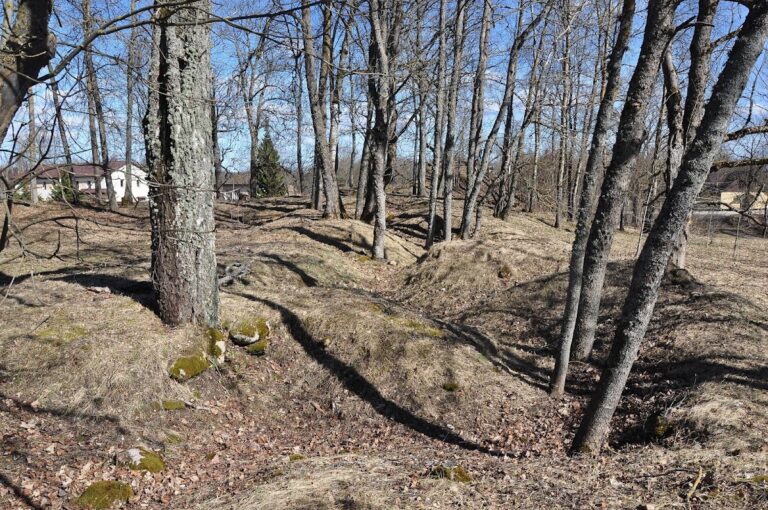
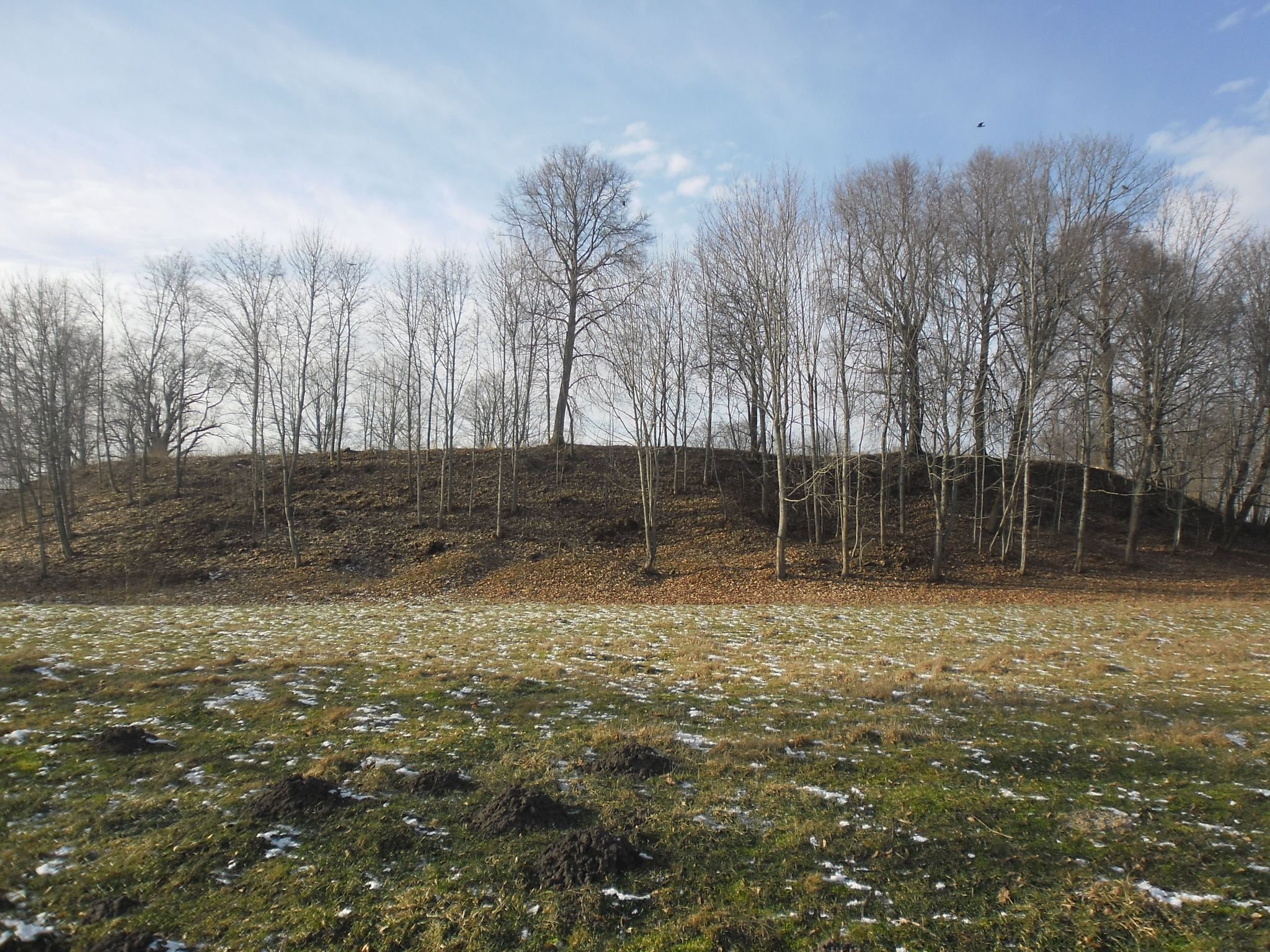
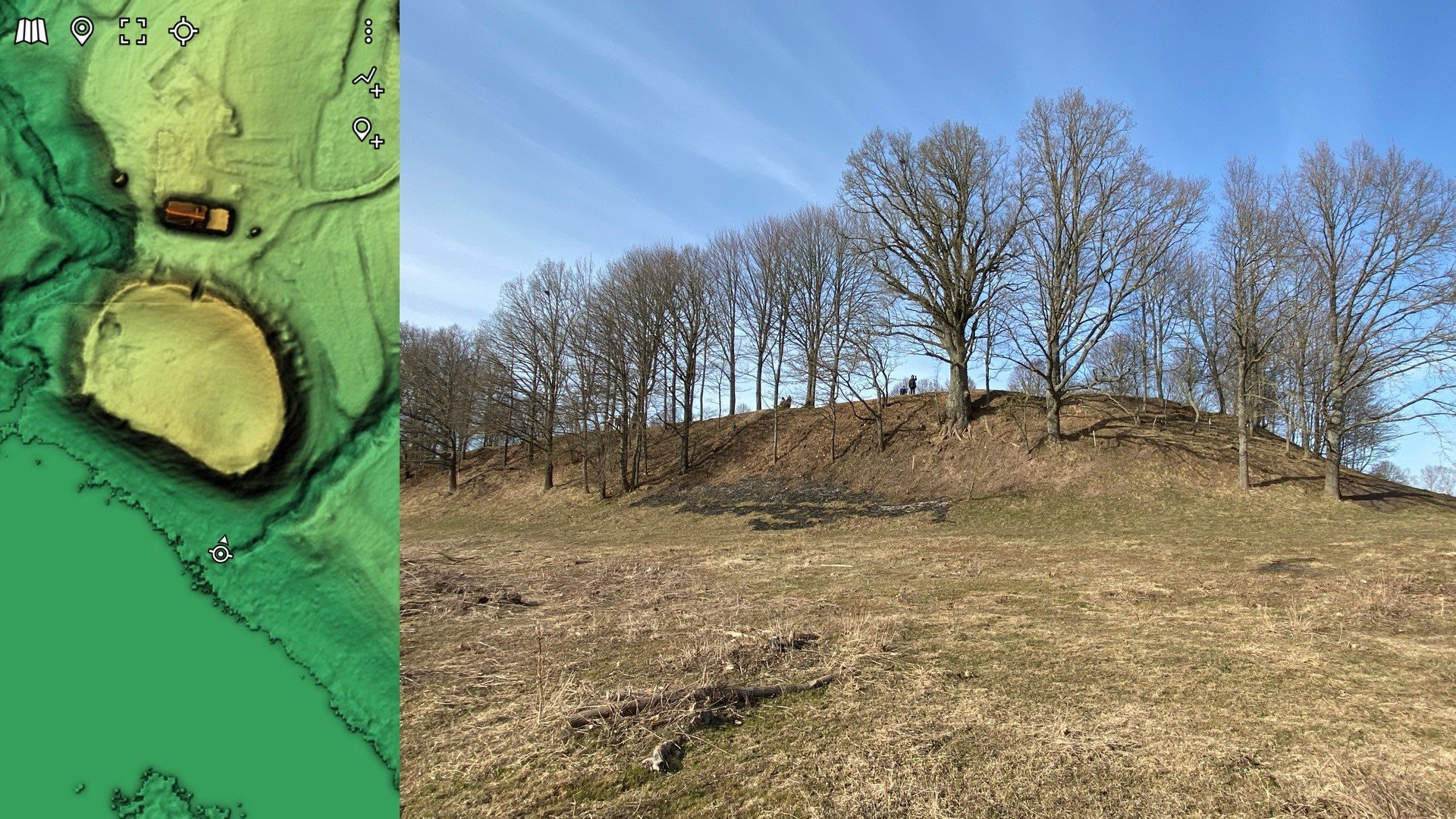
The surviving site consists of a raised fortified plateau, enclosing earthworks, an adjoining settlement area, and a nearby cemetery. The hillfort stands on the right bank of the Daugava between two small streams that occupy deep ravines. It rises 18 metres above the river, while the northern side was strengthened by an embankment about 2 metres high.
Hillfort and associated settlement
Fortified plateau
The fortified plateau measures approximately 100 by 75 metres. A rampart, an earth embankment forming part of a fortification, enclosed the summit and carried a wooden-and-earth wall. Traces of a ditch remain beyond the rampart. The streams provided natural protection on the northwestern and southeastern sides, while the surviving earthworks preserve the main defensive form of the hillfort.
Ancient town and cemetery
An unfortified settlement of approximately 15 hectares adjoined the hillfort. A nearby cemetery was used from the 10th to the 14th century, and 32 Latgalian burials have been excavated or exposed there. The burial practices include strong Slavic and Lithuanian elements, including a grave containing a horse burial.
Buildings, crafts, and finds
Domestic and working areas
Excavation revealed a cultural layer up to 2.5 metres thick and evidence of dense occupation. The remains include log-built dwellings with stone stoves, domestic buildings, workshops, and other structures. Together, they provide physical evidence for household life and craft activity within the settlement.
Religious and material remains
Archaeological finds include tools, weapons, jewelry, pottery, Orthodox crosses, and other objects. Neck ornaments and pendants reflect a strongly Latgalian cultural tradition alongside contacts with the East Slavic world and Lithuania. The medieval city described by Henry of Livonia contained gates and Orthodox churches, and an Orthodox church probably stood within the hillfort, although the archaeological evidence for its precise location is not conclusive.
The surviving ramparts and archaeological layers preserve evidence for fortification, domestic life, craft production, weapon use, religious practice, burial customs, and the trading connections that linked Jersika with neighboring regions.