Jedburgh Castle: A Medieval Fortress and Reform Prison in Scotland


Site at a Glance
- Rating
- 4.5
- Popularity
- Low
- Country
- United Kingdom
- Primary era
- Modern
- External website
- Open
- Eras represented
- Modern
- Civilizations
- British
- Site type
- Civic
On this page11 sections
History
Jedburgh Castle is a medieval Scottish fortress and later reform prison in Jedburgh, United Kingdom. Established under David I as a twelfth-century motte-and-bailey fortification, probably before 1153, it occupied a strategically unsettled position on the Scottish-English border and later became the site of a surviving prison associated with the John Howard system.
Royal fortress and border stronghold
The original castle consisted of a raised earthwork mound, or motte, with an adjoining enclosed courtyard, or bailey. Its border location drew it into repeated incursions, raids, and military struggles during the Wars of Scottish Independence, the conflicts between Scotland and England over Scottish sovereignty and control.
In 1174, Jedburgh was one of five Scottish castles surrendered to the English. It later returned to Scottish control, but changed hands repeatedly and was at times used as a royal residence. Negotiations between Alexander III of Scotland and Henry III of England took place there in 1258 during disputes over the succession to the Scottish throne. Alexander III also married at the castle in 1285.
Stone rebuilding and destruction
In 1335, the motte was converted into a stone fortress with defensive towers. The castle remained an English stronghold until 1409, when Scottish forces led by Sir James Douglas, 7th Earl of Douglas, destroyed it. Its destruction removed the last major English stronghold in Scotland.
Reform prison and museum
A reform prison was begun on the former castle site in 1820 and built in 1823. Its design was influenced by John Howard, an eighteenth-century English prison reformer whose proposals emphasized reform, order, hygiene, and the controlled classification of prisoners. The Scottish architect Archibald Elliot designed the prison, and Thomas Brown modified it in 1847.
During the nineteenth century, the prison was regarded as a model institution and one of the most modern establishments of its type. It closed in 1868. Restoration during the 1960s returned the former prison to an appearance associated with the 1820s. After a period as a youth hostel operated by the Scottish Youth Hostels Association, it became Jedburgh Castle Jail and Museum. The museum presents local history and traditions, the lives of David Brewster, Mary Sommerville, and James Veitch, and the daily experience of nineteenth-century Scottish prison life. It also displays artefacts from the castle and the surrounding region.
The castle remains part of local tradition through Jedburgh’s Ba Game, played on the Thursday after Shrove Tuesday since 1704. The “uppies” team uses the castle to record its victories. A local legend also says that the ghost of Edwin McArthur, a prisoner executed at the site in 1855, haunts the building.
Remains
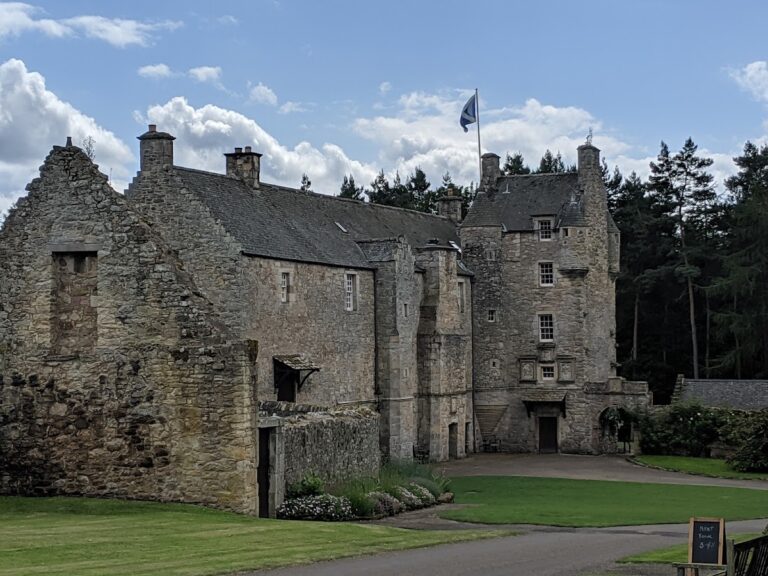
The surviving complex stands near Jedburgh cemetery on the site of the medieval castle, in the area identified with Castlewood Road and Castlegate. Its present appearance combines a prison building designed to resemble a medieval castle externally with Georgian-style interiors, preserving the later institution within the setting of the earlier fortress.
Medieval fortress site
Motte-and-bailey
The earliest physical form was an earthwork motte-and-bailey. The motte was the raised defensive mound, while the bailey formed the adjoining enclosed courtyard. This arrangement represents the castle’s foundation as a twelfth-century Scottish border fortification.
Stone fortification
The medieval stronghold was transformed into a stone fortress in 1335. Defensive towers were added during this rebuilding, creating the stone form associated with its later military use before the castle was destroyed in 1409.
Surviving prison complex
Castle-like exterior
The present exterior was designed to resemble a medieval castle, linking the nineteenth-century prison visually with the earlier fortress. The restored appearance reflects the building’s 1820s form, while the prison interiors retain a Georgian style.
Jedburgh Castle Jail and Museum
The restored complex is the surviving reform prison associated with the John Howard system and is described as the only prison of this type still existing in Scotland. It now contains Jedburgh Castle Jail and Museum, where the preserved building provides the setting for displays about the castle, the surrounding region, local figures, and nineteenth-century prison life.