Jamia Masjid: A Historic Friday Mosque in Srinagar
Site at a Glance
- Rating
- 4.7
- Popularity
- Medium
- Country
- India
- Primary era
- Medieval
- Eras represented
- Medieval
- Civilizations
- Unclassified
- Site type
- Religious
- Remains
- Mosque
On this page16 sections
History
Jamia Masjid is a historic Friday mosque in Nowhatta, Srinagar, India, commissioned in 1394 and completed in 1402 in a Persian-influenced Kashmiri architectural tradition. Founded by Sultan Sikandar Shah Miri at the request of Mir Mohammad Hamadani, son of the religious leader Mir Sayyid Ali Hamadani, it became an important institution in Kashmir’s religious and political life. The mosque is headed by the Mirwaiz of Kashmir, a senior Muslim religious authority who combines religious leadership with preaching and community guidance.
Foundation and early enlargement
Sultan Zain-ul-Abidin later enlarged the mosque and added a turret to its principal structure. These early changes established the form of a complex that would be repeatedly repaired and altered after fires and periods of political upheaval.
Fires and reconstruction
The mosque suffered three major fires and was restored after each one. Following the first fire in 1479, Sultan Hasan Shah began reconstruction. After his death, Ibrahim Magre, commander-in-chief of the Kashmir forces under Muhammad Shah and Fateh Shah, completed the work by 1503.
A later fire during the Mughal period led to a reconstruction directed by Malik Haider of Tsodur, a Kashmir-based architect and historian. The repairs took 17 years. Another restoration is associated with Mughal emperor Aurangzeb, who ruled from 1658 to 1707 and is said to have arranged repairs after a further fire. That work was completed within three years in 1672.
Restrictions and restoration under later rulers
During the reign of Maharaja Pratap Singh, repeated restoration works received financial assistance from the ruler. The renovations aimed to retain the mosque’s original architectural character and historical value.
Sikh rule began in Kashmir in 1819, and Governor Moti Ram restricted prayer at the mosque. It remained closed for 24 years. Governor Shaikh Muhy-ud-Din reopened it in 1843 after repairs costing approximately 150,000 rupees. For the next 11 years, however, prayers were allowed only on Fridays, and the building opened for only a few hours at a time.
Religious education and political life
Jamia Masjid was closely associated with the Kashmir agitation of 1931. After Dogra police killed 22 Kashmiri Muslim protesters, their bodies were taken to the compound of the Khwaja Naqshband shrine in Khwaja Bazar. Sheikh Abdullah, Muhammad Yusuf Shah, and other leaders spoke there against Maharaja Hari Singh.
After 1947, the mosque continued to provide religious education. Through the efforts of Mirwaiz Ghulam Rasul Shah, it also became associated with the growth of political consciousness among Kashmiri Muslims. Sheikh Muhammad Abdullah received instruction there in Kashmiri Muslim politics from Mirwaiz Muhammad Yusuf Shah.
The mosque later served as a venue for political debate concerning the Kashmir conflict. Authorities periodically restricted congregational activity, including prolonged closures during the 2008 Amarnath land controversy and further closures during unrest in 2016, 2017, and 2018.
Administration and recent history
On 28 December 2018, masked men entered the nearly empty mosque after Friday prayers carrying ISIS flags. The incident was condemned by the mosque’s Mirwaiz, the state chief minister, and other public figures. Observances stressing the mosque’s purification, importance, and sanctity followed the next week.
After Jammu and Kashmir’s special status was revoked and the territory was divided into two union territories on 5 August 2019, restrictions associated with the COVID-19 pandemic further affected worship. Prayers at the mosque were restricted for 136 days.
A caretaker board was established in 1975. The mosque is administered by the Anjuman-e-Auqaf Jamia Masjid Srinagar, and its principal income comes from rent collected from 278 Auqaf-owned shops around the building together with public funding. Before Auqaf administration, the institution depended on wealthy donors. The Indian heritage organization INTACH assumed responsibility for renovation work in 2012.
Remains
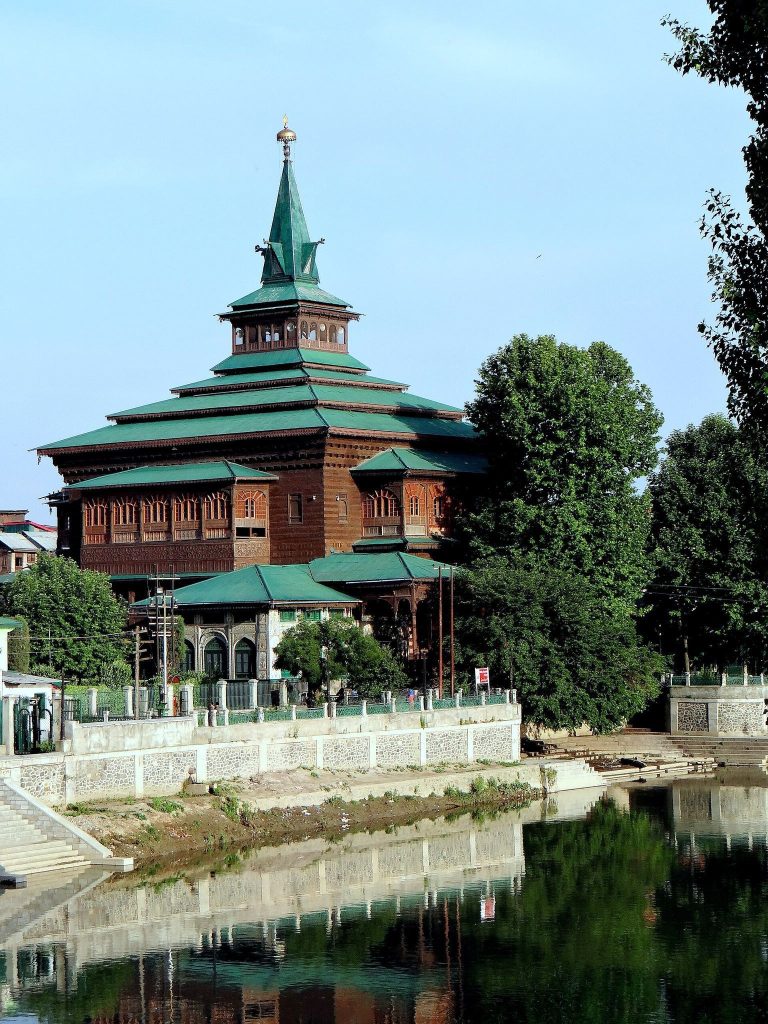
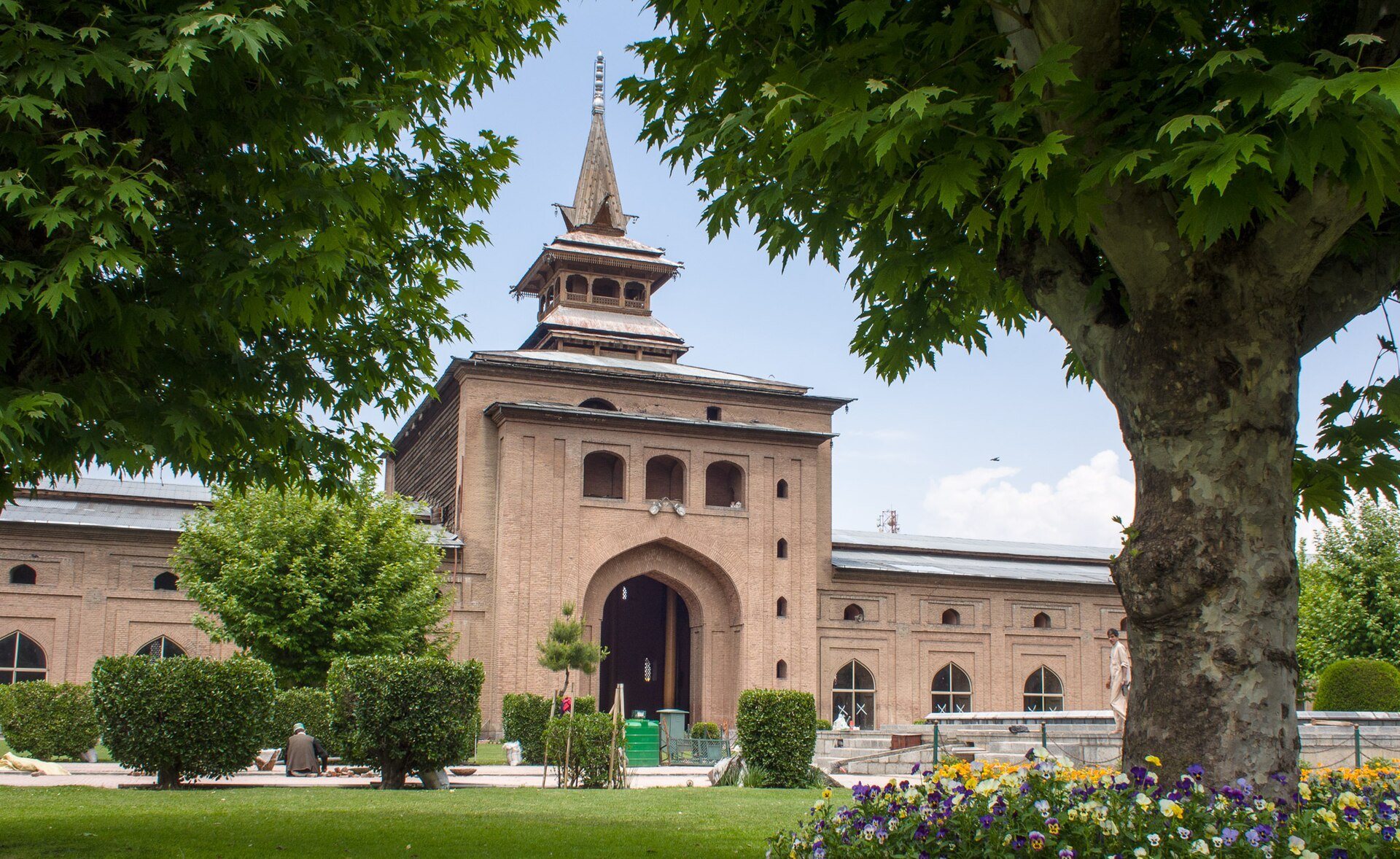
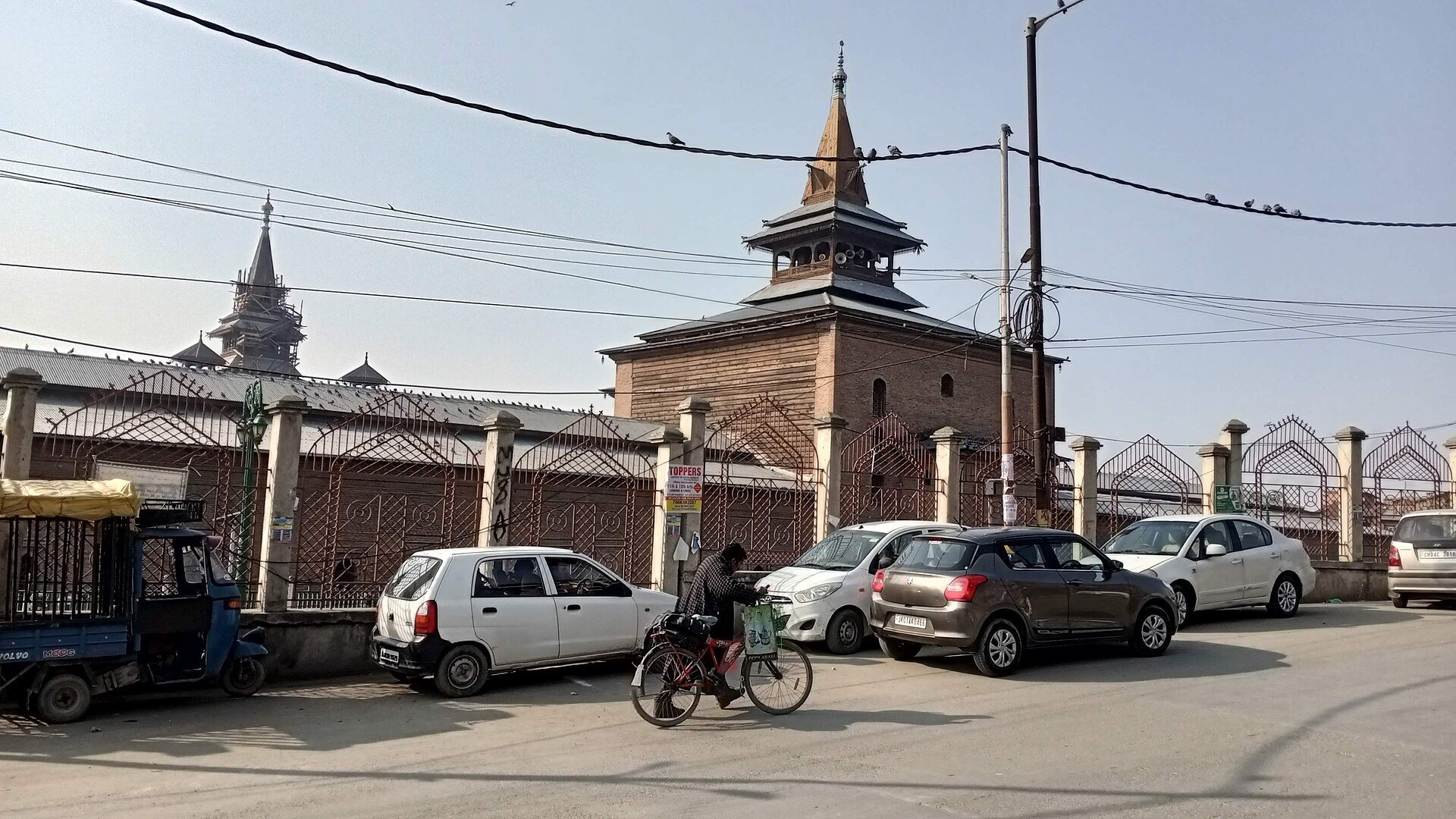
Jamia Masjid occupies a large quadrangular complex organized around a central garden and courtyard. Four turrets stand at the centers of the sides, each with a pyramidal roof, while spacious halls connect the main parts of the building. The structure combines burnt brick, stone, and deodar wood, and its style is described variously as Persian Koshur, Persian-influenced, and Indo-Saracenic. It measures approximately 116 metres from east to west and 117 metres from north to south, with another measurement giving it dimensions of about 120 by 120 metres.
Courtyard and entrances
Central garden and prayer court
The southern entrance passes through a recessed portico into the inner courtyard. The court follows a Chahar Bagh plan, a four-part garden arrangement organized around intersecting axes and water. It contains four lawns, chinar trees, pointed-arched brick arcades, and a central water tank with a fountain used for ablution, the ritual washing performed before Islamic prayer. The courtyard measures about 114 by 113 metres, while the tank is approximately 10 by 10 metres. It was originally supplied through a water channel known as Lachma Kual.
Gates and cloisters
Large entrance gates occupy the northern, southern, and eastern sides. The eastern entrance, known as the Shah Gate, has a pyramidal roof topped by a square open pavilion called a brangh, which carries a spire. Arched cloisters, or liwans, enclose the courtyard beneath two-tiered sloping roofs.
Timber structure and turrets
Columns and roof
The walls are built of burnt brick more than 1.2 metres thick, with rectangular stones forming their lower sections. Timber and iron bars support the roof. Its original covering of birch bark and clay has been replaced by corrugated iron sheets. A total of 378 wooden columns supports the roof. The interior includes 346 columns, each approximately 6.4 metres high and 1.5 metres in girth.
Turrets and roof access
Each of the four turrets rests on eight deodar pillars about 15 metres high and 1.8 metres in girth. A similar turret rises above the mihrab, the prayer niche indicating the direction of prayer. Circular internal stairways within the four main turrets lead to turret lounges and then to the roof. The elevated turrets provide views over Srinagar.
Mihrab and capacity
Prayer niche
The western cloister wall contains a mihrab made of black Kashmiri marble. Calligraphy decorates the niche, which is engraved with the 99 attributes of Allah.
Worship space
The mosque accommodates 33,333 worshippers in addition to the imam. During peak gatherings, as many as 100,000 people can pray together. Its principal materials are deodar wood, stone, and brick, while the central fountain provides water for ablution.