Madin Sahib: A Fifteenth-Century Mosque and Tomb Complex in Srinagar
Site at a Glance
- Rating
- 4.8
- Popularity
- Very Low
- Country
- India
- Primary era
- Medieval
- Eras represented
- Medieval
- Civilizations
- Unclassified
- Site type
- Religious
- Remains
- Mosque
On this page11 sections
History
Madin Sahib is a historic mosque and tomb complex in Zadibal, Srinagar, India, built under the Kashmir Sultanate during the 1440s. Its foundation is associated with Sultan Zayn al-Abidin and Syed Mohammad Madani, a fifteenth-century religious scholar from Medina in the Hejaz. The complex is one of the few surviving masonry monuments linked with the Kashmir Sultanate, when timber was the principal building material for many structures in Kashmir.
Madani and the Kashmir Sultanate
Syed Mohammad Madani is said to have reached Kashmir during the reign of Sultan Sikandar Shah, possibly as part of an envoy connected with Timur, the Central Asian ruler whose empire was based in Transoxiana. Madani later chose to remain in the Kashmir Valley. He first lived in Rainawari and then moved to Naushahr, the capital of the Kashmir Sultanate under Sultan Zayn al-Abidin.
Sultan Sikandar and later Sultan Zayn al-Abidin supported Madani and helped establish a khanqah, a Sufi institution for worship, teaching, residence, and spiritual practice. Madani also became a companion and disciple of Mir Muhammad Hamadani, the son of Mir Sayyid Ali Hamadani. Kashmiris popularly knew him as Madin Saeb, and the mosque and shrine were named after him. Madani had also served as the sultan’s teacher.
Syed Mohammad Madani died on 13 October 1445. Baha al-Din Ganj Bakhsh led the funeral prayer, and Madani was buried at the site of the present shrine. The mosque and tomb were built under Sultan Zayn al-Abidin’s patronage during the 1440s.
Religious and administrative disputes
The shrine became important to both Sunni and Shia Muslims, although Madani’s religious affiliation later became disputed. Sections of the Shia community cited an inscription reading “Ali-un-Wali-Allah,” formerly placed above the mosque entrance, as evidence of an association with Shia tradition.
During the nineteenth century, under Dogra rule, the administration of the mosque and shrine became the subject of a major dispute between Sunni and Shia communities. Dogra rule was the period when the Hindu Dogra dynasty governed the princely state of Jammu and Kashmir. Communal unrest led to restrictions on access, and disagreements over management continued into the modern period.
Decline and protection
Further disagreements led to the mosque being locked and access to the complex being restricted in 2002. The mosque is now inactive and partly ruinous. Archaeologists and historians had already described the monument as neglected and partly ruined in the late nineteenth and early twentieth centuries. The loss of much of its tilework and its prolonged closure contributed to deterioration.
Madin Sahib remains a State-protected monument, although concerns about conservation and restoration have continued. Its surviving masonry, tomb, and early glazed decoration preserve evidence of the architectural culture of the Kashmir Sultanate.
Remains
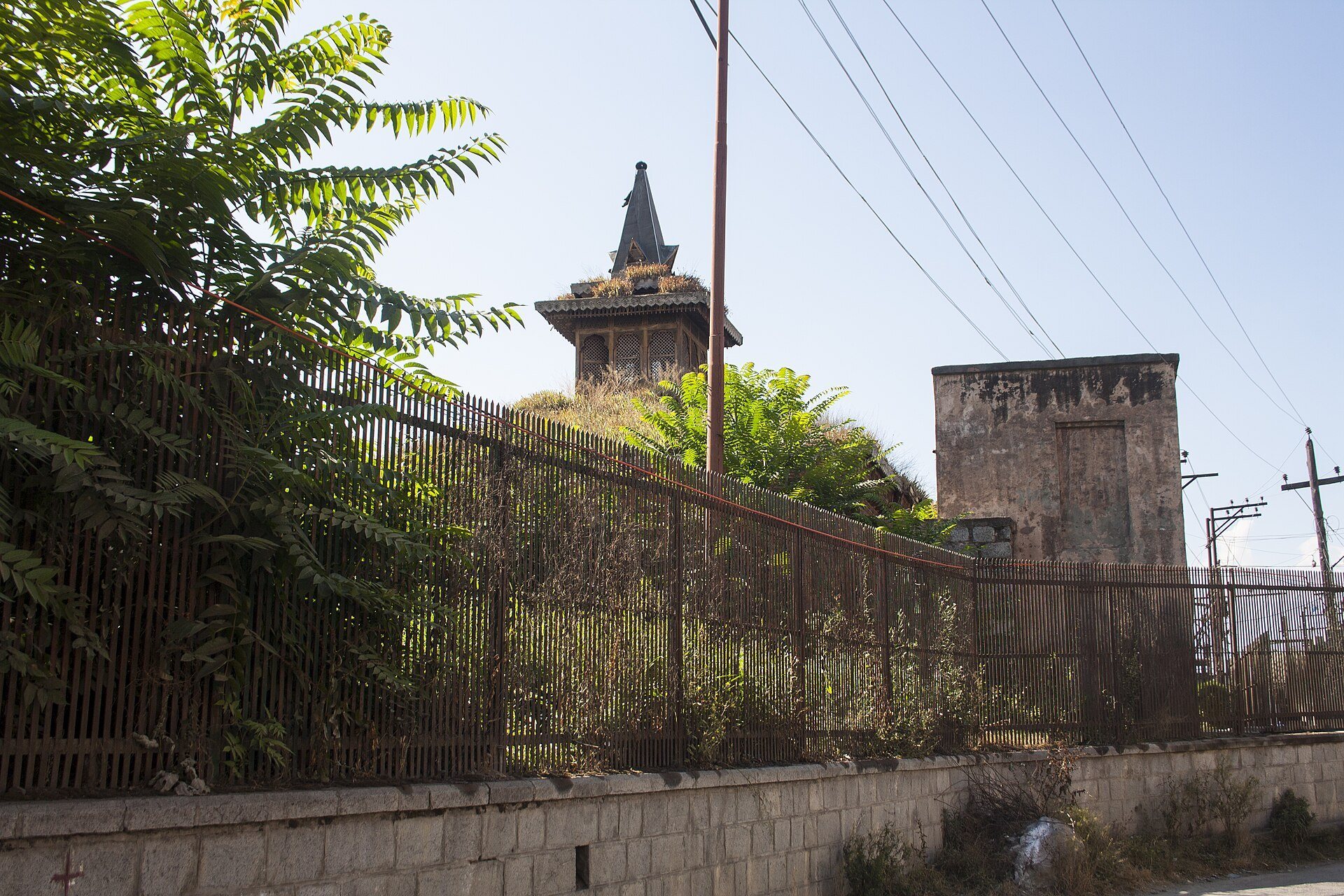
The complex occupies the historic area of Naushahr and consists of a mainly square brick-and-masonry mosque with a single pagoda-like spire, together with the tomb of Syed Mohammad Madani. The tomb stands to the left of the mosque. Damage and partial collapse have altered the surviving structure, while early multicoloured glazed tiles remain among its most distinctive physical features.
Buildings of the complex
Mosque
The mosque is mainly square in plan and was constructed in brick and masonry. This method distinguishes it from the wooden mosques that were more common in medieval Kashmir. The building has one pagoda-like spire, and parts of the monument have been damaged or have collapsed over time. A fifteenth-century inscription was associated with the entrance, including the inscription reading “Ali-un-Wali-Allah,” which was formerly positioned above the doorway.
Tomb
The tomb of Syed Mohammad Madani forms part of the complex and lies to the left of the mosque. It marks the burial place of Madani, who died in 1445, and remains physically connected with the mosque as part of the shrine compound.
Glazed tile decoration
Multicoloured tilework
The complex retains early multicoloured glazed tilework regarded as an important example of pre-Mughal architectural decoration in Kashmir. Pre-Mughal refers to the period before the establishment of the Mughal Empire in the Indian subcontinent. Unlike mosaic decoration, which assembles many small pieces to form an image, these tiles were made as square pieces carrying several colours on a single tile. Surviving colours include blue, green, yellow, red, and brown. Many original tiles were damaged or removed, and some were transferred to the Shri Pratap Singh Museum in Srinagar for preservation.
Figural and patterned panels
The southern spandrel of the main eastern arch, the curved or roughly triangular space between an arch and its rectangular frame, reportedly once held a large multicoloured image of a mythical creature. Early observers interpreted it variously as a dragon or another mythical animal, while Sir John Marshall, the British archaeologist who directed the Archaeological Survey of India in the early twentieth century, identified it as a centaur holding a bow. The figure reportedly combined a human upper body with the body of a spotted animal and a dragon-like tail. Other decorative elements included flowers, cloud patterns, and a fox-like figure.