Kedarnath Temple: A Himalayan Shrine of Shiva in India
Site at a Glance
- Rating
- 4.7
- Popularity
- Very High
- Country
- India
- Primary era
- Medieval
- External website
- Open
- Eras represented
- Medieval
- Civilizations
- Unclassified
- Site type
- Religious
- Remains
- Temple
On this page12 sections
History
Kedarnath Temple is a Hindu shrine dedicated to Shiva in Kedarnath, Uttarakhand, India. Built in the Garhwal Himalayas, it is traditionally associated with the Katyuri architectural style and is revered as one of the twelve Jyotirlinga shrines, one of the five Panch Kedar temples, and one of the four principal temples of the northern Himalayan Chota Char Dham pilgrimage. Its original builder and exact construction date remain uncertain.
Early traditions and pilgrimage
Local religious tradition calls Shiva at the shrine Kedarnath or Kedareshvara. A Jyotirlinga is a particularly sacred manifestation of Shiva, while a self-manifested image is believed to have arisen naturally rather than been carved by human hands. The Skanda Purana, dated approximately to the seventh or eighth century, refers to Kedara as the place where Shiva released the Ganges from his matted hair. The name Kedarnath means “Lord of the Field,” formed from the Sanskrit words kedara, meaning field, and natha, meaning lord. The Kashi Kedara Mahatmya explains the name through the image of a crop of liberation growing there.
Traditions attribute the first temple to the Pandavas, the five heroic brothers of the Mahabharata, sometimes identifying their grandson King Janamejaya as its builder. Another tradition associates the temple with King Bhoja, whose reign is dated in the material to Vikram Samvat 1076–1099. One account places the present temple in the eighth century and connects its rebuilding or revival with Adi Shankara, an eighth-century Hindu philosopher associated with Advaita Vedanta. Other traditions place its construction in the medieval period. Kedarnath was an established pilgrimage centre by the twelfth century, when it appeared in the Kritya-kalpataru of Bhatta Lakshmidhara, a minister of the Gahadavala dynasty.
The temple’s religious history is linked to the sages Nara and Narayana, who are said to have performed penance at Kedara and asked Shiva to remain there as a Jyotirlinga. Another legend tells how the Pandavas sought Shiva after the Kurukshetra War to atone for killing their relatives. Shiva concealed himself as a bull, and when Bhima, the strongest of the brothers, seized him, the bull’s body disappeared into the ground and emerged in five places. Its hump is associated with Kedarnath, while its arms, face, navel and stomach, and hair are associated with Tungnath, Rudranath, Madhyamaheshwar, and Kalpeshwar. Together, these shrines form the Panch Kedar. The Mahabharata itself does not mention Kedarnath.
In the same tradition, the Pandavas built the five shrines, meditated at Kedarnath for salvation, performed a fire sacrifice, and then travelled towards heaven by the route called Mahapanth or Swargarohini. Pandava traditions also connect Kedarnath with Guptakashi, Pandukeshwar, and other places in the surrounding Himalayan landscape. Tamil Shaiva literature further expresses the shrine’s importance. Kedarnath is included among the northern temples praised in the Tevaram tradition, with hymns attributed to Tirugnanasambandar, Appar, Sundarar, and Sekkizhar.
Hagiographical traditions differ over Adi Shankara’s death. Accounts based on Madhava’s Sankshepa-shankara-vijaya place it in the mountains near Kedarnath, while accounts based on Anandagiri’s Prachina-Shankara-vijaya place it at Kanchipuram. A monument behind the temple is traditionally identified with the place of his death, and local tradition credits him with restoring Kedarnath, Badrinath, and other temples of Uttarakhand.
Ritual life and administration
The temple traditionally opens during the milder part of the year, approximately from April or Akshaya Tritiya until November, around the period after Diwali or Kartika Purnima. During winter, the sacred image is carried to Ukhimath, where worship continues for about six months. The opening and closing dates follow the Hindu calendar, with the opening date announced around Akshaya Tritiya and Maha Shivaratri.
The chief priest, or Rawal, belongs to the Veerashaiva Jangam community of Karnataka. He directs the daily rites, which are conducted by assistants, and five principal priests serve in rotation, each acting as head priest for one year. The Rawal traditionally accompanies the deity to Ukhimath during winter, while ritual mantras are recited in Kannada. A Naib Rawal, an Acharya or Dharmadhikari, and a Vedpathi also serve the temple.
Regional Brahmins serve as hereditary pilgrimage priests, known as tirth purohits, performing or arranging rites for devotees. Their ancestors are traditionally said to have worshipped the lingam since the time of Nara and Narayana and Daksha Prajapati. Another tradition credits King Janamejaya with granting these priests worship rights and authority in the Kedar region. Jangam priests from southern India worship the Shiva lingam, while the regional Brahmins conduct rites for pilgrims. A tradition recorded by mountaineer Eric Shipton in 1926 states that, centuries earlier, one priest served both Kedarnath and Badrinath, travelling between them daily.
Kedarnath and Badrinath are administered under legislation governing the two temples. A state-appointed committee administers them, and after a 2002 amendment its board comprised seventeen members drawn from representatives selected by the Uttarakhand Legislative Assembly and district councils, together with members nominated by the state government. In 2019, a Uttarakhand law temporarily replaced this committee with a statewide Char Dham Devasthanam management board covering Kedarnath, Badrinath, Gangotri, Yamunotri, and other temples. The Uttarakhand High Court upheld the law in 2020 while limiting the board’s authority to temple administration and property management. The state government withdrew the law in November 2021.
Floods, restoration, and recent changes
On 16 and 17 June 2013, catastrophic flash floods, landslides, and debris flows struck the Kedarnath Valley. A landslide occurred near the temple at about 7:30 p.m. on 16 June, followed by a large flow of water from Chorabari Tal, also called Gandhi Tal, into the Mandakini River at about 8:30 p.m. The next morning, water and debris from the Saraswati River and Chorabari Tal carried silt, rocks, and boulders through the valley.
A large boulder lodged behind the temple and diverted water and debris around both sides of the building, greatly reducing damage to its principal structure. The surrounding settlement, including shops, hotels, roads, and other buildings, suffered extensive destruction, and many pilgrims and residents died. People sheltered inside the temple until the Indian Army evacuated them. Specialists associated with the Archaeological Survey of India and a team from the Indian Institute of Technology Madras later examined the walls, foundations, and structural condition using non-destructive testing. Their interim assessment found the temple stable and not in immediate danger.
The Nehru Institute of Mountaineering, led by mountaineer Colonel Ajay Kothiyal, carried out a year of high-altitude reconstruction and redevelopment after the disaster. The pilgrimage resumed in 2014, and the temple reopened for worship in May that year after restoration and work around the shrine. A glacial outburst flood in 2021 caused substantial damage in Kedarnath and the lower settlement of Gaurikund. Reconstruction followed in the Kedarnath and Gaurikund areas, and a statue of Adi Shankara was unveiled behind the temple near his traditional samadhi site on 5 November 2021.
Remains
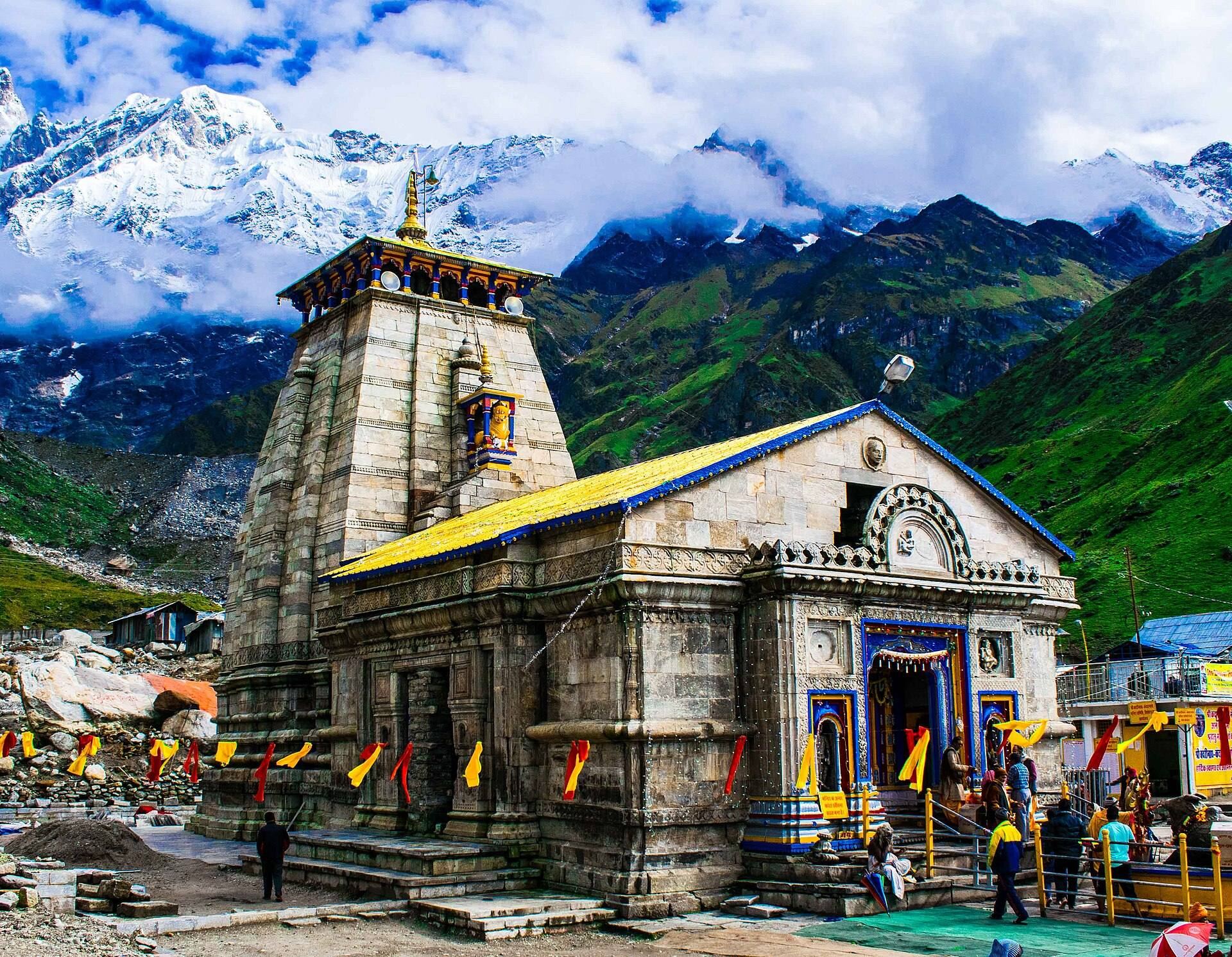
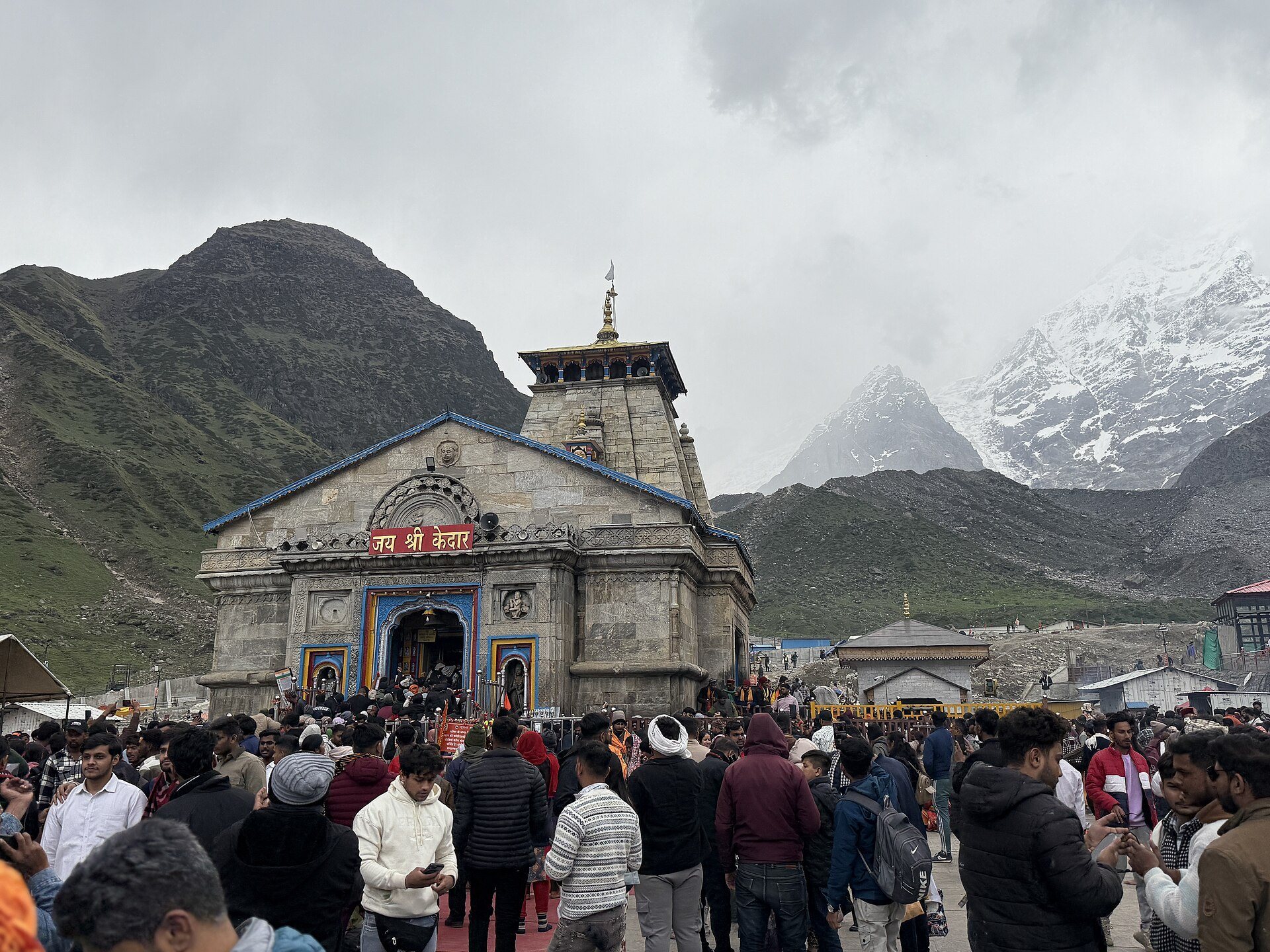
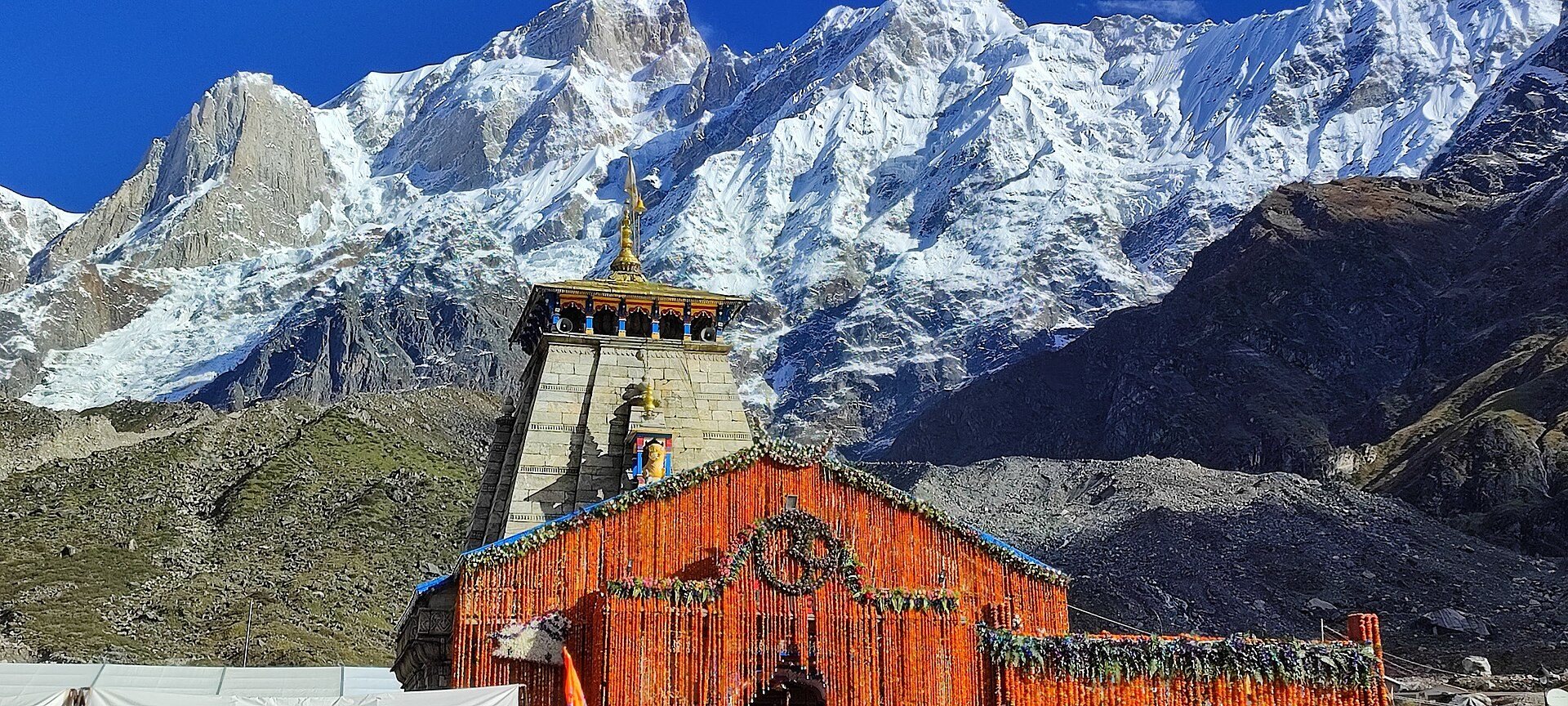
Kedarnath Temple is a stone-built structure beside the Mandakini River, a tributary of the Ganges, at an elevation of approximately 3,583 metres above sea level. It stands on a plateau surrounded by snow-covered mountains and glaciers near the foot of Kedarnath mountain. The building rests on a square platform about six feet high and contains an inner sanctuary, an intermediate section, and a pillared assembly hall. A passage for ritual circumambulation runs around the sanctuary.
The main temple
Sanctuary and sacred image
The principal shrine contains a naturally occurring Shiva lingam, a sacred representation of Shiva, with a triangular or three-sided form. Its stated dimensions are approximately 3.6 metres in height and 3.6 metres in circumference, while another description gives it as about four hands long and one and a half hands thick. The image represents the hump or back of Shiva in the bull form of the Panch Kedar legend. A human head is carved into the triangular stone, a feature also associated with a nearby temple linked to the marriage of Shiva and Parvati.
The front of the lingam has a natural, thread-like sacred feature, while its rear has a natural feature resembling a crystal garland. The image is also described as having a nine-lingam form, giving rise to the local designation “Nava Linga Kedar.” Four large pillars surround it and are interpreted as representations of the four Vedas. They support a broad lotus-like roof. Floral and other decorative motifs cover the sanctuary walls, and the upper interior has a gilded surface.
Halls and interior images
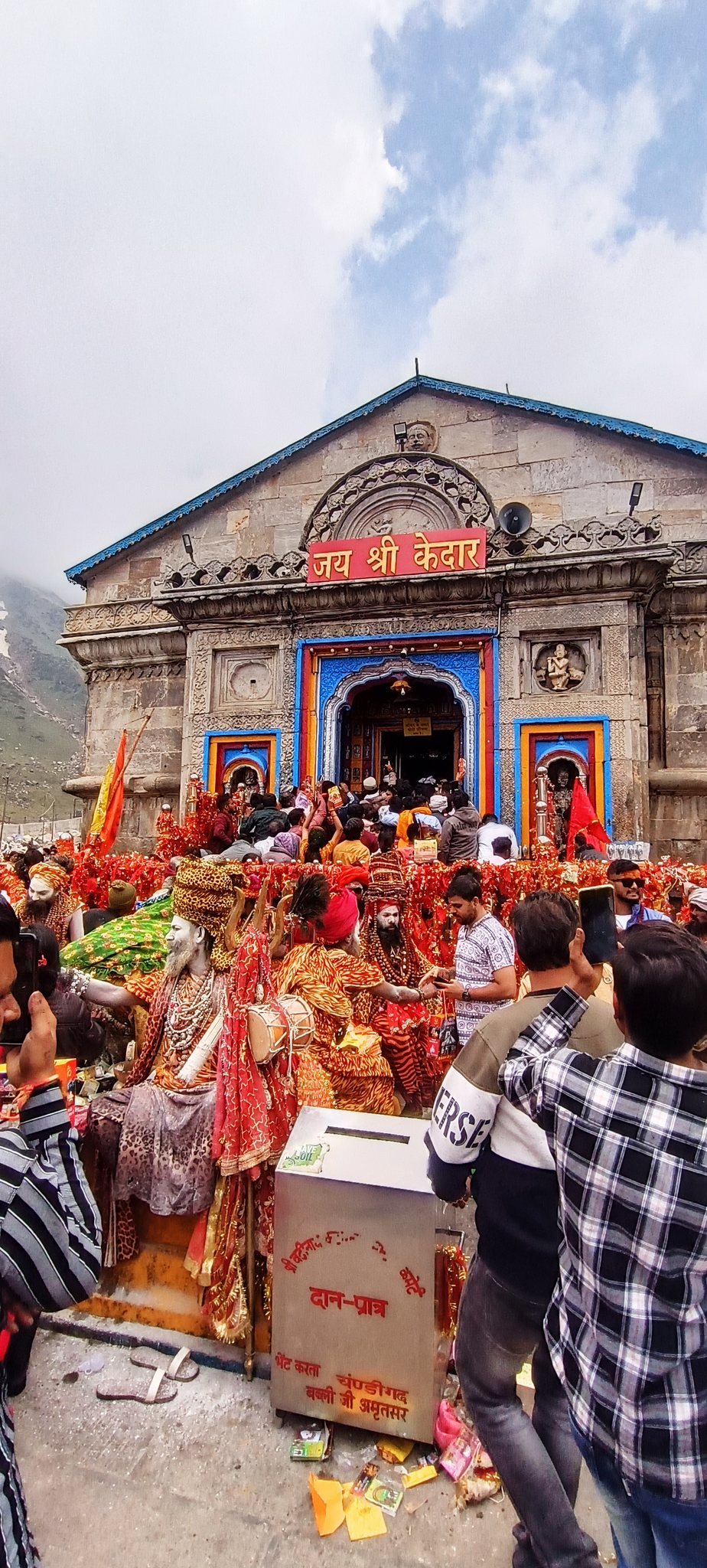
A small pillared hall in front of the temple contains images of Parvati and the five Pandava princes. The first hall inside the building contains images of the five brothers, Krishna, Nandi, Virabhadra, Draupadi, and other deities. Nandi is positioned outside or in front of the temple facing the sanctuary. The inner space is dark and illuminated by lamps, including a traditionally described single lamp on the western side of the lingam.
Ritual practice helps define the arrangement of the sanctuary. The morning ceremony includes bathing the image and applying ghee, while water, flowers, and sacred leaves are offered from the front. Ghee is also applied to the triangular lingam in memory of Bhima’s legendary anointing of Shiva’s bull form. The circumambulatory route passes behind the four pillars and around the image. A stone enclosure around the sanctum was replaced by an eight-millimetre copper enclosure in 2003–04, and the enclosure, sanctuary walls, and temple doors were later described as having silver coverings.
Surrounding sacred features
Adi Shankara memorial
Behind the temple stands a samadhi shrine and monument traditionally associated with Adi Shankara. A samadhi is a memorial or sacred place associated with the final meditative absorption or death of a religious figure. The monument forms part of the sacred area behind the main building and is connected with traditions concerning Shankara’s death and his restoration of Himalayan temples.
Bhim Shila and ritual water features
The boulder that lodged behind the temple during the 2013 floods is known as Bhim Shila, or “Bhim’s Rock.” It is worshipped as a sacred protective rock, and pilgrims visit it after worshipping at the temple. Several water tanks behind the building are used for ritual acts, including sipping water and making offerings to the dead.
Bhukund Bhairavnath shrine
An open-air shrine dedicated to Bhukund Bhairavnath, the guardian deity associated with Kedarnath, stands on a ridge overlooking the main temple complex. The broader sacred landscape also includes the mountain peak Swargarohini and the sites of Pandukeshwar and Guptakashi, which are connected with traditions about the Pandavas and the religious history of Kedarnath.