Nakatsuyama Kofun: A Late-Fourth-Century Japanese Keyhole Burial Mound


Site at a Glance
- Rating
- 3.9
- Popularity
- Very Low
- Country
- Japan
- Primary era
- Classical
- External website
- Open
- Eras represented
- Classical
- Civilizations
- Yamato
- Site type
- Burial
- Remains
- Burial Mound
On this page6 sections
History
Nakatsuyama Kofun is a large keyhole-shaped burial mound in Fujiidera, Japan, built by the ancient Japanese ruling power around the end of the fourth century. Constructed during the late fourth to early fifth century, it forms part of the Furuichi Kofun Group, a concentration of large burial mounds associated with the ancient ruling power in the Kawachi region and recognized together as a UNESCO World Heritage cultural property.
Construction and Early Significance
The characteristics of the mound’s haniwa, fired clay objects placed on or around burial mounds, indicate that Nakatsuyama Kofun was probably constructed near the end of the fourth century. Within the Furuichi Kofun Group, these characteristics place it as the second-oldest of the giant keyhole mounds, after Tsudō-Shiroyama Kofun. The archaeologist Taichirō Shiraishi regarded it as the first great-ruler tomb constructed in Kawachi. Although he questioned the historical existence of Emperor Chūai, he considered traditions in the chronicles and the Engishiki, a tenth-century compilation of court rites, institutions, and precedents, to preserve some historical reality about Chūai as the first great ruler buried in Kawachi.
Debate over the Occupant
The actual occupant of Nakatsuyama Kofun is unknown. The Imperial Household Agency designates it as Nakatsuyama Mausoleum, identifying it as the tomb of Nakatsuhime no Mikoto, presented in traditional imperial histories as the empress consort of Emperor Ōjin. Another interpretation identifies the mound as the tomb of Emperor Chūai, an early ruler recorded in Japan’s traditional imperial histories.
The interpretation associating the mound with Chūai rests partly on its position as one generation earlier than Konda Gobyōyama Kofun, which the Imperial Household Agency designates as Emperor Ōjin’s tomb. The agency instead identifies nearby Okamisanzai Kofun, southwest of Nakatsuyama, as Chūai’s tomb. Okamisanzai is generally dated to the late fifth century, nearly a century after the period traditionally assigned to Chūai’s reign. If the death date conveyed through the zodiacal cycle in the Kojiki, one of Japan’s early historical and mythohistorical chronicles, is followed, Chūai died in AD 362, approximately one or two generations before Nakatsuyama Kofun was built.
The identification of Okamisanzai as Chūai’s tomb was made during the late Edo period. The antiquarian Gamō Kunpei rejected it in his work Sanryōshi, arguing that Nakatsuyama Kofun was the Nagano Mausoleum mentioned in historical chronicles. He also connected the name Nakatsuyama with Tarashinakatsuhiko, Chūai’s Japanese posthumous name. In 2021, the surviving surrounding embankment was added to the national historic-site designation for the Furuichi Kofun Group.
Remains
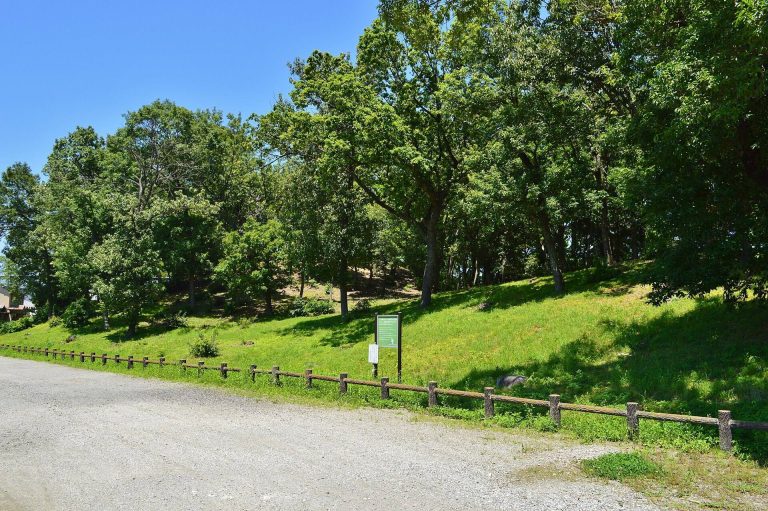
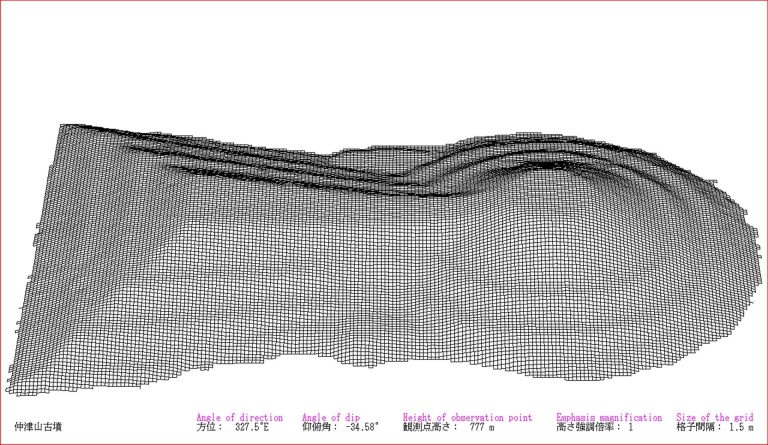
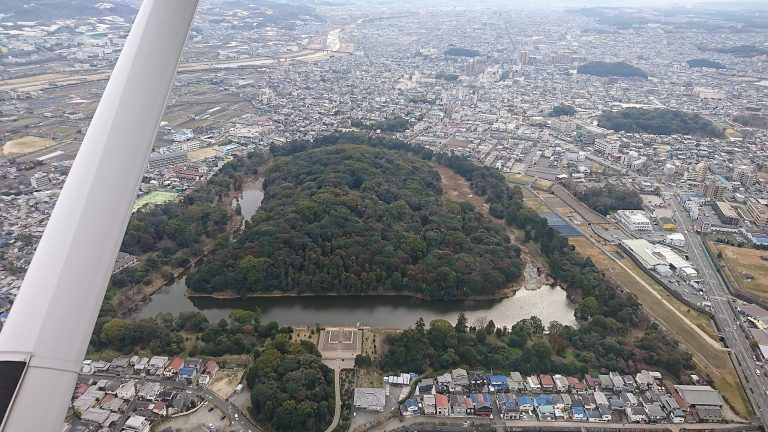
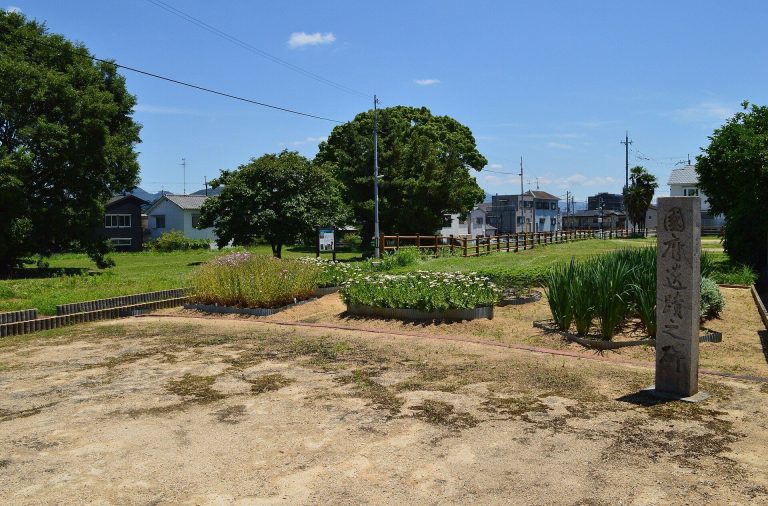
Nakatsuyama Kofun occupies the highest point of the Kokufu Plateau in the northern part of the Furuichi Kofun Group, northeast of Konda Gobyōyama Kofun. Its keyhole-shaped mound measures approximately 290 meters in total length. The rear circular section is about 170 meters in diameter and 26.2 meters high, while the front rectangular section is about 193 meters wide and 23.3 meters high. The mound has three stepped tiers, and projecting platforms extend from both sides of its narrowed central section.
Mound and Embankment
The mound surface included fukiishi, stones laid over the slopes to protect and finish them, together with haniwa. The surrounding moat lies in wetland because of the mound’s elevated position on the plateau, giving it a character close to that of a dry moat. Excavation established that the outer slope of the surrounding embankment was faced with fukiishi. The embankment therefore formed a substantial stone-finished boundary around the burial mound.
Burial Features
The burial arrangement remains uncertain, although a stone coffin may have been present and a magatama bead may have been recovered. In size, Nakatsuyama Kofun ranks second within the Furuichi Kofun Group and ninth in Japan.