Jagdschloss Wermsdorf: A Renaissance Hunting Lodge in Germany


Site at a Glance
- Rating
- 4.5
- Popularity
- Low
- Country
- Germany
- Primary era
- Early Modern
- External website
- Open
- Eras represented
- Early Modern, Modern
- Civilizations
- Electorate of Saxony, German, Holy Roman Empire
- Site type
- Domestic
- Remains
- Palace
On this page12 sections
History
Jagdschloss Wermsdorf is a Renaissance hunting lodge in Wermsdorf, Germany, established in 1609–1610 for Elector Christian II of Saxony near the forests then known as the Mutzschener Heyde. Its history reflects changing electoral, royal, administrative, military, and civic uses from the early seventeenth century to the present.
Foundation and Renaissance Expansion
The lodge replaced the old Starschedel manor on the site. The predecessor building was demolished in 1608, and Christian II commissioned a simple hunting residence the following year. The location provided convenient access to the Wermsdorf forests, which formed the setting for the electoral court’s hunting activities.
After Christian II died in 1611, his successor, Johann Georg I, ordered a major enlargement. Simon Hoffmann, a master builder from Freiberg who came from Graupen, directed alterations between 1617 and 1626. The work transformed the original lodge into a more elaborate Renaissance residence, adding wings and giving the building its irregular three-wing arrangement.
Jagdschloss Wermsdorf served as an electoral hunting lodge until 1628. Its early function was interrupted by the Thirty Years’ War, the major European conflict of 1618–1648 that involved religious, dynastic, and territorial struggles. In 1639, Swedish forces set fire to the lodge, but the occupants extinguished the blaze before it destroyed the building.
Administrative and Courtly Uses
From the seventeenth century onward, the lodge also housed administrative institutions, including the Mutzschen office. When Schloss Mutzschen burned in 1681, the office moved to Wermsdorf and continued to operate from the Old Hunting Lodge. The building therefore served both the electoral hunting establishment and the territorial administration.
Elector Johann Georg III returned to Wermsdorf for hunting in 1685. From 1696 to 1716, Anton Egon, Prince of Fürstenberg and Heiligenberg, occupied the lodge for life as Saxony’s governor. He died there. In 1699, Fürstenberg introduced the French-style parforce hunt into the Wermsdorf Forest, a mounted pursuit in which hounds followed a game animal across an extended course.
The construction of Hubertusburg from 1721 reduced the lodge’s importance within the Saxon hunting landscape. It then functioned mainly as a guesthouse and as accommodation for servants. The grounds still included gardens and four small ponds used to hold fish.
Royal Hunting Residence
In 1873, the royal Saxon government decided to dissolve the Saxon offices and replace them with district administrations. After almost two centuries of administrative use, King Albert took over the lodge and converted it into a hunting residence in 1874–1875. Albert, who ruled Saxony from 1873 to 1902, began regular one- or two-day stays there from October 1878.
The conversion altered both the building and its grounds. The garden was redesigned as a park, three ponds were filled in, and a water pipeline was laid from Hubertusburg. A lime tree was planted in the courtyard and remains visible. Inside, paintings and hunting trophies were installed, while the dining room received an elaborately carved wooden ceiling. The central hall in the north wing was also heightened during this period.
In 1916, Prince Maximilian of Saxony, Albert’s brother, was confined to the lodge after criticizing German military conduct in Belgium. He remained there until one week before the fall of the Saxon monarchy in 1918.
State Property and Twentieth-Century Uses
Jagdschloss Wermsdorf became property of the Saxon state in 1918, with the legal arrangements defined in detail by a 1924 law. The former Wettin furnishings were treated as private property. Some were transferred to Moritzburg, while others were auctioned, and most rooms were converted into apartments.
In July 1934, a Saxon riding and driving school moved from Leisnig to Wermsdorf. The lodge and its grounds supported riding, driving, jumping, cross-country riding, and mounted hunts in the nearby forest. A copy of the lodge’s hunting frieze was made around 1936 for the hall of Jagdschloss Grillenburg in Tharandt, when Grillenburg was being developed as a Saxon hunting centre under Martin Mutschmann, the National Socialist Reich Governor of Saxony and the state’s chief hunting official.
Refugees occupied the lodge toward the end of the Second World War. In 1946, the state government ordered its conversion into a convalescent and children’s home. After 1950, the building again became an administrative centre, and rooms were occupied by the German People’s Police.
Municipal Ownership and Conservation
In 1996, the Free State of Saxony transferred ownership of the lodge to the municipality of Wermsdorf. Comprehensive renovation followed in 1999. The building now accommodates the municipal administration, a tourist centre, and a riding stable.
A monument to King Albert had been erected in front of the lodge in 1908. During the Soviet occupation in 1945, it was demolished and melted down. A replacement monument was installed at the historic location and inaugurated on 8 November 1998.
Remains
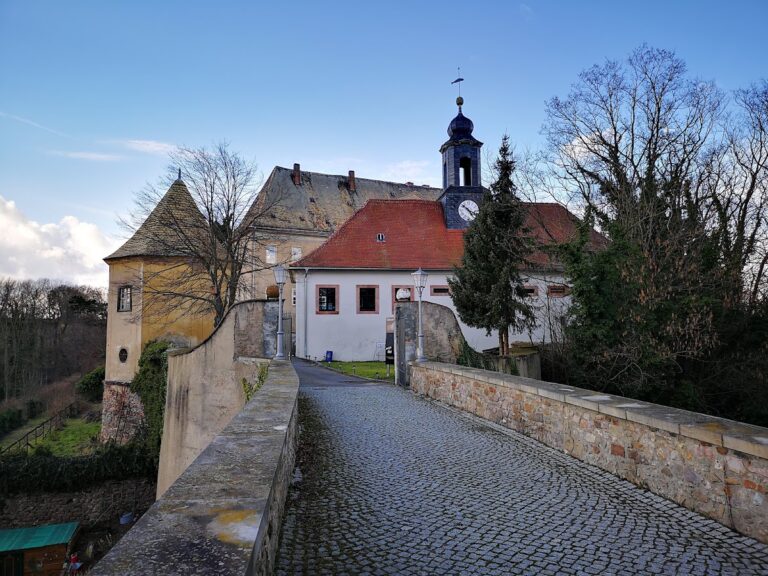
Jagdschloss Wermsdorf survives as an irregular three-wing Renaissance complex. Its façades are arranged with numerous gables, and the two principal wings meet at an acute angle. Two-storey transverse projections, volute gables, elaborate sandstone work, and a stair tower give the lodge a strongly articulated exterior. The adjacent Royal Stables and the later riding hall extend the historic group beyond the main residential building.
Renaissance Lodge
The principal wings contain two-storey transverse gabled projections with volute gables, a bay window decorated with elaborate sandstone work, and a stair tower positioned between the two main gables. The tower is crowned by a Welsche Haube, a curved, bulbous roof form, together with a lantern, the small structure rising above a tower roof. A spiral staircase occupies the angle between the two principal wings and is similar to the staircase at Schloss Noschkowitz.
The ground floor is vaulted, while the upper floor has a flat ceiling. During Hoffmann’s alterations from 1617 to 1626, the timber-framed upper floor of the north wing was removed and rebuilt in solid masonry. Hoffmann also added an east wing to the north wing and extended the originally shorter west wing, producing the three-wing form visible today.
The central hall in the north wing was heightened during King Albert’s conversion of 1874–1875. Its earlier dining-room ceiling was an elaborate carved wooden structure. The interior was also furnished with paintings and hunting trophies during Albert’s period as owner and resident.
Grounds and Riding Buildings
Royal Stables
The Royal Stables stand immediately beside the lodge and are surviving parts of the Royal Mews, the service complex for the monarch’s horses, carriages, and riding activities. They continue to be used as stables. Their close position beside the principal residential block, or corps de logis, and their artistic coordination with it represent features of the transition toward Baroque architecture.
Riding Hall
The Wermsdorf riding hall stands parallel to the road and was built between 1932 and 1934. Its plinth is made from granite porphyry quarried in Wermsdorf. The building is used by the Wermsdorf Riding and Driving Association and by the castle stud farm, where horses associated with the estate are bred and raised.
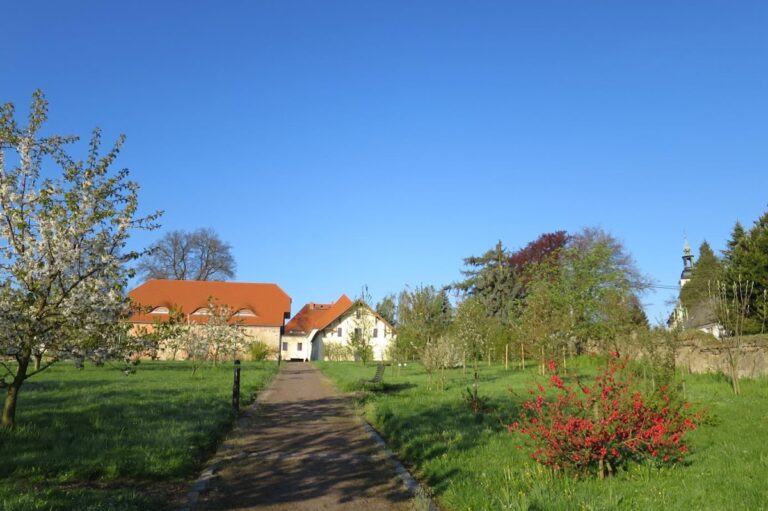
The historic grounds included gardens and four small fish-holding ponds. When the garden was redesigned as a park during Albert’s ownership, three ponds were filled in. The lime tree planted in the courtyard during the same period remains visible as part of the grounds.
Hunting Frieze
The hunting frieze was painted in 1609 for the lodge by Daniel Breitschneider the Elder, a painter at the Dresden court. Measuring 65 metres in length and 41 centimetres in height, it shows a hunting procession led by Johann Georg I as master of the hunt. Margrave Christian of Brandenburg, Duke Albrecht of Holstein, and representatives of important Saxon noble families also appear in the scene.
The frieze was later removed with the interior furnishings and hung in the Electoral Forest Tavern at Moritzburg. After the Wettins were expropriated in 1945, the tavern became a state-owned restaurant and the frieze was treated as public property. Its two sections were sent to the Old Masters Picture Gallery in Dresden for restoration in 1987 and 1990. The first restored section returned to the Electoral Forest Tavern at Moritzburg, where it is accessible in the Elector’s Room, while the second remained with the Dresden gallery after German reunification. The copy made around 1936 is installed in the hall of Jagdschloss Grillenburg.