Ikaruga-dera Temple: A Tendai Buddhist Temple in Japan


Site at a Glance
- Rating
- 4.1
- Popularity
- Low
- Country
- Japan
- Primary era
- Early Modern
- External website
- Open
- Eras represented
- Early Modern, Modern
- Civilizations
- Ashikaga shogunate, Japanese
- Site type
- Religious
- Remains
- Monastery
On this page18 sections
History
Ikaruga-dera Temple is a Tendai Buddhist temple in Taishi, Hyogo Prefecture, Japan, traditionally founded in 606 during the early seventh century. Its foundation is associated with Prince Shotoku and the reign of Empress Suiko, and the temple became an important religious and administrative center in Ibo District, historically part of Harima Province.
Traditional foundation in the seventh century
The foundation tradition connects Ikaruga-dera with lectures given by Prince Shotoku. He is said to have explained the Sutra of Queen Srimala to Empress Suiko for three days at Toyoura Palace, followed by lectures on the Lotus Sutra at Okamoto Palace. Suiko then rewarded him with 360 cho of land in Ibo District. The tradition of Shotoku lecturing on the Lotus Sutra and receiving rice fields in Harima is regarded as credible, while the detailed account of the temple’s establishment remains traditional.
According to this tradition, Shotoku traveled from Ikaruga Palace in Yamato and named the estate Ikaruga-no-sho. He established an administrative office and a temple there. The estate was organized within the kind of regular land-allocation system known as the Jorisei, which divided cultivated land into a formal grid. A plan dated 1329 later marked ten boundary points with unworked stones, and five of those markers survive as traces of the historic estate.
From Horyu-ji branch to Tendai temple
Ikaruga-dera was originally a branch temple of Horyu-ji, the ancient Buddhist temple in Nara traditionally associated with Prince Shotoku. During a later reconstruction, it was transferred to the Tendai tradition, a major Japanese Buddhist school centered on the Lotus Sutra and the synthesis of Buddhist teachings. The institution developed into a large complex arranged according to the classical seven-building monastic layout, with several dozen subsidiary residences or monastic quarters.
Warfare, rebuilding, and patronage
In 1541, warfare in Harima involving the Amago clan burned the temple. The Amago were a medieval warrior house based in the Izumo region of western Japan. Reconstruction followed gradually, and the complex had been substantially restored by about 1565. This work was promoted by Masahide Akamatsu, lord of Tatsuno Castle, together with his son and the abbot of Ensho-ji at Rakurakuyama.
The rebuilt complex received support from powerful rulers. Toyotomi Hideyoshi granted Ikaruga-dera an endowment of 300 koku, a historical measure of rice-based land revenue. During the Edo period, the temple held land under vermilion-seal grants, officially sealed authorizations issued by the shogunal government.
Repairs and heritage protection
Several buildings were repaired or rebuilt during the early modern period. The Sanno Shrine was rebuilt in 1656, the front hall of the Shotoku Hall received major repairs in 1665, and the Niomon gate was rebuilt in 1673. The lecture hall was repaired in 1769, while the Seirei Gongen Shrine was rebuilt in 1827 and the Tenjin Shrine in 1835. The bell tower underwent major repairs in 1693.
Modern conservation has included repairs to the lecture hall in 1932 and the dismantling, repair, and reassembly of the three-story pagoda in 1952. The pagoda is an Important Cultural Property. The central and rear halls of the Shotoku Hall are nationally registered tangible cultural properties, while the front hall, bell tower, Niomon gate, kitchen building and front gate, and several shrines have prefectural or municipal cultural-property designations.
Remains
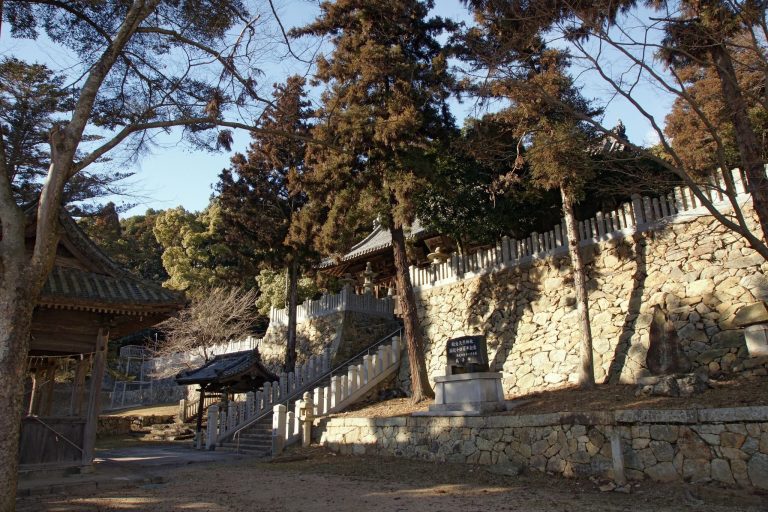
Ikaruga-dera retains a group of halls, gates, shrines, and other structures associated with its long development. The surviving buildings combine the remains of the postwar and early modern temple complex with later construction, while five unworked boundary stones preserve physical evidence of the estate described in the 1329 plan.
Main halls and devotional images
Lecture Hall
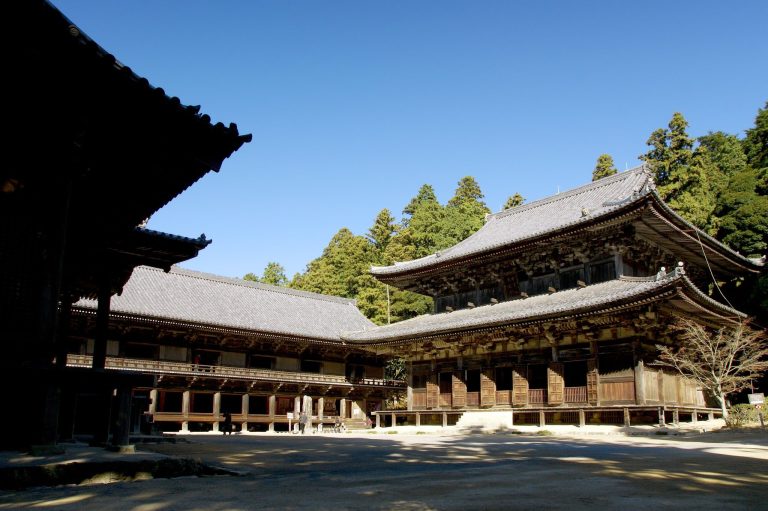
Rebuilt in 1556, the lecture hall contains seated images of Shaka Nyorai, Yakushi Nyorai, and Nyoirin Kannon. Each is described as a six-shaku statue, meaning a large Buddhist image measured in the traditional shaku unit. The three figures are hidden devotional icons and are opened for viewing during the February 22 to 23 memorial observance for Prince Shotoku.
Tradition attributes the images to the sculptor Tori Busshi and says that each cut was accompanied by three acts of reverence. Their actual creation belongs to the Muromachi-period rebuilding of Ikaruga-dera. The archaic forms of their clothing suggest that the makers modeled them on older images from the Asuka period.
Shotoku Hall
The front hall of the Shotoku Hall was rebuilt in 1551 and extensively repaired in 1665. The middle and rear halls were built in 1916. The rear hall contains a statue of Prince Shotoku at the age of sixteen and has an octagonal, double-ringed circular form surrounded by a lower skirt roof. Its design was modeled on the Yumedono at Horyu-ji.
The complex also preserves a standing wooden image of Nikkō and a standing wooden image of Gakkō, bodhisattva attendants traditionally associated with Yakushi Buddha. Eight wooden standing figures from a group of the Twelve Heavenly Generals are also held at the temple. These generals are protective figures linked with Yakushi Buddha.
Pagoda, bell tower, and gates
Three-Story Pagoda
The three-story pagoda was rebuilt in 1565 by Masahide Akamatsu and forms one of the principal structures of the temple complex. Its dismantling, repair, and reassembly in 1952 preserved the building as an important part of Ikaruga-dera’s surviving architectural fabric.
Bell Tower and Niomon Gate
The bell tower was rebuilt in 1592 by Akamatsu Hirohide and substantially repaired in 1693. The Niomon gate, which forms another principal approach structure, was rebuilt in 1673. Other surviving elements of the site include the East Gate, the Miroku Hall, and a statue of Prince Shotoku.
Shrines and administrative buildings
Associated Shrines
The Tenjin Shrine was rebuilt in 1835. The Seirei Gongen Shrine, which served as a temporary sanctuary for Hieda Shrine, was rebuilt in 1827. The Sanno Shrine was rebuilt in 1656. Together, these structures form part of the religious complex surrounding the Buddhist halls.
Kitchen and Front Gate
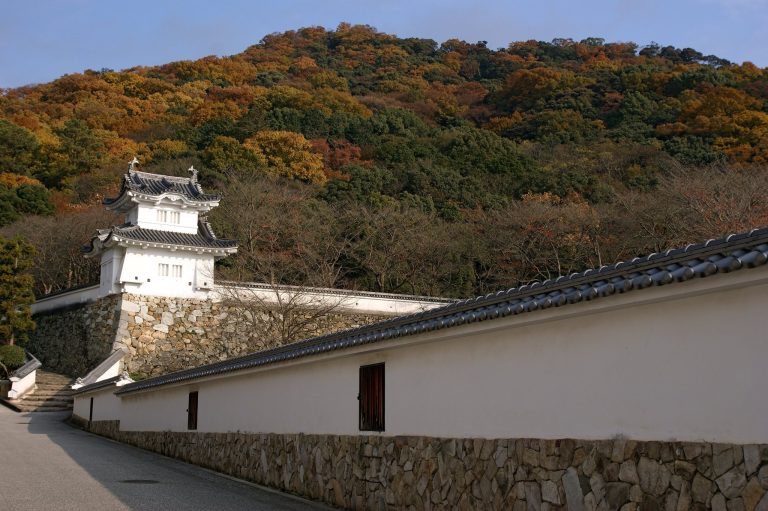
The present head temple, Hoshō-in, includes a kitchen and administrative building erected in 1649. The building originally served as the kitchen of the subsidiary Hosei-in temple, and the front gate also originally belonged to that subsidiary institution. The Seihoden treasure hall is another surviving building within the temple grounds.
Paintings, manuscripts, and estate markers
Religious and Historical Objects
The temple’s associated cultural objects include five hanging paintings of Shaka and his two attendants surrounded by the Sixteen Arhats, revered Buddhist disciples traditionally shown around the Buddha. A silk painting depicts Prince Shotoku lecturing on the Sutra of Queen Srimala. The temple also preserves a manuscript copy of the Mineai-ki completed in 1511 and the register of the Ikaruga Estate.
Boundary Stones
Five boundary markers survive from the ten points shown on the 1329 estate plan. They are unworked stones of varying sizes. Their surviving positions provide physical traces of the historic temple estate and connect the present grounds with the administrative landholding associated with Ikaruga-no-sho.