Buttsū-ji Temple: Head Temple of a Rinzai Zen Branch in Japan


Site at a Glance
- Rating
- 4.3
- Popularity
- Low
- Country
- Japan
- Primary era
- Early Modern
- External website
- Open
- Eras represented
- Medieval, Early Modern, Modern
- Civilizations
- Ashikaga shogunate, Tokugawa
- Site type
- Religious
- Remains
- Monastery
On this page14 sections
History
Buttsū-ji Temple is a Buddhist temple in Mihara, Hiroshima Prefecture, Japan, founded in 1397 by Kobayakawa Haruhira as a clan temple of the Kobayakawa family during the Nanboku-chō period, a fourteenth-century era of conflict between rival imperial courts. It belongs to the Rinzai school of Zen Buddhism, a tradition centered on disciplined meditation, teacher-disciple training, and direct insight, and is now the head temple of the autonomous Buttsū-ji branch.
Foundation and Medieval Development
Haruhira served the shogunal government in Kyoto and learned of the reputation of the Zen monk Guchū Shūkyū through his colleague Naka Muneyasu. He invited Guchū to establish a temple for the Kobayakawa clan. The foundation was intended to reinforce unity and independence within the family during a period of political conflict. The site was chosen for its favorable relationship between mountain and water landscapes.
The temple’s name comes from the posthumous title Buttsū Zen Master, given to Sokukyū Keiryō, the teacher of Guchū Shūkyū. Sokukyū was honored as the temple’s invited founding master, although Guchū served as its founding abbot. In 1409, Emperor Go-Komatsu authorized Guchū to wear the purple robes associated with high ecclesiastical rank. Guchū died later that year, and his disciples subsequently formed the Guchū branch within the Rinzai school.
In 1441, Buttsū-ji became a prayer institution of the Ashikaga shogunal family. The Ashikaga ruled Japan through the Muromachi shogunate, and a prayer institution was a temple assigned religious observances for a ruling house. Buttsū-ji also received protection from the Kobayakawa and Mōri clans. At its height, it reportedly had 88 subtemples, meaning affiliated temples within its institutional network, and about 3,000 affiliated temples in western Japan.
Decline, Revival, and Independence
The Ōnin War, a fifteenth-century civil war that caused widespread political and institutional disruption, was followed by a decline in the temple’s influence. Buttsū-ji recovered some authority under Kobayakawa lord Kobayakawa Takakage, but later shifts in political power again left it behind.
After the Meiji Restoration, government confiscation of temple lands contributed to the deterioration of its halls. When the Rinzai branches became independent in 1876, Buttsū-ji belonged to the Tenryū-ji branch. With support from the Asano clan, Ganki-in was revived that year, the Jizō-dō was repaired, and the Sanmon was built. The main hall was also renovated. In 1905, Buttsū-ji separated from Tenryū-ji and became the head temple of the Buttsū-ji branch of Rinzai Zen, which is described as governing 47 temples.
Before the Second Sino-Japanese War, the army officer and writer Sugimoto Gorō often visited Buttsū-ji for spiritual cultivation. The temple is also associated with the Chūgoku Thirty-Three Kannon Pilgrimage, as its twelfth station, the Aki Thirty-Three Kannon Pilgrimage, as its twenty-fifth station, and the Sanyō Flower Temples pilgrimage, as its twenty-first temple. Its religious calendar includes a spring memorial service on April 15 and 16 for Sokukyū Keiryō and an autumn memorial service on September 24 and 25 for Guchū Shūkyū.
Remains
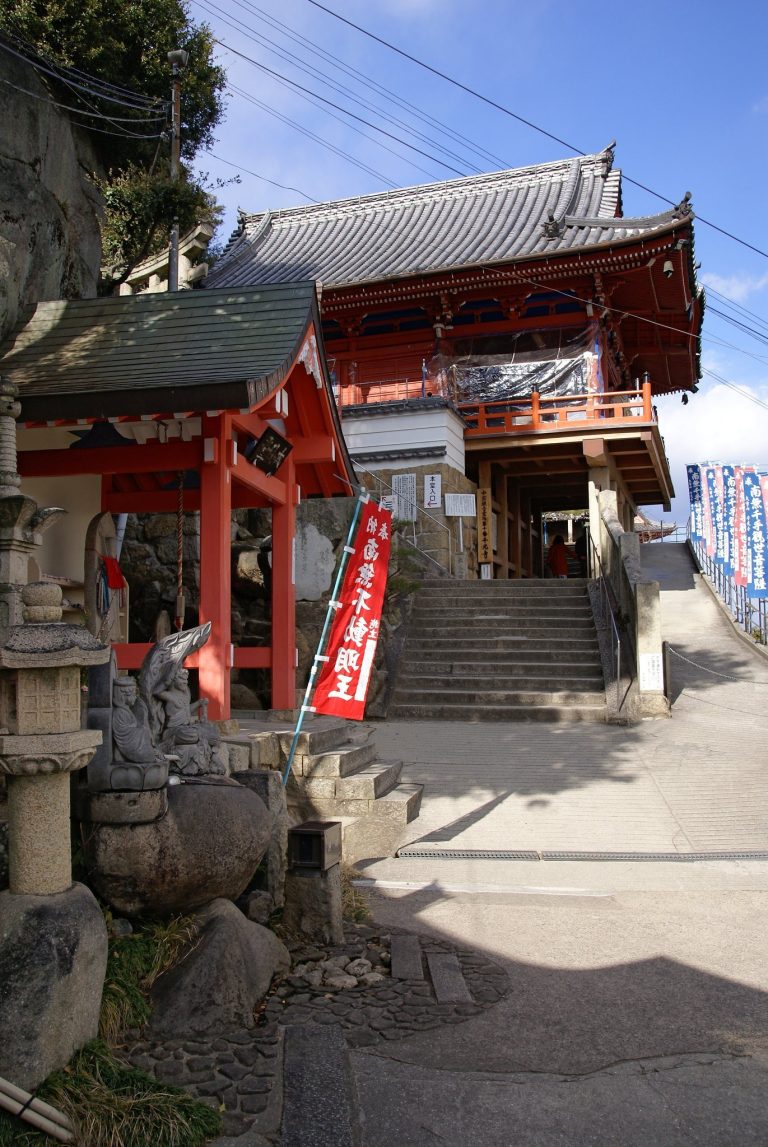
The complex contains the Hattō, which also functions as the Butsuden, the large abbot’s quarters called the Kōma-den, the temple kitchen and living quarters, the small abbot’s quarters, the Zen hall, bell tower, treasure storehouse, sutra repository, founder’s hall, and Jizō-dō. Together, these buildings represent the principal halls and supporting spaces of the temple’s religious community.
Principal Halls
Hattō-Butsuden
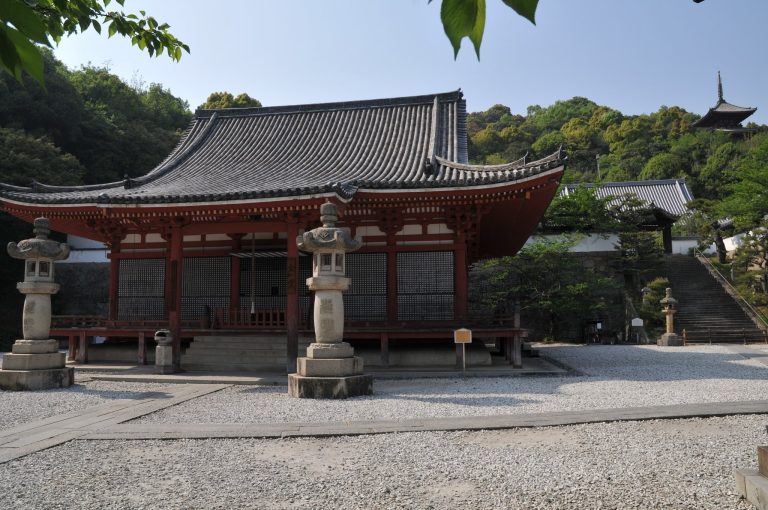
The Hattō-Butsuden was built between 1804 and 1830, during the Bunka and Bunsei periods, after a fire destroyed the earlier hall in 1796. The Hiroshima domain’s Asano lords supported its construction. Inside is a crowned seated image of Shakyamuni Buddha, accompanied by Mañjuśrī and Samantabhadra. A cloud-and-dragon painting by Kan Nanzan covers the ceiling.
Kōma-den
The large abbot’s hall, known as the Kōma-den, contains an image of Eleven-Headed Kannon. It serves as the twelfth station of the Chūgoku Thirty-Three Kannon Pilgrimage.
Founder’s Hall
The founder’s hall houses wooden seated images of Buttsū Zenji and Daitsu Zenji. A stone hōkyōintō, a memorial pagoda associated with Buddhist commemorative practice, stands with them.
Jizō-dō and Associated Structures
Jizō-dō
The Jizō-dō stands beside the founder’s hall and was built in 1406. It is said to retain the form of the temple’s foundation period. The single-story building has three bays in each direction, a pyramidal hōgyō-zukuri roof whose slopes meet at one apex, and a tiled covering that originally consisted of thatch. It houses a seated image of Jizō Bosatsu. The building was originally constructed as the Buddha hall of Ganki-in, and its associated altar is included with the designation of the structure.
Tahōtō
A tahōtō, a type of Japanese Buddhist pagoda, stands beside the founder’s hall. Built in the early Shōwa period, it uses deliberately curved materials around the eaves and has a carefully proportioned tower form.
Tree and Cultural Materials
Japanese Plum-Yew
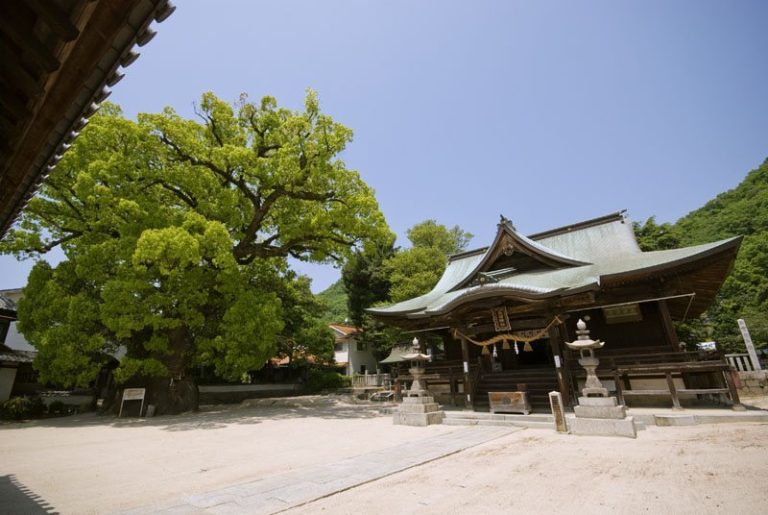
A sacred female Japanese plum-yew tree stands on the left side at the front of the approach, between Prefectural Route 50 and a bridge over the Buttsū-ji River. It is about 20 meters high and has a trunk circumference of 3.52 meters at breast height. Tradition attributes its planting to Guchū Shūkyū.
Portrait of Daitsu Zenji
The portrait of Daitsu Zenji is a fourteenth- or fifteenth-century hanging silk painting in color. The master touches the crown of his head with his right hand, an exceptionally unusual pose for a chinzō, the formal portrait of a Zen master. He wears black robes and a brown kashāya, the monastic robe worn by Buddhist clergy, and sits on a naturally shaped wooden chair marked by many knots.
The painting is accompanied by an inscription from Guchū Shūkyū, an ink inscription dated 1407, and a letter dated 1408. Addressed to the temple’s administrative office, the letter states Guchū’s intention to return to Buttsū-ji after leaving Kyoto, refers to an obstruction attributed to Kobayakawa Norihira, and directs that temple affairs be discussed with the monk named in the letter. Guchū ultimately did not return to Buttsū-ji. The wooden image of Buttsū Zenji, the Buttsū-ji documents, and other associated cultural materials are among Hiroshima Prefecture’s important cultural properties.