Kinomiya Shrine: A Shinto Shrine and Sacred-Tree Center in Atami, Japan


Site at a Glance
- Rating
- 4.4
- Popularity
- High
- Country
- Japan
- Primary era
- Modern
- External website
- Open
- Eras represented
- Modern
- Civilizations
- Japanese
- Site type
- Religious
- Remains
- Sanctuary
On this page16 sections
History
Kinomiya Shrine is a Shinto shrine in Atami, Japan, traditionally founded in 710 within Japan’s indigenous religious tradition. Its principal deities are Yamato Takeru no Mikoto, a legendary imperial prince and warrior, Izotakeru no Mikoto, a tree-associated sacred presence, and Okuninushi no Mikoto, a kami linked with land, community, and worldly welfare. The shrine’s history, name, and foundation traditions are closely connected with reverence for sacred trees.
Foundation and sacred-tree traditions
The foundation is traditionally associated with the fifteenth day of the sixth lunar month, observed on July 15 after Japan adopted the Gregorian calendar. One tradition tells that fishermen in Atami Bay drew a wooden image or tree root from their nets. The object was caught three times and was placed beneath a nearby pine tree, where roasted barley flour was offered. After Izotakeru appeared in a dream and complained about the sound of the surf, the object was moved to the present site.
Another version relates that a child who identified himself as Izotakeru appeared to villagers and led them to seven enormous camphor trees. He instructed them to enshrine him inside a hollow tree so that residents and visitors would receive protection. These traditions reflect Kinomiya belief, a regional form of sacred-tree worship distributed especially from western Kanagawa to the Izu Peninsula.
Names and religious associations
The shrine was formerly known as Kimiya Myojin and Kinomiya Daimyojin. After the Meiji Restoration, the political transformation that began in 1868, it took the name Azusawake Shrine because it was identified with an ancient shrine listed in the Engishiki, a tenth-century compilation that includes officially recognized shrines. When that identification was found to be incorrect, the shrine returned to the name Kinomiya Shrine.
The name Kinomiya is associated with the worship of sacred trees. The shrine regards itself as the head shrine of about 44 Kinomiya Shrines in Japan. This position rests on a tradition that Sakanoue no Tamuramaro, an imperial commander of the late eighth and early ninth centuries, prayed here for victory and later distributed the shrine’s divided spirit to other regions.
Kinomiya also enshrines deities connected with Inari Shrine, Kakimoto Shrine, and Tenjin Shrine. The Hashiriyu Mountain Engi describes it as the tutelary deity of Izusan Shrine. An interpretation of Kinomiya as “shrine of abstinence” has also encouraged prayers for abstinence from alcohol and other forms of renunciation.
Worship during the Edo period
During the Edo period, the era of Tokugawa rule from the seventeenth through the mid-nineteenth century, Tokugawa Ieyasu, founder of the Tokugawa shogunate, visited the shrine. Daimyo, townspeople, and other visitors who came to Atami for hot-spring treatment also paid their respects. They made many offerings, including stone monuments, and a donation register from 1734 records contributions connected with the annual grand festival.
In 1859, during the Kamanariya Heishichi incident, five of the shrine’s seven sacred trees were felled. Their timber was used to provide litigation expenses and assistance for poor villagers, linking the sacred grove to a moment of community hardship.
Modern recognition and local religious role
Kinomiya Shrine was formerly classified as a village shrine. After the Second World War, its status was supplemented by inclusion on the Beppyo Shrine list in 1981. A Beppyo Shrine is placed on the official special list of the Association of Shinto Shrines because of historical standing or institutional importance. Kinomiya serves as one of Atami’s central shrines, and its chief priest conducts religious rites for many other shrines in the city, apart from those with their own chief priests.
The shrine has also received recognition for its natural and cultural traditions. The Great Camphor Tree associated with Azusawake Shrine is a nationally designated natural monument, while Kashima Odori is an intangible folk cultural property designated by Shizuoka Prefecture.
Several prominent figures were connected with the shrine in the early twentieth century. Nogi Maresuke, a Japanese army general and later governor-general of Taiwan, visited on January 1, 1911, and inscribed the shrine’s memorial monument. On January 13, 1913, the Crown Prince presented ritual cloth offerings. Members of the Imperial Family also visited and made tamagushi offerings, which are ritual offerings of sacred branches. The shrine’s name was additionally written for it by Fusako Kitashirakawa, chief priest of the Ise Shrine priesthood, and by Togo Heihachiro, a Japanese admiral and naval commander.
The Kogashi Festival
The annual Kogashi Festival takes place from July 14 to 16, with its central observance on July 15. An opening evening rite seeks the successful performance of the ceremonies. The main rite includes a procession with a mikoshi, a portable shrine, and offerings of roasted barley flour, lily bulbs, bitter oranges, and wild yam. Ritual performances include Kashima Odori, shrine-maiden kagura, which is music and dance performed for kami, Urayasu no Mai, and lion dancing.
On July 16, a procession of about 500 priests, shrine officials, parish representatives, and performers travels through Atami before returning to the shrine. A figure representing Sarutahiko leads the procession in a tengu mask and tall clogs, scattering roasted barley flour believed to bring blessings. The route includes Yuno-mae Shrine, Atami Station, the beach, Nagisa Shinsui Park, Shimizu, Ginza, and the city hall. Kashima Odori is performed at several stops, and a beach-descending rite is held for the sacred palanquin, or horen. More than 30 neighborhood floats join the associated parade and competition.
Remains
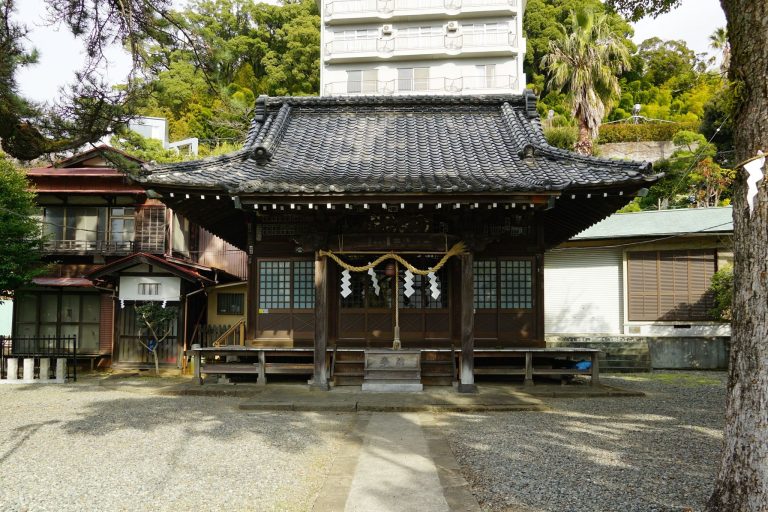
Kinomiya Shrine stands in Atami’s Nishiyama district near Kinomiya Station, with Atami Municipal Daiichi Elementary School to the north. Its precinct covers approximately 5,021 to 8,264 square metres. The grounds combine a connected sanctuary complex, subsidiary shrines, assembly and tea facilities, sacred water, garden paths, and the Great Camphor Tree and Second Great Camphor Tree.
Sanctuary complex
Main hall
The main hall forms part of a connected sanctuary arrangement with the offering hall and worship hall. The layout is described as Gongen-zukuri, in which these three spaces are joined by connecting roofs or intermediary areas. The main hall itself follows the Nagare-zukuri style, whose roof extends forward to create a protective canopy over the front of the sanctuary.
The main hall was destroyed by fires in 1932 and 1939 and rebuilt in 1958. The rebuilt structure occupies about 16.53 square metres. Records give the original main hall’s dimensions as approximately 2.12 metres wide and 3.64 metres long. The offering hall measures about 4.55 metres wide by 6.36 metres long, while the worship hall measures approximately 11.52 metres wide by 7.27 metres long.
Shrine office and Sanshuden
The shrine office was also destroyed in the fires of 1932 and 1939 and rebuilt in 1958. In January 2014, the Sanshuden assembly hall was added. It contains a 70-tatami area for distributing amulets and protective charms, a 50-tatami prayer waiting room, and a large hall accommodating 150 people. A 50-metre-long camphor-tree approach runs along the roof.
Gardens, paths, and sacred trees
Great Camphor Tree approach
The path to the Great Camphor Tree, called Kusunoki Koji, is made of diatomaceous earth, a porous sedimentary material. About 6,000 varieties of classical Japanese garden plants grow along both sides. They include bamboo, Japanese laurel, Fatsia japonica, dwarf bamboo, leopard plant, Japanese lily turf, and Japanese marlberry, as well as plants associated with celebration or protection from misfortune.
Precinct landscape
Other facilities include the Sai-kan, built in 1958, the approximately 661-square-metre Shikisai tea garden, the multipurpose venue Okusu Goshiki no Mori, and the adjoining Goshiki no Mori tea room. Torii no Yuiha tea room stands near the torii, and the precinct also contains a sacred water source, the Great Camphor Tree, and the Second Great Camphor Tree.
A Japanese laurel beside the torii, estimated to be about 300 years old, fell from its roots in May 2011 and struck the torii. The torii had been erected in 1920 and was damaged in the incident.
Subsidiary shrines
Inari, Benzaiten, and Mitsumine
Kinomiya Inari Shrine was invited from Fushimi Inari Taisha and enshrines Ukanomitama no Mikoto. Kinomiya Benzaiten was transferred from Chichibu Shrine in 1824, and its image was made by the sculptor Koun Takamura. Mitsumine Shrine was invited from Mitsumine Shrine in Saitama during the Taisho period, which lasted from 1912 to 1926.
Seven reconstructed shrines
Seven subsidiary shrines were destroyed by the 1932 fire. Their reconstruction began on February 1 and was completed on August 1, 2022. They are Shodo Shrine, Akiba Shrine, Jimmu Tenno Shrine, Yasaka Shrine, Raiden Shrine, Toko-ura Shrine, and Kakimoto Shrine.
Their enshrined figures and deities include the four Watatsumi deities, Sugawara no Michizane, the ninth-century scholar and poet honored as Tenjin, Kagutsuchi no Okami, Jimmu Tenno, the legendary first emperor of Japan, Susanoo no Mikoto, Kushinada-hime no Mikoto, deities associated with food and agriculture, the Raiden deities, the Sumiyoshi deities, and the poet Kakimoto no Hitomaro.