Jungshoved Voldsted: A Medieval Stronghold in Denmark
Site at a Glance
- Rating
- 4.2
- Popularity
- Very Low
- Country
- Denmark
- Primary era
- Medieval
- Eras represented
- Medieval, Early Modern
- Civilizations
- Danish
- Site type
- Military
- Remains
- Castle
On this page7 sections
History
Jungshoved Voldsted is a medieval stronghold near Præstø in Denmark, established about a century before it was named in King Valdemar’s Land Register in 1231. The register was a thirteenth-century royal record of estates, resources, and obligations within the Danish realm. Jungshoved was mentioned together with Jungshoved Church, placing the stronghold within the administrative and settlement landscape of medieval Denmark.
Medieval defenses
The northern defenses were strengthened during the fourteenth century. An outer moat and a palisade, a barrier made from vertically set wooden stakes, added protection beyond the central earthwork and its surrounding moat.
Buildings and destruction
By 1628, the castle mound held a derelict building complex. A description from 1649 presents the site in a more developed state, with several timber-framed buildings that included royal rooms and service quarters. During the Karl Gustav Wars, conflicts between Denmark-Norway and Sweden fought from 1657 to 1660, Swedish forces plundered Jungshoved and removed its ironwork and timberwork.
In 1762, King Frederik V sold Jungshoved to Henrik Adam Brockenhuus, and the site became part of the Stampenborg estate. The stronghold was later used as a quarry. Its building materials were reused elsewhere, including in barracks and stables at Prince George’s Palace in Vordingborg.
Archaeology and literary tradition
The National Museum excavated a small area of the castle mound in 1999. Trial trenches identified two building phases, one linked with the original construction and another dating from around 1500.
Jungshoved also became prominent in Carit Etlar’s 1853 novel The Gønge Chieftain. Etlar, the pen name of the Danish author and playwright Carl Brosbøll, placed several chapters at and around the stronghold during the war of 1657. The novel attributes the site’s foundation and an earlier name, Joffneshoved, to the legendary pirate Joffne. Its massive masonry walls, narrow doors, small elongated windows, loopholes, and heavily fortified appearance are imaginative elements, since the historical buildings were timber-framed. The story also features King Frederik III and Queen Sophie Amalie, the Gønge chieftain Svend Poulsen, and the fictional character Ib Abelsen in episodes involving royal visits, Swedish occupation, and wartime rescue and escape.
Remains
Earthworks and defensive layout
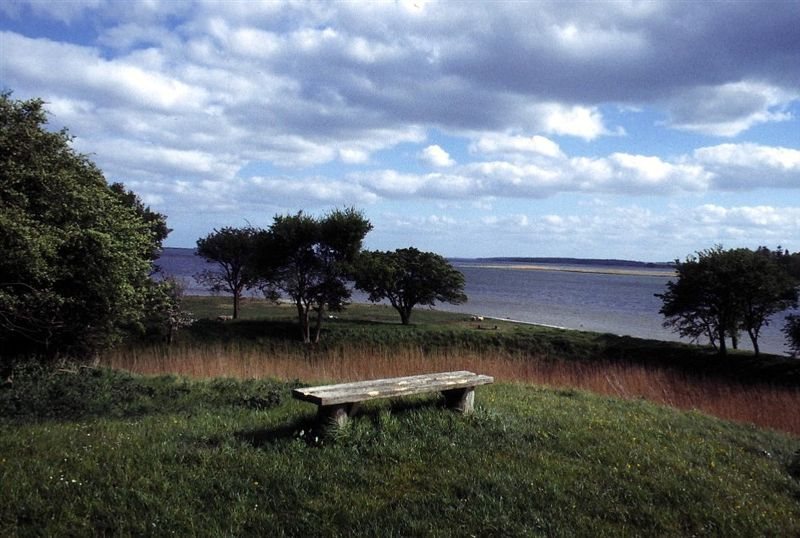
The site occupies a promontory immediately south of Jungshoved Church beside Jungshoved Inlet. Its earthwork rises about 5 metres above the surrounding landscape. At the centre is an approximately rounded triangular castle mound, a raised fortified platform, measuring about 47 by 45 metres. A moat approximately 20 metres wide surrounds it. An outer rampart protected the east, south, and west sides, although much of this earthwork has been removed. The highest surviving sections reach about 2.5 metres. On the northern side, the fourteenth-century outer moat and palisade provided an additional defensive line.
Timber-framed buildings
The 1649 description identifies three two-storey timber-framed wings on the mound. The New House contained the king’s rooms. The Old House included the ladies’ chamber, two bay windows, and a stair tower topped by a spire. A third, older house held a brewhouse and several chambers, while a fourth building contained the farm bailiff’s room. Trial trenches on the mound revealed an earlier structural phase associated with the stronghold’s construction and a later phase dating from around 1500.