Irish College in Paris: A Centre for Irish Clerical Education and Culture


Site at a Glance
- Rating
- 4.5
- Popularity
- Low
- Country
- France
- Primary era
- Early Modern
- External website
- Open
- Eras represented
- Early Modern
- Civilizations
- French
- Site type
- Religious
On this page15 sections
History
The Irish College in Paris is a historic Irish Catholic institution in France, founded in 1578 to educate secular clergy for missionary work in Ireland. It emerged during the religious persecution associated with the suppression of monastic schools under Elizabeth I and James I, and later became affiliated with the University of Paris from 1624 to 1792.
Foundation and early development
John Lee, an Irish priest, arrived in Paris in 1578 with six companions to study at the Collège de Montaigu, one of the constituent colleges of the historic University of Paris. After completing his studies, Lee became associated with the Church of Saint-Séverin. Through the French nobleman John de l’Escalopier, he secured a house in the Rue de Sèvres for Irish students and became the college’s first rector around 1605.
Thomas Dease succeeded Lee as rector and held the office until 1621, when he became Bishop of Meath. Letters patent issued by Louis XIII in 1623 gave the Irish priests and scholars in Paris the right to receive and possess property. Under Dease’s successor, Thomas Messingham, the college was recognized by the University of Paris as a seminary in 1624. A seminary was an institution for educating and forming candidates for the priesthood. Messingham organized a course intended to prepare missionaries for service in Ireland.
The college trained secular clergy, meaning priests who served dioceses rather than belonging to monastic orders. Its students were particularly intended for the Irish mission, and the institution became part of a wider network of Irish colleges on the Continent. The original house soon proved too small. Some students continued to live at the Collège de Montaigu, the Collège de Boncourt, or, if they were wealthy, the Collège de Navarre. Vincent de Paul and others therefore sought a larger establishment.
The Collège des Lombards
In 1672 the Irish bishops commissioned John O’Molony, Bishop of Killaloe, to negotiate with Colbert, a leading minister of Louis XIV, for a new college. Patrick Maginn and Malachy Kelly obtained royal authorization for the Irish community to take possession of the Collège des Lombards, a college on the Rue des Carmes that had been founded in 1333 for Italian students.
The institution was in ruins when Maginn and Kelly acquired it. They rebuilt it at their own expense and became its first superiors. Louis XIV confirmed the acquisition through letters patent in 1677 and 1681, and John Farely later extended the buildings. The Collège des Lombards subsequently accommodated the Irish ecclesiastical students in Paris until the establishment of a separate junior college.
The college admitted students from every county and province of Ireland. Its population reached 160 in 1764, encouraging the foundation of a second establishment. The growth also exposed differences between the older students and the priests. A division developed between the two institutions, with junior students moving to a new site while priests remained at the Collège des Lombards.
The junior college and its curriculum
Construction began in 1769 on the Rue du Cheval-Vert, now the Rue des Irlandais. The junior students moved there in 1776, while priests continued to use the older college. The new establishment occupied a hôtel particulier, a substantial private urban mansion, together with adjoining land acquired in 1769 by an Irish college official. François-Joseph Bélanger renovated and enlarged the building in 1775.
Students attended classes at the Collège de Plessis, the Collège de Navarre, or the Sorbonne, the theological college and faculty associated with the University of Paris. Their six-year course included two years of philosophy, three years of theology, and one year of pastoral preparation. Selected students could remain for an additional two years to qualify in theology or canon law.
The college’s religious purpose was supported by a papal privilege. Under the bull Piis Christi fidelium, issued on 10 July 1626, junior students at Irish colleges in France and elsewhere could be ordained for the Irish mission outside the usual ordination periods and without formal permissions known as dimissorial letters, provided that the rector presented them. These letters normally authorized ordination by a bishop other than the cleric’s own diocesan bishop. Pope Gregory XVI later restricted the privilege, particularly in relation to such permissions.
Ordained students partly supported themselves through Mass stipends, while numerous bursaries, or funded student endowments, supported students at the Collège des Lombards. In the eighteenth century the college was governed by four Irish priests called provisors, one representing each province of Ireland. The students elected them, and the Archbishop of Paris, acting as superior major, appointed one as principal. This arrangement ended in 1788, when the college adopted a single rector.
Revolution, restoration, and administration
The French Revolution closed both Irish colleges in Paris in 1792, along with the other Irish colleges in France. The original Irish College library was entirely lost. The closure of the continental colleges helped persuade the Irish bishops to establish a domestic seminary, leading to the foundation of Maynooth College in 1795. Maynooth became Ireland’s principal Catholic seminary and later developed into a university.
Patrick MacDermott leased the Paris premises and operated a lay school there until 1800. Napoleon Bonaparte’s youngest brother and stepson studied at the school. The college was re-established by decree of the First Consul, the title held by Napoleon before he became emperor. In 1805 the Fondation Irlandaise was created under French governmental control to administer the Irish College and surviving assets of related Irish colleges in France.
The foundation lost two-thirds of its endowment when French state funds depreciated to one-third of their former value. The interests of the Scots and English colleges in Paris were temporarily consolidated with it, although their foundations were separated again in 1824 under Louis XVIII. Richard Ferris had been appointed by the French authorities in 1810 to administer the United British Colleges, including the Irish institutions.
In 1814 the Irish bishops sent Paul Long, supported by Maynooth College, to assert Irish control. Long became superior, although Ferris briefly resumed the position when Napoleon returned to power in 1815. After the Bourbon Restoration, the return of the Bourbon monarchy following Napoleon’s fall, the superior was appointed on the presentation of the four Irish archbishops and remained subject to French ministerial authority.
Compensation claims for revolutionary losses were submitted on behalf of the college in 1816, renewed in 1832 and again in 1870. They were rejected or defeated, including a parliamentary motion introduced by Isaac Butt in 1875. The main reason given for rejecting the earlier claims was that the college was regarded as a French establishment.
Nineteenth- and twentieth-century changes
In 1834 Thomas McSweeney acquired a country house at Arcueil, about an hour’s walk from the college, for student weekends and public holidays. The property was sold after the Second World War and redeveloped. Its former association survives in the names Villa des Irlandais and Cité des Irlandais, as well as in the graves of Irish priests and students at Cachan Cemetery.
During the nineteenth century the college continued to educate priests and bishops for the Catholic Church. Forty students became bishops during the seventeenth and eighteenth centuries. Irish members of the University of Paris also held academic and administrative posts, including the procuratorship of the German nation and professorships at the Sorbonne, the Collège de Navarre, and other colleges.
With the consent of the French Government and the Sacred Congregation of Propaganda, the Roman Catholic body responsible for missionary territories and related ecclesiastical affairs, the Irish bishops transferred management to the Irish Vincentian Fathers in 1858. The Vincentians, members of the Congregation of the Mission associated with clerical education and pastoral work, retained responsibility until 1984. From 1873 the property was administered by a board established by decree of the Conseil d’État, France’s senior administrative and advisory council, with representatives of the Archbishop of Paris and the Irish episcopate.
During the Franco-Prussian War in 1870, the premises became a hospital for 300 French soldiers. In December 1906, France’s law separating Church and State led the government to propose closing the college, selling its immovable property, and applying the proceeds and existing bursaries to Irish students. Patrick Boyle and the British ambassador in Paris helped keep the institution open until the outbreak of the First World War.
During the First World War, Patrick Boyle opened the college to sisters and orphans from the Verdun Orphanage. The institution resumed operation in 1919 but closed again at the outbreak of the Second World War. Students were evacuated, while Patrick Travers remained at the college. In 1945 the premises also sheltered displaced people seeking American nationality. After the war, they housed the Polish seminary in Paris until 1997, and the college did not reopen as an Irish seminary.
Restoration and present institutional role
Irish control and an Irish presence were gradually restored during the 1970s and 1980s. Renovation took place in 1989, and the Fondation Irlandaise was reconstituted in 1991 with equal representation from Ireland and France. Its members included nominees of the Archbishop of Paris, Maynooth, and the Irish ambassador to France. The Polish community moved to Notre-Dame de Sion in Issy-les-Moulineaux in 1997.
After the Polish seminary’s departure, the college, chapel, and library underwent complete restoration funded by the Irish Government. Since 2002, the restored complex has housed the Centre Culturel Irlandais, while the Fondation Irlandaise has remained its managing foundation. The centre supports Irish cultural activity, artists in residence, scholars, and students, and provides 45 rooms for rent. It also hosts Irish-language classes in association with Maynooth University, together with concerts, performances, seminars, and exhibitions.
The Irish Chaplaincy in Paris is based at the centre. It uses the Chapel of Saint Patrick for weekly Mass, weddings, baptisms, and an annual carol service, while maintaining links with the parish of Saint-Étienne-du-Mont and Saint Joseph’s Church in Paris. The college chaplains have continued an Irish Catholic presence in Paris, including Liam Swords, the first priest in residence there since 1945.
Remains
The surviving college buildings represent two related Paris establishments. The older Irish foundation occupied the rebuilt Collège des Lombards on the Rue des Carmes, while the junior college established in 1769 occupied a mansion and adjoining land on the Rue du Cheval-Vert, now the Rue des Irlandais. The buildings were altered over time for clerical education, wartime relief, seminary use, and later cultural activity.
The Collège des Lombards
Rebuilt college complex
The Collège des Lombards was a former university college founded in 1333 for Italian students. Patrick Maginn and Malachy Kelly acquired its ruined buildings for the Irish community and rebuilt them at their own expense. John Farely later extended the complex. The college was situated on the Rue des Carmes and housed Irish ecclesiastical students until the junior establishment opened.
College chapel
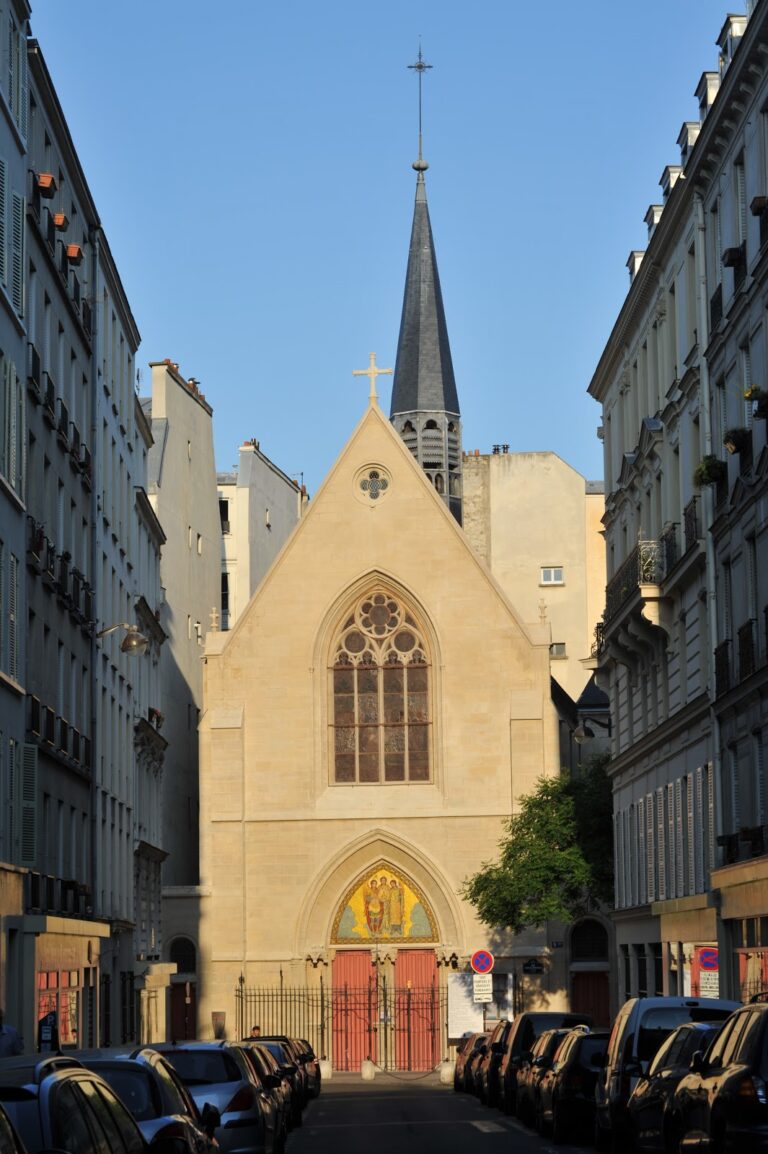
The chapel was rebuilt in 1738 under the direction of Pierre Boscry. Its surviving structure is now used by the Saint-Ephrem-le-Syriac Church, which has occupied it since 1927. The chapel vaults contain the burials of Andrew Donlevy, Dominic Maguire, and John O’Molony, and are also associated with the burial of Charles Kearney.
An annual service takes place in the chapel for Irish people buried at the older college site. The restored Irish College plot at Cachan Cemetery, in the Arcueil-Cachan area, provides another surviving place of remembrance for priests and students connected with the institution.
The junior college on the Rue des Irlandais
Urban mansion and enlargement
The second college occupied a hôtel particulier and adjoining land on the Rue du Cheval-Vert. François-Joseph Bélanger renovated and enlarged the building in 1775. Junior students moved into the premises in 1776, while the priests continued to use the Collège des Lombards. During the Revolution the buildings were converted into storage premises, and the Irish seminary later returned there during the Restoration.
Restored cultural complex
The restored complex includes the college chapel and library and contains 45 rooms for scholars, students, and other residents. The chapel harmonium was restored as part of the wider work. The Chapel of Saint Patrick remains a place of Irish Catholic worship and community services within the Centre Culturel Irlandais.
Arcueil and Cachan traces
The country house acquired at Arcueil in 1834 served as a place for student weekends and public holidays. It was sold after the Second World War and redeveloped. The names Villa des Irlandais and Cité des Irlandais preserve its association with the college, while graves at Cachan Cemetery and the restored Irish College plot remain physical links with the former property and its users.