Collège Sainte-Barbe: A Historic Educational Institution in Paris
Site at a Glance
- Popularity
- High
- Country
- France
- Primary era
- Modern
- Eras represented
- Modern
- Civilizations
- French
- Site type
- Civic
- Remains
- University
On this page14 sections
History
Foundation and early growth
Collège Sainte-Barbe is a historic educational institution in Paris, France, conventionally dated to 1460. Before it closed, it was described as the oldest identified college in Paris. Its early history has competing claims to a founder: Jean Hubert may have opened a boarding house in 1430, while around 1460 Geoffroy Lenormand, a professor at the Collège de Navarre, acquired buildings from Vézelay Abbey and established a school there. The college remembered Lenormand as its founder, and his role helped give it its enduring name.
The school was dedicated to Saint Barbara, a Christian saint traditionally venerated as a virgin martyr. It invoked her as a learned virgin who had defeated pagan advocates in debate. Without an endowment, the college aimed to admit pupils from all parts of France rather than serving one region. It quickly attracted a broad clientele: families of members of parliament sent their children, and the king of Portugal entrusted the school with fifty pupils.
Institutional change and religious conflict
Hubert’s earlier purchase of the Hôtel des Coulons, a substantial private townhouse, contributed to the later dispute over the college’s origins. The college sought to use the property in its early years and permanently annexed it in 1556. In 1553, Robert Dugast, a University of Paris director and the college’s principal, bought the institution back and left it his fortune. He issued statutes on 19 November 1556, created seven scholarships, and rebuilt and enlarged the premises.
During the Reformation, Sainte-Barbe admitted Catholic and Protestant pupils alike, prompting accusations that its principals tolerated heresy. Classes continued during the conflicts involving the Catholic League, a powerful Catholic political movement in France’s religious wars. In 1579, forty of the University’s fifty colleges were empty, while Sainte-Barbe kept teaching until late 1589. After ceasing to function as a full college, it reopened in 1607 as a small college. Its pupils had to attend instruction at the University’s full colleges, an arrangement that lasted until shortly before the French Revolution.
Revolution and revival
A financial appeal in 1790 brought no response, while the deteriorating buildings and their layout made orderly management difficult. In April 1793, the Revolution forced Sainte-Barbe to close. The revolutionary state confiscated its premises as national property and assigned them to the Collège de l’Égalité, which became the Prytanée français, a state secondary school.
Victor de Lanneau, a deputy director at the Prytanée from 1797, worked to restore Sainte-Barbe’s original purpose and recover its grounds. After the premises had been confiscated and sold to different buyers, he rented them and re-established the institution. Studies resumed on 4 December 1798. First known as the College of Sciences and Arts, it later reclaimed the name Collège Sainte-Barbe. De Lanneau restored an internal hierarchy and a family-like ethos, using scholarships to reward merit rather than family wealth.
Private school and rebuilding
In 1815, Sainte-Barbe operated chiefly as a private secondary boarding school. A decree required pupils at private institutions in towns with a college or lycée to attend classes there. Sainte-Barbe therefore concentrated on boarding and supervised study, supplementing pupils’ education with evening lessons and tutors. The Association of Former Sainte-Barbe Students, founded in 1820 and recognized as serving the public interest in 1880, became France’s oldest alumni association.
Financial problems brought the college close to seizure in 1831. Claude Bellaigue, a former pupil and member of parliament for Yonne, organized a company with former students to save it. Managed by Adolphe de Lanneau, the company took ownership on 30 December 1831 and assumed the establishment’s assets and outstanding bills. After Victor de Lanneau’s death, Adolphe became director. Alexandre Labrouste took over on 3 April 1838, requiring that the college’s debts be cleared and that he be allowed to choose its teachers.
Reconstruction was prompted by the poor and unhealthy condition of the buildings, many of them rented houses. In June 1839, a main beam cracked in a building on Rue des Sept-Voies; nobody was injured. After litigation, the owner allowed the college to buy the land for demolition and rebuilding. Labrouste had also acquired 22 Rue des Sept-Voies for the college and transferred it to the institution on 8 April 1841. A new wing began in 1840 and was occupied the following year. Further work took place in 1846, paused during the upheavals of 1848, resumed in 1852, and was completed in 1853. A shareholding company established by royal ordinance in 1841 helped finance the rebuilding.
Expansion, state ownership, and closure
Sainte-Barbe opened preparatory classes for competitive higher-education entrance examinations in 1835. In 1853, more than a third of the pupils admitted to École Polytechnique, a highly selective French engineering school, had boarded at Sainte-Barbe. The college acquired a château at Fontenay-aux-Roses in 1851 as a separate annex known as Sainte-Barbe-des-Champs. To unite its traditional college and preparatory school, it began another redevelopment in 1881. Pupils entered from Rue Valette from the start of the 1882 school year, and the new premises were inaugurated in 1884.
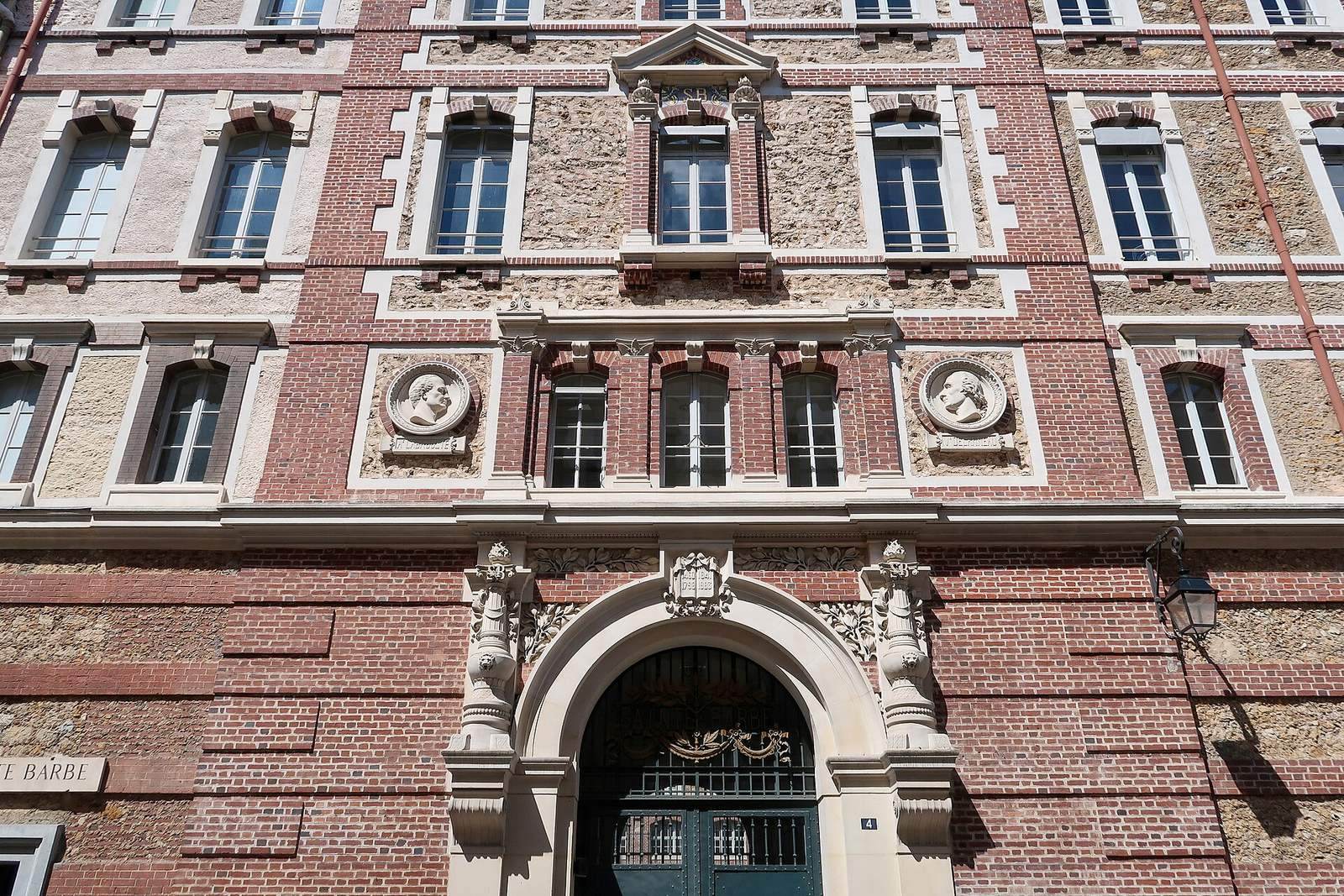
The state provided financial assistance in 1892 and bought the college in 1898, leasing it back to the shareholding company. The former college premises were later allocated to the Bibliothèque Sainte-Geneviève and demolished. From 1950, Sainte-Barbe pupils attended classes in the former preparatory-school buildings. The institution’s decision to remain entirely private and avoid a contract with the state contributed to continuing financial difficulties and higher tuition fees. Parts of its buildings received French historic-monument protection in 1999, a legal status for safeguarding historically important structures. The college closed that year.
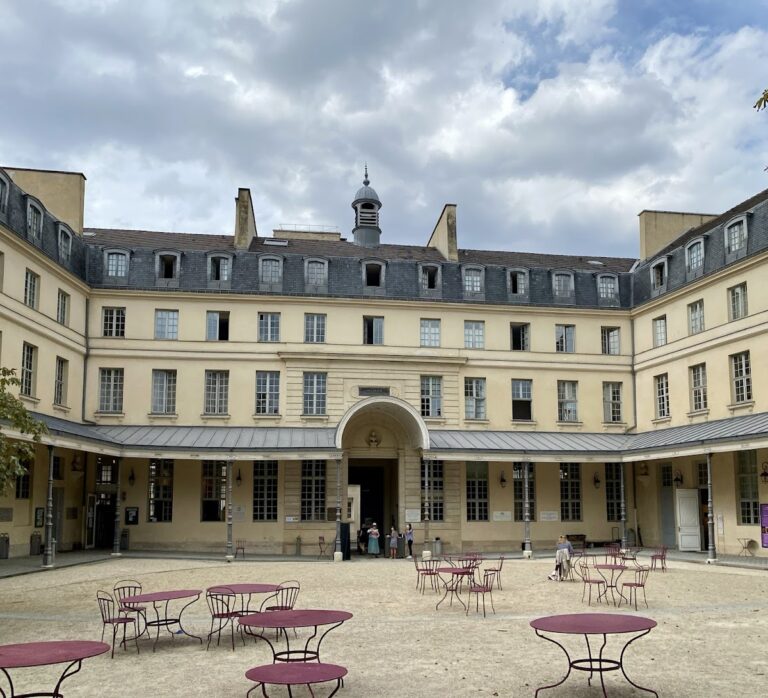
Architect Antoine Stinco rehabilitated the former college buildings. Since March 2009, they have housed the Sainte-Barbe Library, which serves students and staff from multiple universities, and a center of Panthéon-Assas University, known particularly for law and political science.
Remains
The college’s physical layout developed through successive acquisitions and rebuilding on Montagne Sainte-Geneviève. Its earlier premises occupied several buildings among the surrounding streets, while later campaigns joined separate college and preparatory-school properties. The surviving former preparatory-school complex includes protected exterior features, staircases, and teaching and dining spaces.
College premises and nineteenth-century rebuilding
Medieval and early site
The medieval college occupied buildings on Montagne Sainte-Geneviève at a site associated with the former Hôtel des Châlons in the now-vanished Rue de Reims. The Hôtel des Coulons, bought earlier by Jean Hubert, became part of the college grounds and was annexed in 1556. Buildings constructed under Robert Dugast were later rebuilt.
Wings and street plan
The nineteenth-century college consisted of groups of private houses, including properties on Rue des Sept-Voies and Rue Jean-Hubert. The rebuilding campaign that began on 8 August 1840 started with a large wing extending from Rue des Sept-Voies to Rue de Reims. Théodore and Henri Labrouste directed the work and prepared its plans. Rue des Chiens and Rue des Cholets were removed to make room for the expanding college.
Chapel and connecting buildings
In 1846, builders reconstructed the former chapel on Rue de Reims and buildings erected under Dugast. A covered gallery connected the northern and southern buildings in place of one of the houses. On the portion of Rue des Cholets ceded to the college, the visitors’ room and dining halls stood behind the entrance, with a chapel on the first floor. Archbishop Affre inaugurated the chapel on 4 December 1847. Work resumed in 1852 with a north wing on the part of Rue de Reims removed for the college, and the last stone was laid on 3 December 1853.
Former preparatory-school complex
Buildings and staircases
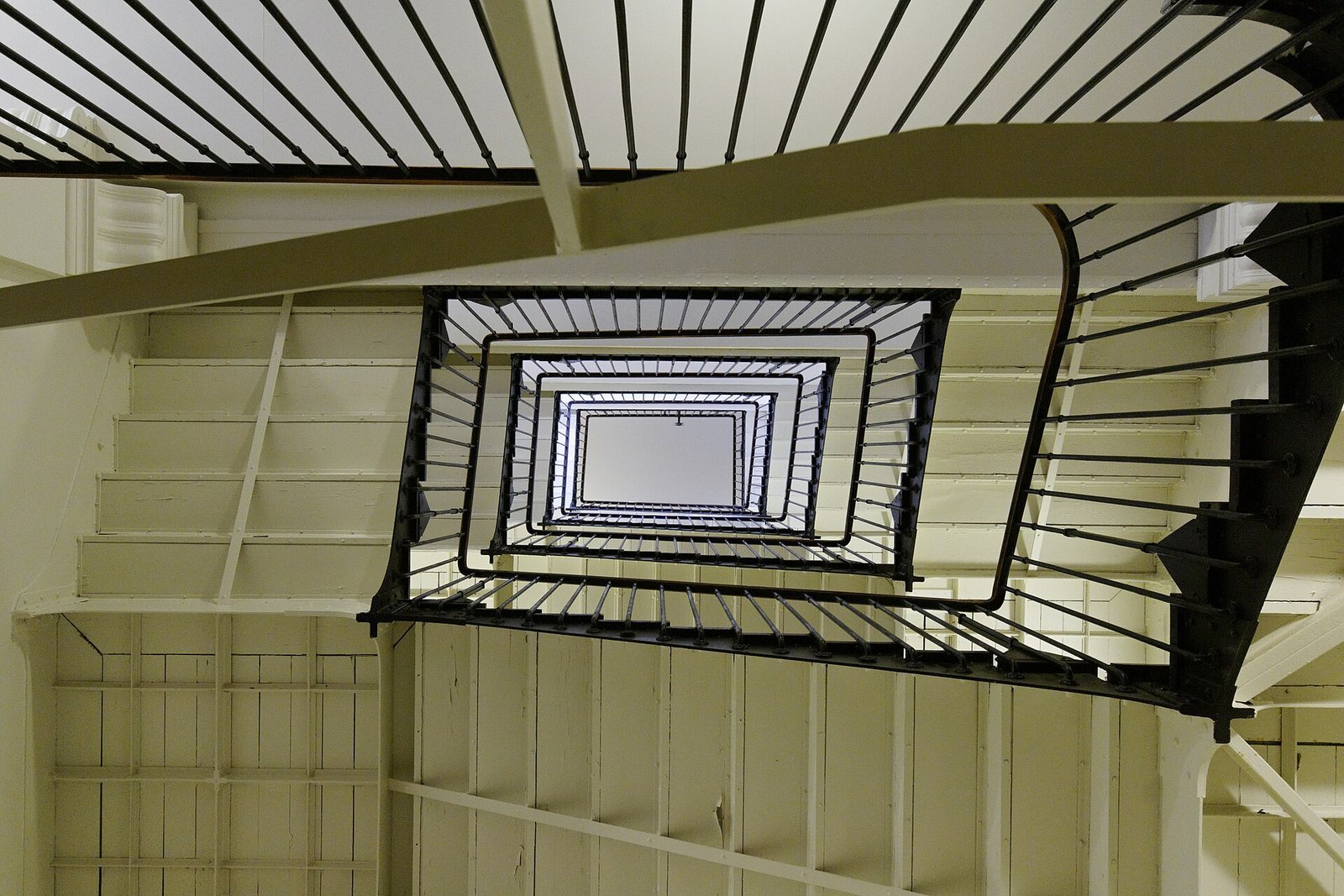
The preparatory school first used buildings of the former Collège de Reims, separate from the traditional college. Louis-Ernest Lheureux designed new premises for the later redevelopment. The work joined the two parts of Sainte-Barbe by removing Rue de Reims and Rue du Four, along with the southern part of Rue d’Écosse. Protected staircases include those at the ends of the Lheureux buildings and one beneath the covered courtyard of a building dating from the 1930s.
Protected interior spaces
The protected interiors include the refectory and amphitheatre, with their functional systems and decoration, as well as a drawing classroom and its decoration. Together with the protected façades and roofs of the college buildings, these spaces preserve elements of the complex’s teaching and institutional layout.