Instituto Valencia of Don Juan: A Museum and Research Centre in Madrid


Site at a Glance
- Rating
- 4.8
- Popularity
- Very Low
- Country
- Spain
- Primary era
- Modern
- External website
- Open
- Eras represented
- Modern
- Civilizations
- Spanish
- Site type
- Domestic
- Remains
- Elite Residence
On this page8 sections
History
The Instituto Valencia of Don Juan is a museum, library, archive, and research centre in Madrid, Spain, founded in 1916 by the diplomat and archaeologist Guillermo de Osma y Scull and his wife, Adelaida Crooke y Guzmán, the 24th Countess of Valencia de Don Juan. It was created to preserve, enlarge, and study their collections of decorative arts, including objects assembled by Osma and inherited collections associated with the counts of Oñate and Valencia de Don Juan.
Foundation and scholarly purpose
A notarial act formally established the Institute on 15 March 1916, and it opened in 1917. Its aims extended beyond the preservation of objects. The institution was intended to support research into Spanish history, art, archaeology, and material culture, while also encouraging Spain’s international cultural and archaeological relations.
The first Board of Trustees brought together prominent figures from politics, scholarship, the Spanish aristocracy, and international cultural life. Its members included Prime Minister Antonio Maura, the scholar Miguel Asín Palacios, the Spanish peer Jacobo Fitz-James Stuart y Falcó, the American philanthropist and scholar Archer Milton Huntington, and the British archaeologist Sir Charles Hercules Read.
Collections and institutional development
The Institute became known for holdings in textiles, ceramics, earthenware, and Andalusian art, alongside coins, manuscripts, silverwork, and paintings. In 1920, Guillermo de Osma endowed the University of Oxford with £2,110 to establish the De Osma Studentship, a scholarship supporting the study of Spanish at the Institute. Manuel Gómez-Moreno directed the institution from 1925 to 1950.
Its documentary holdings include material connected with the Catholic Monarchs, Queen Isabella I of Castile and King Ferdinand II of Aragon, whose joint rule at the end of the fifteenth century marked the dynastic union of much of Spain. They also include documents from the reign of Philip II, the Spanish Habsburg king who ruled from 1556 to 1598. Osma acquired part of this material from the archive of Madrid’s Altamira Palace in an effort to keep the remaining groups in Spain. Other portions had already gone to the libraries of Geneva and the British Museum, while another quarter remains in Madrid’s Zabálburu Library.
The building was declared a historical-artistic monument and a Spanish Site of Cultural Interest in the Monument category in 1981. This designation is a formal protection for historically important cultural assets and structures. The Institute’s later physical history included a restoration by José Luis González García in the late twentieth century.
Remains
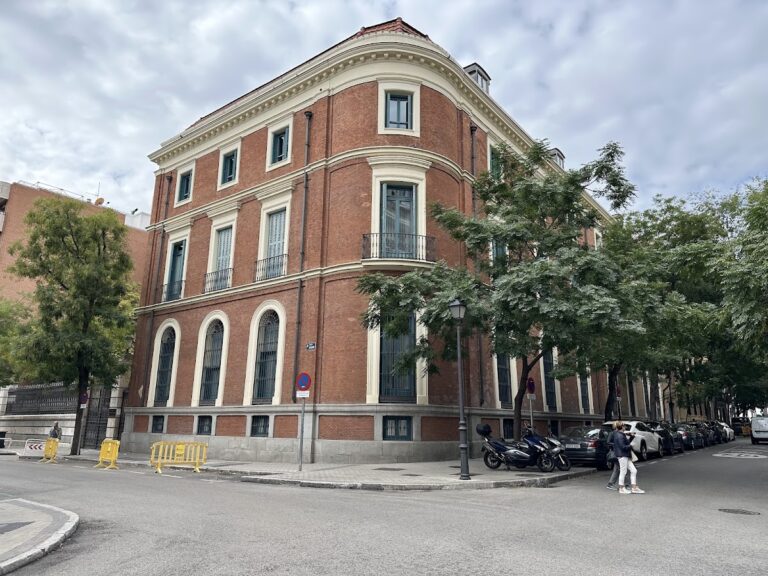
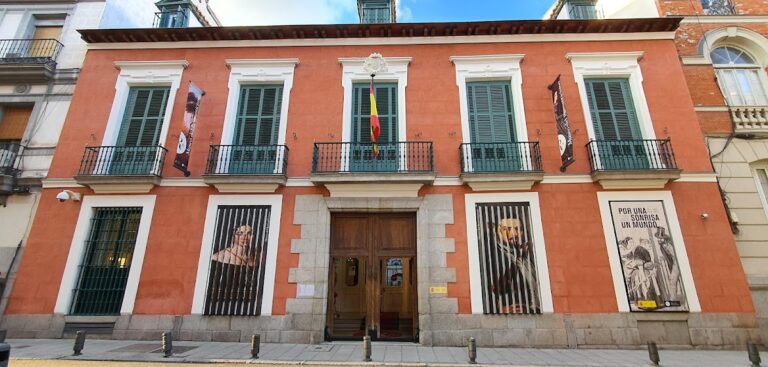
The Institute occupies the Palacete de Osma, a relatively small urban mansion, on Calle de Fortuny. The building combines a late nineteenth-century residential origin with successive additions and a Neo-Mudéjar appearance, a style that revived architectural forms associated with Mudéjar buildings in Christian Spain through brickwork, geometric decoration, and glazed tiles.
The Osma mansion and garden pavilion
The original mansion was designed by Enrique Fort y Guyenet. Its exterior azulejo work, made from glazed ceramic tiles used for architectural decoration, was produced by Daniel Zuloaga. Luis Mosteiro remodelled the building in 1912, forming part of the architectural development that prepared the residence for its later institutional use.
In 1917, Vicente García Cabrera added a pavilion over the garden. The pavilion retains Neo-Mudéjar characteristics and has a Neo-Gothic portal opening onto Calle de Fortuny. Together, these elements preserve the building’s layered architectural history, from private mansion to museum and research centre.
The west wing
Modesto López Otero added the west wing in 1946. This extension forms a facade on Calle Eduardo Dato and represents a later phase in the building’s expansion. The mansion was therefore enlarged in stages in 1912, 1917, and 1946 before its late-twentieth-century restoration.
Library and archival holdings
The library contains a fully digitized documentary collection of 40,000 documents dating from the reign of the Catholic Monarchs to the nineteenth century. It also holds 710 medieval parchment documents dated from 875 to 1500 and 247 bound manuscripts. Among the notable manuscripts is a sixteenth-century Book of Hours, a Christian devotional book often richly illustrated, produced in Flemish workshops.
The Institute formerly held the Codex of the Order of the Golden Fleece, a historic chivalric order founded in the fifteenth century. That manuscript was later sold to Spain’s National Heritage. The documentary and manuscript collections remain central to the Institute’s role as a place for the study of Spanish history and material culture.
Decorative arts and paintings
The collections bring together textiles, ceramics, earthenware, coins, manuscripts, silverwork, and paintings. A notable work is Allegory of the Carthusian Order by El Greco, whose subject refers to the Carthusian Order, a Catholic monastic order. These objects complement the library and archive by presenting Spanish and related artistic traditions through both fine and decorative arts.