Tsunashiki Tenjinsha: A Shinto Shrine in Osaka


Site at a Glance
- Rating
- 4
- Popularity
- Low
- Country
- Japan
- Primary era
- Early Modern
- External website
- Open
- Eras represented
- Medieval, Early Modern
- Civilizations
- Tokugawa
- Site type
- Religious
- Remains
- Sanctuary
On this page13 sections
History
Tsunashiki Tenjinsha is a Shinto shrine in Osaka, Japan, associated with the historic Kitano area and traditionally linked to Emperor Saga and Sugawara no Michizane. Its origins are placed in 843, when a sanctuary for Emperor Saga was established at the site during the early Heian period.
Origins under Emperor Saga
Shrine tradition connects the site with Emperor Saga’s visit to the Utagano area of Settsu Province in 822. A temporary imperial residence was established near Mount Kamiyama, at the location of present-day Kamiyamacho. After the emperor’s death, his son, Prince Minamoto no Tōru, founded the seven-hall Buddhist temple Taiyuji nearby as a memorial. In 843, a shrine called Kamino Daijingu was established there to enshrine Emperor Saga.
The shrine was also known as Kitano Tenjin, while its traditional parish broadly corresponded to the former Kitano Village in Nishinari District, now within the eastern part of Kita Ward. These earlier names reflect the shrine’s long connection with the local community and the wider Kitano area.
The tradition of Sugawara no Michizane
In 901, Sugawara no Michizane reached the area while being exiled to Dazaifu. Michizane was a Heian-period scholar, poet, and politician who later came to be worshipped as Tenman-Tenjin, a kami associated with scholarship and learning. According to tradition, he pulled in a boat’s mooring rope to make a temporary seat while looking at a flowering red plum tree. This episode is associated with the name Tsunashiki, meaning “rope-spread.”
Local residents offered Michizane dumplings in a vessel called a yuriwa. Dumplings continue to be offered in this type of vessel during important shrine rites. Michizane is also said to have instructed six local followers, including Harushige, the grandson of the aged retainer Watarai Haruhiko, also known as Hakutaifu, to remain in the area and await his return. He gave these followers the surname Shirae, and descendants of the Shirae family have served continuously as the shrine’s priests.
After Michizane died in Dazaifu, his family established a small shrine beneath the red plum tree he had admired. It was called Umetsuka and later became Umetsuka Tenmangu, the predecessor of the present Otabisha in Chayamachi. The plum tree is also traditionally associated with the “ume” element in the name Umeda.
Rebuilding and institutional continuity
In 993, after Michizane was cleared posthumously of the charges against him and received the court titles of Senior First Rank and Grand Minister of State, his spirit was invited into Kamino Daijingu. A new sanctuary was built as the main shrine, and the combined sanctuary subsequently became known as Tsunashiki Tenjin and Kitano Tenjin. Umetsuka Tenmangu was designated as the Otabisha, a shrine used for the temporary or processional transfer of a deity during festivals.
The shrine was damaged during the Nanboku-cho wars in 1340, a period of conflict between rival imperial courts, when its buildings and sacred treasures were burned. In 1461, seven pine trees were said to have appeared at the site overnight. A monk of Taiyuji carried news of the event to Kyoto as a manifestation of Michizane’s spiritual power, and the shrine was rebuilt with assistance from Kitano Tenmangu.
Regulations for the shrine’s priestly association were established in 1739. They made the head of the Shirae family the hereditary head of the shrine’s priestly house, tracing that priestly line to Hakutaifu.
Modern transformations and wartime destruction
A government land-seizure order in 1871 led to the demolition of the Otabisha, which was then also associated with the name Joanji, south of the main shrine. In 1872, its enshrined deity was temporarily transferred to the Saita area near present-day Nishitemma 6-chome. Residents of Chayamachi later donated land so that the deity could return as the neighborhood’s guardian, and the Otabisha was re-established at its present location. Its precinct was reorganized twice during expansion works by Hankyu Railway, and the shrine was classified as a village shrine during this period.
The shrine buildings and all other shrine property were destroyed in the second Osaka air raid on June 1, 1945. The sacred rope and a sacred image survived the attack. Mount Kamiyama, which had given its name to Kamiyamacho and stood behind the main sanctuary, was destroyed by a direct bomb strike. The main shrine buildings were rebuilt on July 15, 1956, the date on which the annual festival is held.
The outer Tooth Shrine became an auxiliary shrine of Tsunashiki Tenjinsha around the beginning of the Meiji period. Its pre-Showa-period building was more than half destroyed by arson in 2000 and rebuilt in May 2001 using usable salvaged components.
Remains
Main precinct
Rebuilt shrine buildings
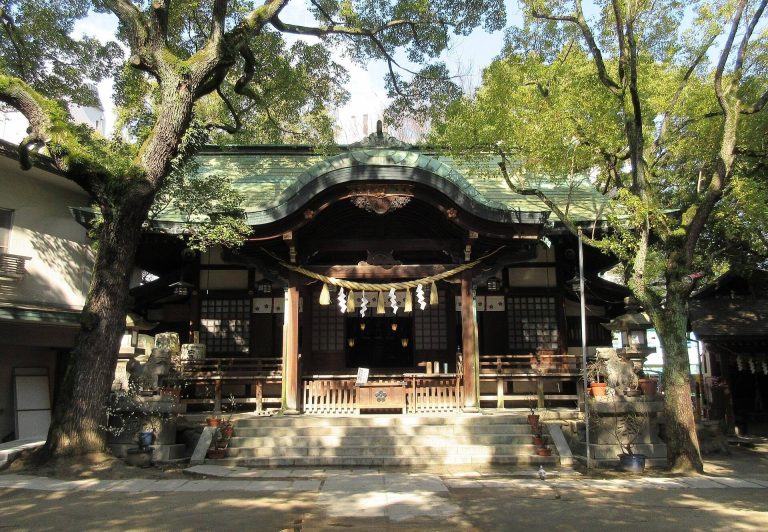
The main precinct contains the main sanctuary, an offering hall, and a worship hall, together with a sacred-implements storehouse, an administrative office, a brush monument, and a Zuishinmon gate. The main sanctuary is the honden, or principal sanctuary, while the worship hall is the haiden and the offering hall is the heiden. All three principal buildings were rebuilt on July 15, 1956, after the wartime destruction of the earlier structures.
Manzaibashi stone railing
The stone railing of Manzaibashi comes from a stone bridge made in the late Edo period. It is regarded as the oldest surviving remnant of Osaka’s traditionally cited “eight hundred bridges of Naniwa.” Within the precinct, it preserves a physical link with the city’s earlier bridge network.
Auxiliary shrines
Kitano Inari Shrine stands within the main precinct and was rebuilt in October 1962. It enshrines Ukanomitama no Okami, a kami associated with food, grain, agriculture, and rice and commonly identified with Inari. The precinct also contains Hakuryu Shrine, which enshrines Hakuryu no Okami and Sarutahiko Okami. Hakuryu is associated with white dragons or white snakes and the protection of houses, shrines, and land, while Sarutahiko is associated with purification, strength, and guidance.
Otabisha and Tooth Shrine
Tsunashiki Tenjinsha Otabisha
The Tsunashiki Tenjinsha Otabisha stands at 12-5 Chayamachi on the site of the former Umetsuka Tenmangu. Because it originated as Umetsuka Tenmangu, it has a complete shrine layout and sanctuary rather than the more limited form of an ordinary temporary festival shrine. Its main sanctuary and worship hall were rebuilt in 1984, and an administrative office stands within the precinct. The main sanctuary enshrines Sugawara no Michizane.
The Otabisha also contains Tamahime Inari Shrine, an auxiliary shrine dedicated to Ukanomitama no Okami. Its building was rebuilt in 1982.
Tooth Shrine
The Tooth Shrine, the outer auxiliary shrine of Tsunashiki Tenjinsha, is located at 2-8 Kakudacho and also enshrines Ukanomitama no Okami. During a major flood in the middle of the Edo period, a large stone beside the Inari shrine was said to have stopped the water’s flow. The shrine consequently came to be regarded first as a deity that “stops” flooding and, by the end of the Edo period, as an Inari shrine believed to stop toothache.
The Tooth Shrine building, which predated the Showa period, was more than half destroyed by arson in 2000. It was rebuilt in May 2001 with reusable surviving materials, preserving elements of the earlier structure in its present form.