House of the Golden Bracelet: A Roman Residence in Pompeii
Site at a Glance
- Popularity
- Low
- Country
- Italy
- Primary era
- Classical
- Eras represented
- Classical
- Civilizations
- Roman
- Site type
- Domestic
- Remains
- House
On this page15 sections
History
The House of the Golden Bracelet is a luxurious Roman residence in Pompeii, Italy, associated with a wealthy household. Pompeii was buried by the eruption of Vesuvius in AD 79.
Victims of the eruption
Four people died when a structure collapsed during the eruption. Their remains were found beneath a staircase in 1974. The group consisted of two men and two children.
Excavation and reassessment
The house was excavated during the 1960s and 1980s. The four victims were initially interpreted as a nuclear family, and the adult wearing a bracelet was mistakenly identified as the mother. DNA analysis in 2024, by a team led by University of Florence biologist Elena Pilli, established that the four people were not related.
Remains
Three-level layout
Built across three levels on the western slope of Civita Hill, the house overlooked the Bay of Naples. It extended beyond the city wall, which no longer served a defensive purpose. Its entrance and rooms were arranged to fit the sloping ground.
Upper level
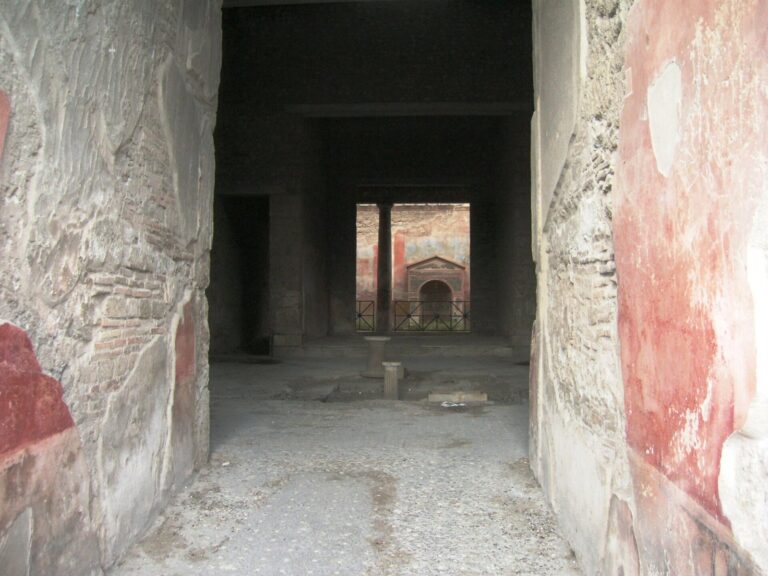
The street entrance opened onto the highest level. From there, the fauces (the passage leading into the house) opened into an atrium (the central reception area), with rooms arranged around it. Living rooms and bedrooms occupied this level.
Middle level
Family rooms included a tablinum (a principal room associated with the household head). Unlike the usual Roman arrangement, it did not stand behind the atrium. A bathroom, kitchen, service rooms, and a terrace overlooking the garden were also on this level.
Garden level
Beneath the terrace, rooms opened onto a large garden. The central room, numbered 31, was a partly open summer triclinium (a dining room with three couches).
Painted rooms
Summer dining room
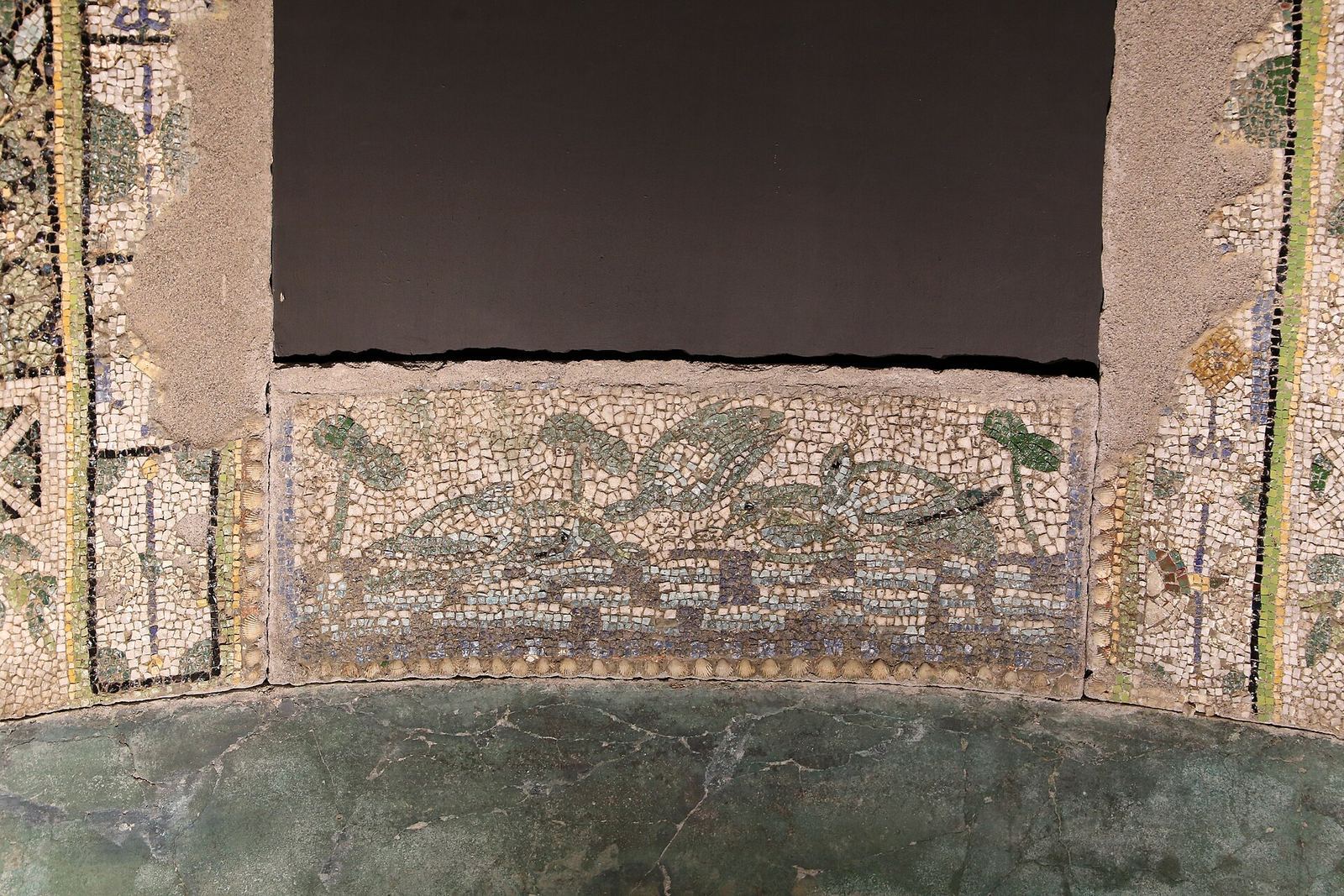
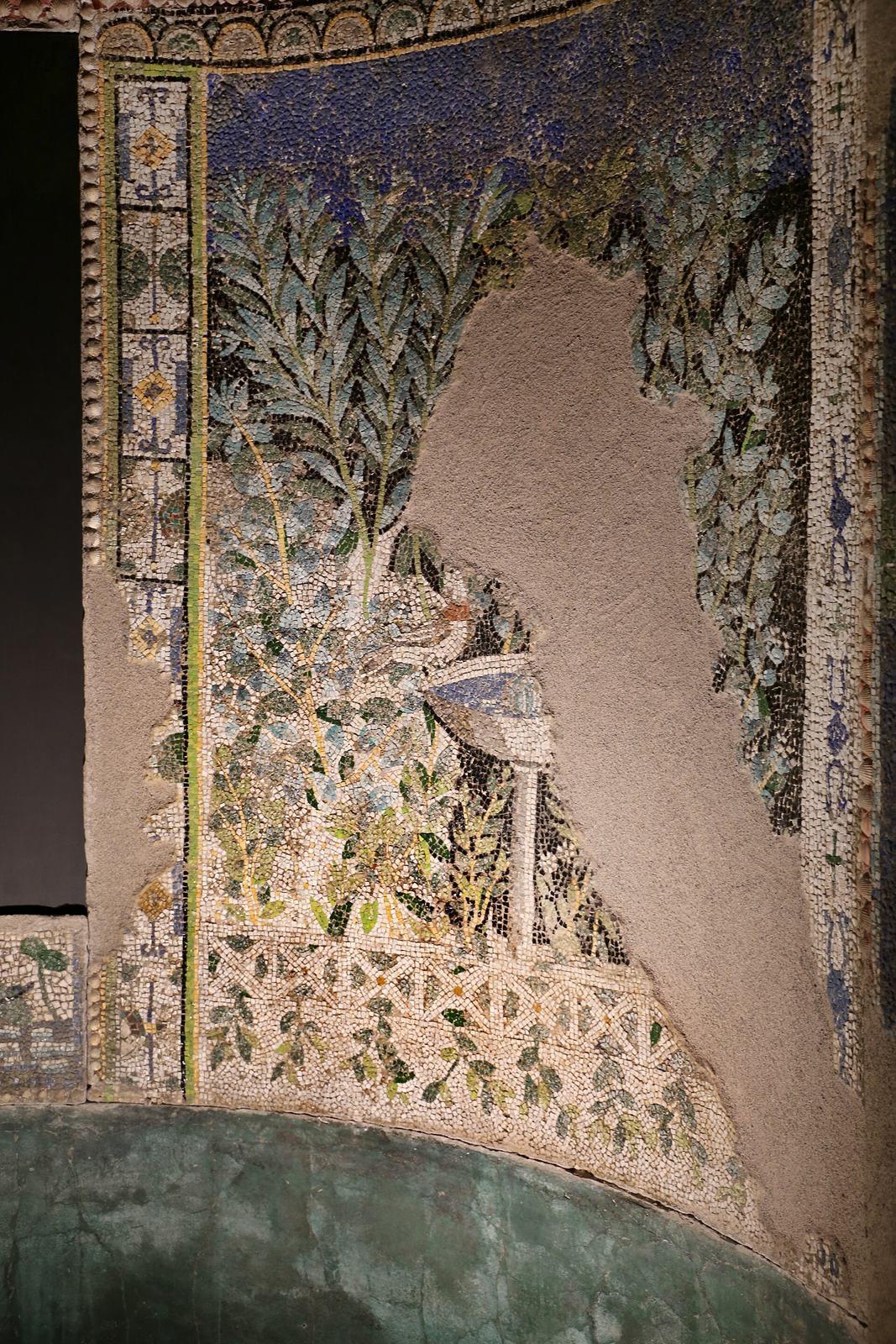
Room 31 had three fixed brick dining couches, partly faced with white marble, and a vaulted ceiling. Its decoration gave it the appearance of a garden pavilion. Three painted panels on the south wall showed plants, birds, and Egyptian-style statues behind latticework. The garden-facing walls carried a landscape with birds, theatre masks, and Egyptian-style figures. At the back, an eastern niche lined with small glass mosaic tiles held a fountain, forming a nymphaeum (a decorative fountain feature).
Adjacent reception room
A richly painted oecus (a large reception room) adjoined the summer dining room. Its north wall showed a garden scene with birds, a fountain, and statues associated with Bacchus. Paintings from both rooms were removed from the walls and are now in Naples.
Middle-level dining room
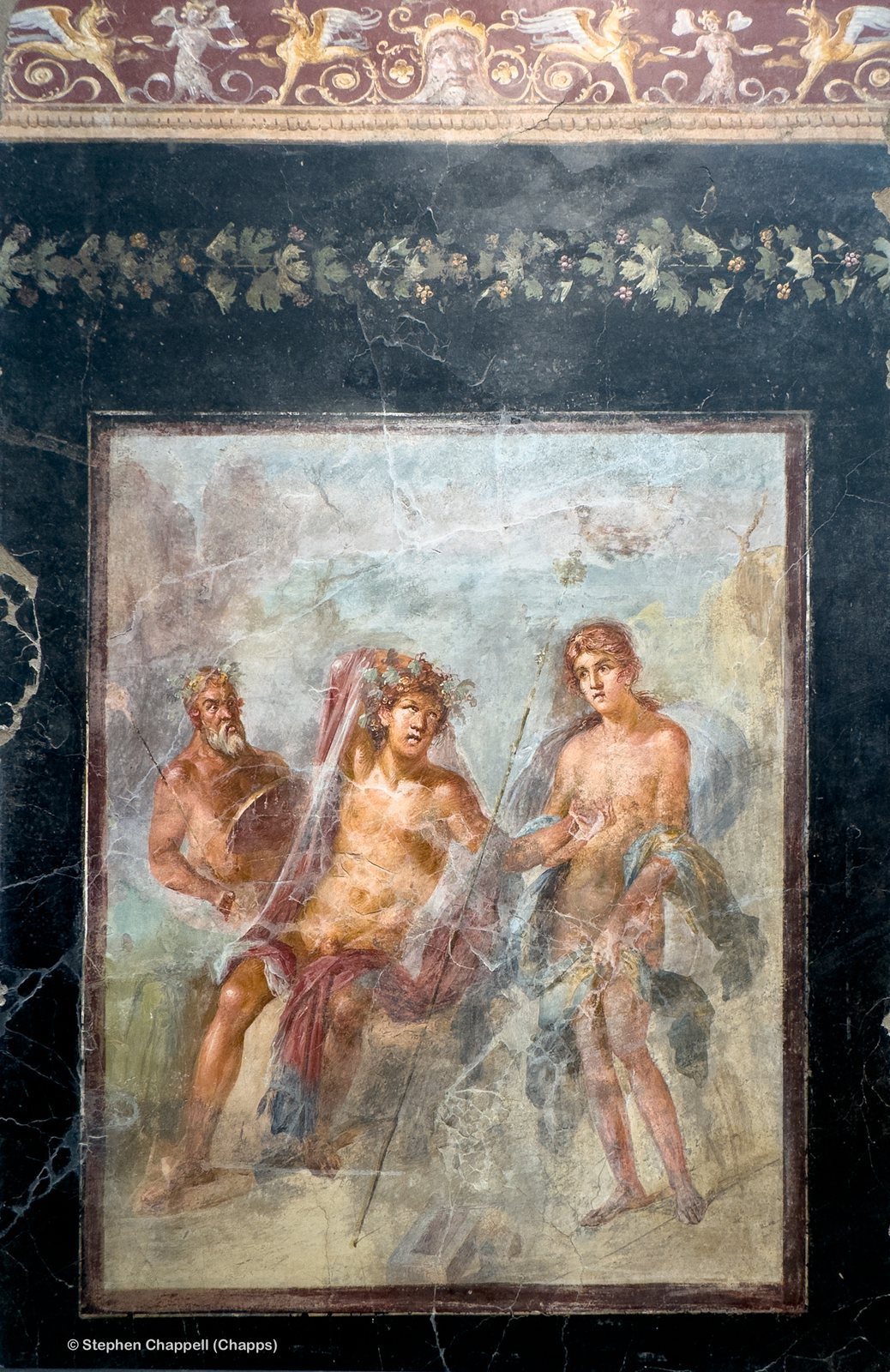
A dining room on the middle level had Fourth Style paintings, one classification of Roman wall decoration. Two large paintings were cut from its walls. One has been interpreted as the wedding of Alexander the Great, the Macedonian king, and Roxane, his wife, although the figures’ identities are uncertain. Other readings identify Ares and Aphrodite, Greek gods, or Alexander and Roxane portrayed as those deities. The second painting depicts Dionysus, also known as Bacchus in Roman tradition, and Ariadne, a figure associated with him in Greek mythology. The house’s alternative name, the House of the Wedding of Alexander, refers to the first painting.
Garden and finds
Garden
A water basin in the garden had 28 taps. Two pillars beside it supported a pergola, an open framework. Root remains helped establish the garden’s plan, with paths and low hedges around lawns or flower beds. The north wall may have been covered with grapevines. Fragments of Third Style Roman wall painting, a recognized category of Roman wall decoration, had been buried in the garden after rooms were redecorated in antiquity.
Household finds
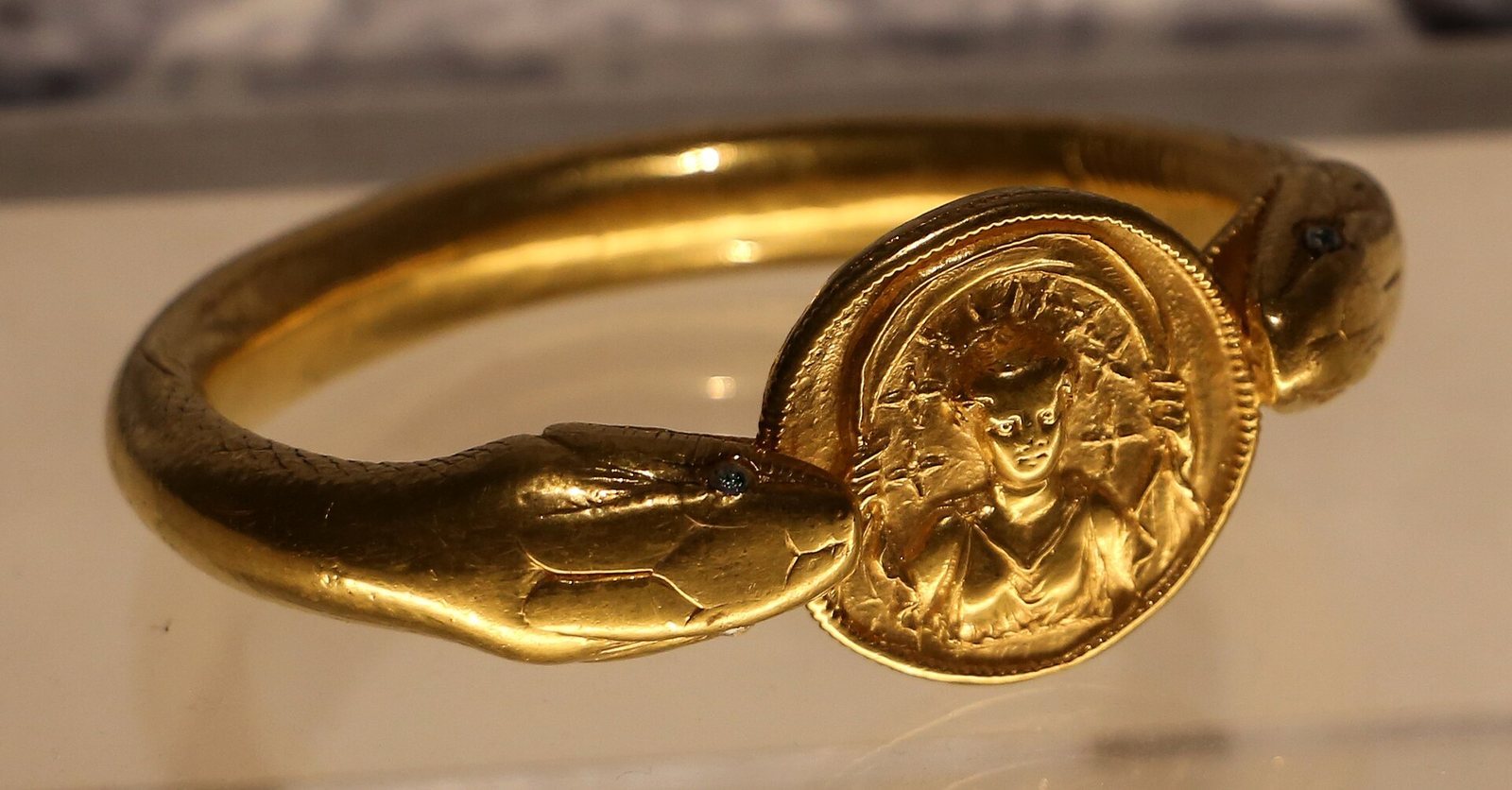
A gold bracelet weighing 600 grams, shaped as a two-headed snake holding a relief of Silenus, the mythological companion of Dionysus, gave the house its modern name. It is now in the National Archaeological Museum of Naples. Gold and silver coins found around the victims included 200 coins. Other finds included 40 gold aurei (Roman gold coins) and 70 silver denarii (Roman silver coins). The bracelet and coins indicate the household’s wealth. Buried food remains included cattle, pigs, sheep or goats, poultry, and fish.