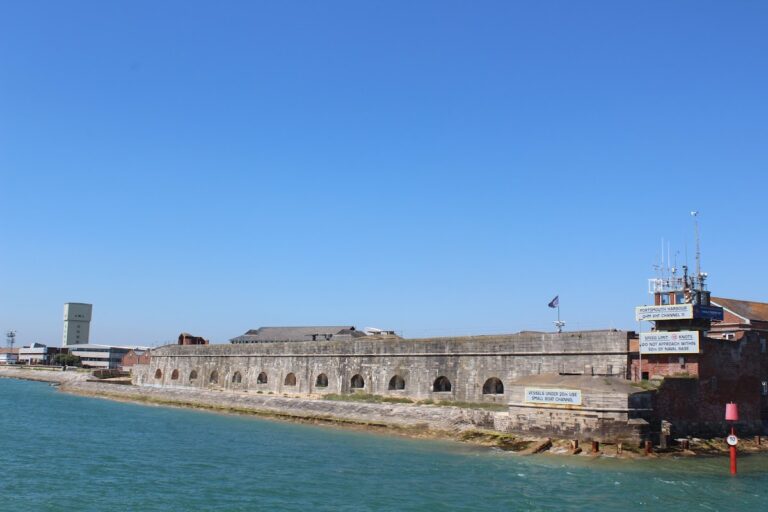
Horse Sand Fort: A Royal Commission Sea Fort in the Solent


Site at a Glance
- Rating
- 4.7
- Popularity
- Very Low
- Country
- United Kingdom
- Primary era
- Modern
- Eras represented
- Modern
- Civilizations
- British
- Site type
- Military
- Remains
- Fort
On this page8 sections
History
Horse Sand Fort is a nineteenth-century British sea fort in the United Kingdom, built in the Solent to defend Portsmouth, its naval base, the approaches to Spithead, and the military ports of Portsmouth and Southampton. It formed part of the Palmerston Forts, a coastal-defence programme developed amid fears of naval attack during the period of Lord Palmerston’s government. The fort stands on Horse Sand, about 3.6 kilometres southeast of Southsea Castle.
Planning and construction
The project arose from a military investigation conducted in 1859. Captain E. H. Stewart designed the fort under the supervision of Colonel W. F. D. Jervois, Assistant Inspector General of Fortifications. Construction began in 1865 and reached completion in 1880, at a cost of £424,694. The circular, heavily armoured structure was intended to bring artillery against enemy shipping approaching the Solent.
Armament and coastal defence
The planned artillery included rifled muzzle-loading guns on two gun floors and ten 12-inch guns arranged in five roof turrets. The turrets did not form part of the completed installation, while the limited space meant that the 12.5-inch guns had to use reduced powder charges. In 1882, 12-inch rifled breech-loading guns were installed in alternate bays. Six-pounder quick-firing guns, designed especially for smaller or faster vessels, were added in 1891.
Submerged defences were constructed from about 1908 between the fort and Southsea. A concrete-block barrier ran roughly 1.8 metres below sea level and left two narrow passages for small craft. A shorter related barrier extended from No Man’s Land Fort towards Ryde Sands. During the Second World War, the forts defended the Portsmouth dockyards, and a further flexible barrier and ship-detection installation were placed between Horse Sand Fort and No Man’s Land Fort. The barriers remain because demolition was considered too expensive.
End of military use and later history
Horse Sand Fort’s military function ended in 1957, after its guns had been removed six years earlier. Ownership then changed several times. The Portsmouth Naval Base Heritage Fund bought the fort for £80,000 in 1993, but development plans failed and it was offered for sale in 2002.
In March 2012, Clarenco LLP, formerly known as Amazing Retreats and already the owner of No Man’s Land Fort and Spitbank Fort, purchased Horse Sand Fort with plans to convert it into a museum. A proposed public opening in 2016 did not take place. The fort was later offered for sale, and in October 2021 it was reported sold to an unnamed buyer for £715,000. Restoration work was delayed in 2018 by a resident family of peregrine falcons. Horse Sand Fort has been a scheduled monument, a site protected under United Kingdom heritage law for its archaeological or historical importance, since 12 June 1967.
Remains
Fort structure and foundations
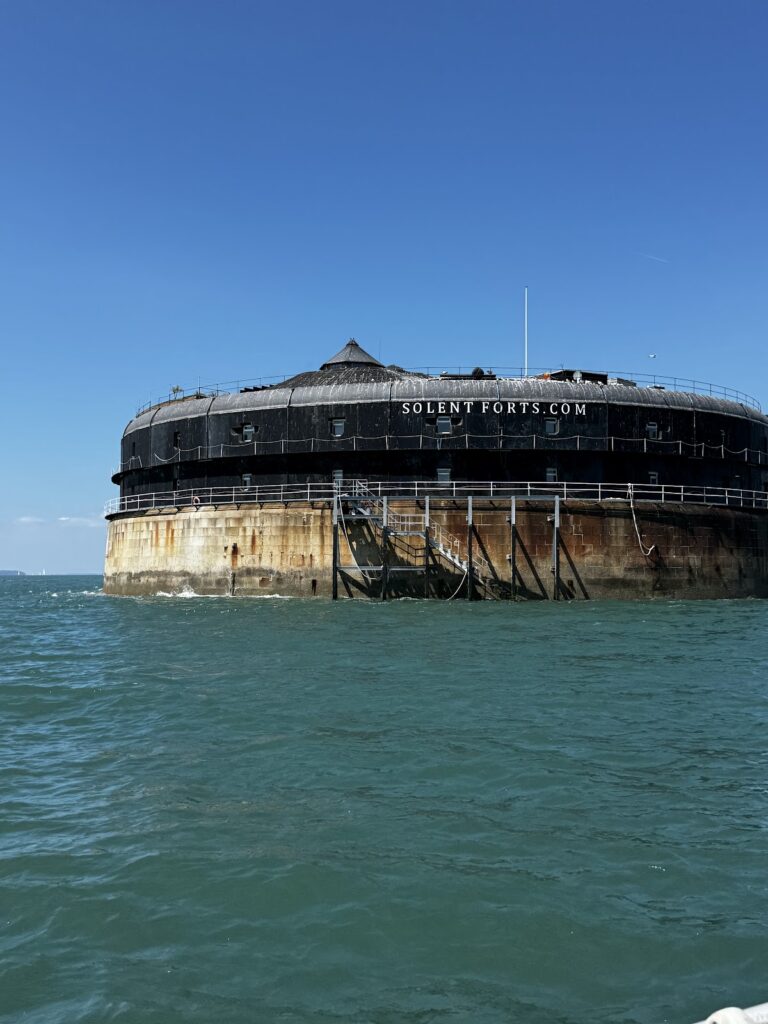
Horse Sand Fort is circular in plan, with two upper floors and a basement. The structure narrows slightly towards the top, measuring approximately 70.4 metres across at its base and about 61 to 62.4 metres across above. Its foundations consist of a ring of large concrete blocks laid in a masonry-like arrangement and faced externally with granite. Clay and shingle or gravel filled the interior of the ring, which was sealed beneath a thick concrete layer. The lower foundation walls are approximately 18 metres thick.
Heavy iron armour plating protected the seaward side. The landward, or rear, side was formed by a thick natural-stone wall. A wooden-decked landing stage, supported on cast-iron piles, provided access. The roof carried a lighthouse, chimneys, and ventilators, while an artesian well supplied fresh water.
Interior and surviving military features
The basement and floors were arranged for ammunition, guns, stores, and supplies serving a garrison of five officers and 72 soldiers. Approximately 100 chambers and living quarters survive, together with an original gun carriage. Photographic records from 1940 show the other-ranks’ sleeping quarters and a six-inch breech-loading gun on the roof. The fort’s physical condition is described as complete, although the proposed museum conversion and restoration were not completed.
Submerged barriers and exterior finish
The concrete-block barrier extending from Horse Sand Fort towards Southsea survives beneath the water, with narrow openings for small craft. A second, shorter barrier runs from No Man’s Land Fort towards Ryde Sands. In the late nineteenth century, the Solent forts received a black-and-white chequered paint scheme, an early form of dazzle camouflage. Parts of this pattern remain visible on the unrestored sections of Horse Sand Fort.