Fort Cumberland: An Artillery Fortification Guarding Langstone Harbour


Site at a Glance
- Rating
- 4.3
- Popularity
- Very Low
- Country
- United Kingdom
- Primary era
- Early Modern
- External website
- Open
- Eras represented
- Early Modern, Modern
- Civilizations
- British
- Site type
- Military
- Remains
- Fort
On this page12 sections
History
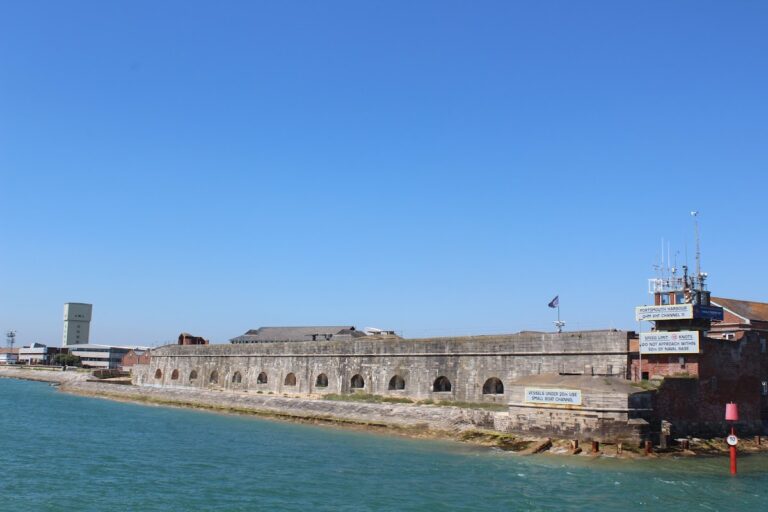
Fort Cumberland is a pentagonal artillery fortification in Southsea, United Kingdom, built to guard the entrance to Langstone Harbour and protect Portsmouth Dockyard from an attack launched through the harbour. An earthwork battery occupied the site from 1714, before the first fort was begun by the Duke of Cumberland, a British royal and military commander, on 1 January 1747. It was substantially complete by the end of 1748.
The first fort
The original Fort Cumberland was an irregular star fort formed mainly from earthworks. Brick buildings within it included a guardhouse, storeroom, and powder magazine, while one of two proposed barrack blocks was probably completed. This first defensive work established the military purpose of the site, protecting the dockyard against an enemy landing at Langstone Harbour followed by an attack from the landward side.
Masonry reconstruction
Fort Cumberland was entirely rebuilt in masonry during a wider improvement programme for Portsmouth’s fortifications. Materials began to be stockpiled in 1782, major construction started in 1785, and the new fort was essentially complete by 1812. It occupied a similar position to its predecessor but followed a different alignment and covered a substantially larger area. The earlier guardhouse and storeroom were incorporated into the new design.
The rebuilt fort was the last United Kingdom fort with angle bastions, projecting angular sections that allowed defenders to provide flanking fire along the walls and ditch, and the first in the country to provide casemated ordnance. A casemated fort places guns in protected vaulted chambers or enclosed gun positions.
Artillery changes and Royal Marine use
By the late 1850s, rifled cannon had made the fort’s smooth-bore muzzle-loading guns obsolete. Rifled cannon have spiral grooves inside the barrel, improving accuracy and range. In late 1858 the fort passed from the War Department, which administered the British Army, to the Board of Admiralty, the authority overseeing the Royal Navy. In 1859 it became the headquarters of the Royal Marine Artillery, the artillery branch of the Royal Marines. Improvements made between 1860 and 1861 prepared the defences for new muzzle-loading Armstrong guns.
Further armament modifications took place between 1886 and 1892. Three bastions were altered for new weapons, with the structures cut down and internally filled while new magazines were built beneath them. By 1892, the armament consisted of three 6-inch breech-loading guns, two 9-inch rifled muzzle-loading guns, and one 64-pounder.
Twentieth-century military and archaeological history
During the twentieth century, Fort Cumberland remained in military ownership for most of the time. It served the Royal Marine Artillery howitzer and anti-aircraft brigade, the Royal Marine Mobile Naval Base Defence Organisation, a formation concerned with defending mobile naval bases, and later functioned as an experimental and training centre. From 1938 it also housed the Inter-Service Training and Development Centre.
On 26 August 1940, during the Second World War, a German air raid struck the fort. Eight Royal Marines were killed, including Second Lieutenant Harold Jameson. The Royal Marines continued to use Fort Cumberland into the 1970s. It was scheduled as an ancient monument in 1964 and placed in the guardianship of English Heritage in 1975.
From 1975, the fort became a base for English Heritage’s archaeological team, the Central Archaeology Service, formerly known as the Central Excavation Unit. The relocation of the Ancient Monuments Laboratory to the site in 1998 led to the creation of a new Centre for Archaeology. Fort Cumberland is now a scheduled monument and a Grade II* listed building, a designation for a building of particular importance and more than special interest. It is owned by English Heritage, while several surrounding buildings have separate Grade II listings.
Since 2018, several casemates have housed The Portsmouth Distillery Co., which produces rum and gin in these former military spaces. The site is also used by the veterans’ charities Company of Makers and Forgotten Veterans UK.
Remains
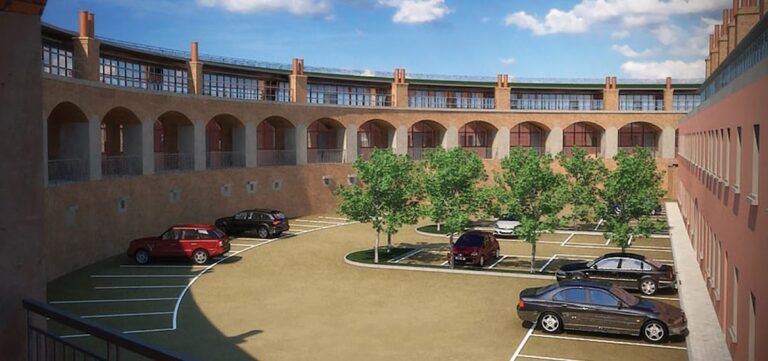
Fort Cumberland survives as a large masonry pentagonal fort enclosing approximately 24 acres, or 97,000 square metres. Its defensive layout includes five bastions and a ravelin on the western side. A ravelin is a detached, usually triangular work placed before a fortified wall or gate. The fort’s later masonry plan was constructed on a different alignment from the earlier earthwork fort, and the original guardhouse and storeroom form part of the surviving design.
Defensive works
Bastions and gun positions
The five bastions project from the pentagonal enclosure. Three were modified between 1886 and 1892 to carry 6-inch, or 150-millimetre, BL Mk IV guns on Mark IV hydropneumatic disappearing mountings. BL means breech-loading. The hydraulic and pneumatic mounting mechanisms lowered each gun after firing, reducing its exposure to enemy fire. Magazines were constructed beneath the altered bastions to serve the new armament.
Ravelin and earlier defences
The western ravelin formed a detached element of the masonry defences. The first fort had used a different earthwork arrangement, including a glacis, banquette, covered way, dry ditch, berm, rampart, parapet, and terre-plein. These terms describe, respectively, a sloping outer bank, a raised firing step, a protected passage, a level strip between defensive slopes, the main defensive bank, its upper wall, and the level space behind the rampart used for guns or movement.
Buildings and later reuse
Guardhouse, hospital, and officers’ quarters
The guardhouse and storeroom from the first fort were incorporated into the later masonry structure. Around the fort, the Guard House, Hospital, and Officers’ Quarters survive as separately listed buildings, forming part of the wider military complex.
Casemates and magazines
The fort contains protected vaulted casemates and magazines associated with its artillery use. The casemates now occupied by The Portsmouth Distillery Co. retain a later civilian use within the fort’s military spaces, while the magazines beneath the modified bastions reflect the late nineteenth-century reorganisation of its gun defences.