Fort Blockhouse: A Coastal Defence and Submarine Base in Gosport


Site at a Glance
- Rating
- 3.9
- Popularity
- Low
- Country
- United Kingdom
- Primary era
- Early Modern
- External website
- Open
- Eras represented
- Early Modern, Modern
- Civilizations
- British
- Site type
- Military
- Remains
- Fort
On this page18 sections
History
Fort Blockhouse is a coastal fortification in Gosport, United Kingdom, guarding the Gosport side of the entrance to Portsmouth Harbour. Its history began in 1431, when a timber blockhouse was built under the authority of Henry VI after funds had been set aside to protect the harbour following the burning of Portsmouth during the Hundred Years’ War. The site developed from a late-medieval harbour defence into a major Royal Navy submarine establishment and remains an important record of changing military technology.
From timber blockhouse to Tudor defences
The first defence formed part of a system controlling access to the harbour. A chain ran from Blockhouse Point to a similar tower at Portsmouth and could be raised to obstruct hostile ships. The timber structure was later rebuilt and strengthened. By 1542, the antiquary John Leland described it as a round stone tower armed with artillery.
A separate bulwark was built south-west of the blockhouse around 1539 by Thomas Spert, a Tudor naval administrator and shipbuilder. It later became known as Lymden’s Bulwark. Haselworth Castle was constructed farther south in 1545–46, but was abandoned about eleven years later. By the end of the sixteenth century these defences had fallen into disrepair, and only a mound marked the former bulwark.
Seventeenth- and eighteenth-century reconstruction
A proposal made in 1627 to move Portsmouth’s dockyard to Gosport was not carried out, although warehouses for the planned docks were erected on the site. During the Siege of Portsmouth in 1642, part of the English Civil War, Fort Blockhouse was used to fire on Portsmouth while the town was held by Royalist forces.
During the Second Dutch War, Charles II commissioned Sir Bernard de Gomme to improve the defences of Portsmouth in 1665. De Gomme built a new battery at Gosport Point in 1667 and developed a wider defensive system that included a matching battery beside Portsmouth’s Round Tower, Charles Fort at Gosport, James Fort on Burrow Island, and a bastioned line around Gosport. A bastioned fort uses projecting angular works so defenders can cover its walls with flanking fire.
An inspection early in the eighteenth century found the defences in poor condition. Between 1708 and 1714, the battery was entirely rebuilt as a bastioned fort. These works form the oldest surviving parts of the present fort. The Gosport defences were extended in 1757 to enclose the Weevil brewery, an important source of beer for the navy. Further works followed in 1778, including Fort Monckton on the former site of Haselworth Castle.
Fears of a French invasion led to extensive rebuilding from 1797 to 1803. A continuous line of bastions was created from Blockhouse Point to Forton Lake, with French prisoners of war among those employed in the construction. The expanded system made Charles Fort and James Fort redundant, and both fell into ruin during the early nineteenth century.
Nineteenth-century adaptation
Fort Blockhouse was remodelled from 1813, with major work carried out between 1817 and 1820. The sea battery was rebuilt in the 1840s. In 1859, the Royal Commission on the Defence of the United Kingdom judged the Gosport fortifications obsolete. The fort’s armament was not substantially modernised, and it still mounted 32-pounder smooth-bore guns in 1867.
From the 1870s, the Royal Engineers used the site to deploy remote-controlled submarine mines intended to defend the harbour. The School of Submarine Miners was established there in 1884, and a Portsmouth militia submarine-mining unit arrived in 1892, remaining until 1907. A narrow-gauge railway connected the fort with Fort Monckton and experimental facilities at Stokes Bay.
The submarine-mining establishment continued to add piers, boathouses, cable sheds, storage buildings, testing rooms, and a slipway. A defensive boom, a floating barrier used to control movement through a harbour entrance, was installed in 1893–94. These developments shifted the site’s importance from traditional artillery defence toward specialised harbour protection.
HMS Dolphin and the submarine service
In 1905, Fort Blockhouse was transferred to the Royal Navy as a Submarine Boat Station. Five Holland-class submarines and the depot ship HMS Hazard were based there, and the station became the principal training centre for naval submariners. From August 1912, the establishment was known as HMS Dolphin. The Commodore Submarine Service was based there for the following 65 years.
During the First World War, HMS Dolphin served as the navy’s principal submarine depot. Periscope training introduced there in 1917 later developed into the Submarine Command Course, informally known as the “Perisher”. The establishment expanded greatly between the world wars, extending beyond the original fort with administrative, residential, training, and command buildings. It remained associated with Britain’s submarine service throughout the Second World War and the postwar period.
The loss of HMS Truculent in 1950 prompted the construction of the Submarine Escape Training Tower in 1953. It opened in 1954 and was designed to train submariners to escape from disabled submerged vessels. The fort’s battery was disarmed in 1956, after the United Kingdom abolished its Coastal Artillery service, but HMS Dolphin continued to grow during the 1950s, 1960s, and 1970s to support submarine training and the Royal Navy’s nuclear-deterrent responsibilities.
The Royal Navy Submarine Museum was established outside the entrance to HMS Dolphin in 1980. The Submarine School later introduced computer simulators and facilities for training crews of Vanguard-class ballistic-missile submarines. The end of the Cold War reduced defence requirements. The last submarine left in 1994, HMS Dolphin was declared surplus in 1996, and it was formally decommissioned in 1998. The Royal Navy Submarine School remained until 23 December 1999, when it moved to HMS Raleigh in Cornwall. Escape training continued at Fort Blockhouse until January 2020.
Other military uses and later estate history
A coastal motor-boat base was established beside Fort Blockhouse on Haslar Creek during the First World War. It closed in 1918, reopened in 1921, and became HMS Hornet in 1926. Recommissioned as a Coastal Forces base during the Second World War, it had forty-eight motor torpedo boats stationed there by 1943. HMS Hornet closed in 1957, and the area subsequently became known as Dolphin 2.
The former HMS Hornet site became a sailing club for serving and former Royal Navy personnel in 1964. A joint-services adventure sailing training centre was established beside it in 1972. These uses continued after the submarine base closed. In 2022, command of the Joint Services Adventurous Sail Training Centre passed from the Royal Navy to the Army.
Military medical organisations also moved to Fort Blockhouse in the mid-1990s. In 1996, 33 Field Hospital relocated there as a 200-bed rapid-deployment hospital. It served in Kosovo, Iraq, Afghanistan, and South Sudan before being disbanded on 1 December 2018. The Defence Medical Training Organisation was established at the fort in 1996, and the Royal Defence Medical College moved there from Millbank in 1996–97. The college trained military medical officers, nurses, and most medical technicians before relocating to Birmingham in 2002. A successor training organisation retained a small facility until 2008.
Fort Blockhouse was the Royal Navy’s principal saluting station in Portsmouth until 2017. The practice extended back at least to 1773, when King George III received 21-gun salutes from Fort Blockhouse, the saluting platform, and Southsea Castle. In 1683, a gunner was killed when a gun burst during a salute to Charles II. Since 2008, the National Coastwatch Institution has maintained a daily lookout from the signal tower. In the early 2020s, the Ministry of Defence still owned three parcels of the Haslar Peninsula estate, including the fort, the former HMS Hornet site, and land formerly belonging to Haslar Gunboat Yard. Proposed disposal of the main fort estate, announced in 2016, was postponed to at least 2025.
Remains
Fortifications and artillery works
Early harbour defences
Fort Blockhouse occupies Blockhouse Point on the Gosport side of Portsmouth Harbour, with water on three sides and a position overlooking the harbour entrance. The original timber blockhouse of 1431 was later replaced by a strengthened round stone tower carrying artillery. Its associated chain defence crossed the entrance to a similar tower at Portsmouth. Lymden’s Bulwark stood south-west of the blockhouse, while Haselworth Castle occupied ground farther south before Fort Monckton was later built there.
Seventeenth-century battery
The 1667 battery at Gosport Point had an L-shaped plan. Eighteen guns faced south-east toward the seaward approach, while two faced south-west toward the narrow landward approach. A matching eighteen-gun battery was built beside Portsmouth’s Round Tower. The surviving fortification therefore formed part of a coordinated defence covering both sides of the harbour entrance.
Bastioned fort
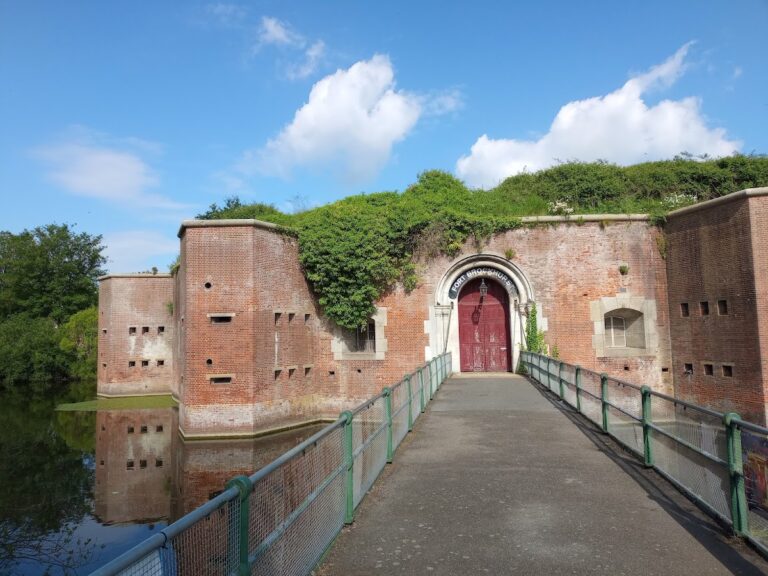
The fort rebuilt between 1708 and 1714 retained a bastioned plan. An open seaward battery occupied the south-east side, while substantial earthworks defended the south-west. The south-west entrance had a tall gatehouse flanked by two demi-bastions, or half-bastions. The gatehouse was demolished in the 1960s, but its keystone remains on site with the arms of the Board of Ordnance and the inscription “Anno 1708.”
A moat protected the south-west and south-east sides. The south-west moat was crossed by a bridge guarded by a stone redan, a projecting angular fieldwork, and angled outer earthworks. Wooden palisades enclosed the northern side and formed a bastion at the northernmost point. The fort carried twenty-one 18-pounder guns and three 6-pounder guns in the 1750s. By 1805, its armament comprised fifteen 36-pounder and fifteen 18-pounder guns.
Nineteenth-century batteries
The west demi-bastion was extended northward in 1817–20. The sea battery was then rebuilt with thirteen covered casemates, enclosed or vaulted gun positions, for 32-pounder guns. In 1845–48, its upper section was strengthened and widened so that thirteen additional guns could be mounted on the terreplein, the level surface above the fort’s main works, firing over the parapet.
This rebuilding created a rounded north bastion of red brick faced with limestone. Its upper and lower batteries covered the harbour. Long brick casemated buildings connected it with the west bastion and sea battery. One provided officers’ accommodation, while the other housed other ranks. As the traditional artillery role declined, the armament was reduced to ten rifled muzzle-loading 64-pounder guns in 1885 and three in 1888. Three machine guns defended the associated minefield, and five 12-pounder quick-firing guns were later installed against fast torpedo boats.
Submarine-mining and naval installations
Mining establishment
The Royal Engineers added a short pier north of the fort, together with boathouses, cable sheds, a slipway, stores, administrative buildings, and a light railway for moving mines and explosives. The pier was extended in 1888, and further storage and testing rooms were added through 1891. The boathouses and cable sheds remained in place in 2024. The narrow-gauge railway linking Fort Blockhouse with Fort Monckton and Stokes Bay survived into the early twentieth century.
Naval station
After the Royal Navy takeover in 1905, a pier was built along the north-west edge of the headland by 1909, creating an enclosed water pool. A separate petrol pier stood farther west for refuelling. HMS Hazard served as the depot ship, and a hulk named HMS Dolphin provided additional accommodation. In 1912, the name HMS Dolphin was extended to the entire establishment.
Between the world wars, buildings filled the fort’s open courtyard. Upper floors were added to the casemated accommodation blocks, and the officers’ block was enlarged to form a new officers’ mess. The moat west of the main gatehouse was infilled and the earthworks levelled in the 1920s. Vulcan Block, a seamen’s accommodation building, was erected there in 1933 with a new guardhouse and other structures. A Warrant Officers’ block was built beside the north bastion, and a headquarters for the Rear Admiral was constructed north-west of the fort in 1937–38.
Training buildings and surviving equipment
Escape and submarine training
The Submarine Escape Training Tower was built in 1953. Its surrounding training area was rebuilt in the mid-1960s, replacing wooden huts with teaching blocks equipped for practice with torpedo tubes, sonar, fire-control systems, missile-launch systems, and navigation systems. Further accommodation and training buildings followed during the 1970s and 1980s. Mackenzie Block became a major Submarine School facility, and a later upper floor provided weapons and systems training for Vanguard-class submarines. Large accommodation blocks were also built west of the fort beside the recreation ground, facing the Solent.
Ceremonial guns
Four QF 3-pounder Hotchkiss guns were mounted in the southern casemates for ceremonial salutes. The earliest dates from 1886. They were identified as the oldest firing guns in the Royal Navy and remained in ceremonial use until 2017.
Fort Blockhouse is described as complete and preserves successive layers of construction and adaptation over approximately five centuries. The surviving complex brings together the medieval blockhouse, later bastioned fortifications, submarine-mining works, naval-base buildings, and twentieth-century training facilities.