St Helens Fort: A Palmerston Sea Fort in the Solent


Site at a Glance
- Rating
- 4.9
- Popularity
- Very Low
- Country
- United Kingdom
- Primary era
- Modern
- External website
- Open
- Eras represented
- Modern
- Civilizations
- British
- Site type
- Military
- Remains
- Fort
On this page9 sections
History
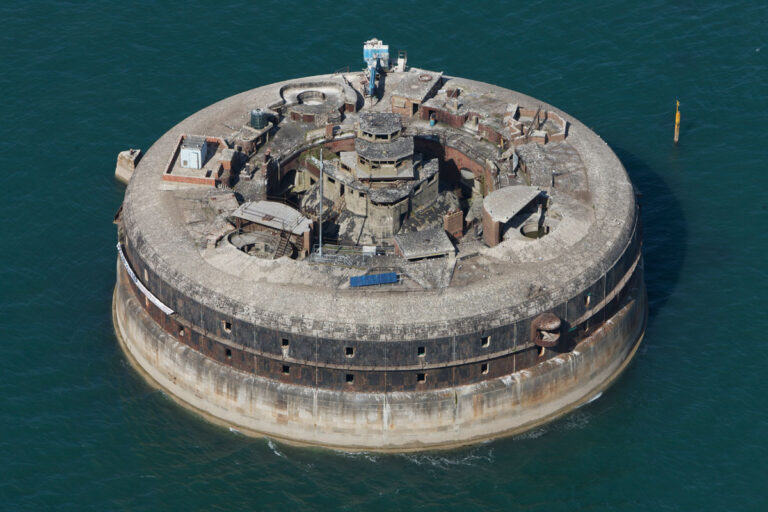
St Helens Fort is a British sea fort in the Solent near the Isle of Wight, United Kingdom. Built as part of the nineteenth-century Palmerston Forts, it was constructed to protect the St Helens anchorage under the major coastal-defence programme that followed the Royal Commission on the Defence of the United Kingdom of 1859.
Construction and defensive planning
The Royal Commission had assessed Britain’s coastal and military defences and led to a wide programme of new fortifications. At St Helens, Captain E. H. Stewart designed the fort under the supervision of Colonel W. F. D. Jervois, Assistant Inspector General of Fortifications. Construction began in 1865 and was completed in 1878, at a cost of £123,311.
The fort formed part of a wider Solent defensive system developed amid fears of a French invasion under Louis Napoleon III, emperor of France from 1852 to 1870. Concern was strengthened by the launch of the ironclad warship Gloire and by the Jeune École, a French naval doctrine that favoured torpedo craft and attacks on commerce and ports rather than relying mainly on battleships in conventional fleet actions.
Severe subsidence during construction forced substantial changes to the planned design. The completed armament was therefore reduced to two 10-inch, 18-ton rifled muzzle-loading guns directed towards the land and one 12.5-inch, 38-ton rifled muzzle-loading gun facing the sea. Rifled muzzle-loading guns were heavy artillery pieces loaded through the barrel, with internal rifling intended to improve the accuracy of their projectiles.
Changing military use
The perceived threat from France declined after French defeat in the Franco-Prussian War of 1870 to 1871. St Helens Fort nevertheless remained part of Britain’s defensive preparations and was used for defence during both the First and Second World Wars. In the Second World War, its military role included service as a searchlight and anti-aircraft-gun platform.
The heavy guns also affected the fort’s relationship with nearby residents. Concussion from firing practice broke windows, making the armament unpopular with local householders. As the fort’s defensive function declined, its principal useful role became that of a navigational lighthouse.
Later status
St Helens Fort was designated a scheduled monument in 1967 and listed at Grade II in 1972. It is privately owned, and its recorded condition is complete. The fort was offered for sale in 2003.
Remains
Sea fort and armament
Fort structure
St Helens Fort stands in the Solent as a sea fort positioned to command the St Helens anchorage. Subsidence during construction altered its planned form, and the surviving arrangement reflects those changes. Its principal recorded armament consisted of two 10-inch, 18-ton rifled muzzle-loading guns facing landward and a larger 12.5-inch, 38-ton gun facing seaward.
Water supply
An artesian well provides the fort with its own water supply. This was an important self-contained service for a structure built offshore and separated from the nearby shore by the waters of the Solent.
Shore connections
A causeway between St Helens beach and the fort becomes visible at exceptionally low tides. Building materials were originally transported along this route from the shore near St Helen’s Old Church, where a quarry formerly operated. The fort can also be reached along the spit from Bembridge. It remains privately owned and is not open to the public.