Holzen Abbey: A Former Benedictine Nuns’ Abbey in Bavaria
Site at a Glance
- Rating
- 4.8
- Popularity
- Very Low
- Country
- Germany
- Primary era
- Early Modern
- Eras represented
- Early Modern
- Civilizations
- Electorate of Bavaria, Holy Roman Empire
- Site type
- Religious
- Remains
- Monastery
On this page11 sections
History
Holzen Abbey is a former Benedictine nuns’ abbey in Germany, located in Allmannshofen, Bavaria, and traditionally founded in 1150. Marquard von Donnersberg, a medieval nobleman, is credited with establishing it as a double monastery, an institution with separate communities of monks and nuns, below the present site near the Neuwasser, a branch of the Schmutter. After a partial relocation, the monastery was known as “zum Holz” from the beginning of the thirteenth century.
Medieval development and reform
After a fire destroyed Salmannshofen Abbey in 1401, that monastery’s possessions and parish were incorporated into Holzen. The women’s convent expanded during the fifteenth century, while the male community was dissolved in 1470 as the Melk Reform introduced stricter Benedictine discipline.
The convent continued to acquire land during the fifteenth and sixteenth centuries. Its holdings included the villages of Allmannshofen, Druisheim, Heretsried, and Osterbuch, and before secularization they had expanded to include Ortlfingen, Blankenburg, and Feigenhofen. Holzen had held abbey status since 1617.
War, rebuilding, and pilgrimage
Maria Langenmantel vom Sparren served as abbess, also called a “Meisterin,” from 1538 to 1553. The monastery suffered severe damage during the Peasants’ War and the Schmalkaldic War, the 1546–1547 conflict between the Protestant Schmalkaldic League and Emperor Charles V. Swedish forces invaded in 1632, and the nuns abandoned the monastery until their return in 1647.
Reconstruction of the monastery and church began in 1556 under Abbess Barbara von Welden. A later rebuilding on the Karlsberg took place between 1696 and 1704, and the new church was consecrated in 1710. A pilgrimage devoted to the Christ Child developed at Holzen from 1740.
Secularization and the Treuberg estate
Holzen Abbey was dissolved in 1802 during secularization, the suppression of church institutions and transfer of their property to secular owners. Its property, together with that of the Beuron Augustinian canons’ monastery, passed to the Princes of Hohenzollern-Sigmaringen, although the nuns were allowed to remain. In 1813 the former monastery complex passed by marriage to Franz Xaver Fischler, Baron von Treuberg.
Holzen later became associated with the cultural and political circles surrounding the Treuberg estate. From July to October 1877, the realist painter Wilhelm Leibl lived there, and the estate became a meeting place for Munich painters associated with him. During his stay, Leibl painted Rosine Edle von Poschinger and Count Treuberg. Rosine was married to Ferdinand Fischler von Treuberg, whose son Ernst Ludwig married Hetta Countess Treuberg in 1904. Hetta, later known as a Berlin pacifist, stayed frequently at Holzen until the couple divorced in 1914.
Ferdinand Fischler von Treuberg was a nephew of Pedro II, emperor of Brazil, who visited Holzen several times. Carlo Caputo, the Apostolic Nuncio to the King of Bavaria and the pope’s diplomatic representative to the Bavarian state, was also a frequent guest. The counts’ hunts attracted diplomats, military officers, and politicians, including the son of Bavarian prime minister Clemens von Podewils-Dürnitz.
Twentieth-century use
Financial difficulties eventually affected the Treuberg family. In 1927, the St. Joseph Congregation of Ursberg acquired the buildings through an intermediary and established a facility for people with disabilities. Twenty-five residents were murdered there during the Nazi period.
Since 1996, the Dominikus-Ringeisen-Werk, an independent ecclesiastical foundation under public law, has operated the facility. The former monastery now provides residential and work opportunities for people with disabilities. Its wider modern use includes a hotel and conference center, accommodation for pilgrims, and a daycare center for elderly people. A traditional annual Johannimarkt is held at the abbey on the feast of St. John.
Remains
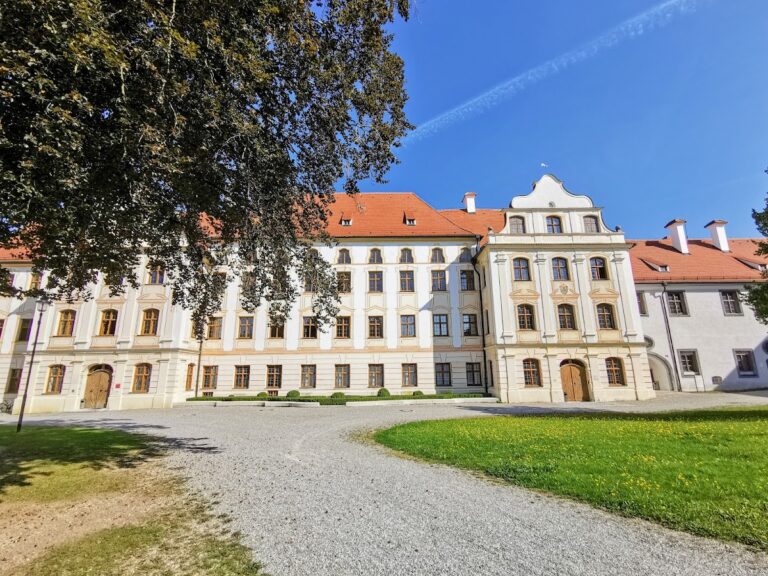
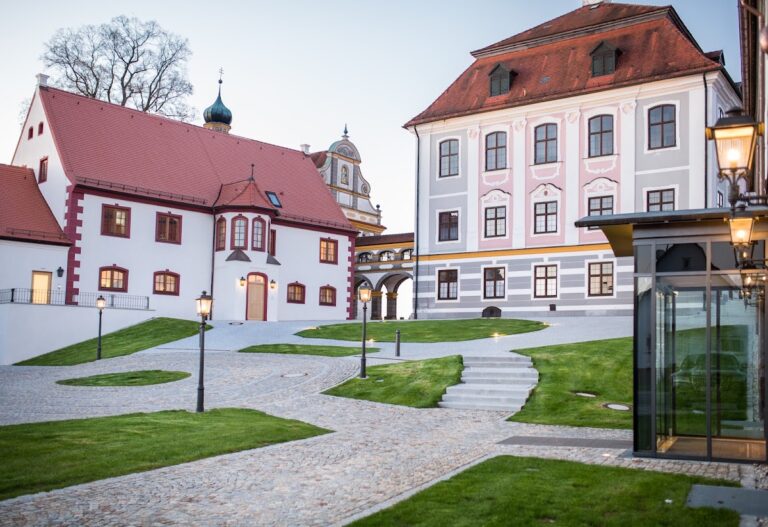
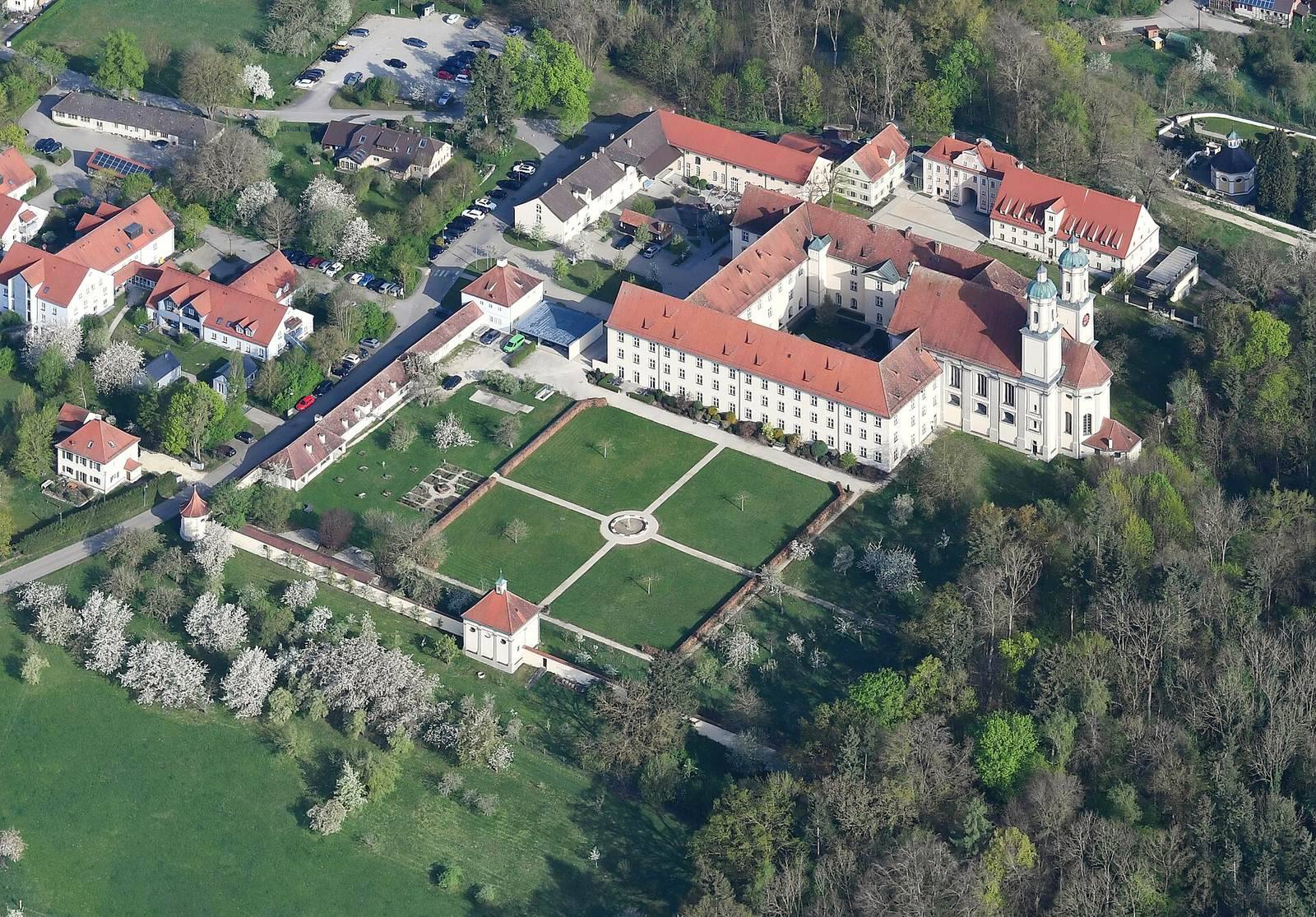
The surviving complex stands on the Karlsberg west of the B2 near Nordendorf, above the Schmutter. Its earlier foundation lay below the present site near the Neuwasser, while the later monastery was constructed on the hill. The buildings combine the former monastic complex with facilities adapted for residential, occupational, hospitality, and pilgrimage uses.
Church and monastery buildings
Church of St. John the Baptist
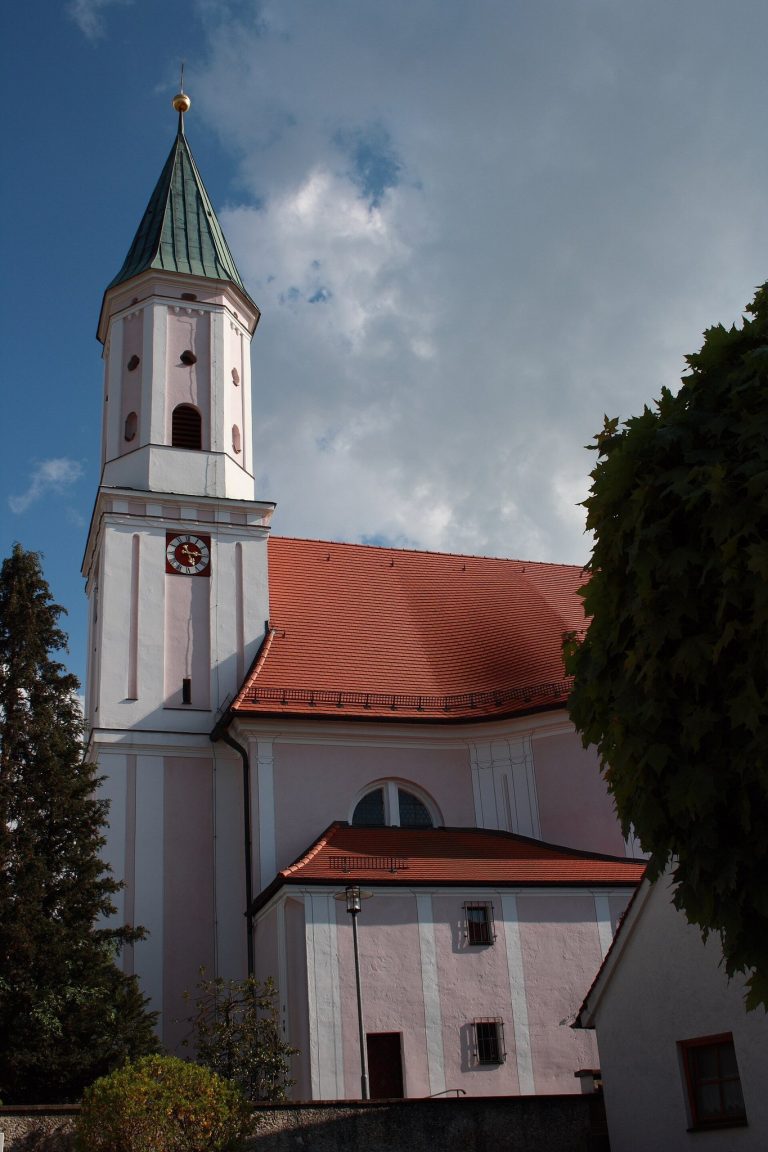
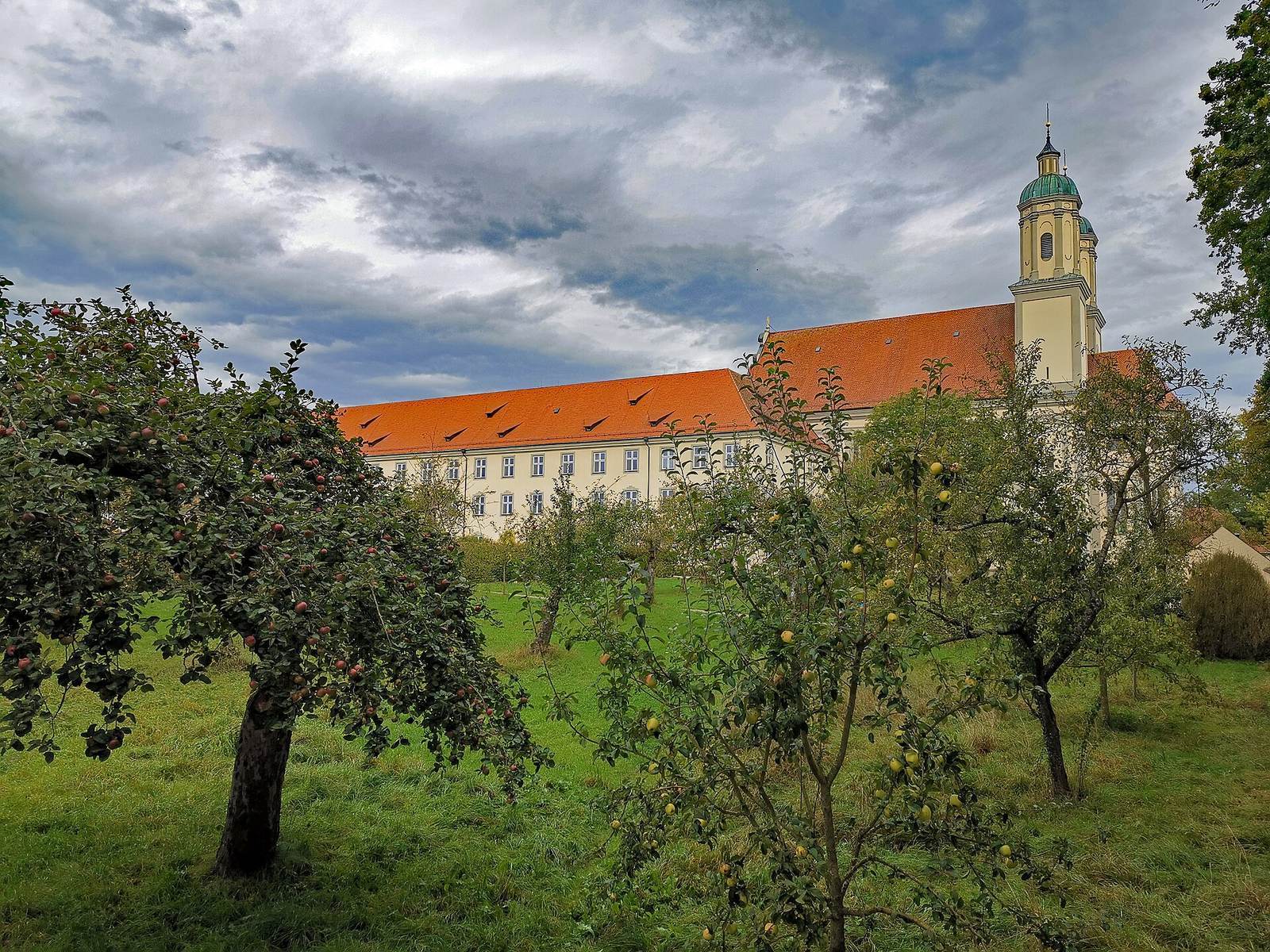
The Church of St. John the Baptist was built in 1704 and consecrated in 1710. Its interior is richly furnished in the Baroque style, a European artistic tradition characterized by elaborate ornament and theatrical effects. Benedikt Vogel created the stucco decoration, while Ehrgott Bernhard Bendl produced the sculptures.
Former monastery complex
The western part of the former monastery is occupied by a conference hotel. Other parts of the complex contain pilgrim accommodation and facilities connected with residential and occupational care for people with disabilities.
Former estate lands
Gut Schwaighof
The former Holzen estate included nearby Gut Schwaighof. Beyond the abbey complex, the property continues as a Trakehner stud farm and park. The park was designed by Harry Maasz, a German garden architect known for landscape and garden design.