Holy Cross Church: A Romanesque Church in Munich
Site at a Glance
- Rating
- 4.6
- Popularity
- Very Low
- Country
- Germany
- Primary era
- Medieval
- External website
- Open
- Eras represented
- Medieval, Early Modern
- Civilizations
- Holy Roman Empire
- Site type
- Religious
- Remains
- Fortified Church
On this page6 sections
History
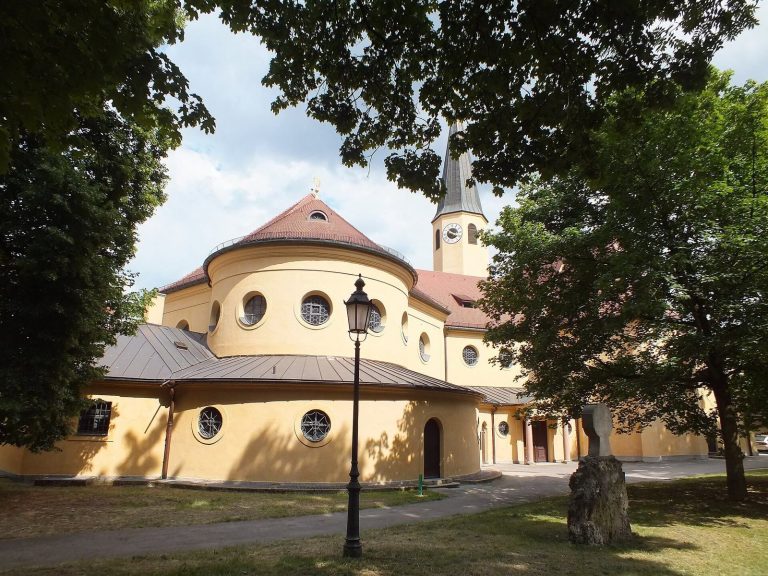
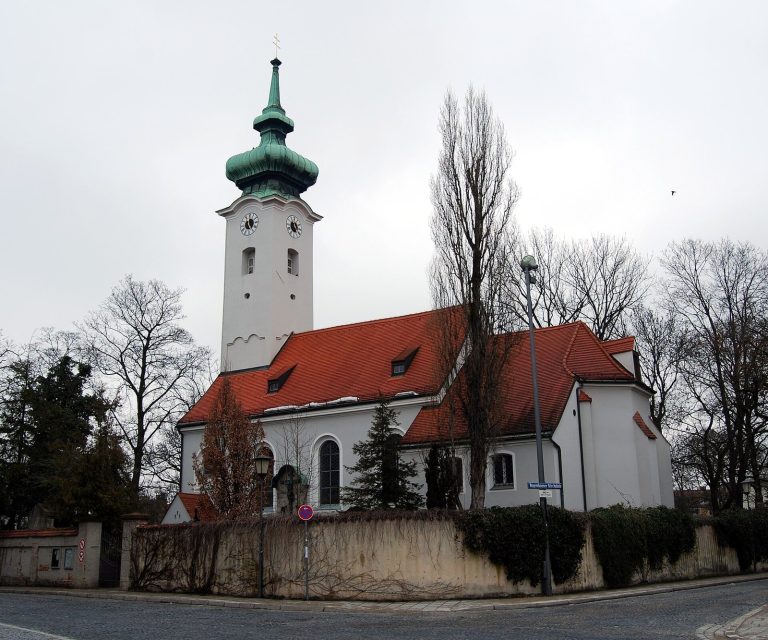
Holy Cross Church is a Roman Catholic filial church in Fröttmaning, Munich, Germany, built for the most part in the early thirteenth century in the late Romanesque period. A filial church serves as a subsidiary place of worship rather than as the principal church of its parish. Under the Archdiocese of Munich and Freising, it preserves the history of a village that has belonged to Munich since 1931 and is now effectively abandoned. Since the demolition of Jakob Church in 1955, Holy Cross has been described as Munich’s oldest completely preserved church building and remains an especially important surviving example of Romanesque architecture in the city.
Early foundation and medieval rebuilding
Fröttmaning was officially documented by 815, although the church’s history began earlier. In that year, the Fröttmaning nobleman Situli donated a wooden church and its associated farmland to the Bishopric of Freising, the medieval ecclesiastical jurisdiction of the area. Bishop Hitto of Freising then consecrated the church. The deed recording this donation is the oldest document in the Bavarian State Archives.
The present church was erected for the most part at the beginning of the thirteenth century and later extended. Its form belongs to the chancel-tower tradition associated with the medieval Bishopric of Freising. In this design, the tower rises directly above the chancel, the area around the main altar.
Isolation and civic protection
In the 1930s, Holy Cross became a filial church of St Albert in Munich-Freimann. The building was threatened with demolition several times. During construction of the Munich ring motorway, citizens led by Ludwig Maile, the churchwarden of St Albert, secured the relocation of the planned Munich-North interchange. Without that change, the route toward Salzburg would have crossed the cemetery and church.
The last farmsteads were demolished for motorway construction in 1969, leaving Holy Cross isolated. By 1971, the church had deteriorated, been looted, and been desecrated. Valuable artworks and its two fifteenth-century bells were lost. In 1984, citizen protests stopped a plan to extend the Fröttmaning landfill mound, an artificial hill formed from deposited waste, up to the church wall. The same civic initiative later helped secure consideration of the church as a protected historic building during planning for the nearby Allianz Arena, built between 2002 and 2005. The arena’s emergency road and bridge were consequently moved 200 metres south.
Romanesque wall paintings were discovered and partly exposed during renovation work in 1981. Holy Cross has also been identified as an architectural heritage monument. In connection with the Allianz Arena, Munich’s Commission for Art in Architecture and Public Space organized an international competition that included the landfill mound. On 29 June 2004, the commission unanimously recommended German conceptual artist Timm Ulrichs’s proposal, Sunken Village, for realization. Completed in 2006, the work commemorates the disappearance of Fröttmaning and the cultural losses associated with destructive forms of modern civilization.
Remains
The Romanesque church
Holy Cross is a compact late Romanesque chancel-tower church measuring 15 metres in length and nearly 7 metres in width. Its tower rises 18 metres above the choir and has round-arched windows and a frieze. Inside, the masonry preserves traces of a former battlement walkway with loopholes. These remains can be seen where the masonry begins and on the inner wall.
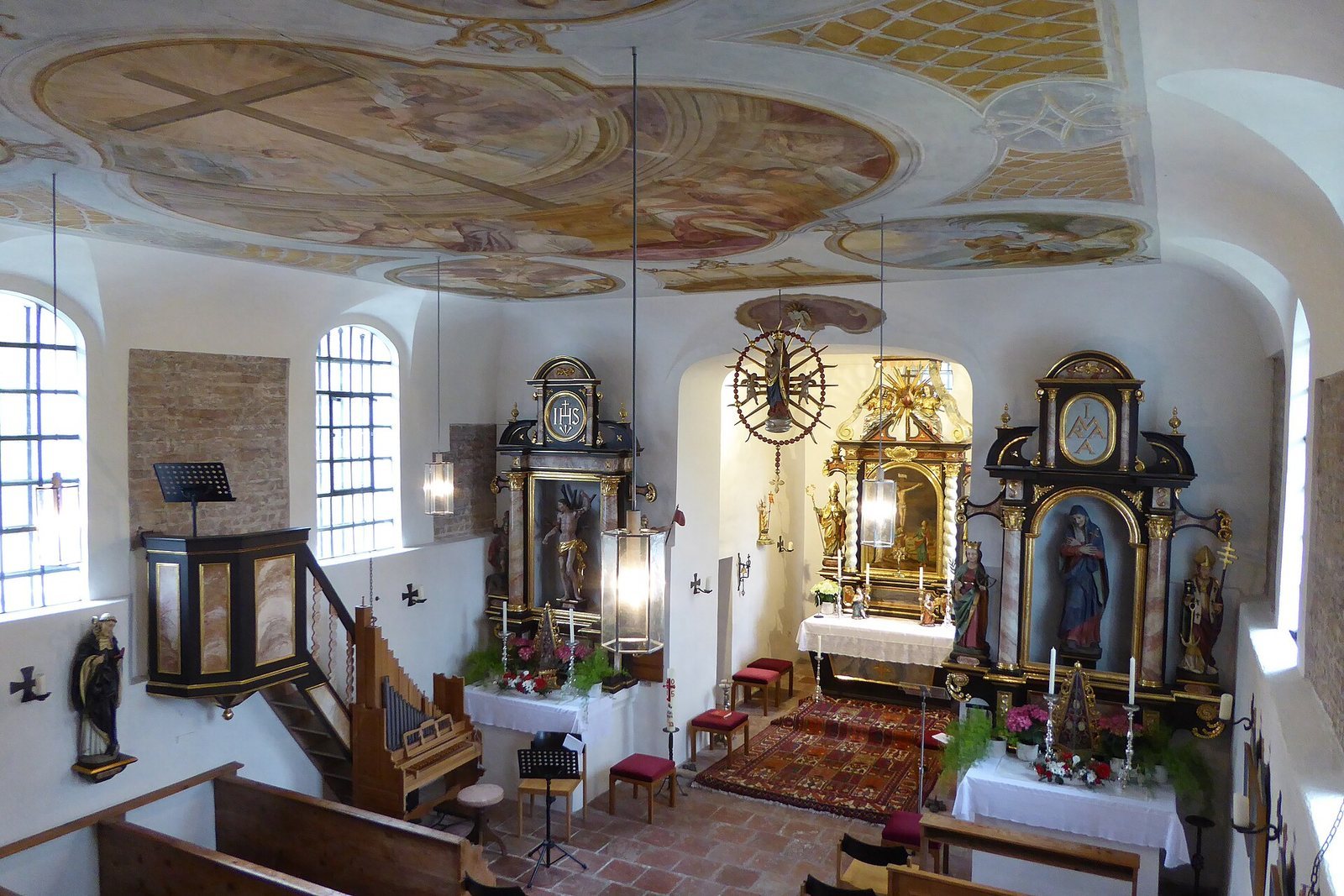
Rare Romanesque frescoes were painted directly onto the interior’s red bricks with lime paint. Among them are painted circles surrounding a tree of life, a design that symbolizes the sun. One wall painting is described as the oldest depiction of Christ in Bavaria. Most of the surviving furnishings are Baroque. A ceiling fresco painted around 1740 by pupils of the Bavarian artists Cosmas Damian Asam and Egid Quirin Asam shows the veneration of the Holy Cross. Its subject refers to the tradition that Byzantine Emperor Heraclius brought the cross back from Jerusalem in 629.
Sunken Village
Approximately 150 metres south of the historic church stands the inaccessible artwork Sunken Village. It is a life-size double of the Romanesque building, made from plastered cast-in-place concrete with a prefabricated roof. The structure was sunk into the landscaped Fröttmaning landfill mound, leaving only parts of its tower and nave visible.
The title echoes Friedrich Rückert’s poem of the same name from 1813. By duplicating and partly burying the form of Holy Cross, Ulrichs’s work sets the surviving historic building against a symbolic image of its disappearance beneath the landfill mound.