St. Georg (Bogenhausen): Former Village and Parish Church in Munich
Site at a Glance
- Rating
- 4.7
- Popularity
- Very Low
- Country
- Germany
- Primary era
- Early Modern
- External website
- Open
- Eras represented
- Medieval, Early Modern
- Civilizations
- Duchy of Bavaria, Electorate of Bavaria, Holy Roman Empire
- Site type
- Religious
- Remains
- Church
On this page15 sections
History
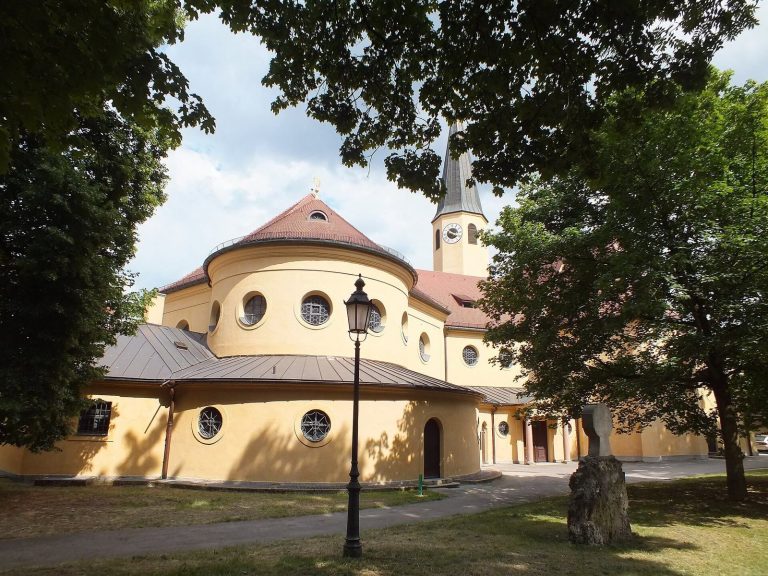
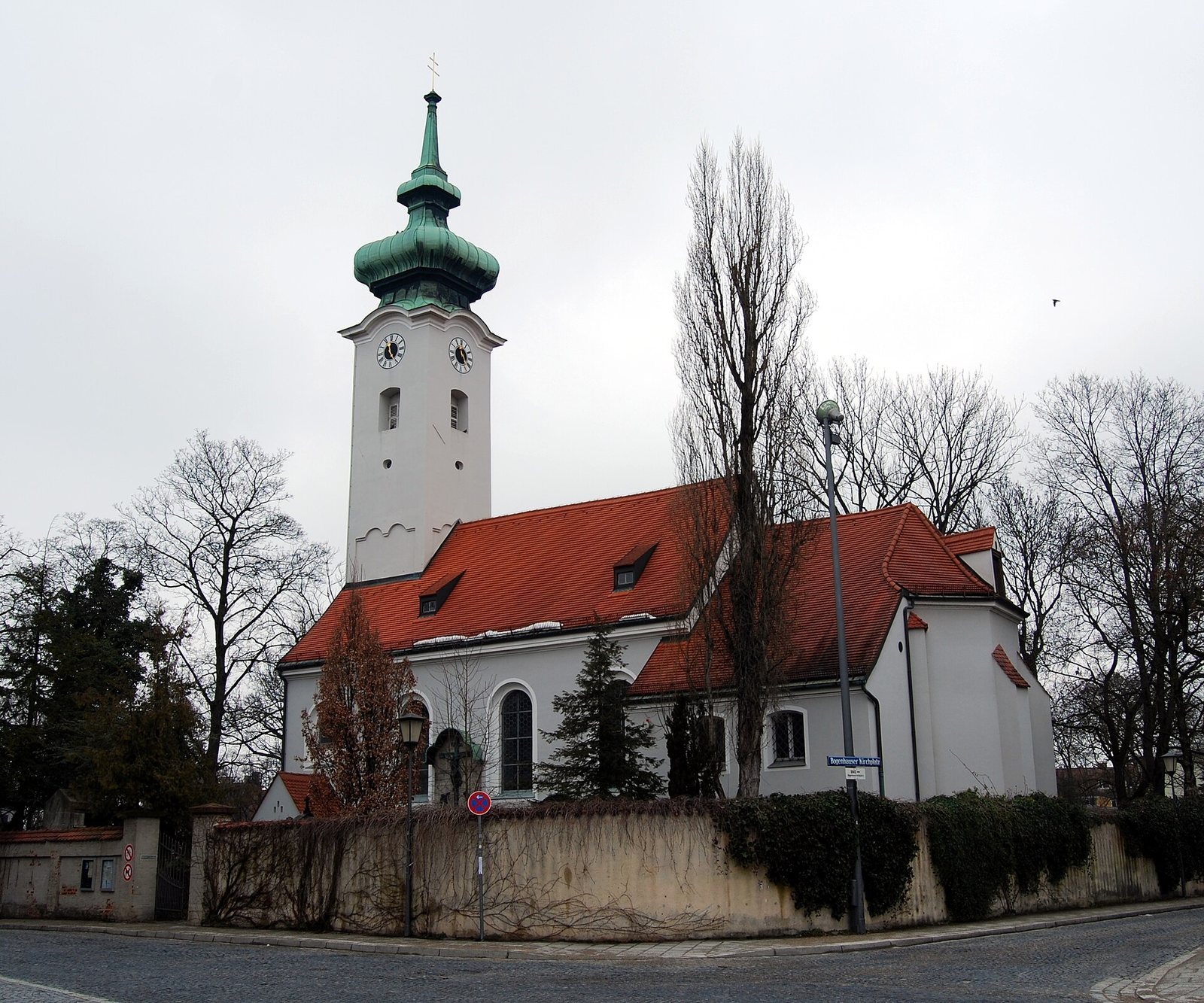
St. Georg (Bogenhausen) is a historic church in Munich, Germany, and the former village church and spiritual center of Bogenhausen. Its surviving medieval fabric and eighteenth-century Rococo transformation reflect the long development of the original parish church for communities on the right bank of the Isar.
Medieval parish origins
The church served as the mother church for the territory between Menterschwaige, Oberföhring, and Haar. In 1357, its parish was incorporated into the Freising bishopric, the historic ecclesiastical jurisdiction centered on Freising in Bavaria. The lowest storey of the tower preserves remains of a late Romanesque predecessor and provides the oldest surviving evidence of a church at Bogenhausen.
Bogenhausen became a district of Munich on 1 January 1892. St. Georg continued to serve as the former village’s spiritual center until the construction and consecration of the Heilig Blut parish church in 1934. That year, the older church lost its status as an independent parish church, partly because it had become too small for Bogenhausen’s growing population, and became a filial church, meaning a church dependent on a principal parish church.
The eighteenth-century rebuilding
In 1759, parish priest Franz Georg Riedl and Count August Joseph von Toerring, the owner of nearby Neuberghausen Castle, initiated the renewal of the nave. They engaged Johann Michael Fischer, an important eighteenth-century Bavarian architect associated with late Baroque and Rococo churches. The conversion into a Rococo building began in 1766, a style known for light forms, curved shapes, rich ornament, and bright interiors.
After Fischer’s death in 1766, Balthasar Trischberger continued the construction. He raised the building and created its vaults. The structural work ended in 1768, while the interior furnishings were completed in 1777. The tower received its characteristic onion-shaped roof, formed by two constricted sections, in 1777.
War, resistance, and later history
St. Georg survived the Second World War almost undamaged. A general restoration that lasted until 2000 returned the interior to Johann Michael Fischer’s original color scheme. The church is protected as a Bavarian architectural monument and is included in the list of architectural heritage monuments in Bogenhausen.
During the 1930s, the Jesuit priest Alfred Delp served as rector. The parish house hosted meetings of the Kreisau Circle, a German resistance group that developed plans for Germany’s political order after the expected end of National Socialist rule. Delp was arrested there after a morning Mass at St. Georg on 28 July 1944. The Nazi regime executed him in 1945.
A memorial to Delp was dedicated near the church on 23 May 1981 by Cardinal Joseph Ratzinger, who became Pope Benedict XVI in 2005. St. Georg is also closely associated with the Bogenhausen Cemetery, where many prominent people are buried. The former Hompesch Schlössl once stood immediately beside the church. In 1973, the Italian film director Michelangelo Antonioni filmed a key scene of The Passenger, also known as Profession: Reporter, inside the church.
Remains
Structure and medieval fabric
Tower and medieval predecessor
St. Georg is a hall church with a recessed west tower. An entrance room adjoins the tower on the south, and a baptistery adjoins it on the north. The lowest tower storey incorporates the remains of a late Romanesque predecessor, making it the oldest surviving part of a church at Bogenhausen. Three bells hang in the tower, whose onion-shaped roof has two constricted sections and dates from 1777.
Late Gothic choir
The earlier choir was probably replaced during the first half of the fifteenth century by a late Gothic choir with a polygonal termination. This choir survives as part of the present building and provides the principal medieval counterpart to the later Rococo nave.
Rococo interior
Vaults and frescoes
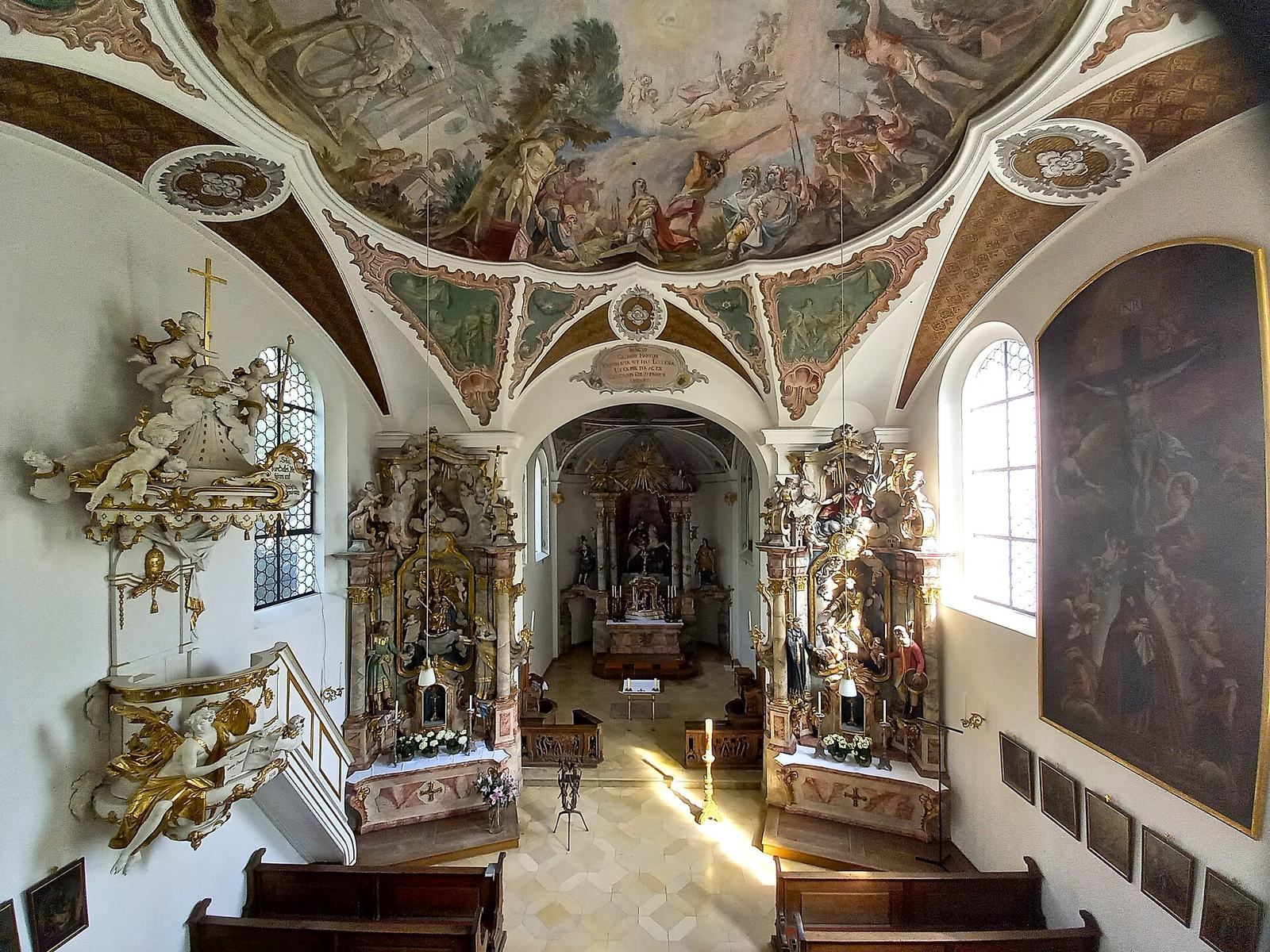
A deep gallery divides the nave into two sections. The front section has a flat dome with lunettes, crescent-shaped vault sections, and pendentives, which are curved triangular transitions supporting a dome-like ceiling. The rear section has a shallow barrel vault, a continuous curved ceiling. Philipp Helterhof painted the vaults. His choir fresco, The Reception of St. George into Heaven, dates from 1767–1768, as does his nave fresco, The Martyrdom of St. George.
Altars and pulpit
The high altar is a Baroque stage-like structure made by Johann Baptist Straub between 1770 and 1773. Its sculptures show St. George as a dragon-slayer, together with figures of St. Donatus and St. Irene. Ignaz Günther made the pulpit and the Korbinian altar during the same period. A separate Maria altar contains an older enthroned Madonna dated 1628, whose maker is unknown.
Organ
G. F. Steinmeyer & Co. built the organ in 1958. It has two manuals, a pedal, twelve stops, and electro-pneumatic pouch chests. Its action uses electrical signals and compressed air to operate the valves controlling the pipes. The instrument has the couplers II/I, I/P, and II/P, along with a crescendo roller, tutti, swell shutter, one free combination, and hand registers.
Associated buildings and memorial
Rectory
The rectory on Neuberghauser Strasse is a Baroque building with a gabled roof. It was already recorded in 1705 and forms part of the historic architectural setting associated with the church.
Alfred Delp memorial
The memorial near the Maximiliananlagen consists of a bronze plaque and a representation of the Three Men in the Fiery Furnace from the Book of Daniel. Created by the Munich artist Klaus Backmund, it refers in its form and separate placement to the Bavarian tradition of the Totenbrett, or death board. The memorial physically connects Delp’s memory with the church and the events surrounding his arrest in 1944.