Höllinghofen Castle: A Moated Estate in Arnsberg, Germany


Site at a Glance
- Rating
- 4.7
- Popularity
- Very Low
- Country
- Germany
- Primary era
- Early Modern
- External website
- Open
- Eras represented
- Early Modern, Modern
- Civilizations
- German, Holy Roman Empire
- Site type
- Domestic
- Remains
- Castle
On this page12 sections
History
Höllinghofen Castle is a moated castle in Germany, in the Voßwinkel district of Arnsberg, whose present main building reflects a major 1865 remodeling in the historicist Romanesque style. Its history reaches back at least to the medieval period, although the date of its earliest mention remains disputed.
Medieval Estate
A charter issued in 1036 by Conrad II, a Holy Roman Emperor who ruled from 1027 to 1039, names a place called Hullikinghouon. Whether this reference concerns Höllinghofen is uncertain. Secure information about the estate begins in the fourteenth century, when it was a forest estate held as a fief of the provosts of the St. Patrokli Collegiate Foundation in Soest. A collegiate foundation was a religious institution in which clergy jointly maintained worship and administration, led by a provost.
In 1371 the estate passed to the von Fürstenberg family. By 1382 it belonged to the knight Honann Freseken of Neheim, who subsequently adopted the name “von Höllinghofen.” Through inheritance, the property returned to the Fürstenbergs in 1414. A Höllinghofen branch of that family retained it until the end of the sixteenth century.
Changing Noble Ownership
During the following centuries, several noble families from outside the region owned Höllinghofen. One was Wilhelm of Bavaria, who from 1615 also used the title Imperial Baron of Höllinghofen. An Imperial Baron held the rank of baron directly under the Holy Roman Empire rather than through an intermediate territorial lord. Wilhelm was an illegitimate descendant of Elector Ernst of Bavaria of the Wittelsbach dynasty and Gertrud von Plettenberg. He later entered the clergy and died in 1657 as Prince-Abbot of Stablo and Malmedy, a prince-abbot being an abbot who also governed an ecclesiastical territory as a sovereign prince.
The Silesian von Kanitz family later held the estate. In 1749 it sold Höllinghofen for 78,500 thalers to its neighbor Friedrich Wilhelm von Droste-Füchten. His heirs had to sell the property again in 1753 for the same price. In 1754 it passed to the barons von Boeselager of Haus Nehlen. The purchase covered the aristocratic residence, the estate, mills, lands, and feudal rights.
Boeselager Family Seat
Under the von Boeselagers, Höllinghofen served as a hunting residence, while the family’s principal seat was Schloss Heessen in Hamm-Heessen. The family originated as a noble house of the Archbishopric of Magdeburg. In 1920, Höllinghofen Castle and its seven-hectare historic park became the family’s principal seat.
The property is now owned by Ildikó Freifrau von Ketteler, born Freiin von Boeselager, who operates the nearby Wildwald Voßwinkel with her husband, Franziskus Freiherr von Ketteler. During the 1960s, the castle and park, like nearby Herdringen Castle, were used as settings for Edgar Wallace films. The park is protected as a historic site, and parts of it also lie within the Im Sundern mixed-deciduous-forest nature reserve, the Im Schee ponds nature reserve, and the Im Schee landscape-area nature reserve.
Remains
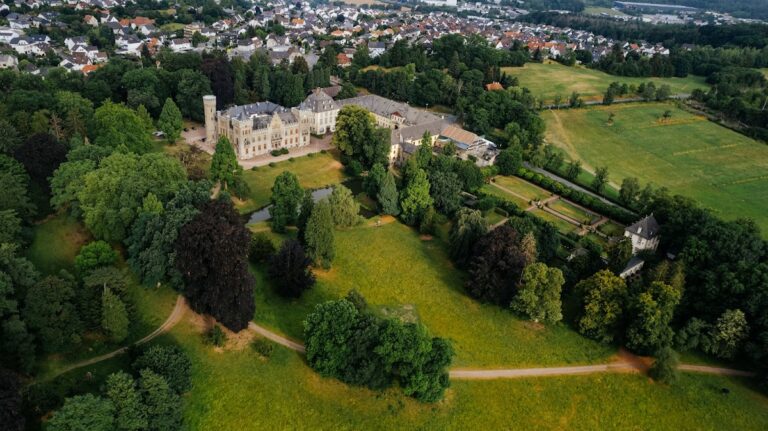
The surviving estate combines a three-winged main residence with an English-style park, a family burial chapel, and several historic ancillary buildings. The present arrangement reflects rebuilding after an eighteenth-century fire, nineteenth-century remodeling, and changes made during the twentieth century.
Main Residence
A plan from the second half of the eighteenth century shows the manor house as a rectangular building without wings. Fire destroyed it completely in 1765. The house was rebuilt on older foundations dating from the sixteenth century, and the two side wings may also have been added during this rebuilding.
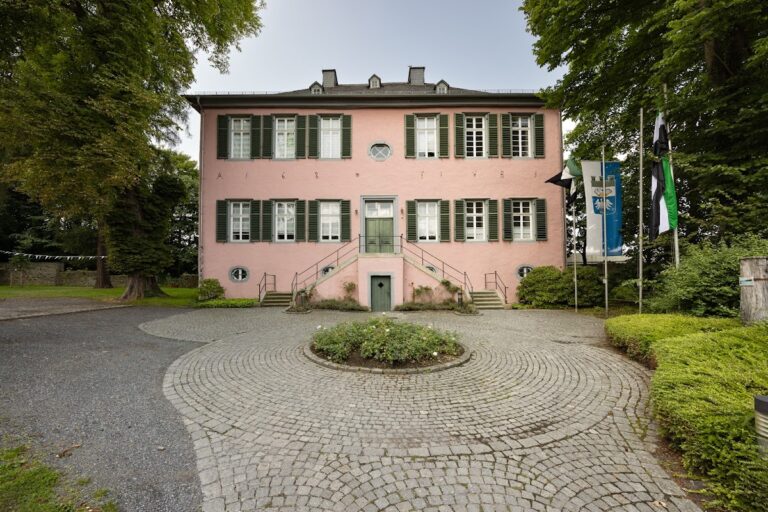
The main building was extensively remodeled in 1865 in the historicist Romanesque style, which revived and reinterpreted Romanesque forms in nineteenth-century architecture. Further additions and alterations followed in 1924. The building now has three wings of unequal size and is partly covered with ivy.
Park and Burial Chapel
English-Style Castle Park
The estate includes an English-style castle park incorporating older elements. Its present form dates mainly from the 1920s and 1930s, when the grounds acquired much of their current character.
St. Benedict Burial Chapel
St. Benedict Burial Chapel stands within the extensive rhododendron park. Completed in October 1923, it serves as the family crypt. Csilla Freifrau von Boeselager, who died in 1994 and founded the Hungarian Maltese Service, is buried there.
Other Estate Buildings
New House
The so-called New House is an eighteenth-century building and forms part of the protected historic estate.
Rentei and Outbuildings
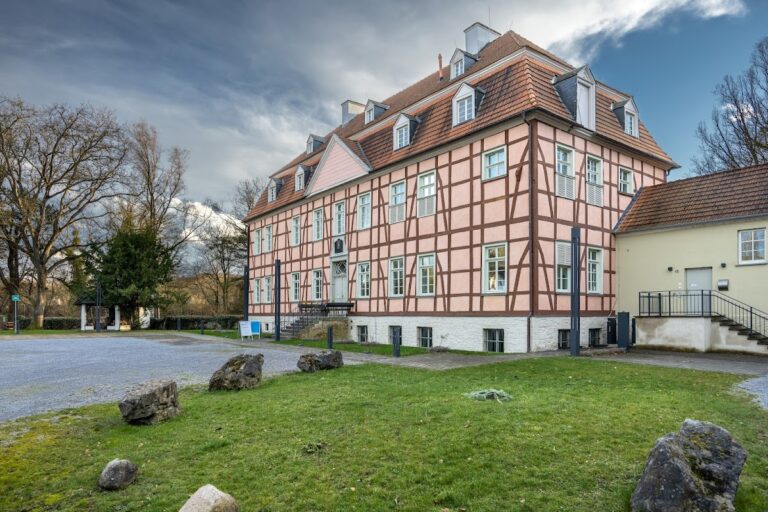
The estate’s outbuildings include the Rentei, an administrative or revenue office for the estate. This half-timbered building dates from 1833 and was constructed in the Classical style.