Palazzo Marcosanti: A Fortified Palace in Poggio Berni, Italy


Site at a Glance
- Rating
- 4.6
- Popularity
- Very Low
- Country
- Italy
- Primary era
- Medieval
- Eras represented
- Medieval
- Civilizations
- Unclassified
- Site type
- Domestic
- Remains
- Castle
On this page7 sections
History
Palazzo Marcosanti, also known as Tomba di Poggio Berni, is a late-thirteenth-century fortified complex in Sant’Andrea, a locality of Poggio Berni in Italy. Built as a defensible residence, it belonged first to the Malatestas, a powerful ruling family of Romagna, and later entered the territories administered by the Papal States, lands governed by the pope before Italian unification. Its history reflects the use of fortified properties as family assets, political instruments, and dowry possessions.
Malatesta possessions and marriage alliances
The complex’s connection with the Malatestas appears in fourteenth-century records linking the property to the family’s possessions. A terracotta frieze with the characteristic Malatesta checkerboard motif provides a visible association with their rule. From the Malatesta period onward, the fortress was repeatedly treated as personal property that could pass to daughters as part of marriage settlements.
In 1418, the property formed part of the dowry of Laura, known as Parisina, the daughter of Andrea Malatesta, lord of Cesena. She married Niccolò III d’Este, but was killed in 1425 after being suspected of a love affair with Ugo, her husband’s illegitimate son. Two years later, the property returned to the Malatestas as the dowry appanage of Margherita d’Este, Niccolò III’s daughter and the wife of Roberto Galeotto Malatesta. An appanage was property assigned to a bride as part of a dowry, providing income, status, or territorial resources for the marriage.
From the Nardini family to the Papal States
After a temporary period under Violante da Montefeltro, widow of Novello Malatesta, lord of Cesena, the property was acquired by Cardinal Stefano Nardini. In 1473, Nardini transferred it to his nephew, Count Cristoforo Nardini of Forlì, who was married to Contessina Malatesta, the illegitimate daughter of Sigismondo Malatesta.
Cristoforo Nardini died at the Battle of Colle Val d’Elsa in 1479, and his illegitimate son Pietro succeeded him. Pietro’s misconduct led Pope Innocent VIII to order the lifelong imprisonment of the Nardini family in a papal bull dated 12 December 1489. On 23 May 1492, the punishment was commuted by transferring almost all the family’s possessions to the Apostolic Chamber, the administrative and financial institution responsible for the possessions of the Papal States. The transfer included the fortified property and the extensive estate of Poggio Berni, together with jurisdictional rights granted through earlier papal and imperial privileges.
On 16 July 1492, Pope Innocent VIII gave the fortress to Giovanni della Rovere d’Aragona, father of the future Duke of Urbino, Francesco Maria I della Rovere. In September 1493, it passed to the Doria family. Six months later, the Doria transferred it to Guidobaldo I, the last Duke of Urbino from the Montefeltro house and the husband of Elisabetta Gonzaga.
Medici, Habsburg-Lorraine, and Albani ownership
In 1557, Guidobaldo II, Duke of Urbino, transferred the fortress and estate to Count Orazio I di Carpegna. Carpegna passed them to Cardinal Giulio della Rovere on 28 September 1558, temporarily returning the property to the possessions of his family.
A public agreement concluded on 30 April 1624 between the Roman Curia, Francesco Maria II della Rovere, Duke of Urbino, and the Grand Duchy of Tuscany assigned the last duke’s allodial property and inheritance to his granddaughter Vittoria della Rovere. An allodial possession was inheritable property held outside feudal tenure. The castle and estate were included in Vittoria’s dowry after her childhood marriage to Ferdinando II de’ Medici, son of the Grand Duke of Tuscany. They remained with the Medici even though they were geographically separated from the family’s other possessions in Romagna.
When the Medici dynasty became extinct in 1738, the property passed to the Habsburg-Lorraine family, which later supplied rulers of the Austrian Empire. In 1763, Franz I, the husband of Empress Maria Theresa, transferred it to the Apostolic Chamber after the family’s rise to the Austrian imperial throne. In 1778, the property passed to the Albani princely family. The Albanis retained it for more than a century, and the building consequently became known as Palazzo Albani.
The Marcosanti period and restoration
On 3 October 1889, Prince Cesare Albani of Milan sold the palace and its estate to the lawyer Paolo Marcosanti. The historic estate was progressively divided, while the palace suffered severe damage during the Second World War. Immediately after the war, the Marcosanti family sold the palace and the fragmented estate.
In 1974, the current owners began the rescue and scholarly restoration of the palace. The work was completed as far as possible, leaving the building in a restored condition after its wartime damage and the changes that followed the breakup of the historic estate.
Remains
Fortified complex and courtyard entrance
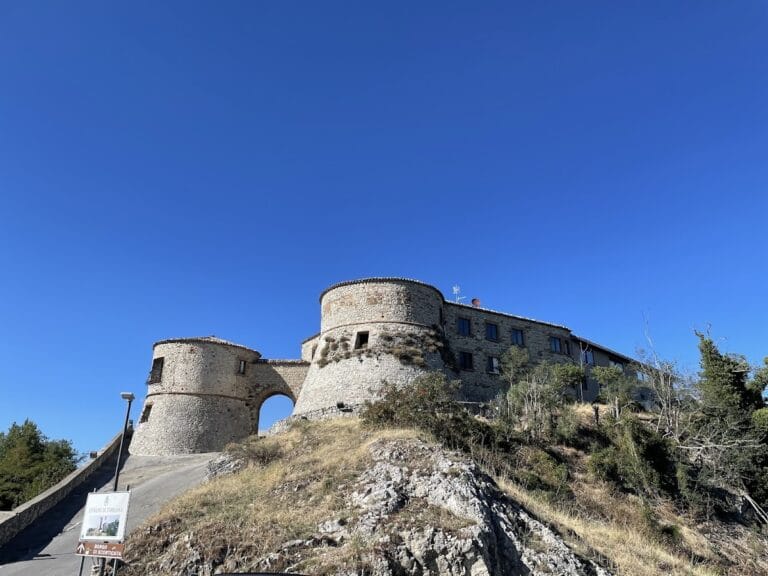
Palazzo Marcosanti survives as a restored fortified complex whose origins lie in a building constructed in the late thirteenth century. Its traditional name, Tomba di Poggio Berni, preserves the medieval use of tomba for a fortified structure generally placed on a hill or another defensible site. The physical character of the complex therefore reflects its original defensive purpose and its later development as a palace.
A pointed arch opens onto the inner courtyard. Its two curved sides meet at an apex, giving the entrance a clearly defined medieval architectural form. The arch is ornamented with a terracotta frieze, made from fired clay, carrying the Malatesta family’s checkerboard decoration. This feature connects the surviving fabric with the period when the fortress belonged to the Malatestas. Extensive damage during the Second World War was followed by recovery and scholarly restoration beginning in 1974, and the palace is now restored.
Nearby sites