Hof: A Former Augustinian Monastery and Civic Complex in Dordrecht


Site at a Glance
- Rating
- 4.2
- Popularity
- Low
- Country
- Netherlands
- Primary era
- Early Modern
- External website
- Open
- Eras represented
- Early Modern
- Civilizations
- Habsburg
- Site type
- Religious
- Remains
- Monastery
On this page10 sections
History
Hof is a monumental building complex in Dordrecht, Netherlands, established as an Augustinian monastery in 1275 as a gift from Floris V, count of Holland and Zeeland. Rebuilt in Renaissance style after a later fire, it became an important religious, civic, and political site, most notably hosting the First Free States Assembly in 1572.
Foundation and medieval monastery
The Augustinians, a Catholic religious order combining communal religious life with preaching, teaching, and study, probably maintained a house in Dordrecht by 1283. The settlement belonged to the ecclesiastical province of Cologne and stood at the corner of Voorstraat and Steegoversloot. A fire destroyed the monastery soon after its foundation. In 1295, an indulgence from the archbishop of Cologne supported rebuilding, after which the complex underwent further alterations and extensions.
The monastery maintained close ties with prominent Dordrecht families. Local regents possessed chapels in the monastery church and were buried there, including Willem van Drenckwaert in 1488, bailiff Jan van Drenckwaert in 1549, and members of the Van Beveren family. The Augustinians also had a strong tradition of learning. Admission required at least basic reading or writing ability, followed by study of Latin, logic, dialectic, philosophy, and theology. Successful students could continue to university.
Rebuilding and sixteenth-century upheaval
In 1440, the Augustinians reused materials dismantled from Eemkerk, which had been drowned in the St. Elizabeth’s Flood of 1421. Further rebuilding took place in 1554, when Emperor Charles V, the Habsburg ruler who held authority over the Netherlands, donated a stained-glass window to the monastery.
The political and religious upheaval of 1572 brought the Dordrecht monasteries to an end. Prior Johan Crabbius was imprisoned, while the Augustinian monks and priests fled to Brussels, where they established the Brotherhood of Saint Anthony.
The First Free States Assembly
In 1572, the Statenzaal, formerly the monastery’s communal dining hall, hosted the First Free States Assembly. Twelve cities, led by Dordrecht, rejected Philip II, the Spanish Habsburg king whose rule in the Netherlands was challenged by the Dutch Revolt. They recognized William of Orange as their only stadtholder, an office carrying executive and military authority, supported freedom of religion, and provided him with money for the war against Spain. Nobles, Sea Beggars, and representatives of William of Orange also attended.
Civic uses and later history
After the monastery’s religious use ended, the complex served several civic and political purposes. It was used as a town hall and courthouse, received important foreign guests, and provided residences for William of Orange and Robert Dudley, the Earl of Leicester. Under Maurice and Frederick Henry, successive princes of Orange and stadtholders, the former monastery was embellished and acquired the name Prinsenhof.
The Statenzaal hosted peace negotiations with Spain in 1648. The complex later declined, and the municipality of Dordrecht bought it in 1835. A school occupied the buildings for a period. Restoration took place from 1969 to 1972, preserving the complex for new public uses.
Since 2015, Hof has housed the Museum Hof van Nederland. Its historical and contemporary displays address freedom and equality in the Netherlands, including the First Free States Assembly, the National Synod of 1618–1619, the De Witt brothers, the Second World War, women’s emancipation, and current issues. The complex also houses the Regional Archive of Dordrecht, which preserves the archives of Dordrecht and many neighboring municipalities, although its archive repository is elsewhere. Hof is protected as a Rijksmonument, a nationally protected monument, under monument number 13433.
Remains
Hof is arranged around a former monastic courtyard. The courtyard was enclosed by a group of religious, residential, and service buildings, including a hospital, brewery, bakery, and other facilities. The complex’s present form reflects rebuilding after the 1512 fire, when the buildings were reconstructed in Renaissance style.
Courtyard and service buildings
The former courtyard remains the organizing feature of Hof. Around it stood the hospital, brewery, bakery, and other service buildings that supported monastic life. Their inclusion within the enclosed complex reflects the range of practical activities carried out alongside worship, study, and communal living.
Religious and civic buildings
Statenzaal
The Statenzaal occupies the former monastic refectory, or communal dining hall. Its stained-glass windows retain the coats of arms of the twelve cities represented at the First Free States Assembly in 1572. The room therefore preserves a physical connection between the monastery’s earlier communal function and its later political role as a meeting hall for the States, the representative assemblies of the Dutch provinces.
Augustijnenkerk
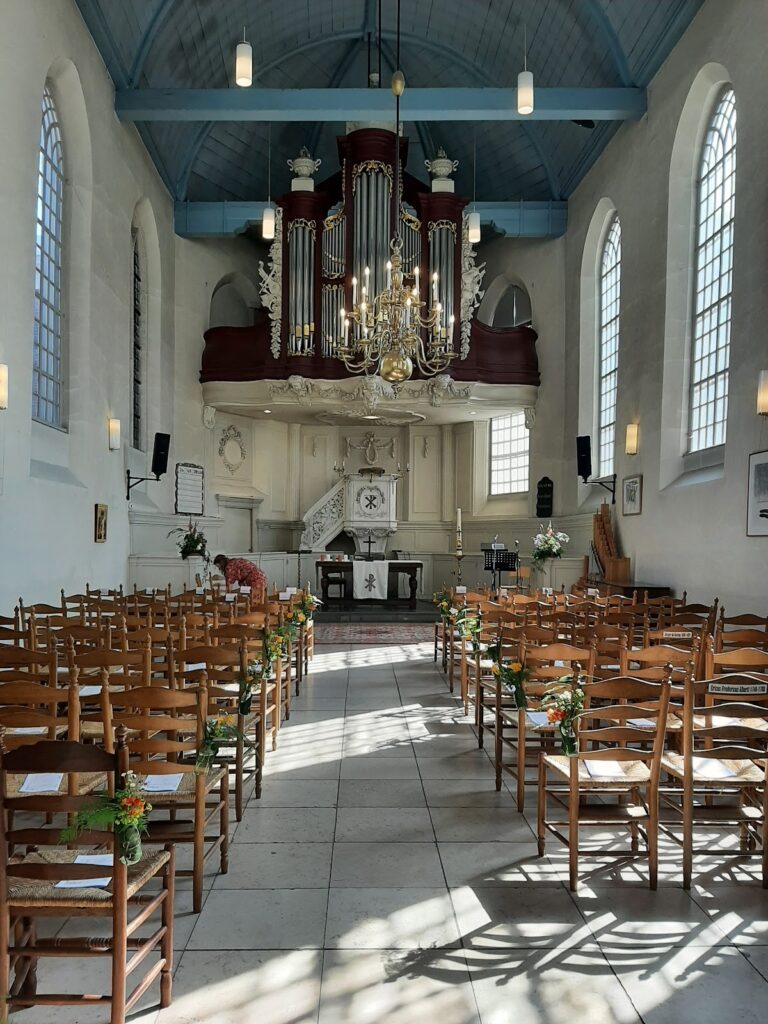
The Augustijnenkerk, or Augustinian Church, is also part of Hof. The church formed the religious focus of the monastery and contained chapels used by prominent Dordrecht families, whose burials included members of the Van Drenckwaert and Van Beveren families.
The complex at Hof 6, on the square of the same name in Dordrecht, preserves the physical setting of a monastery that was later adapted for civic, political, educational, museum, and archival purposes.