History Museum of Armenia: A National Historical and Archaeological Museum in Yerevan

Site at a Glance
- Rating
- 4.4
- Popularity
- Medium
- Country
- Armenia
- Primary era
- Bronze Age
- External website
- Open
- Eras represented
- Stone Age, Bronze Age, Iron Age, Classical, Medieval, Early Modern, Modern
- Civilizations
- Achaemenid, Armenian, Assyrian, Byzantine, Egyptian, Hittite, Kingdom of Cilicia, Mongolian, Ottoman, Roman, Russian, Sassanid, Seleucid, Seljuk, Urartian
- Site type
- Museum
On this page18 sections
History
The History Museum of Armenia is a national historical and archaeological museum in Yerevan, Armenia, established by the National Assembly of the First Republic of Armenia on 9 September 1919. Founded as the Ethnographic-Anthropological Museum-Library, it opened to visitors on 20 August 1921 and now presents the history and culture of Armenia from prehistory to the present.
Foundation and institutional development
The museum was formed from the collections of the Armenian Ethnographical Association of the Caucasus, the Nor Nakhijevan Museum of Armenian Antiquities, the Museum of Antiquities of Ani, and the Vagharshapat Repository of Ancient Manuscripts. Its original collection contained 15,289 objects. Over time, the institution used several names, including the State Central Museum of Armenia, the Historical Museum, and the State History Museum of Armenia. Since 2003, it has been known as the History Museum of Armenia.
In 1935, parts of the collections were transferred to newly established specialized institutions. The future National Gallery of Armenia received 1,660 objects from the art department. The future Charents Museum of Literature and Arts received 301 objects and 1,298 manuscripts from the literature department. When a State Museum of Ethnography was established in 1978, it received a further 1,428 objects and 584 photographs.
The museum’s national collection now contains approximately 400,000 objects. Archaeology accounts for 35 percent, ethnography for 8 percent, numismatics, the study and collection of coins, currency, medals, and related objects, for 45 percent, and documents for 12 percent. Collections continue to grow chiefly through archaeological discoveries in Armenia, purchases, and donations.
Archaeological and historical research
The museum’s archaeological collections are arranged in seven chronological groups: Paleolithic, Neolithic and Chalcolithic, Bronze Age and Early Iron Age, Urartu, the Achaemenian period of the sixth to fourth centuries BC, Hellenistic material, and medieval collections dating from the sixth to the fifteenth centuries. These holdings place the Armenian Highlands in contact with ancient societies and states including Egypt, Mitanni, the Hittite Kingdom, Assyria, Iran, the Seleucid Empire, Rome, and Byzantium.
The museum’s departments of archaeology, ethnography, numismatics, modern history, conservation, and restoration support research and interpretation. Since 1948, the institution has published studies of Armenian architecture, archaeology, ethnography, and history, together with archaeological excavation reports. Conservation stabilizes and protects cultural material, while restoration repairs or reconstitutes objects while taking account of their historical fabric.
The first exhibition was organized in 1925. Later permanent and temporary exhibitions addressed Paleolithic and Bronze Age Armenia, Urartu, the ancient cities of Ani and Dvin, Armenian maps, Christian culture, carpets and national dress, the Armenian genocide, and the First Republic of Armenia. The museum also conducts educational and scientific programs on Armenian history and culture.
Directors and scholarly departments
Yervand Lalayan, an Armenian ethnographer, archaeologist, and folklorist, served as founding director from 1919 to 1927. Karo Ghafadaryan directed the museum from 1940 to 1964 and developed it as a research and educational-cultural center. His work included creating a systematic historical presentation of Armenia from its origins to the modern period. Morus Hasratyan directed the institution from 1964 to 1975, when Armenian culture was presented in international exhibitions and institutional connections were established with Armenian communities in the diaspora. Telemak Khachatryan served as director from 1983 to 1987. Grigor Grigoryan directed the museum from 2014 to 2020, followed by Davit Poghosyan from 2020.
The history department for the modern and contemporary periods has operated since 1949. After the Armenian Revolution Museum was dissolved in 1991, its collections passed to this department. Its scope includes Armenian communities abroad and the social, political, national-liberation, and cultural history of Armenia from the seventeenth century onward. Anelka Grigoryan has chaired the museum’s scientific council since 1997.
Toros Toramanyan, an Armenian architect and a founder of the scientific study of Armenian architecture, directed the architecture department from 1930 to 1932. He had taken part in excavations at Ani since 1904, producing measurements, photographs, descriptions, and reconstruction projects relating to the city’s secular and ecclesiastical architecture and defensive system. Some Armenian monuments are known today only through his records. Yevgeni Bayburdyan headed the archaeology department in 1928 to 1933 and again in 1938, followed by Harutyun Mnatsakanyan from 1949 to 1969 and Valentina Abrahamyan, who led the archaeology and later ethnography departments from 1959 to 1979.
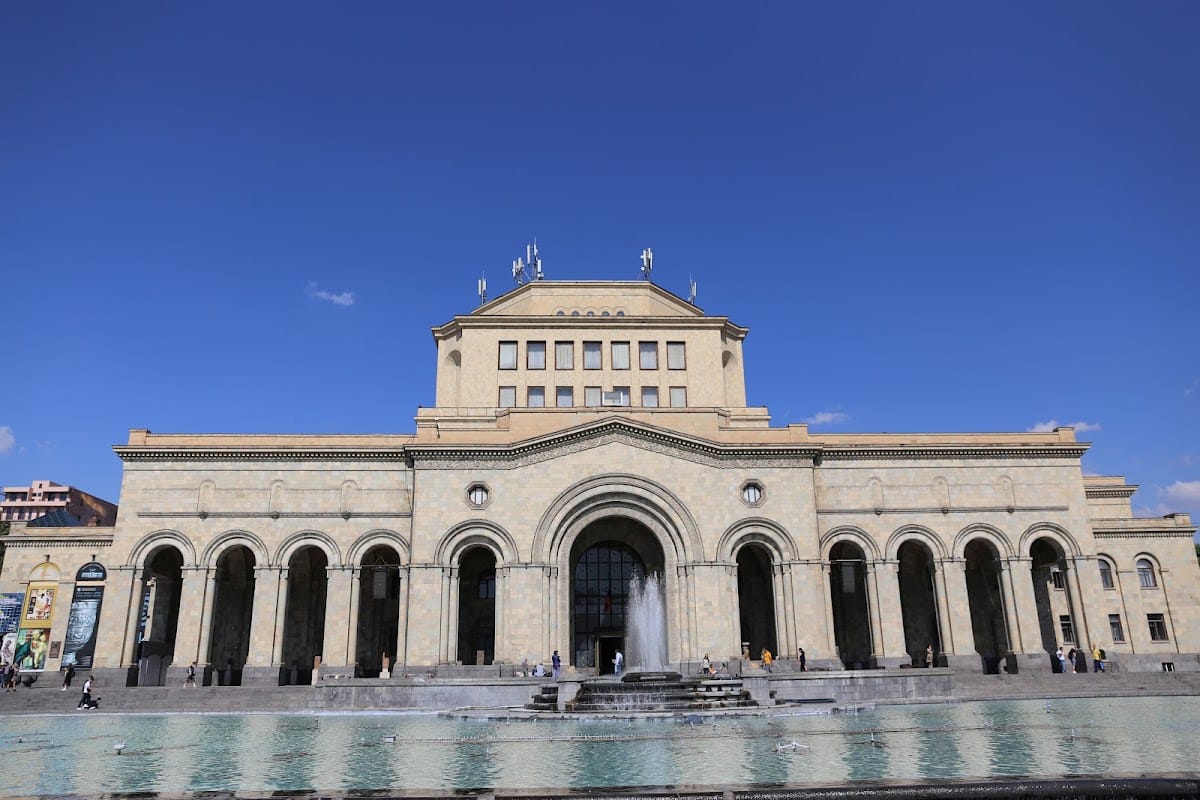
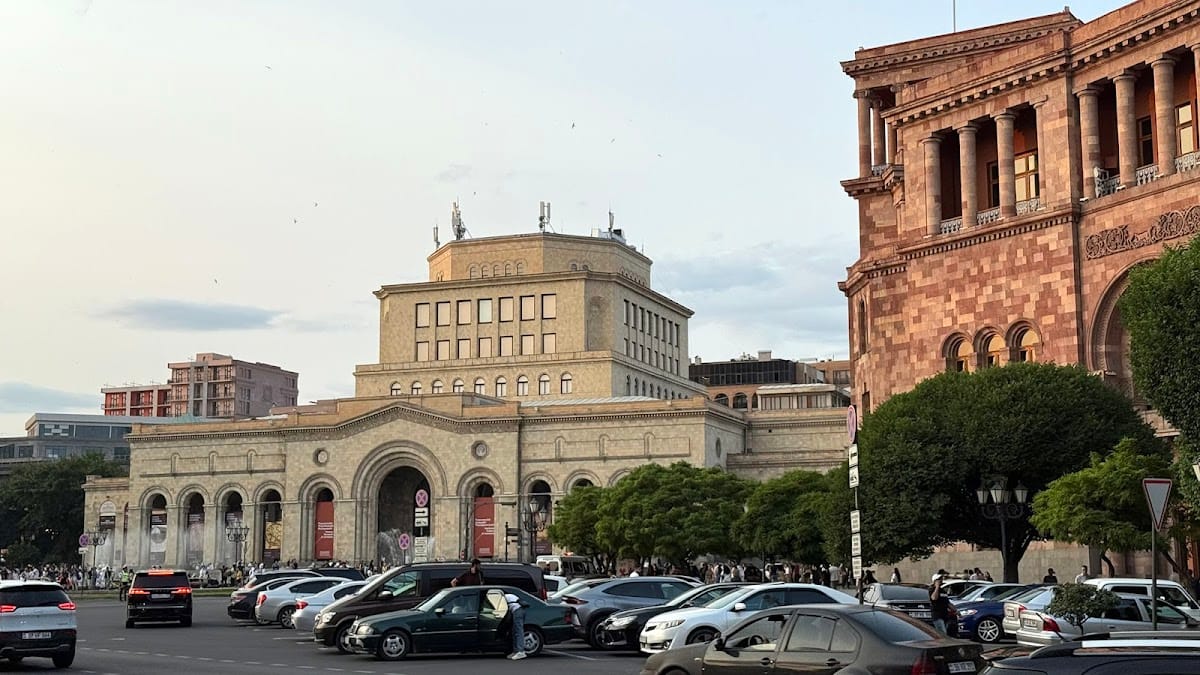
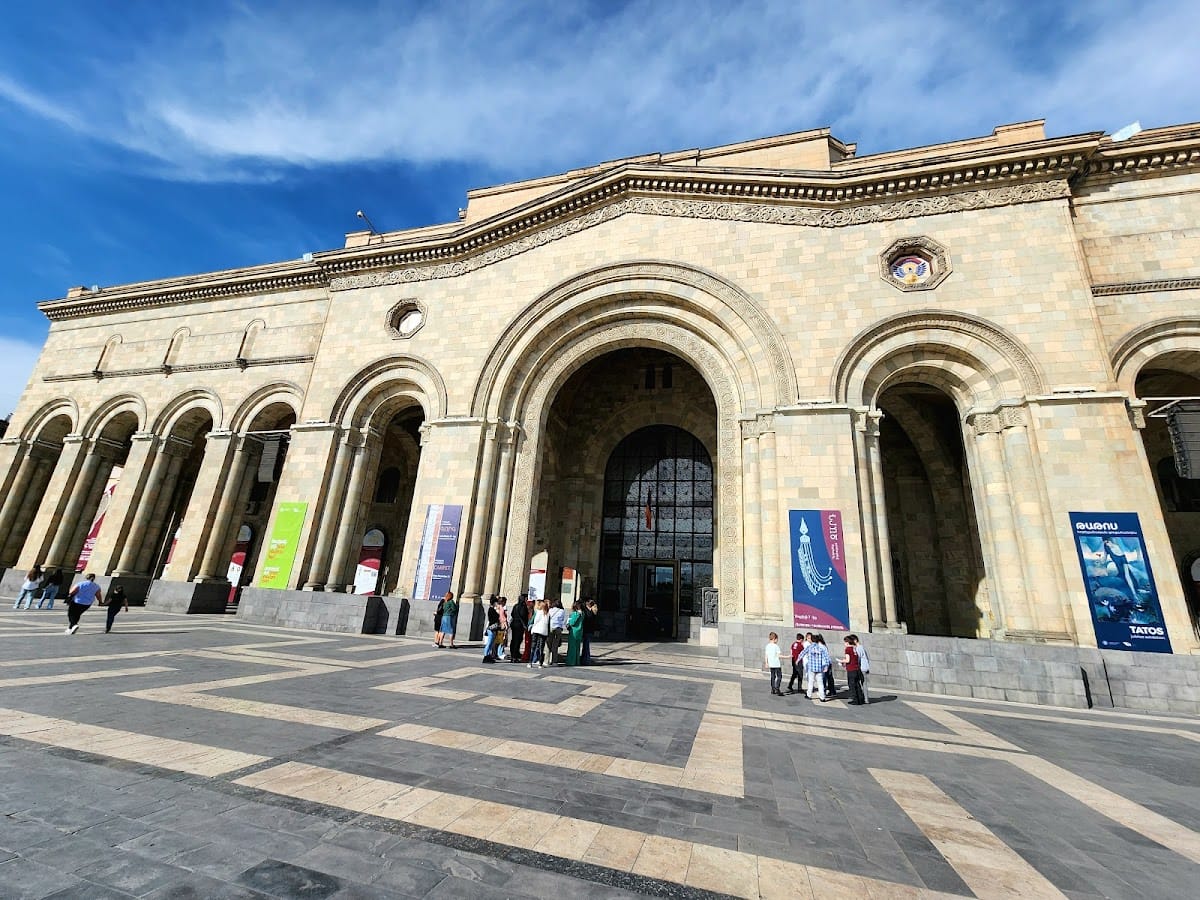
Stepan Lisitsyan headed the ethnography department from 1928 to 1947. Aslan Shahnazaryan directed the numismatic cabinet from 1946 to 1959 and organized its first scholarly collections. Khachik Musheghyan headed the numismatics department from 1959 to 1989, followed by Henry Sargsyan from 1989 to 2000. The museum is state-owned and state-supported, and occupies a building shared with the National Gallery of Armenia on Republic Square.
Remains
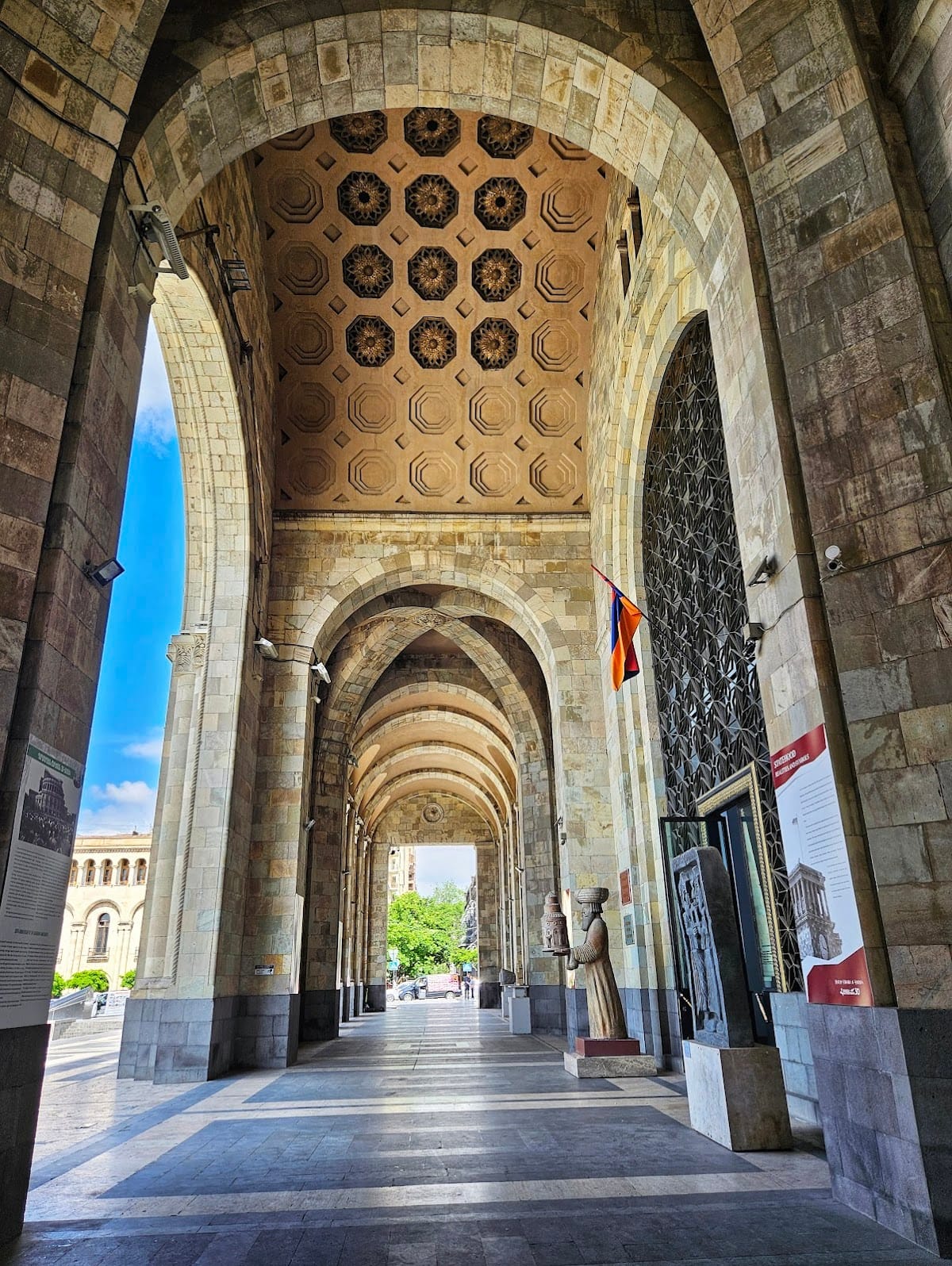
The museum’s physical setting is a shared building on Republic Square, while its interior is organized through collections that follow Armenia’s history from early stone-tool traditions to modern documents and personal archives. The displays bring together archaeological objects, architectural fragments, works of applied art, coins, textiles, and documentary material from sites and communities across Armenia and the wider Armenian historical world.
Prehistoric and Bronze Age collections
Paleolithic tools
The Paleolithic, or Old Stone Age, collections include Acheulean hand axes, cores, and other tools from dozens of Armenian sites, including Mount Arten, the middle Hrazdan River valley, and Gugark. Acheulean tools are shaped bifacial hand axes associated with the Lower Paleolithic. The objects were made from locally available obsidian, flint, dacite, and basalt. Hand axes have almond-shaped, oval, and triangular forms, with regular shaping and careful finishing.
Neolithic and Chalcolithic material
The Neolithic and Chalcolithic collections represent the New Stone Age and the transitional period between the Stone Age and the Bronze Age. They contain blades struck by percussion from pyramidal or conical cores. These blades served cutting, sawing, piercing, and engraving functions in domestic and economic activities. Basalt and diabase axes and hammers, bone implements, and early pottery come from excavations at Masis, Adablur, and Artashat. Pottery first appears in Armenia during the final Neolithic, around the beginning of the sixth millennium BC.
Bronze Age and Early Iron Age finds
Bronze Age and Early Iron Age material forms approximately 60 to 70 percent of the archaeological holdings. The Early Iron Age was the period when iron objects became prominent alongside established bronze technologies. Finds come from Shengavit, Mokhrablur, Harich, Karnut, Lchashen, Vanadzor, Karashamb, Verin Naver, Mayisyan, Berkaber, Aruch, Artik, and Lori Berd.
These collections include ritual hearths and altars, terracotta and bronze sculptures, sculptural groups, cult vessels, objects associated with authority, weapons, ornaments, pottery, wooden carts and chariots, and other examples of applied art. Anthropomorphic idols and monuments described as phallic and dragon stelae add to the range of ritual and symbolic material. Wooden carts and chariots excavated at Lchashen, together with bronze miniature models, date to the fifteenth and fourteenth centuries BC.
Several individual objects provide chronological and artistic reference points within the Bronze Age holdings. They include a Karashamb goblet, a Karashamb brooch dated to the twenty-second and twenty-first centuries BC, a Vanadzor goblet from the seventeenth and sixteenth centuries BC, and a tricolored lidded pot from Karashamb dating to the sixteenth and fifteenth centuries BC. A bird statuette from Lchashen belongs to the fifteenth and fourteenth centuries BC. Other ritual and figurative objects include a ladle, a pitcher with a ritual hunting scene, a woman’s statuette from Ayrum, and a wolf statuette from the same site, both dating to the sixth and fifth centuries BC.
Urartian and Achaemenian-period material
Urartian collections
Urartu, also called the Kingdom of Van, was an Iron Age state centered in the Armenian Highlands. Its collections at the museum date from the ninth century to the beginning of the sixth century BC and include material excavated at Karmir Blur, Arin Berd, Argishtikhinili, Oshakan, Van, and other sites. The objects include Urartian and Assyrian cuneiform inscriptions, metal household objects, bronze weapons with sculptural decoration, gold and silver ornaments, cast-bronze sculptures, furniture parts, painted ritual vessels, rhyta, red-polished vessels, and large storage jars marked with capacities of 800 to 1,200 liters.
The museum holds the cuneiform inscription issued by Argishti I, a king of Urartu, concerning the foundation of Erebuni in 782 BC. Other Urartian holdings include excavated wall paintings, painted ceramics, bronze statuettes, sculpturally ornamented weapons, and gold, silver, and bone objects from Karmir Blur, Arin Berd, and Argishtikhinili. The collection also includes a replica of the Satala Aphrodite, an ancient marble statue identified with the Greek goddess Aphrodite.
Achaemenian-period objects
The Achaemenian Empire was the Persian imperial state that ruled much of the Near East, including Armenia, before the conquests of Alexander the Great. Museum holdings from the sixth to fourth centuries BC include cast-bronze miniature sculptures, jewelry and vessels made from precious metals, red-polished and painted pottery, and engraved stamp seals carved from semiprecious stones. The seals show animals, riders, hunting scenes, and other images.
Hellenistic and medieval collections
Hellenistic archaeology
The Hellenistic collections date from the fourth century BC to the third century AD. Hellenistic culture was the Greek-influenced culture that spread across the eastern Mediterranean and western Asia after Alexander the Great. Excavated and chance finds from Artashat, Garni, Armavir, Sisian, Tigranakert, and other sites include metal objects, pottery, glass vessels, jewelry, small sculptures, and terracotta figurines of mothers and children, riders, musicians, and other figures.
Architectural and sculptural material includes reliefs and high reliefs from Artashat and Garni, large marble statues, and portrait sculptures from Dvin, Yerevan, and Darband. Written monuments include Aramaic boundary stones issued by order of Artashes I, who ruled Armenia from 189 to 160 BC and founded the Artaxiad dynasty. Greek and Latin stelae and tombstones complete this group of written and commemorative material.
Medieval architecture and objects
Medieval holdings from Ani, Dvin, Amberd, and other sites include glazed and faience vessels, decorated storage jars, ecclesiastical metalware, glass objects, textile remains, and rare garment fragments from Ani. They also contain family emblems and objects showing biblical and secular themes. Faience is a glazed ceramic material used for vessels and other objects.
The medieval collection includes early Christian material from the fourth to fourteenth centuries and developed-medieval material from the ninth to fourteenth centuries. Architectural and sculptural fragments include capitals, memorial columns, winged crosses, khachkars, high and low reliefs, wall sculptures, and other elements from Zvartnots, Dvin, Aruch, Talin, Kaghsi, and other sites. A khachkar is an Armenian carved cross-stone, while a winged cross is a cross motif accompanied by wings or winged forms. Carved wooden doors and capitals associated with the monasteries of Mush, Tatev, and Sevan’s Holy Apostles Monastery are among the notable medieval artistic objects.
Coins, ethnography, and modern history
Numismatic collections
The numismatic collection contains gold, silver, and copper coins, including excavated and accidentally discovered hoards. Important archaeological additions include hundreds of coins from Dvin and later Hellenistic, Roman, and medieval coins from Garni and Artashat. The holdings include coins associated with Tsopk, Minor Hayk, the Artaxiad dynasty, the Kiurike kingdom, and the Armenian Kingdom of Cilicia, as well as foreign issues that circulated in Armenia. These include Sasanian, Arab, Byzantine, Seljuk, Mongol, late Persian, Russian, Ottoman, and western European coins.
The department also holds banknotes, stamps, medals, tokens, orders, and badges. Its stamps include issues of the First Republic of Armenia from 1918 to 1920, Soviet Armenia from 1921 to 1923, and the Republic of Armenia from 1992 onward. The medal collection includes Armenian, European, and other medals dating from the seventeenth century to the present, including 900 French silver medals struck at the Paris Mint from original dies.
Ethnographic and modern-history material
Ethnographic holdings from the sixteenth to twentieth centuries include decorative and applied art, household objects, tools and means of production, embroidery and lacework, gold- and silver-thread textiles, ecclesiastical garments, Armenian jewelry, engraved and repoussé copperware, woodcarving, faience, carpets, and pileless rugs. Repoussé is a method of shaping metal from the reverse to create raised decoration. The collection also includes flintlock firearms, pistols, daggers, swords, and weapons associated with notable individuals.
Seventeenth- to nineteenth-century dragon carpets appear alongside carpets with geometric, vegetal, and mixed ornament. Ethnographic photographs, primary documentary sources, maps, and the personal archives of ethnographers broaden the material record of Armenian communities and everyday life. The modern-history collection contains seventeenth- to twentieth-century documents, photographs, stone inscriptions, flags, seals, and the personal archives of social, political, and military figures, together with their photographs, documents, and personal objects.