The Blue Mosque: Yerevan’s Principal Friday Mosque
Site at a Glance
- Popularity
- Very High
- Country
- Armenia
- Primary era
- Early Modern
- Eras represented
- Early Modern, Modern
- Civilizations
- Russian, Zand
- Site type
- Religious
- Remains
- Mosque
On this page14 sections
History
Construction and religious life
The Blue Mosque is a Friday mosque in Yerevan, Armenia, commissioned in 1765–1766 by Hoseyn Ali Khan, ruler of the Erivan Khanate under Iranian rule. A Friday mosque is a principal mosque for communal Friday prayers. Erivan is a historical name for Yerevan, and a khan was a ruling title used in parts of Iran and the Caucasus. The mosque belongs to early Qajar architecture, a building tradition associated with Iran’s Qajar ruling house. It became the city’s principal congregational mosque.
An attached madrasa, or Islamic school, operated from the late eighteenth century. It was the largest and most regularly active of Erivan’s mosque schools. In the 1840s, about thirty boys studied there under two teachers. Their lessons included reading and writing Persian using manuscripts, often a history of Nadir Shah, an eighteenth-century Iranian ruler. The pupils were not taught to read or write their own language.
Russian rule and rebuilding
Russian forces captured Yerevan in 1827. At that time the Blue Mosque was the largest of the city’s eight mosques, and it retained that distinction through the nineteenth century. Western visitors during the Russian period called it the Gök Jami, Turkish for “Sky-Blue Mosque.” Persian names included Masjid-i Juma (“Friday Mosque”) and Jami-i Shahr (“City Congregational Mosque”).
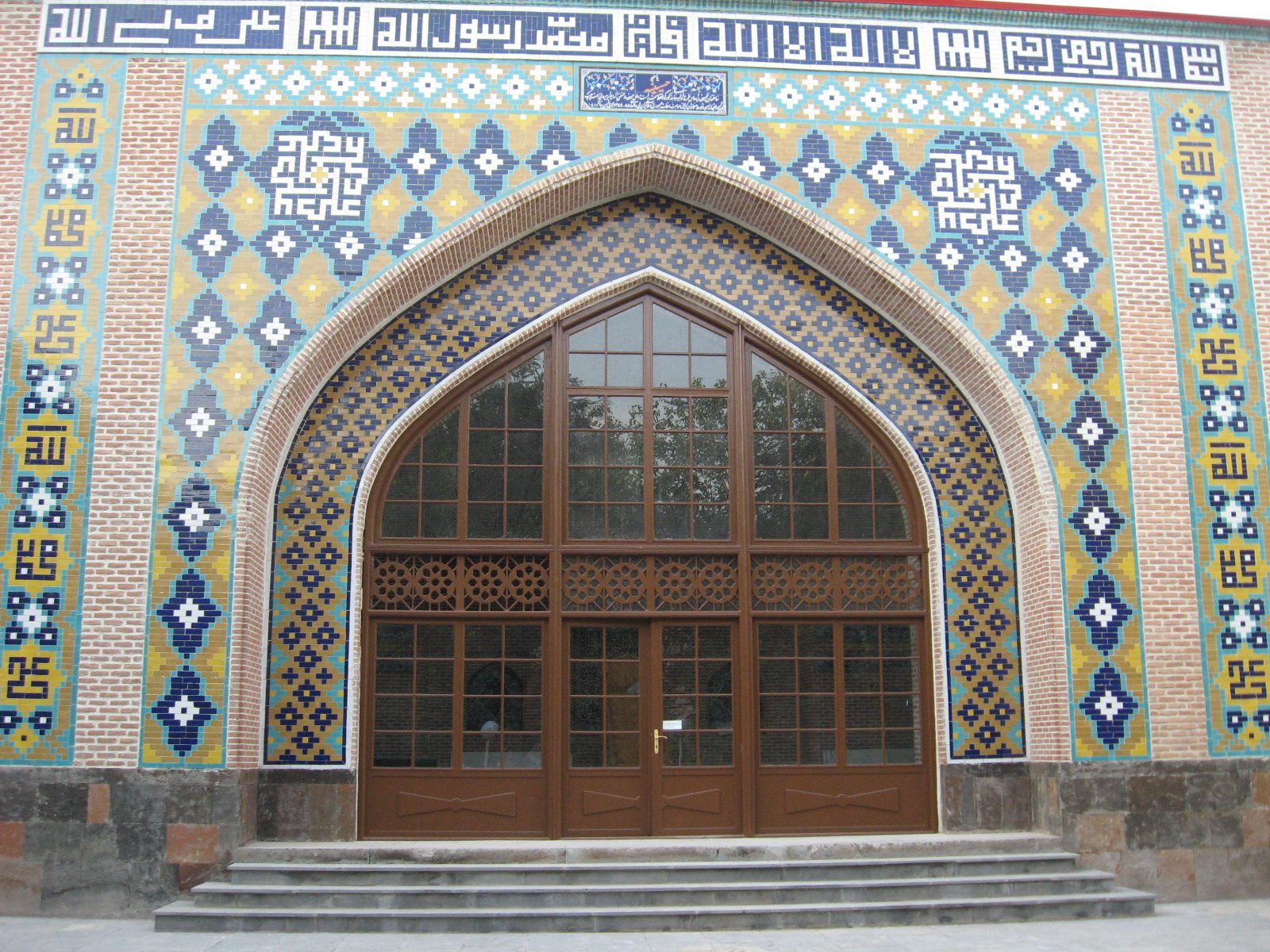
Under Russian administration, the mosque received extensive tile redecoration around 1887–1888 and underwent another reconstruction in 1907–1910.
Secular use and museums
The mosque stopped functioning as a religious institution in the mid-1920s and was put to secular use. Its courtyard became a social and creative gathering place for Armenian artists, writers, poets, and intellectuals, with a teahouse serving as a meeting point. The Armenian poet Yeghishe Charents was particularly associated with efforts to preserve the building.
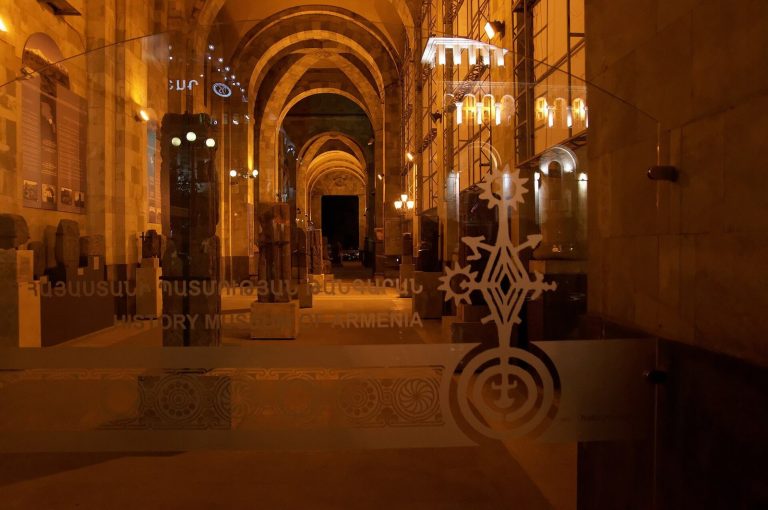
During the 1930s, the building housed first the Anti-Religious Museum and then the Museum of Antifascism. From 1936 until the Soviet Union’s dissolution, it housed the Museum of Natural Sciences and Yerevan History Museum. The main prayer hall was used as a planetarium, and the history museum remained in the mosque for more than five decades.
During the late-1980s Nagorno-Karabakh conflict, which involved Armenia and Azerbaijan, the mosque escaped damage. It was regarded as Persian rather than Azerbaijani heritage and was then occupied by the city history museum.
Restoration and present use
Yerevan authorities and an Iranian delegation reached a preliminary restoration agreement in February 1991. With support from the Iranian government, major renovation followed in 1994–1998. The Mostazafan Foundation, an Iranian state-linked foundation, oversaw the project, with Iranian-Armenian engineer Varoujan Arakelian supervising the work. On October 13, 1995, the city formally transferred the right to use the mosque to Iran. Brady Kiesling characterized the restoration as structurally necessary but aesthetically ambiguous. Further reconstruction took place in 2009–2011.
The Blue Mosque remains Armenia’s only active mosque and serves Muslims living in the country. Since 2015, the complex has also functioned as a cultural center. On December 10 of that year, Armenia leased it to the Iranian embassy for 99 years for cultural use. The center supports Persian-language study among young Armenians.
Cultural identity and status
The mosque’s cultural attribution remains contested. Armenian and many Western descriptions identify it as Iranian or Persian, while Azerbaijani official discourse claims it as Azerbaijani heritage. Journalist Thomas de Waal has argued that most worshippers in the 1760s were Azeris. Scholar Rouben Galichian cautions that applying an Azerbaijani national classification to that period is anachronistic, noting that local Muslims and Persians shared a Shia affiliation, a major branch of Islam. The Armenian government lists the mosque as a monument of national significance.
Remains
Plan and construction
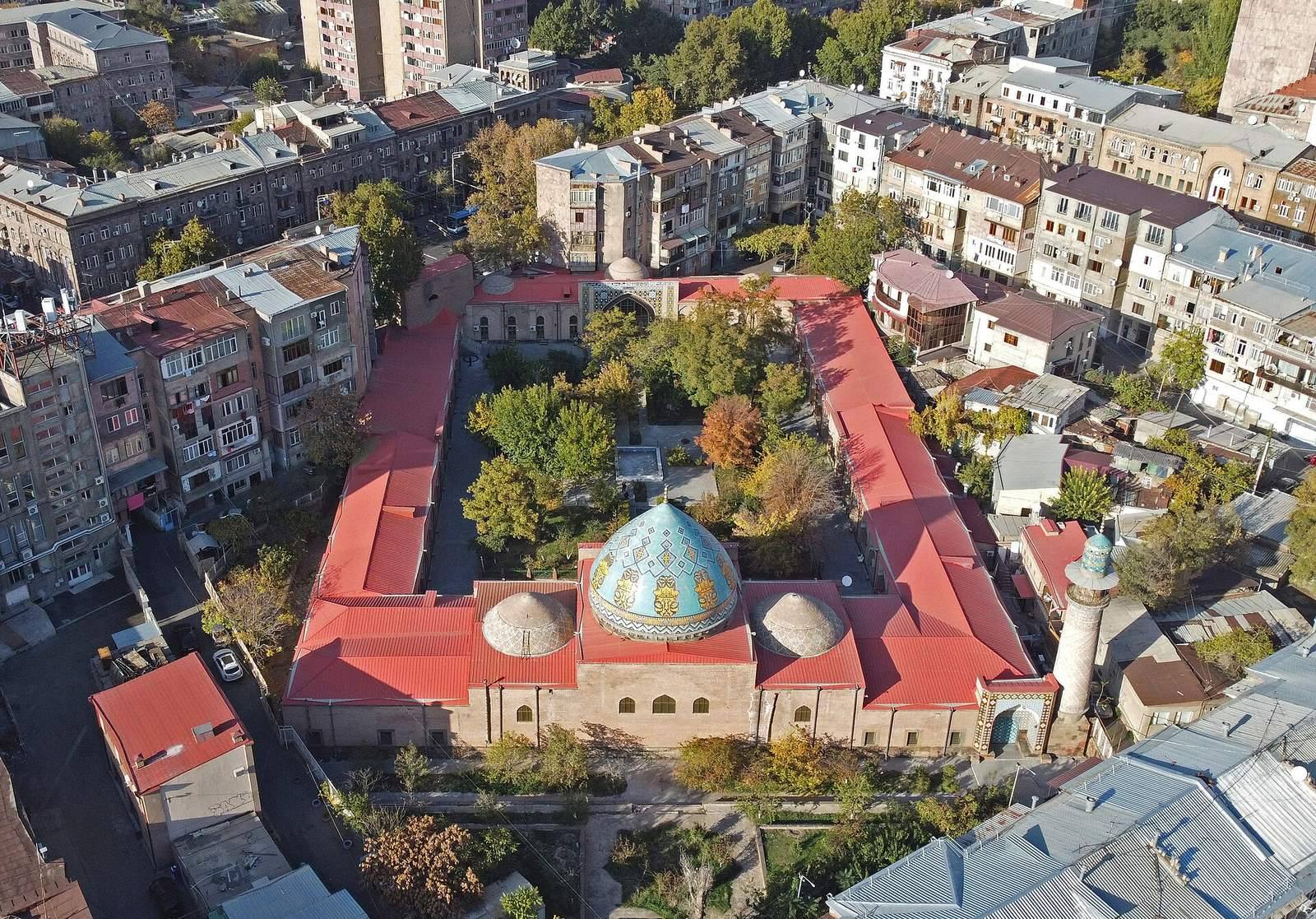
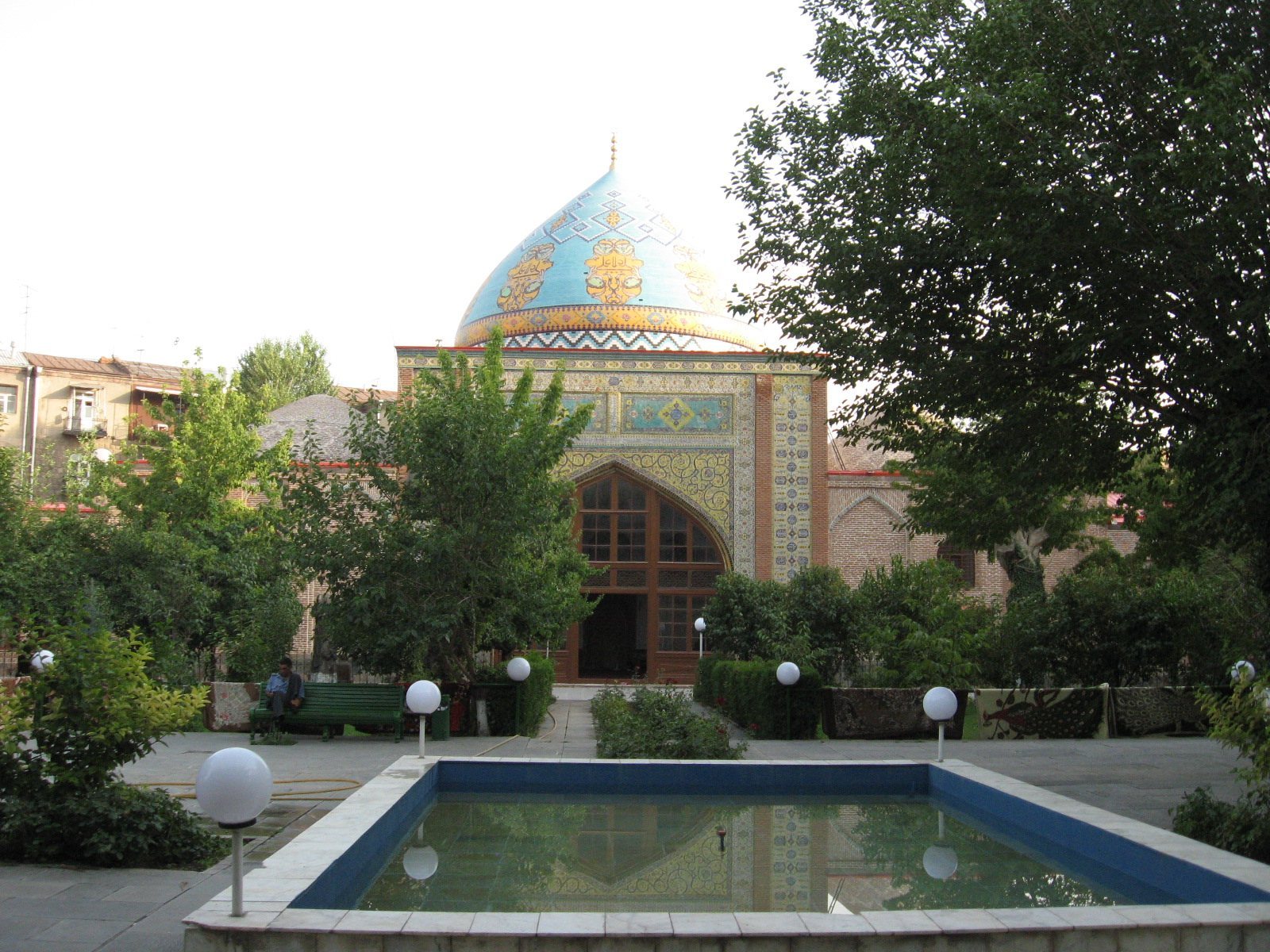
The Iranian-style complex covers about 7,000 square metres. The mosque measures 97 by 66 metres, while its courtyard measures 70 by 47 metres. Its continuous façade and double arcade, a pair of rows of arches, reflect early Qajar architecture. The dome forms, tile patterns, brickwork, colors, and main prayer-area plan distinguish the building from Sunni and Ottoman mosque traditions. The complex includes 28 rooms and a library named for Hafez, the influential Persian poet, with more than 8,000 items.
Prayer hall and tower
Prayer hall
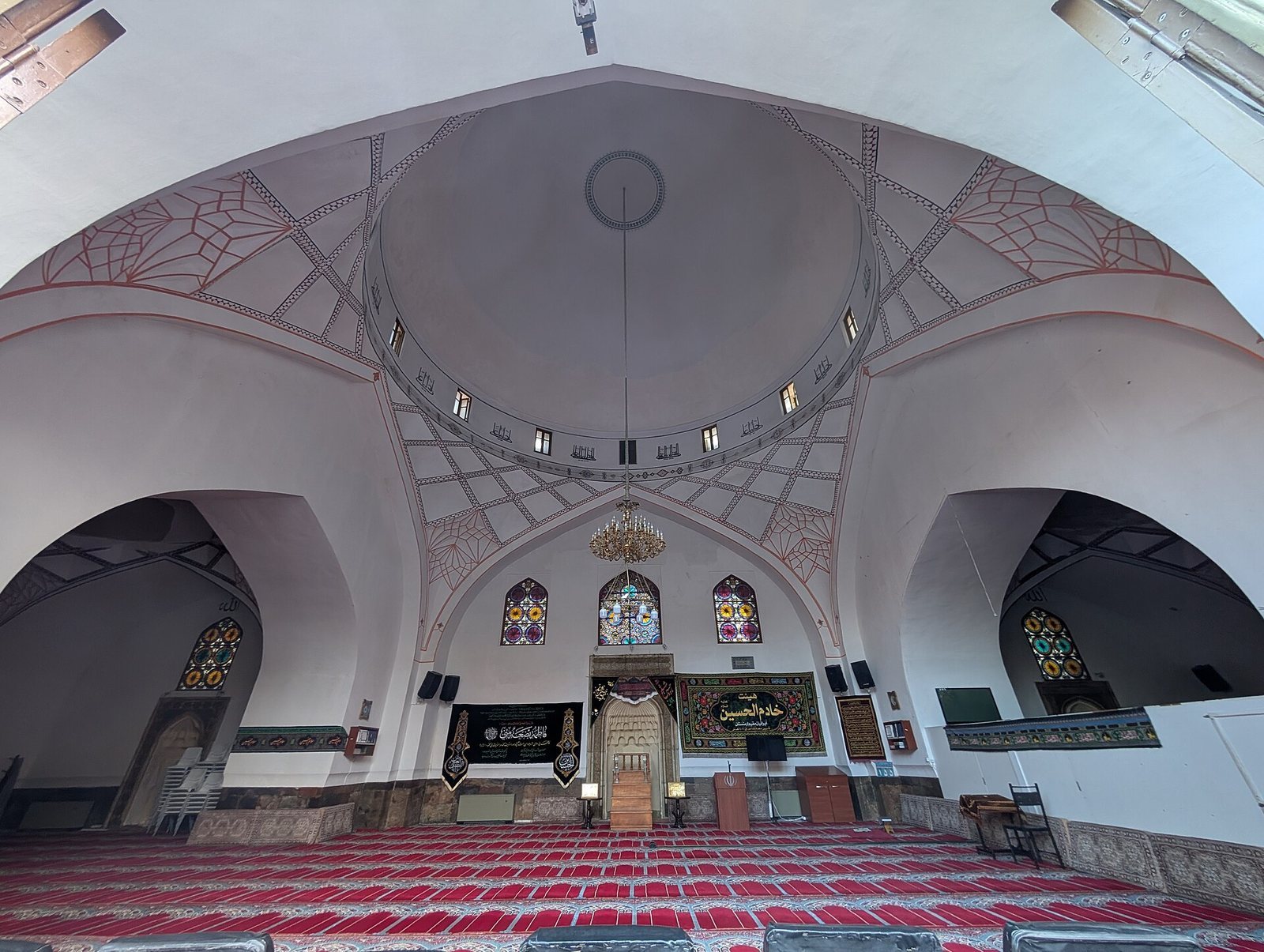
The mosque has three domes and three mihrabs, niches indicating the direction of prayer. Religious inscriptions are in Persian. Iranian cleric Mahmoud Movahedifar identified the language of the inscriptions, and the Iranian embassy has described the Persian writing as centuries old.
Minaret
The minaret, a tower associated with a mosque, rises 24 metres and leans by seven degrees; it is considered structurally safe. During the nineteenth century, it was Yerevan’s tallest structure.
Courtyard and access
Courtyard and associated spaces
Twenty-four arched cells face a pool at the center of the courtyard, around which a rose garden was laid out. Elm and plane trees provided shade, and a smaller companion building on the courtyard’s north side has floral paintings on its ceiling.
Entrances and street level
The mosque stands more than two metres below street level, a relationship established by Yerevan’s 1924 master plan by architect and urban planner Alexander Tamanian. The main southern gate, to the right of the minaret, was blocked during the Soviet period. The western gate became difficult to recognize as an entrance after its incorporation into a residential complex. The northern entrance became the sole entrance, reached by descending steps from Mashtots Avenue.