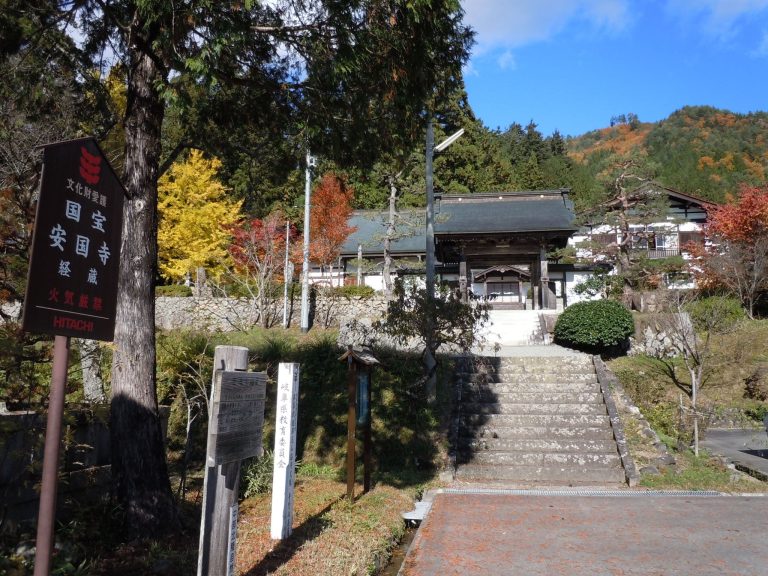
Kaminashi Hakusan-gū: A Historic Hakusan Shrine in Nanto, Japan
Site at a Glance
- Rating
- 4.2
- Popularity
- Very Low
- Country
- Japan
- Primary era
- Medieval
- Eras represented
- Medieval
- Civilizations
- Ashikaga shogunate
- Site type
- Religious
- Remains
- Sanctuary
On this page8 sections
History
Kaminashi Hakusan-gū is a Japanese shrine in Nanto, Japan, built within the tradition of Hakusan mountain worship and centered on a sanctuary whose construction is dated to 1502. Its principal deities are Hakusan Kukurihime-no-Mikoto, the deity conventionally associated with Mount Hakusan, together with Suwa Daimyojin and Hachiman Daijin. The shrine is historically important for its continuing worship, its medieval written records, and its connection with the development of settlements and religious life in Gokayama.
Foundation traditions
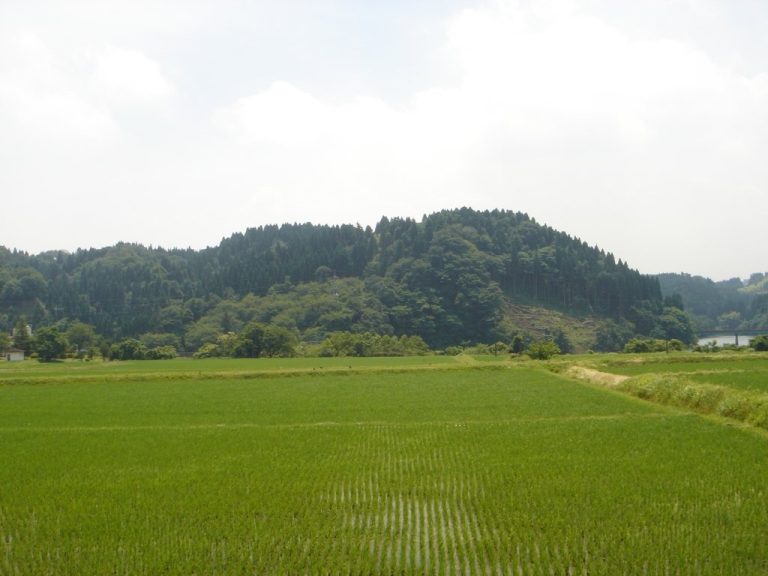
A foundation tradition written in 1833 links the shrine to Taichō Daishi, an eighth-century Buddhist ascetic traditionally associated with the development of Hakusan worship. During the reign of Empress Genshō, Taichō is said to have received an oracle and established a temple-and-pagoda complex on Mount Ningyō, where he enshrined a sacred image. Warfare later destroyed the complex by fire. According to the same tradition, a dream oracle then directed Ichiroemon of Kaminashi to carry the image to the village and honor it as the settlement’s tutelary deity, promising protection and prosperity.
The transfer of the image, traditionally attributed to Taichō, is dated to 1125. Ningyōyama Miyayashiki is regarded as the former location of the Hakusan shrine before its move uphill. The tradition therefore presents the present shrine as the continuation of an older Hakusan institution that shifted from a mountain setting to the village.
Medieval Gokayama
During the Northern and Southern Courts period, a fourteenth-century era in which rival imperial courts competed for authority, refugees associated with the Southern Court contributed to the formation of settlements in Gokayama. Inscriptions at Kaminashi Hakusan-gū and nearby Mameotani Hachimangū are regarded as valuable evidence for this process and are among the oldest written records connected with Gokayama.
A Buddhist statue formerly carried an inscription dated 1395. The writing has become too worn to read, but a historian from Kaminashi interpreted it as referring to repairs in 1395 and 1411. The work was attributed to the lord of Kibune Castle in Tonami District, who is said to have prayed for military success. This association places the shrine’s religious sphere within the political and military conditions of medieval central Japan.
A roof tablet, a dedicatory wooden plaque set within a building’s roof structure, bears the date 1502 and includes the place-name “Kaminashi” and a reference to the Sakamoto administrative unit in Tonami District. It is regarded as the earliest written historical record of the name Kaminashi. The person named on the tablet is considered to have been one of the village headmen who began appearing in Gokayama during the late Muromachi period, the era of the Ashikaga shogunate from roughly the fourteenth to the sixteenth century. The exact nature of the Sakamoto unit remains uncertain, although it may have been a locally administered area used for collecting land taxes.
Hakusan worship and Jodo Shinshu
During the Warring States period, the later fifteenth and sixteenth centuries of political fragmentation and warfare, Jodo Shinshu spread rapidly through Gokayama. This major Buddhist tradition centered on devotion to Amida Buddha made temples and nenbutsu halls, where worshippers gathered to recite Amida’s name, important centers of settlement life. Earlier Hakusan-related Hachiman and Kumano beliefs formed part of the religious background from which this expansion developed. Areas where Ikko uprisings were especially active also broadly corresponded to the distribution of Hakusan worship.
A song preserved in the 1813 work Gokayama Nazo-ki tells of a mountain spider at the Hakusan Myori Daigongen shrine in Kaminashi that harmed travelers until it was defeated. The historian Inoue Toshio interpreted the story as a possible reference to the suppression of Southern Court forces at the foot of Mount Hakusan in 1423 by forces associated with Asakura and Miki. He further argued that the “mountain people” represented by the spider helped the Jodo Shinshu organization develop beyond existing estate, district, and provincial boundaries.
After the Warring States period, religious life in Gokayama became predominantly Jodo Shinshu, and records of other forms of worship became scarce. Kaminashi nevertheless maintained the Hakusan-gū main sanctuary, whose tradition reaches back to the Muromachi period, and continued its ceremonial opening every 33 years.
Modern preservation
A large torii was completed during the 1953 ceremonial opening. The main sanctuary was dismantled and repaired in 1954, when the shrine also became a Toyama Prefectural Cultural Property. On May 14, 1958, it received designation as a nationally recognized Important Cultural Property. Improvements to the grounds from 1979 moved the main sanctuary and worship hall to a higher terrace, and the main sanctuary was returned inside the gongen structure, a shrine building associated with the Buddhist and Shinto understanding of a deity’s manifestation.
Materials connected with Hakusan-gū worship in the Kaminashi district became a Nanto City Tangible Cultural Property on December 24, 2019. The collection contains 25 items comprising 69 pieces and preserves evidence of religious practices in the Gokayama region from the medieval period onward.
Remains
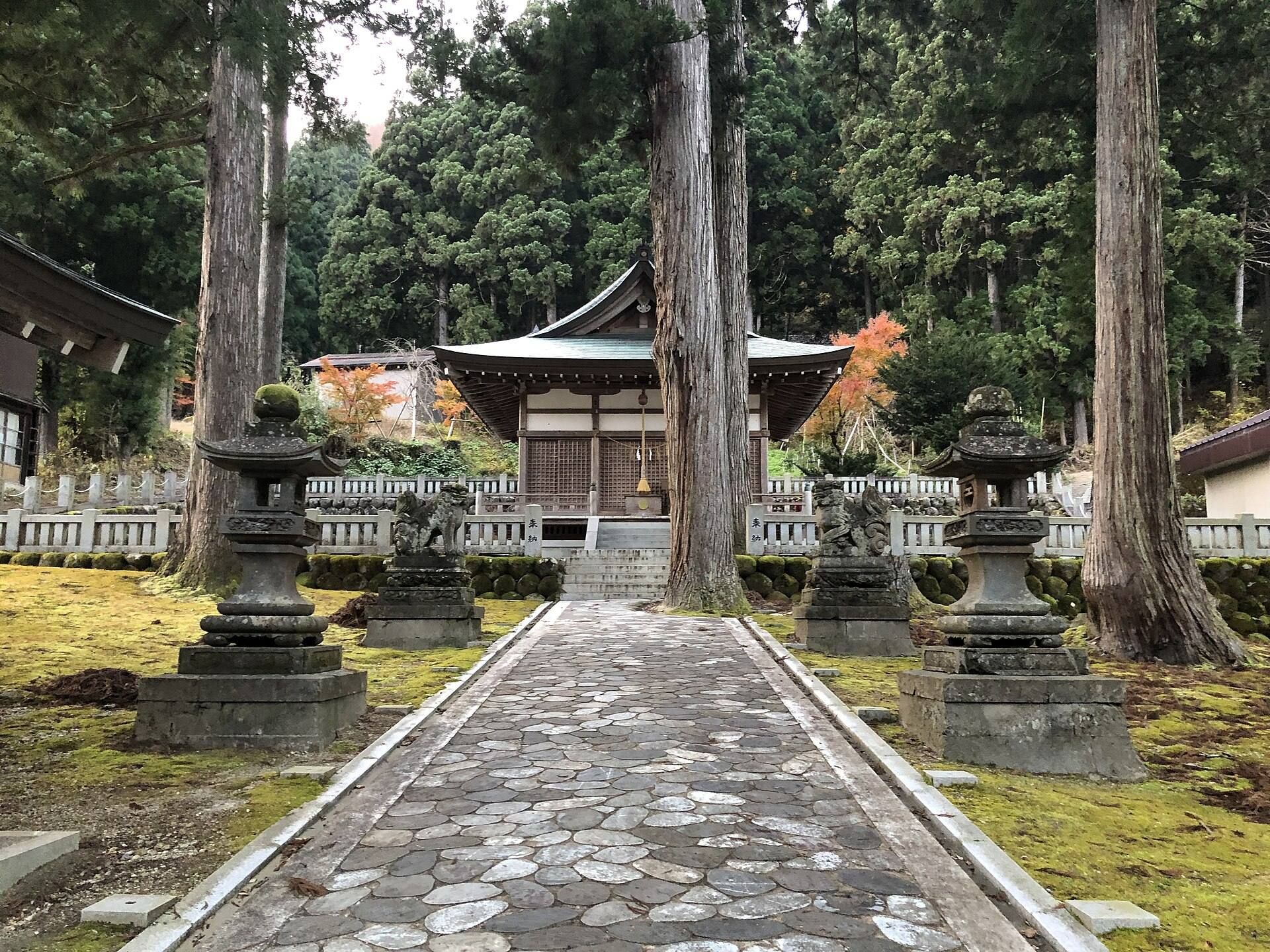
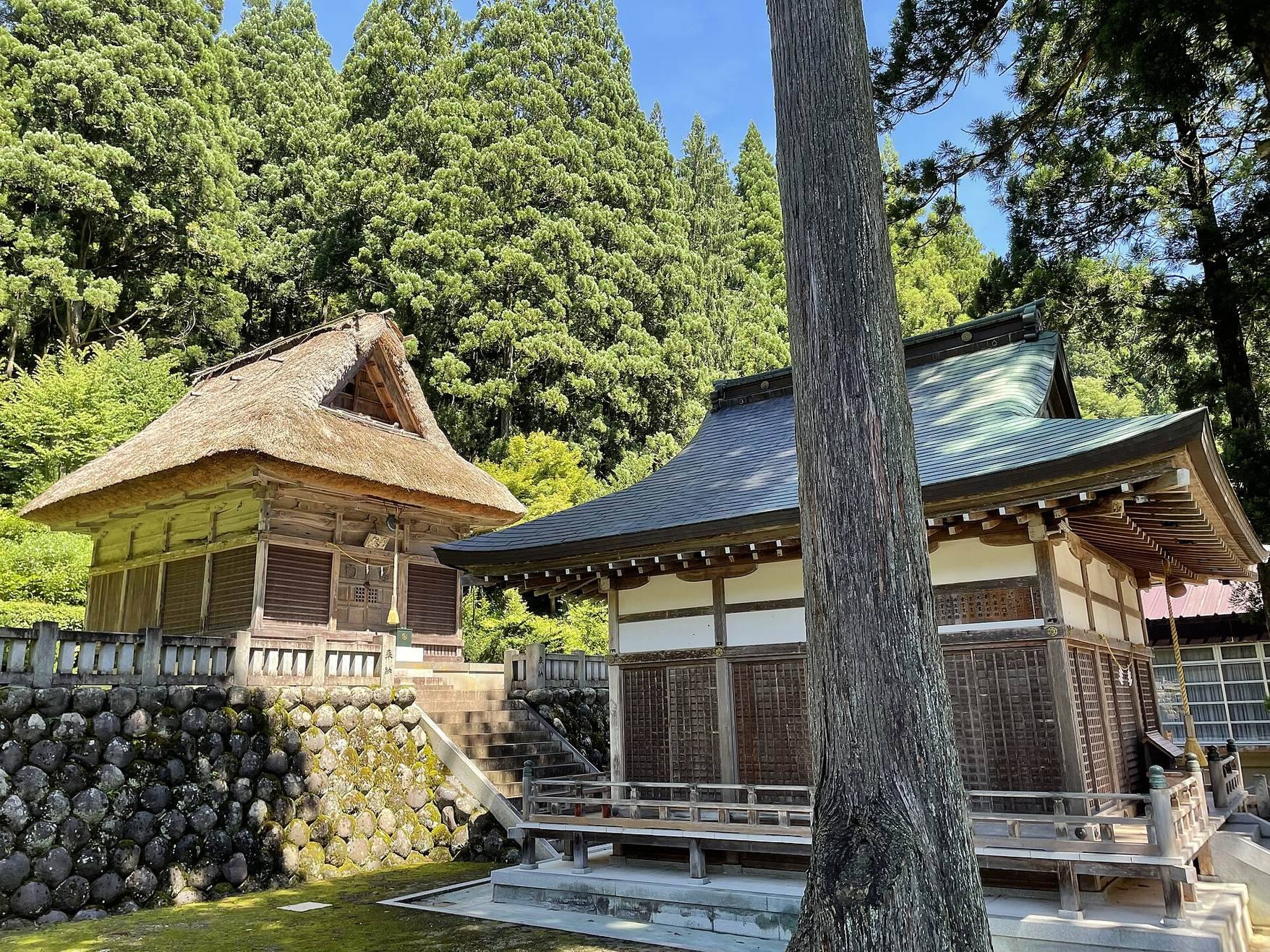
The surviving shrine is organized around a compact wooden main sanctuary, its projecting worship porch, and associated shrine structures on the grounds. The sanctuary is a one-bay building in the nagare-zukuri style, whose front roof slope extends forward over the worship area. Its construction period is known from the 1502 roof tablet, making it the oldest extant wooden building in Toyama Prefecture for which the construction period is known.
Main sanctuary
The sanctuary’s front bay measures 5 shaku, approximately 1.5 meters. Its side measures 4 shaku 3 sun, approximately 1.29 meters, while the projecting worship porch extends 2 shaku 7 sun, approximately 0.81 meters. Round columns support the structure, with horizontal nageshi tie beams at the lower and inner-beam levels. Boat-shaped bracket arms carry the purlin above the columns. Rainbow beams are incorporated into the sides, and the upper bracket assembly supports a large bracket block and patterned timber beneath the ridge beam and gable decoration. The roof combines a gabled form with a projecting subsidiary roof, creating the flowing profile characteristic of nagare-zukuri.
Religious materials
The shrine’s associated materials include groups of wooden Buddhist sculptures, Muromachi-period hanging Buddhist plaques, ritual implements, and votive offerings. They also include the Hakusan Honji-Suijaku Mandala, estimated to have been made at the end of the Muromachi period. The honji-suijaku concept identifies Buddhist figures as the original forms of local Shinto deities, and the mandala presents these sacred relationships together with their religious geography.
The mandala was held by Chōryūji, the Nagataki temple in Mino, no later than the late Edo period. Its composition brings together the Buddha regarded as Hakusan’s original form, the Shinto deity manifested from that Buddha, and a landscape extending from Owari and Mino to the mountain summit. A white-robed seated man occupies the center, while rays of light extend from the Buddha representation. Together with the sanctuary and other devotional objects, the mandala preserves the intertwined Buddhist and Shinto traditions that shaped Hakusan worship in Gokayama.