Het Oude Loo: A Fifteenth-Century Hunting Lodge in the Netherlands


Site at a Glance
- Rating
- 4.6
- Popularity
- Low
- Country
- Netherlands
- Primary era
- Medieval
- External website
- Open
- Eras represented
- Medieval, Modern
- Civilizations
- Dutch, Holy Roman Empire
- Site type
- Domestic
- Remains
- Castle
On this page11 sections
History
Medieval origins and aristocratic ownership
Het Oude Loo is a fifteenth-century hunting lodge in the Netherlands, located at Apeldoorn on the Het Loo Crown Estate near Het Loo Palace. Its oldest parts date from the fifteenth century. The property was first recorded in 1439, when it belonged to Udo Talholt, a wealthy councillor to the Duke of Guelders who had lent the duke a large sum of money. Talholt is considered a possible builder of the castle, providing the earliest known connection between the building and a named individual.
During the sixteenth century, the estate belonged to the Bentinck family, who enlarged the castle around 1540. It later passed for a time to the D’Isendoorn à Blois family, which also held nearby De Cannenburgh Castle. The property was associated successively with the families Varick, Arnhem, Voorst, Van Rossum, Isendoorn, Stepraedt, and Ulft. Members of these families held considerable ecclesiastical and administrative influence in Apeldoorn during the fifteenth and sixteenth centuries.
Purchase by Willem III and royal expansion
On 27 November 1684, Stadholder Willem III bought Het Oude Loo and its grounds. A stadholder was a leading provincial officeholder in the Dutch Republic. Until this purchase, the castle’s great hall, also known as the knights’ hall, contained a clandestine Roman Catholic church. Construction of Het Loo Palace began soon afterward because the older castle was too small for Willem III and his household.
Inheritance disputes during the eighteenth century brought frequent changes of ownership. Although Prince Willem V did not particularly value Het Loo, a large menagerie was built there for patriotic reasons. A menagerie was an enclosure or collection for keeping living animals, often as a display of status.
Occupation and nineteenth-century use
In 1795, Willem V departed for England as French Revolutionary forces confiscated the possessions of the House of Orange. The French garrisoned 3,000 soldiers at Het Oude Loo and Het Loo Palace. In 1806, Napoleon Bonaparte installed his brother Louis Bonaparte as monarch of the Batavian Republic, the French-aligned successor state established in the Netherlands in 1795. After Louis took up residence at Het Loo during the summer of that year, he ordered the moat around Het Oude Loo to be filled in. He had been told in childhood that he would die by drowning.
Between 1839 and 1855, the castle served as a base for the Royal Loo Hawking Club, an international association devoted to falconry and other outdoor activities. The club used a room in the castle for meetings and dinners. Prince Alexander, the second son of Willem II, was its chairman, while Prince Willem, the future Willem III, was a member.
Restoration and continuing royal use
Queen Wilhelmina commissioned the architect Pierre Cuypers to restore Het Oude Loo comprehensively in 1904. Cuypers reconstructed the moat and made extensive changes based on his interpretation of the castle’s original design. His son Jos Cuypers completed the work after Pierre Cuypers died in 1921.
The castle saw little use after this restoration and soon deteriorated. By 1948, its roof structure was considered unsafe, and special safety measures were introduced. A new restoration began in 1968 under C. W. Royaards. After Royaards died in 1970, J. B. Baron van Asbeck completed the work in 1976, largely following Royaards’ plans. Much of Cuypers’ intervention was removed, including the enlarged southwest tower and the tower addition against the south wing.
Since 1968, Het Oude Loo has been owned by the State of the Netherlands through the Rijksgebouwendienst, the government agency responsible for national government buildings. The Dutch royal family leases the castle and continues to use it as an outside residence and meeting place, particularly after Het Loo Palace was relinquished in 1975. Het Oude Loo is protected as a national monument of the Netherlands under Rijksmonument number 8175.
The castle has also accommodated members of other royal families and people displaced by war. On 17 August 2006, Japan’s Crown Prince Naruhito and Crown Princess Masako moved into Het Oude Loo for six weeks. The Dutch royal family made the castle available because Masako was experiencing psychological pressure associated with the rigid etiquette of the Japanese court. In March 2022, the Dutch king announced that the castle would house Ukrainian refugees displaced by Russia’s invasion of Ukraine. The 33 temporary residents moved to new accommodation in January 2023.
Remains
Castle structure
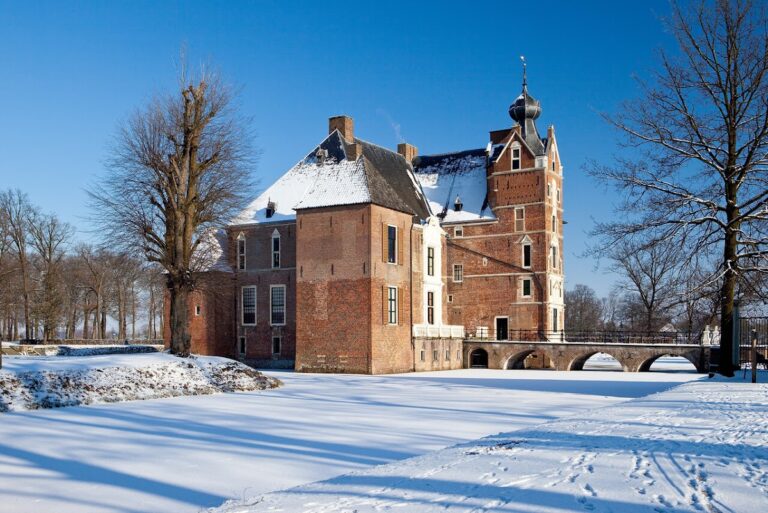
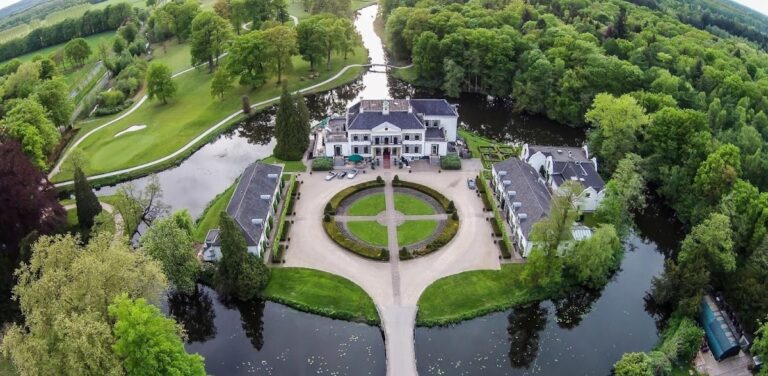
Het Oude Loo developed from a small rectangular castle built mainly of brick, with limited use of natural stone. The earliest building corresponds to the present front wing and had two round corner towers. Around the middle of the sixteenth century, two wings were added at the rear, enclosing an inner courtyard. A wall closed the courtyard on its fourth side, while the rear corner tower belongs to the first construction period.
Front wing and towers
The front wing preserves the form of the original rectangular building. Its corner towers express the castle’s earliest arrangement, while the southwest tower also reflects the changes made during the twentieth-century restorations. Cuypers raised this tower and gave it a transverse roof. The later restoration returned it to its earlier form.
Rear wings and courtyard
The rear wings, added around the middle of the sixteenth century, enclose the inner courtyard with the original building and the wall on its fourth side. Cuypers added a tower against the south wing as an escape route, although no tower had originally stood there. During the later restoration, this addition was replaced by a more slender wooden version.
Great hall and moat
The great hall, or knights’ hall, formerly housed the clandestine Roman Catholic church. The moat surrounding the castle was filled in during Louis Bonaparte’s residence in 1806 and restored during Cuypers’ work, which began in 1904.
Garden and commemorative features
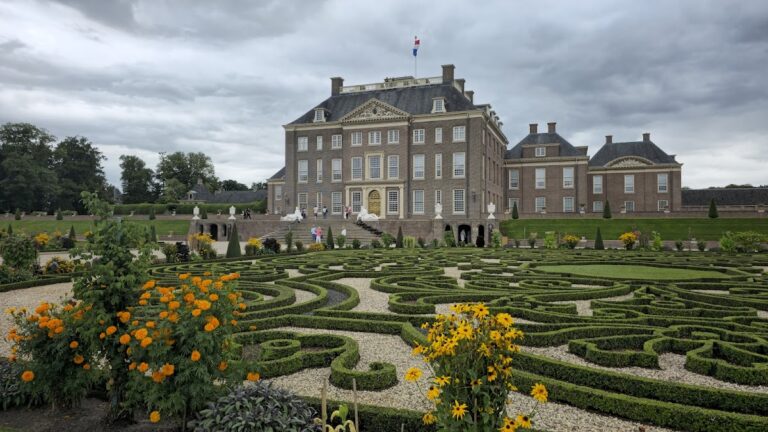
The castle’s associated garden contains a basin with statues, a tree maze, and an outdoor bowling area. J. B. Baron van Asbeck arranged the garden according to its historical layout during the restoration completed in 1976.
Opposite the castle, a commemorative plaque bears the inscription “Presented by the Ukrainian guests in 2022.” A Gelderse Roos tree was planted there in connection with the stay of the Ukrainian residents.
Nearby sites