Hermopolis: An Ancient Egyptian City and Cult Center
Site at a Glance
- Popularity
- Very High
- Country
- Egypt
- Primary era
- Classical
- Eras represented
- Classical
- Civilizations
- Byzantine, Egyptian, Ptolemaic
- Site type
- Settlement
- Remains
- City
On this page8 sections
History
Hermopolis, also known as Hermopolis Magna, was an ancient Egyptian city near the modern town of el-Ashmunein in Mallawi, Minya Governorate, Egypt. It stood near the historical boundary between Upper and Lower Egypt and served as the capital of the Hare nome, an administrative district of Upper Egypt, from the Old Kingdom onward. Because Upper Egypt extended farther north in some periods than it did later, the city’s position at this boundary shifted over time.
Early Egyptian city and cult center
Hermopolis became prosperous and busy as a border city, and was regarded as second in importance only to Thebes. Its Egyptian name, Khemenu, means Eight-Town and refers to the Ogdoad, a group of eight deities associated with creation. The name passed into Coptic as Shmun and underlies the modern name el-Ashmunein.
The city was a principal center of worship for Thoth, the Egyptian god associated with writing and wisdom. Greek speakers called it the City of Hermes, identifying Thoth with their god Hermes. Thoth was also associated with the Phoenician deity Eshmun, and temple inscriptions gave him the title Lord of Eshmun. Set, known to the Greeks as Typhon, was another principal deity worshipped at Hermopolis.
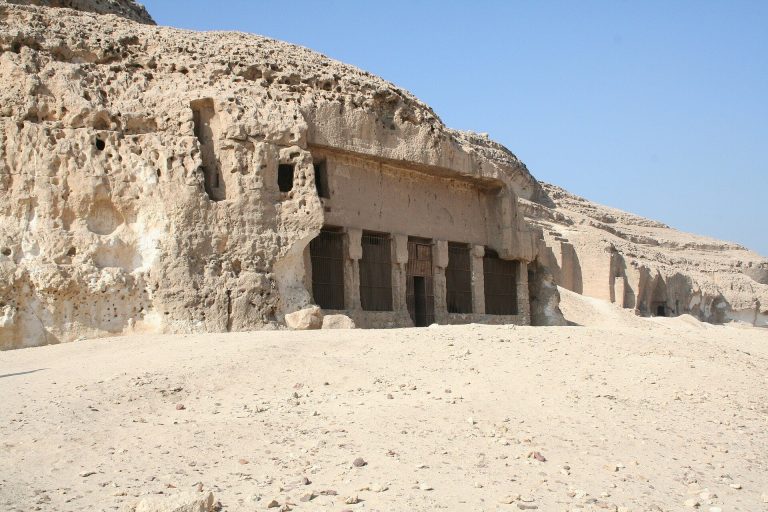
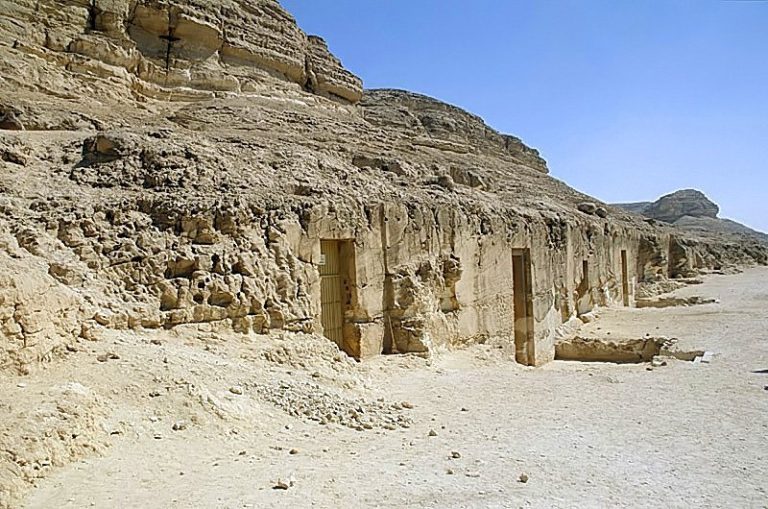
A fortress lay a short distance south of the city, where river craft arriving from the Thebaid, the region around Thebes and farther south, paid tolls. Hermopolitans buried their dead in caves at Beni Hasan, across the Nile near Antinoopolis. Crossing the river made this easier than transporting the dead overland to the western hills.
Roman and Christian periods
Hermopolis grew into a major city in Roman Egypt and an important center in Thebais Prima, a Roman provincial division within the larger administrative division of Egypt. A third-century CE papyrus from Oxyrhynchus describes buildings in the city reaching as many as seven storeys.
Christian tradition identifies Hermopolis as a refuge for Jesus, Mary, and Joseph, known as the Holy Family, during their exile in Egypt. From the third century, the city was an early Christian center. Its diocese was subordinate to the senior church see at Antinoe, within the Patriarchate of Alexandria.
Conquest and later history
Hermopolis’s Christian diocese declined under Muslim rule, and the city was abandoned after the Muslim conquest of Egypt. Its buildings were later badly damaged as stone was burned to make lime or taken away for use in other construction. The city had escaped much of the warfare that devastated the Heptanomis, a historical region of Middle Egypt, during the late Pharaonic and Roman periods.
The ancient city’s name continued in church titles. In the eighteenth century, Hermopolis Maior was nominally restored as a Latin Catholic titular see, a former diocese retained in name without territory or an active local bishop. Its title was Hermopolis Magna from 1925 to 1929; in 1849, its territory had been reassigned to the Coptic Catholic Eparchy of Minya. The Latin titular see was suppressed in 1949. A Coptic Orthodox titular see was also associated with Hermopolis, although its continuing status is uncertain. Arabic papyri concerning the city, dating from the eighth to the eleventh centuries, are held in Manchester’s John Rylands Library.
Moharam Kamal discovered the basilica in 1942, and an Alexandria University expedition later cleaned it. A Polish-Egyptian expedition documented the building between 1987 and 1990.
Remains
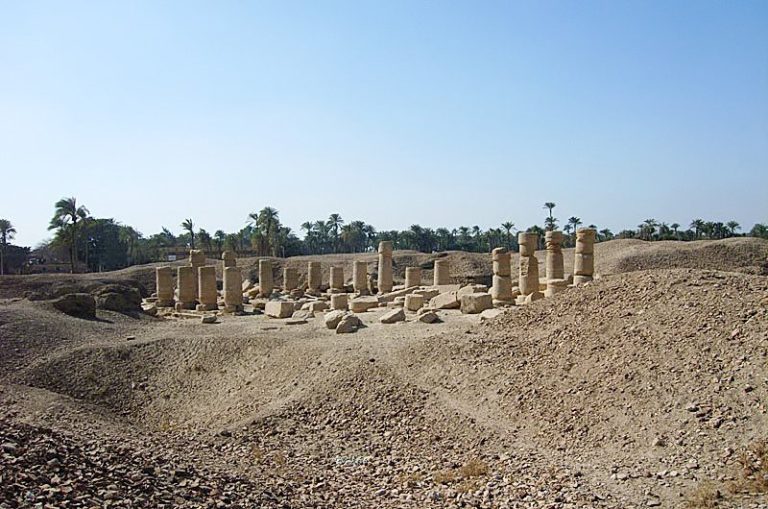
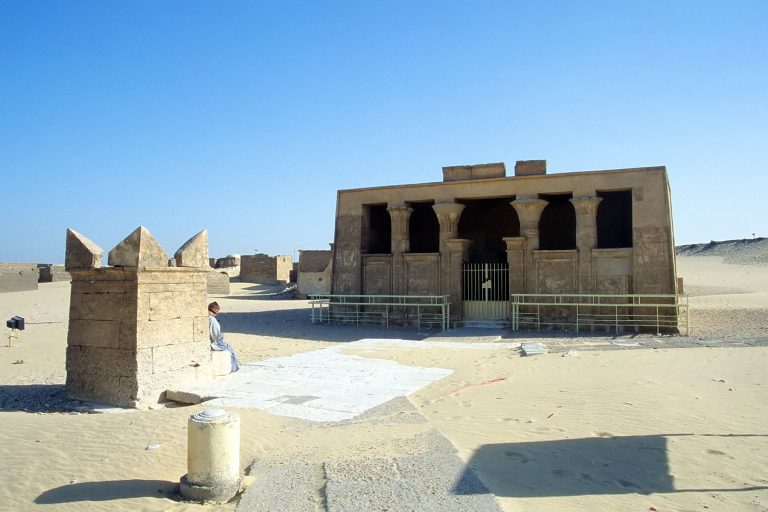
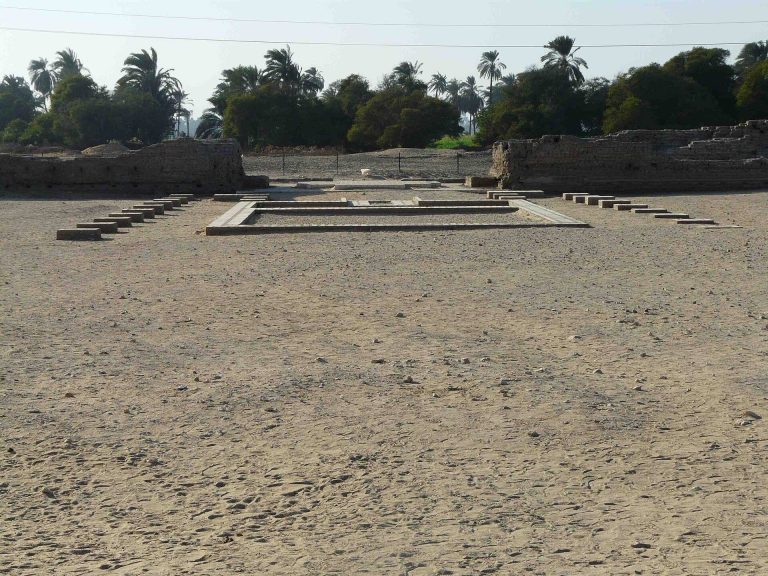
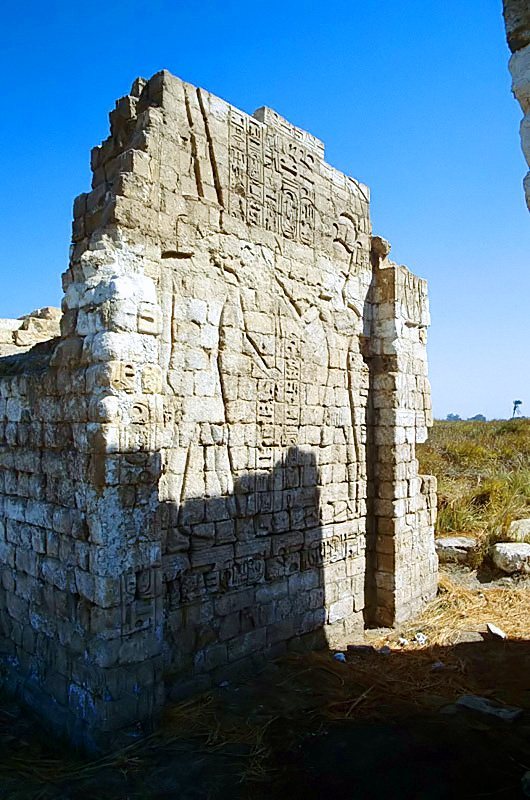
The surviving remains include a temple portico and a Coptic basilica outside the temple complex. The site also has a small open-air museum containing statues and carved blocks.
Temple portico
The portico, which dates to the Pharaonic era, survives as a remnant of the temple. Extensive building works were carried out at Hermopolis during the Ptolemaic period, when Greek-origin monarchs ruled Egypt, but the work followed essentially Egyptian forms. Sculptures on the great portico showed Thoth with the ibis and baboon as emblems.
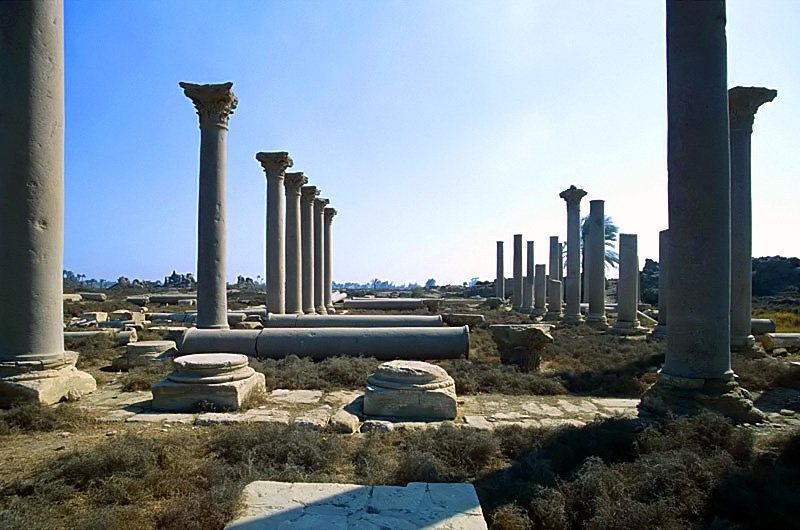
The portico has two rows of six pillars. Its horizontal beams above the pillars, called architraves, are each made from five stones spanning between pillar centers. The middle span is wider, and the stone above it is 25 feet 6 inches long. The pillars were painted in alternating yellow, red, and blue bands. Rather than being assembled from large horizontal blocks, each was formed from irregular pieces fitted so closely that the joints are difficult to see.
The pillar bases represent lower lotus leaves, with concentric rings above them and then reed-like bundles bound by horizontal bands. Each pillar is about 40 feet high and tapers toward its base and top. Its greatest circumference, about 28.5 feet, is roughly five feet above ground. The widest space between pillars is 17 feet; the other intervals are 13 feet. The same pillar form is known at the temple of Gournou in the Theban region.
Coptic basilica
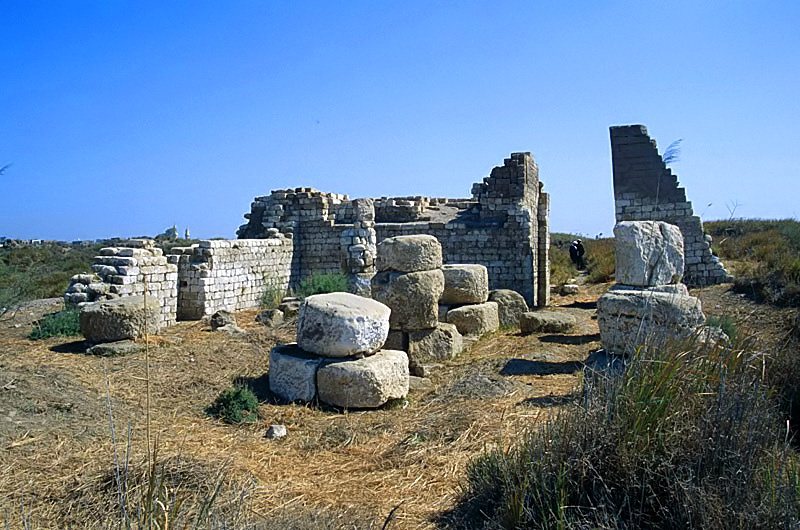
Built in the fifth century over earlier buildings, the basilica is 55 metres long. A basilica is a large church organized around a main central space, or nave, with side aisles and an apse, usually a semicircular end. At Hermopolis, the nave and apse are 14.7 metres wide, while the aisles are 5.6 metres wide. A crosswise arm, or transept, ends in recessed spaces called exedras, and the church also has side galleries.
Open-air museum
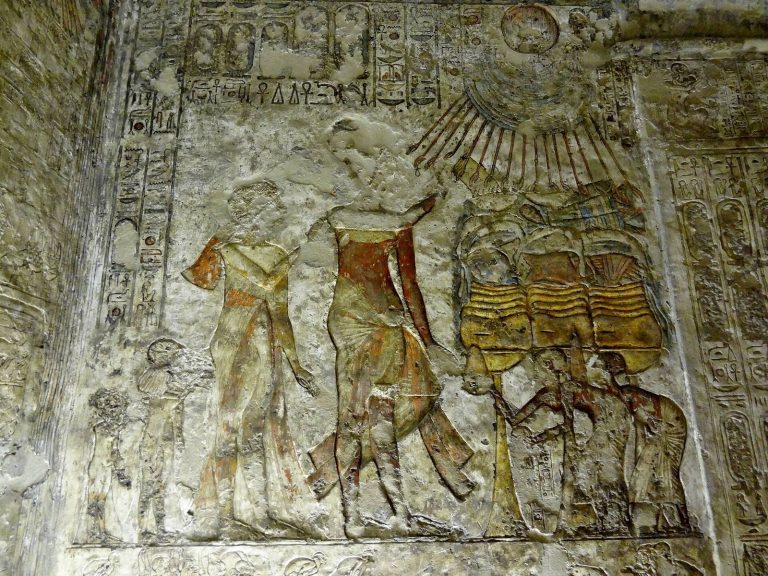
The small museum at the site contains two large statues of Thoth represented as a baboon worshipping the sun, together with several carved masonry blocks.