Quedlinburg Abbey: A Royal Women’s Foundation and Imperial Center
Site at a Glance
- Popularity
- High
- Country
- Germany
- Primary era
- Medieval
- Eras represented
- Medieval, Modern
- Civilizations
- German, Holy Roman Empire
- Site type
- Religious
- Remains
- Church
On this page11 sections
History
Quedlinburg Abbey, a royal women’s collegiate foundation in Quedlinburg, Germany, was established in 936 by East Frankish King Otto I at the request of his mother, Queen Mathilda. It commemorated Mathilda’s husband, Henry I, who had died that year. The surviving church and associated buildings form a remarkably complete Romanesque ensemble, while the abbey itself became an important royal memorial and center of imperial life.
Royal memorial and imperial center
The foundation occupied a hill where Henry I had maintained a fortified royal residence, intended in part to strengthen the realm’s defenses against Hungarian attacks. Henry and Mathilda frequently stayed there, and the hill became their burial place. A palace beside the abbey later hosted Holy Roman Emperors, including for Easter celebrations.
Mathilda guided the community until 966 but did not hold the office of abbess. That position first belonged to her granddaughter Mathilda, Otto I’s daughter. The foundation was for unmarried women of noble and royal families who lived communally without taking formal monastic vows. They followed the Aachen rule, regulations for such communities established at a church council in 816. Quedlinburg provided education and support for noblewomen and widows, as well as maintaining the royal family’s commemorations.
Ottonian rulers endowed the abbey with property and granted it immunity and direct standing in the Holy Roman Empire. It was one of about forty Imperial Abbeys, religious institutions with a direct position in the Empire rather than ordinary subordination to a territorial ruler. Its abbess held a seat and vote in the Imperial Diet, the assembly of the Empire’s estates, on the Rhenish prelates’ bench. Popes granted protection and exemption from diocesan authority in 946 and 966. Although the abbess formally answered to no church superior other than the pope, the bishops of Halberstadt repeatedly challenged her authority.
Emperor Otto III granted the abbey the rights to hold a market, mint coins, and collect tolls in 994, alongside further property. Under the Ottonian and subsequent Salian dynasties, successive ruling houses of East Francia and the Empire, Quedlinburg served as an educational institution and an imperial gathering place. East Frankish rulers stayed there more than sixty times. Empresses Adelaide and Theophanu also spent periods at the foundation.
The abbey’s political connections helped support its written record. Work on the Quedlinburg Annals began there in 1008 and was completed in 1030, probably by a woman. The chronicle focused chiefly on the Holy Roman Empire. Quedlinburg’s ties to the rulers and its proximity to Magdeburg brought it information about political affairs.
Land, dependent houses, and changing protection
Royal gifts and later purchases built a wide estate. Otto I granted Quedlinburg Soltau in 936, about 170 kilometres away, and lands around the town, including areas cleared for cultivation. He made further grants over the following decades, as did Otto II and Otto III; later acquisitions added more than 150 estates. Among the abbey’s other possessions were Duderstadt, received in 974 and held for 262 years, and Potsdam, granted by Otto III on 3 July 993. That grant is the town’s first documentary mention and came amid attempts to recover lands east of the Elbe after the Slavic uprising of 983. Gera passed to the abbey in 999, and in 1209 its abbess appointed administrators there.
Religious houses also depended on Quedlinburg. These included the convent of St Mary on Münzberg, founded in 986, and foundations at Walbeck, Michaelstein, and Brehna. In 956 Otto I gave Quedlinburg the Church of St Michael near the Volkmarskeller cave; Abbess Beatrix II later established the site as Michaelstein Abbey. Houses within Quedlinburg included the foundation of St Wigbert and St James, which became a Premonstratensian community in 1139–46, as well as Franciscan and Augustinian Hermit houses established in the later thirteenth century.
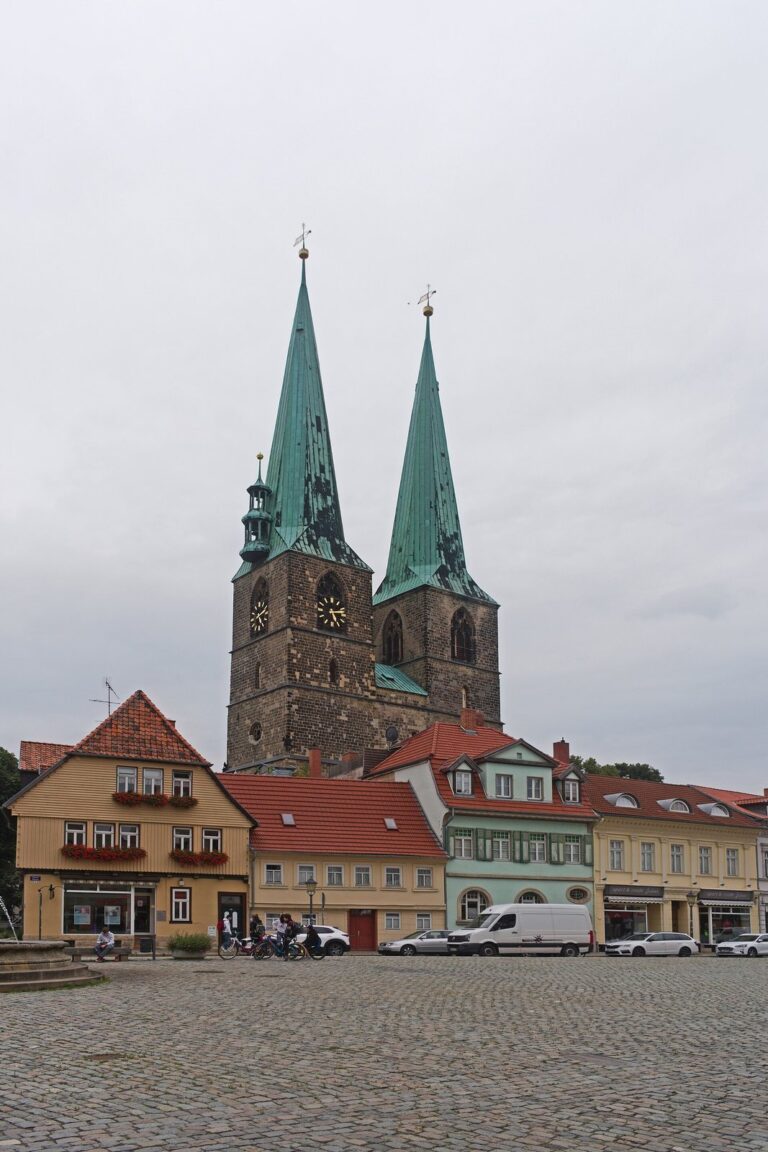
A market settlement and nearby communities developed into the town of Quedlinburg around 1300 under the abbey’s protection. Relations between the town and the foundation were sometimes strained. Protective authority over the abbey shifted from Harz counts in the mid-twelfth century to the counts of Regenstein in 1273, and then to the Wettins in 1477. Disputes involving the town, the bishop of Halberstadt, Abbess Hedwig of Saxony, and her brothers Ernst and Albrecht preceded the establishment of Saxon electoral protection in 1477–79. The Albertine Wettin line held that role from 1485. Brandenburg acquired the rights in 1697, and Brandenburg-Prussian forces occupied the abbey’s territory on 30 January 1698.
Reformation, dissolution, and modern history
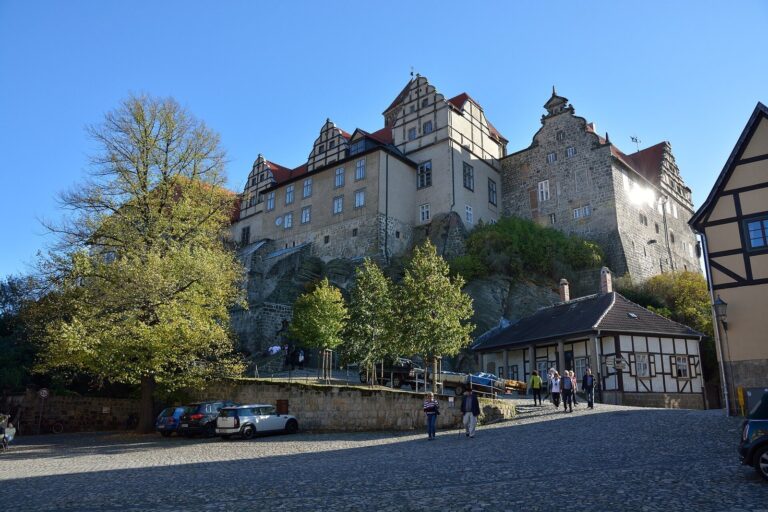
Quedlinburg adopted Protestantism in 1539 under Abbess Anna II, Countess of Stolberg, its last Catholic abbess. The institution continued as a Lutheran women’s foundation. In 1802–03, secularization, the transfer of church property and political authority to a secular state, brought its lands, property, and subjects under Prussian control as the Principality of Quedlinburg. The former abbey building subsequently became known as Quedlinburg Castle. The territory belonged to the Napoleonic client state known as the Kingdom of Westphalia from 1807 to 1813, then entered Prussia’s Province of Saxony around 1815–16. Sophia Albertina of Sweden was the final abbess.
At the end of the Second World War, American soldier Joe Tom Meador stole valuable objects from the abbey treasury. They resurfaced in 1987 and were returned to the church in 1993 after legal proceedings. From 1936, Heinrich Himmler, a senior Nazi official, held ceremonies in the church crypt on 2 July, the anniversary of Henry I’s death. He presented Henry as the first German king and promoted the tomb as a German pilgrimage site. Human remains said to be Henry’s were placed in a new sarcophagus in 1937; after the war, they were treated as a forgery and removed.
In 1994 UNESCO inscribed the collegiate church, castle, and old town as a World Heritage property. The listed area covers 90 hectares, with a 270-hectare buffer zone.
Remains
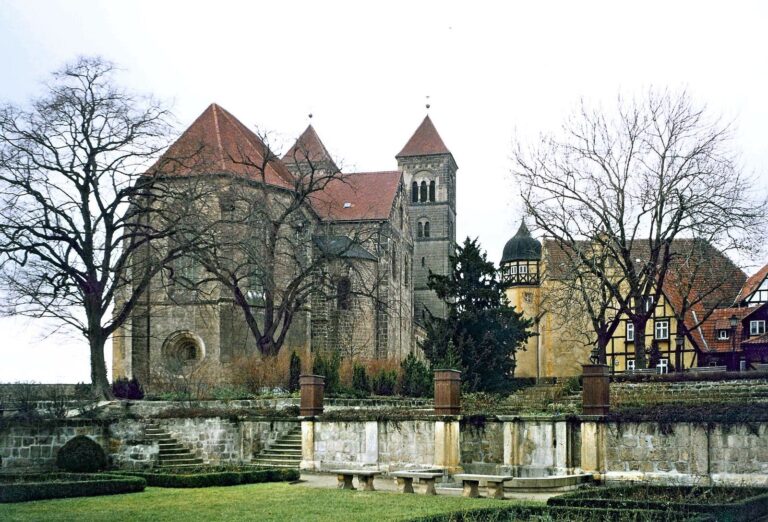
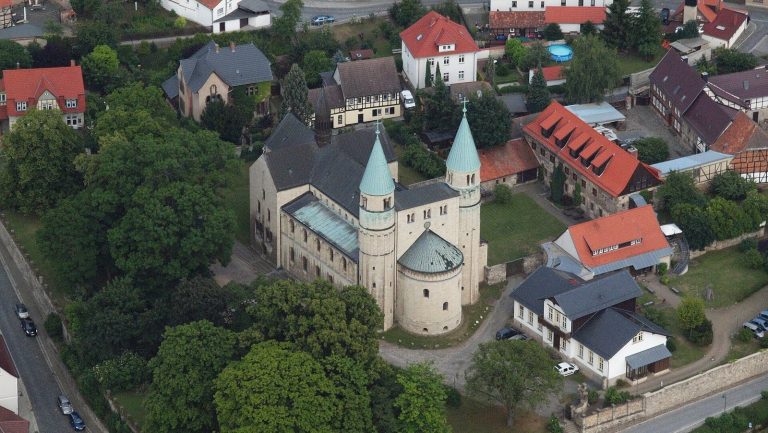
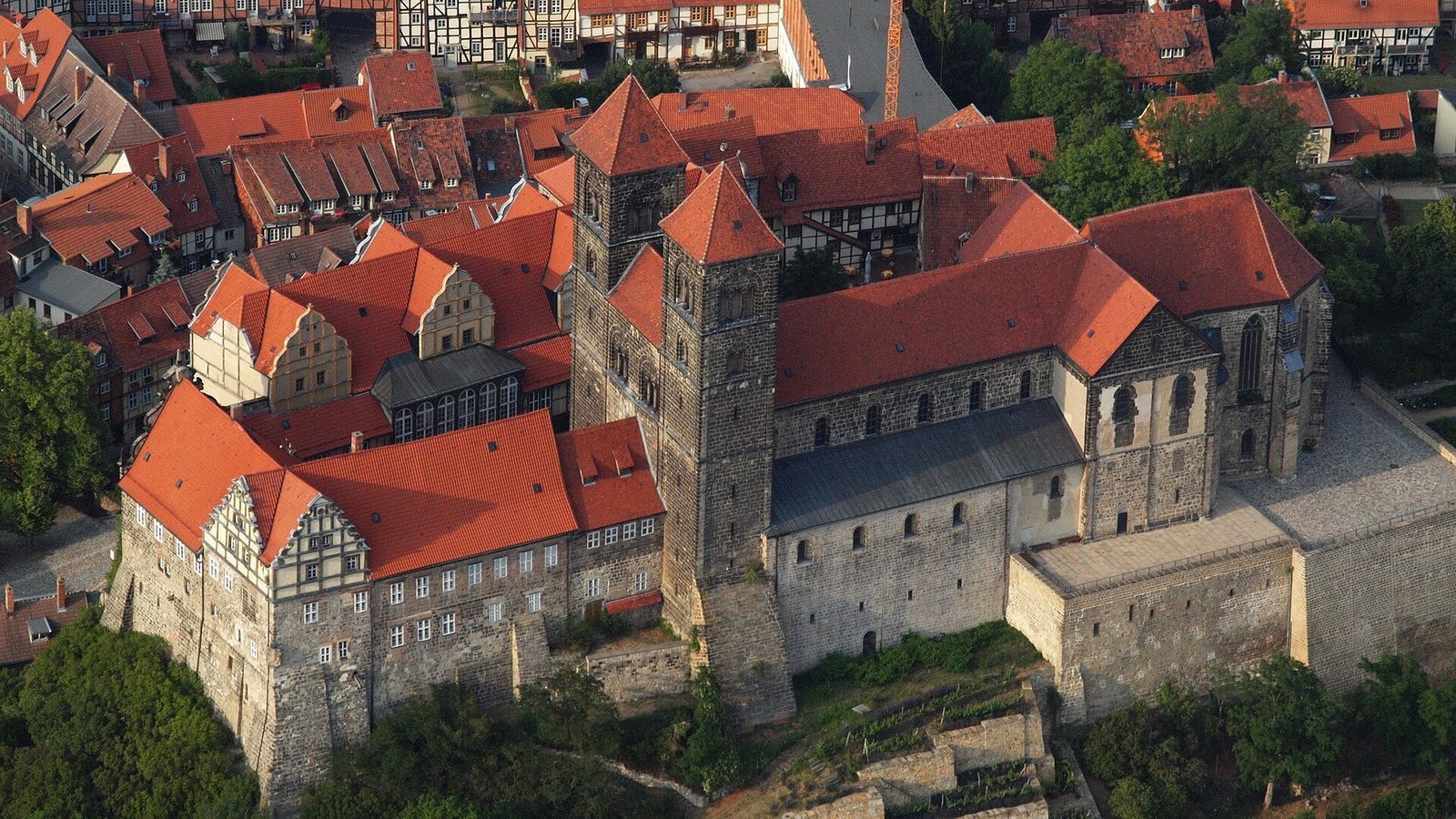
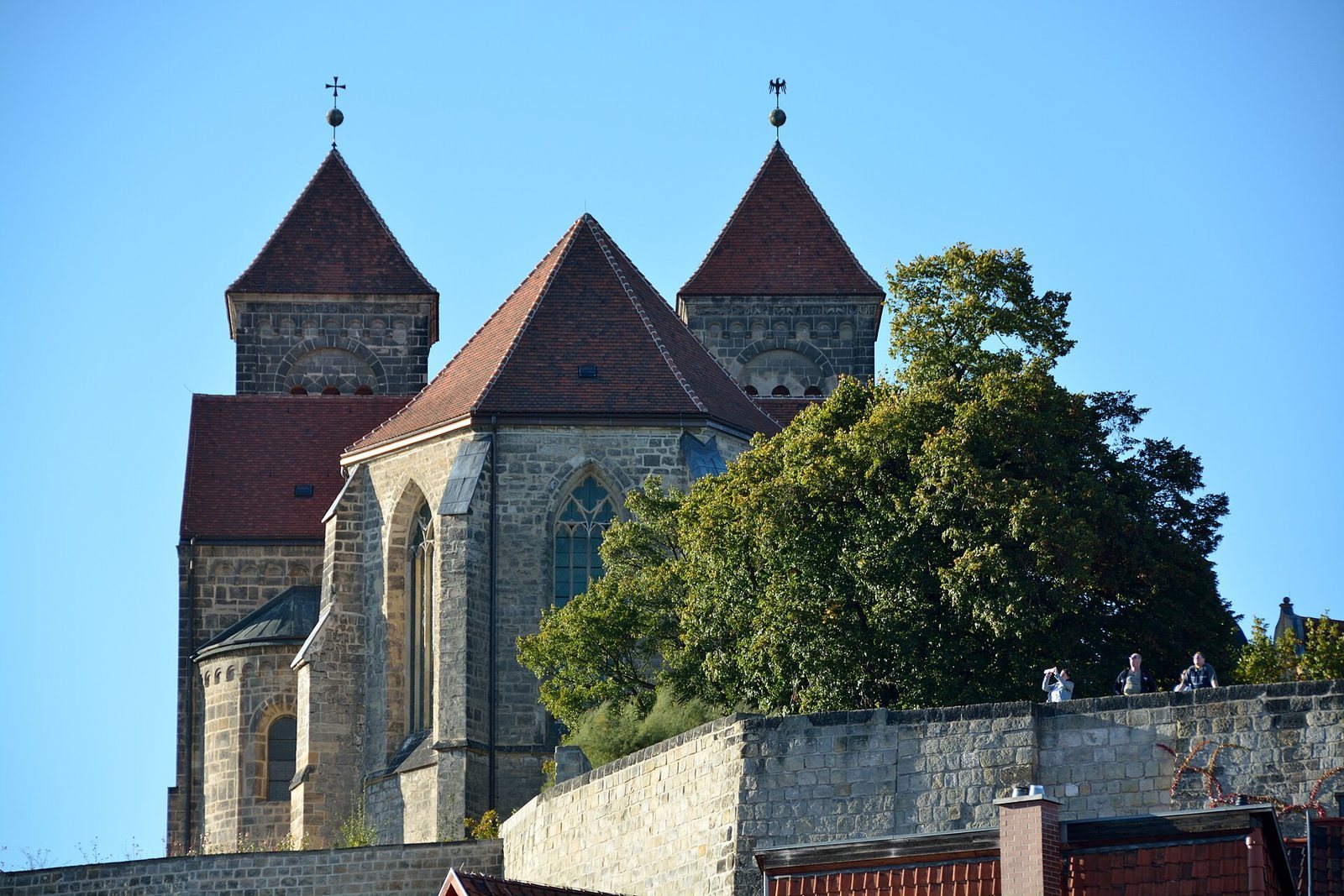
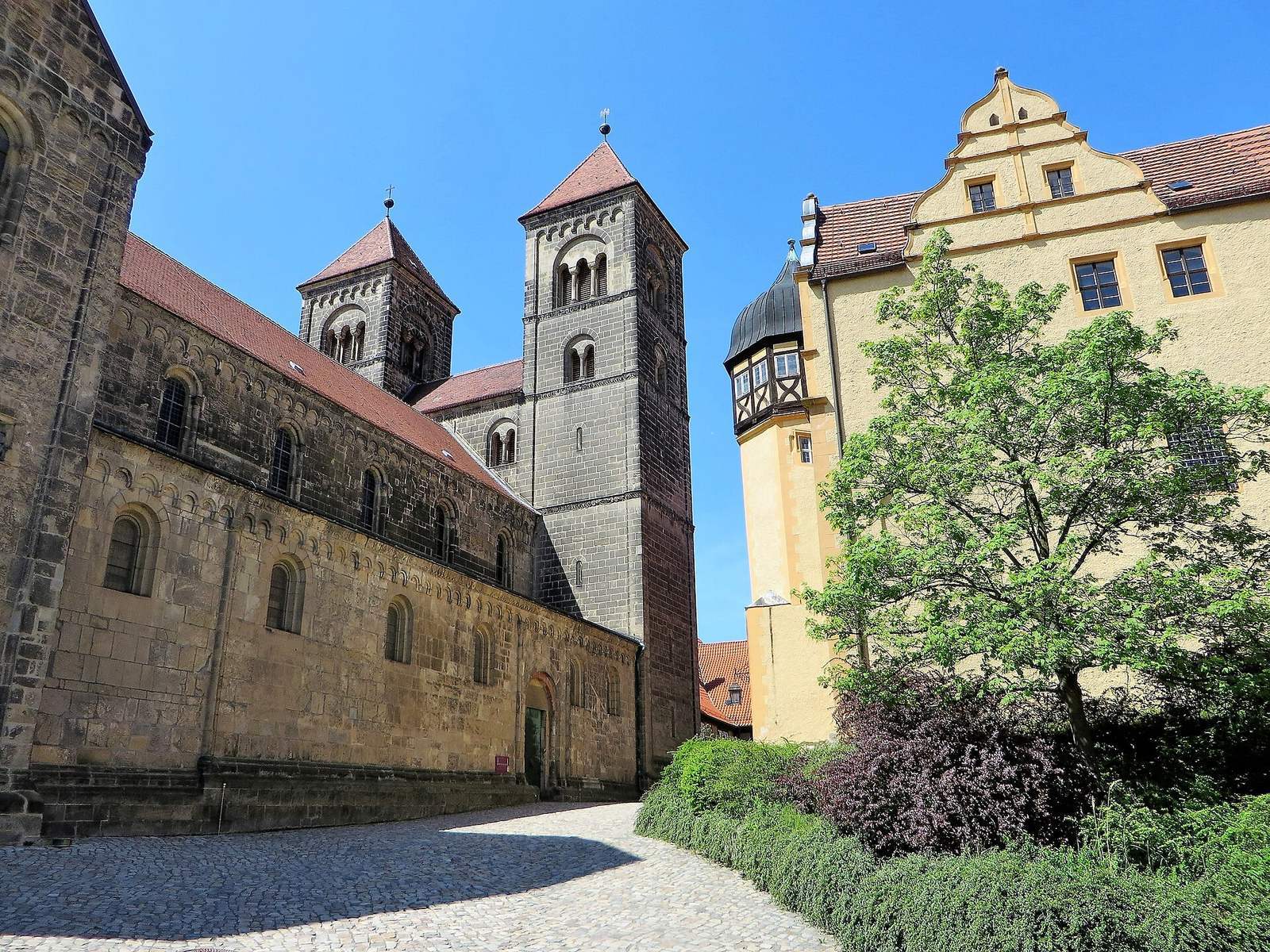
The surviving abbey ensemble includes the collegiate Church of St Servatius, the castle, and surrounding buildings. The church is dedicated to Saints Servatius and Denis. Although often called Quedlinburg Cathedral, it has never been a bishop’s seat.
Collegiate church
Basilica and later alterations
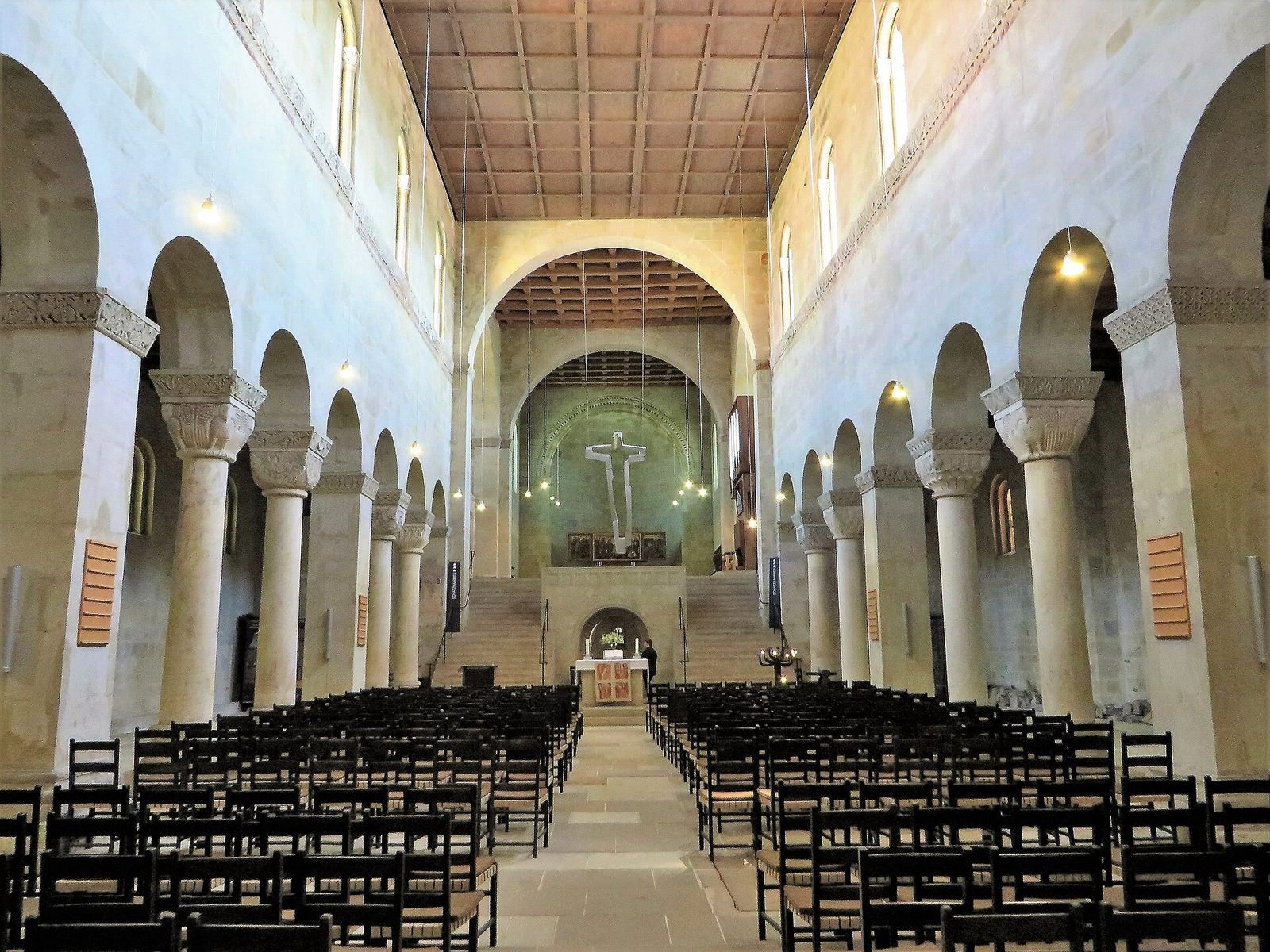
The church is a flat-roofed, three-aisled basilica, a building with a long central nave and side aisles. It stands over the remains of three earlier church buildings. The structure immediately before it was a smaller three-aisled church with narrow side aisles. In the present church, two columns alternate with a heavier masonry support known as a pier.
Later changes are visible in the choir and in sections of the south transept and south nave walls. The western towers were rebuilt, a pulpit was added, and nineteenth-century renovation gave the crypt a new front. Under the Nazi regime the choir was reshaped for shrine use, and the interior was altered to evoke a more Romanesque appearance. The church was rededicated in 1945, and restoration has continued since then.
Crypt and burials
The crypt contains burial associations with Henry I and Mathilda. Henry’s grave has a battered, empty stone coffin; the whereabouts of his remains and the circumstances of their disappearance are unknown. The crypt also holds the remains of Saint Mathilda and her granddaughter, Abbess Mathilda, as well as the burials of Abbesses Adelaide I, Beatrice I, and Adelaide II.
Treasury and manuscript remains
Relics and liturgical objects
Relics of Servatius of Tongeren were brought from Maastricht to Quedlinburg in 961. The church treasury also held books, manuscripts, and objects used in public worship. Its treasures included a reliquary of Servatius dating from the time of Charles the Bald, the ninth-century Samuhel Gospel book, the printed Gospel book of St Wipert from 1513, and an ivory comb used in liturgical practice. The treasury ranked among the most valuable medieval church treasuries, alongside those of Aachen and Halberstadt.
The Quedlinburg Itala fragment
The Quedlinburg Itala is a group of six leaves from a fifth-century illustrated Latin Bible, containing parts of 1 Samuel in an early translation that predates the Vulgate. It is considered the oldest surviving illustrated biblical manuscript. The leaves measure about 305 by 205 millimetres and were probably produced in Rome in the 420s or 430s. Fragments were found from 1865 onward reused in the bindings of seventeenth-century books in Quedlinburg: two in 1865, two in 1867, and one in 1887. The manuscript may have spent much of its earlier history at the abbey. The fragment has been held by the Berlin State Library since 1875–76.