Hampton Down Stone Circle: A Prehistoric Monument in Dorset
Site at a Glance
- Popularity
- Low
- Country
- United Kingdom
- Primary era
- Bronze Age
- Eras represented
- Bronze Age, Modern
- Civilizations
- British
- Site type
- Civic
- Remains
- Megalithic Monument
On this page6 sections
History
Hampton Down Stone Circle is a prehistoric stone setting at Portesham in Dorset, United Kingdom. It is generally thought to have been built during the Bronze Age, probably in its Early phase, although its construction date remains uncertain. Stone-circle building across Britain, Ireland and Brittany extended from about 3300 to 900 BCE, with its principal building phase around 3000 to 1300 BCE. These dates describe the wider tradition, not a securely established date for Hampton Down.
Date and interpretation
Archaeologist Geoffrey J. Wainwright proposed an Early Bronze Age date by comparing the circle with other examples whose dates were better established. Stuart and Cecily Piggott also considered Dorset’s circles probably Bronze Age, while allowing that their use, and perhaps their construction, could have continued into the Middle or Late Bronze Age. Aubrey Burl questioned whether Hampton Down was a stone circle, suggesting instead that its stones formed the kerb, or ring of edge stones, around a Bronze Age round barrow, a roughly circular burial mound. Nearby Dorset barrows, including examples at Poole, informed this interpretation.
Hampton Down is one of nine possible stone circles in Dorset, all within five miles of the sea. All but Rempstone are on chalk hills west of Dorchester. The group’s circles are generally small, oval settings made of sarsen, a hard sandstone, though their original outlines may have changed; none is more than 28 metres across. Circles on Dartmoor and Exmoor, and at Stanton Drew to the north, are cited as parallels. Hampton Down and other Dorset circles may also have been associated with local earthen henges.
The circle’s purpose is unknown. A religious function has been suggested, including the possibility that its stones were associated with supernatural beings, but no specific use has been established.
Displacement and excavation
Evidence from soil layers led Wainwright to suggest that agricultural work moved the stones from their original position during the second half of the seventeenth century. By 1908 the setting had been shifted east, and a hedge crossed the site. A photograph from that year showed 16 stones, the same number recorded by the Piggotts in 1938. By 1939, a hedge and bank divided the circle from north to south, leaving its three westernmost stones apart from the others.
Agricultural activity disturbed the stones again in 1964. When the field east of the hedge was cleared, numerous surface stones were added to the group, bringing its total to 28. Some may have come from another nearby prehistoric monument, such as a long barrow or round barrow. In May 1965, the Ministry of Public Building and Works, a government department responsible for public building projects, ordered an excavation led by Wainwright. By 2003, Hampton Down was the only stone circle in Dorset to have been excavated. The site is protected as a scheduled monument under the Ancient Monuments and Archaeological Areas Act 1979.
Remains
Setting and excavated plan
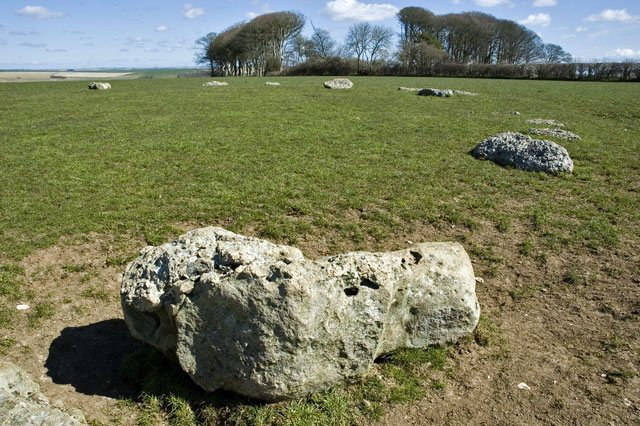
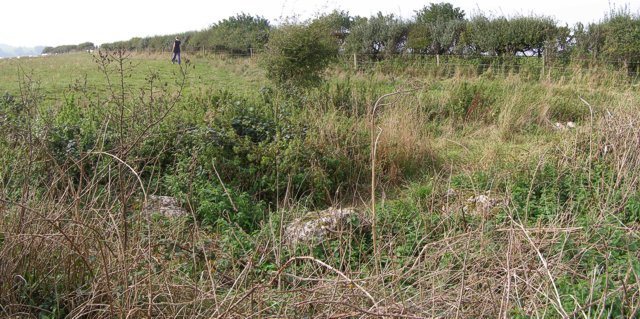
The excavated monument is an oval arrangement of sarsen stones on the southern edge of an open downland ridge, at the rim of Portesham Hill, about 680 feet above sea level. The site overlooks the coast; if vegetation was low when the setting was built, it may have offered wide coastal views. Excavation revealed an original plan measuring about 20 feet (6.5 metres) along its longest axis, with eight or perhaps nine holes for stones. The original setting lay a few feet west of the displaced group, beneath the adjacent hedge. V-shaped ditches marked its eastern and western edges. A track about 4 feet (1.2 metres) wide approached from the north and met the circle beside three stake holes on its western side.
Stones and reconstruction
In 1939, the Piggotts judged ten stones in the eastern half likely to remain in their original positions. Their roughly cubical forms did not show whether they had stood upright or lain on the ground, and the Piggotts estimated a circle about 35 feet (11 to 12 metres) across. The holes found by excavation instead indicated a substantially smaller setting. After the investigation, several stones were placed in the original holes to reconstruct the circle, and the surplus stones were removed. A fence was erected around the site to discourage further interference.