Hagia Irene: Byzantine Church and Imperial Arsenal in Istanbul


Site at a Glance
- Rating
- 4.1
- Popularity
- Medium
- Country
- Turkey
- Primary era
- Medieval
- External website
- Open
- Eras represented
- Classical, Medieval
- Civilizations
- Byzantine, Roman
- Site type
- Religious
- Remains
- Cathedral
On this page12 sections
History
Hagia Irene is an early Byzantine church in Istanbul, Turkey, whose origins are traditionally associated with Constantine I in the fourth century. Dedicated to “Holy Peace” or “Divine Peace,” it commemorated a divine attribute rather than a saint named Irene. Alongside Hagia Sophia, dedicated to divine wisdom, and Hagia Dynamis, dedicated to divine power, it belonged to a group of churches named for aspects of the divine. The church became the first cathedral of Constantinople and served as the seat of the Patriarchate before Hagia Sophia was completed.
Constantinople’s First Cathedral
Tradition holds that Constantine I, the Roman emperor who established Constantinople as the eastern imperial capital, commissioned or enlarged the first church on the site. It was reputedly built over a pre-Christian temple and was completed before Hagia Sophia. In 381, the Second Ecumenical Council met at Hagia Irene. This major Christian council took place during continuing disputes over doctrine, including conflict between Arian theology, which questioned the full divinity of Christ, and Trinitarian theology, which affirmed the Trinity.
Hagia Irene and Hagia Sophia formed a shared ecclesiastical complex during the Byzantine period. Hagia Irene had no separate body of priests, so clergy from Hagia Sophia conducted services there, generally in the presence of the Patriarch. The two churches were apparently not divided by a wall at that time, and their association connected Hagia Irene closely to the religious and institutional life of Constantinople.
Justinianic Reconstruction and Later Fires
The Nika Revolt, a major uprising in Constantinople in 532, burned Hagia Irene. Justinian I, who ruled from 527 to 565 and directed extensive rebuilding across the city, reconstructed the church in 548. His endowment included funds and hospices intended to serve poor and sick people. The reconstruction also altered the atrium and narthex, while the surrounding complex continued to develop.
Later fires destroyed the narthex, two nearby monastic establishments, and the Samson hospice. A rapidly built dome partly collapsed, and another fire followed in 564. These events left the building subject to repeated structural change before the major destruction caused by an earthquake on 20 October 740.
The Eighth-Century Rebuilding
The earthquake brought down the dome and caused extensive damage. Hagia Irene remained in ruins until it was largely rebuilt, probably during the reign of Constantine V, who ruled from 741 to 775. This rebuilding established much of the church’s present form and added mosaics and frescoes. Constantine V was an important Byzantine emperor during Iconoclasm, a period when the public use of religious images was restricted or suppressed. Some decoration from this phase survives, including the great cross in the apse.
The church’s clergy continued to come from Hagia Sophia, while its fabric preserved evidence of several building phases. Fourth-century foundations or origins, Justinianic alterations, and substantial eighth-century upper construction together record the transformation of an early basilica into a more centrally organized church.
Ottoman and Modern Uses
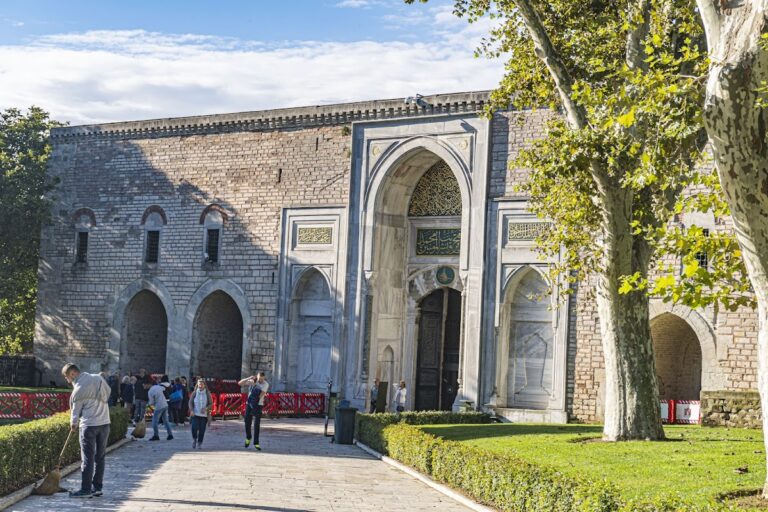
After the Ottoman conquest of Constantinople in 1453, Mehmed II enclosed Hagia Irene within the walls of Topkapı Palace. The building retained its ecclesiastical structure while entering a new institutional setting. Janissaries used it as an arsenal until 1826, and it stored military equipment, weapons, trophies, and military regalia. In 1726, during the reign of Sultan Ahmed III, it became the National Military Museum.
Ahmed Fethi Pasha, Marshal of the Imperial Arsenal, converted Hagia Irene into a museum of military antiquities in 1846. The collection moved to Topkapı Palace in 1875 because the church could not contain it, after which the building served as an Imperial Museum. It became a Military Museum again in 1908, and responsibility passed to Turkey’s Ministry of Culture in 1978. A careful restoration began in 1973.
Hagia Irene is now a museum and is principally used as a classical-music concert hall because of its acoustics and atmosphere. Major concerts of the Istanbul International Music Festival have taken place there since 1980. In 2000, Faruk Saraç presented a show in the church featuring 700 Ottoman-inspired designs, including garments representing 36 Ottoman sultans from Osman Gazi to Mehmed VI. Hagia Irene forms part of the Historic Areas of Istanbul, which were inscribed on the UNESCO World Heritage List in 1985, and it remains historically affiliated with the Greek Orthodox Church.
Remains
Layout and Construction
Hagia Irene stands in the outer courtyard of Topkapı Palace, between Hagia Sophia and the later palace complex. A broad avenue separates the two churches, and the Samson hospice formerly stood along this area. Excluding the atrium, the building measures approximately 85 by 30 metres. Its lower level retains the form of a Roman basilica, with a central nave and two aisles divided by three pairs of piers or columns. These supports carry galleries above the narthex, while semicircular arches joined to the capitals help support the upper structures.
The upper level places a cross-domed, centrally organized arrangement over the earlier longitudinal basilica. The atrium and narthex occupy the western end, while the eastern polygonal apse has three large arched windows. The central dome rises above the main crossing. It is approximately 15 metres in diameter, reaches 35 metres above the floor, and contains twenty windows. The four arms of the cross are covered by peaked roofs.
Atrium and Narthex
The original atrium survives and is described as the only original Byzantine church atrium preserved in Istanbul. Both the atrium and narthex were modified during Justinian’s reconstruction. The narthex survived the earthquake of 740, although later fires destroyed it and related parts of the surrounding complex. The atrium also preserves ten capitals reused from the original church. Their monograms name and identify the imperial couple Justinian and Theodora.
Apse and Iconoclast Decoration
The eastern apse is a polygonal sanctuary end with a semidome and a bema arch, the arch marking the sanctuary area. Their mosaics, together with fresco fragments in the south aisle and the diakonikon, a chamber associated with liturgical service and storage, preserve a distinctive example of Byzantine Iconoclastic art. The upper masonry belongs to the rebuilding after the earthquake, and its fabric can be visibly distinguished from the earlier foundations. That restoration also strengthened foundations that had previously caused serious structural problems.
Apse Cross
The principal apse mosaic consists of a large cross formed from black tesserae, small pieces used to create a mosaic, against a gold ground. Teardrop-shaped extensions finish its arms, which continue around the base of the semidome. Alternating gold and silver tesserae and the adjustment of the cross to the curved surface create an effect of soft light and horizontal balance. The cross replaced earlier images of heavenly figures or saints during the rebuilding under Constantine V, when figurative religious imagery was suppressed. It occupies the position where Byzantine church decoration commonly placed an image of the Theotokos, a title for Mary meaning “Bearer of God.”
Bema Inscriptions
The inner face of the bema arch carries an inscription from Psalm 64:4–5, while its outer face bears words from Amos 6:6. The texts praise the church as the house of the Lord. They show traces of alteration and were restored shortly before the Ottoman conquest, preserving written evidence of the building’s later Byzantine history.
Synthronon
In the apse, the surviving synthronon, a semicircular set of built seats for clergy, consists of six curved tiers. Clergy sat there during the Divine Liturgy. Doors at both sides lead to an ambulatory beneath the fourth tier. The structure is described as the only surviving Byzantine example in Istanbul, and its position within the apse preserves the arrangement of the church’s ceremonial seating.
Nearby sites