Tiled Kiosk: Mehmed II’s Ottoman Pleasure Pavilion at Topkapi Palace
Site at a Glance
- Popularity
- High
- Country
- Turkey
- Primary era
- Medieval
- Eras represented
- Medieval, Early Modern
- Civilizations
- Ottoman
- Site type
- Domestic
- Remains
- Palace
On this page13 sections
History
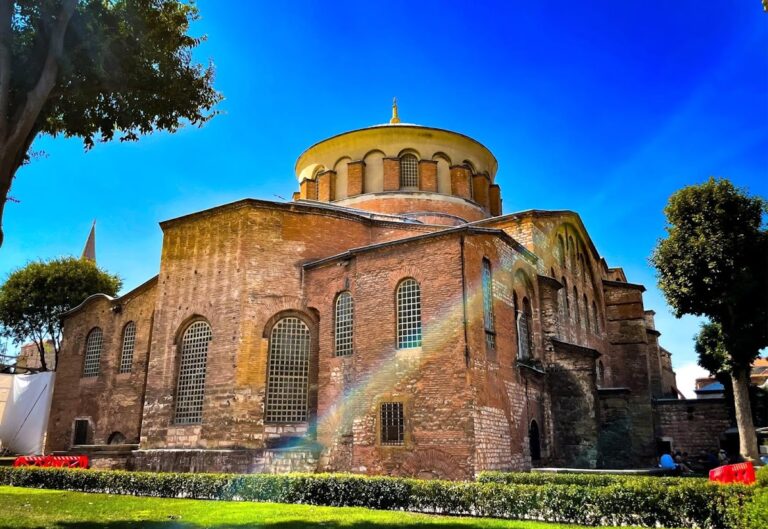
The Tiled Kiosk is an Ottoman pleasure pavilion within the Topkapi Palace complex in Istanbul, Türkiye. Mehmed II had it built in 1472 as a summer retreat, and it was the first building he constructed in the complex. It is the oldest surviving part of the palace and the only example in Istanbul of Ottoman civil architecture built in the Seljuk style, associated with a medieval Turkic dynasty.
Foundation and court life
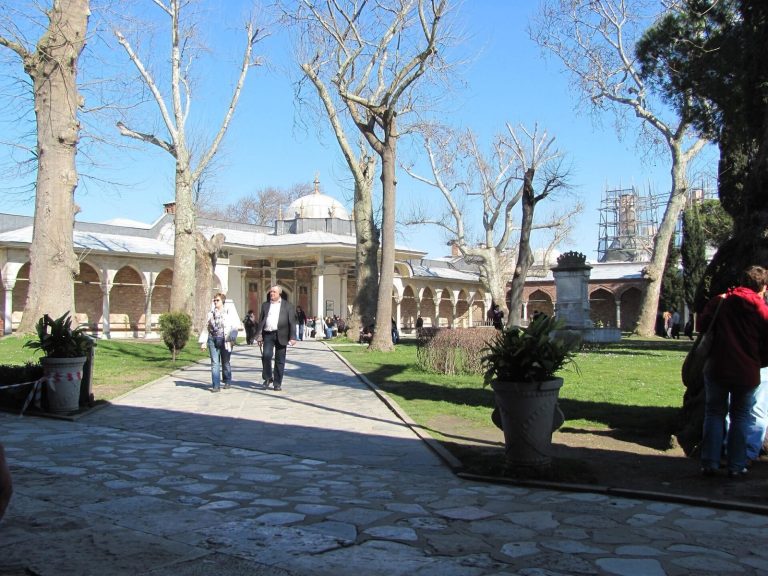
The kiosk belonged to an original group of three pavilions whose Greek, Turkish, and Persian architectural traditions represented different regions of the Ottoman Empire. The grounds around the buildings were known as Ağa Çayırı and Kum Meydanı. Javelin throwing and wrestling took place there, with the sultan and his family watching from the pavilion’s portico. Court poetry also describes banquets and entertainments held inside for court pages and women.
Later Ottoman changes
Alterations were made during the reign of Murad III. An inscription beside a fountain in a corner room gives the building the name Sırça Köşk, meaning “Glazed Kiosk,” a reference to its tiled surfaces inside and out. After a fire damaged the original wooden portico, a colonnaded replacement was built in 1737.
Museum use
The kiosk served as the Imperial Museum from 1875 to 1891, displaying archaeological and Islamic artifacts. It was incorporated into the Topkapi Palace complex in 1939, after which the collection was removed and the building stopped functioning as a museum. It opened in 1953 as the Fatih Museum of Turkish and Islamic Art. In 1981 it became part of the Istanbul Archaeology Museums and housed the Museum of Islamic Art.
Remains
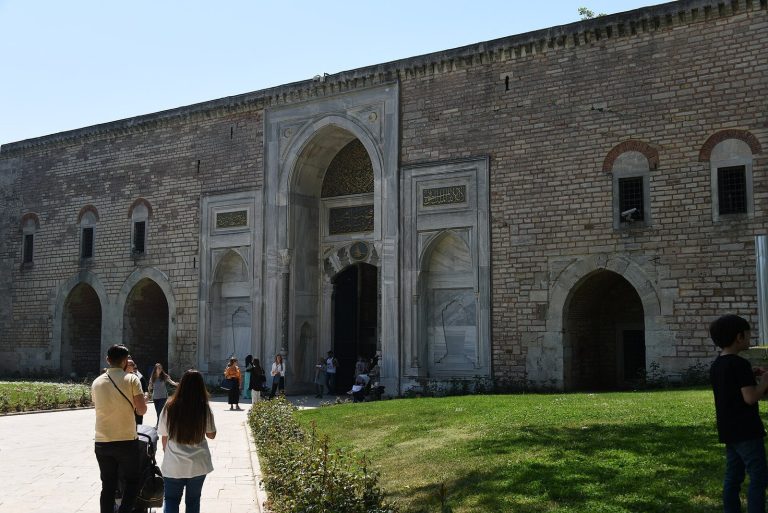
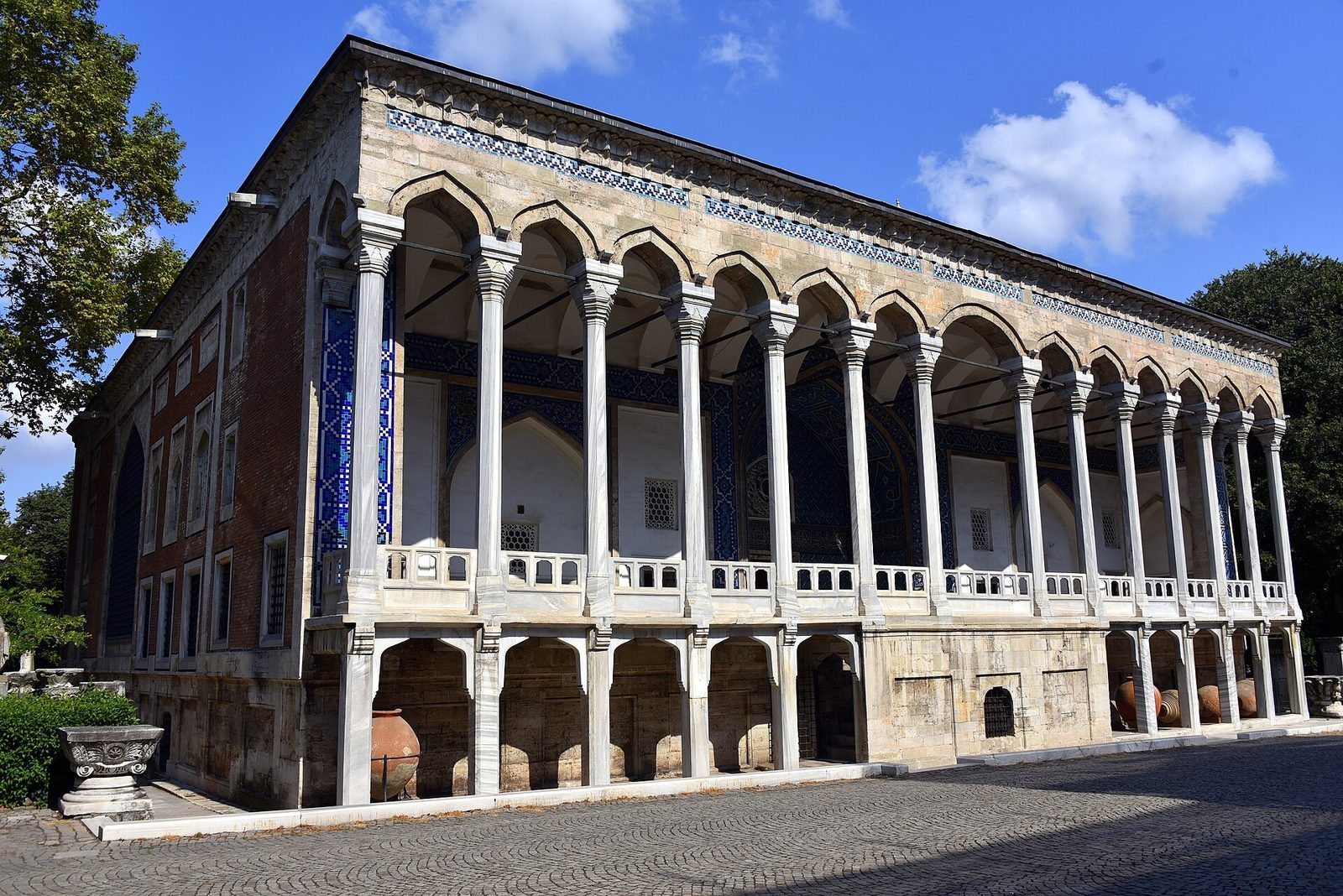
The pavilion stands within Topkapi Palace’s outer walls, in the complex’s outermost area near Gülhane Park and opposite the Istanbul Archaeological Museum. Built in a wooded area at Sarayburnu, it has a two-storey structure that descends along a slope, so only one storey is visible from the main entrance. Its square layout centres on a domed hall, with four corner rooms and four balconies.
The pavilion
Plan and exterior
The plan combines a Greek cross with four Persian-style balconies. The four corner rooms surround the central dome, completing the square form; this arrangement has been interpreted as representing the world’s four corners and the sultan’s universal authority. The building has six rooms as well as its central hall, and a flat roof above which only the central dome rises. Sections of the exterior are covered in glazed ceramic tiles or bricks in a Timurid style, associated with Central Asian traditions and compared particularly with the Bibi-Khanym Mosque in Samarkand. The side walls are brick framed with stone, while the façade’s polygonal pillars have a Persian character.
Entrance and central hall
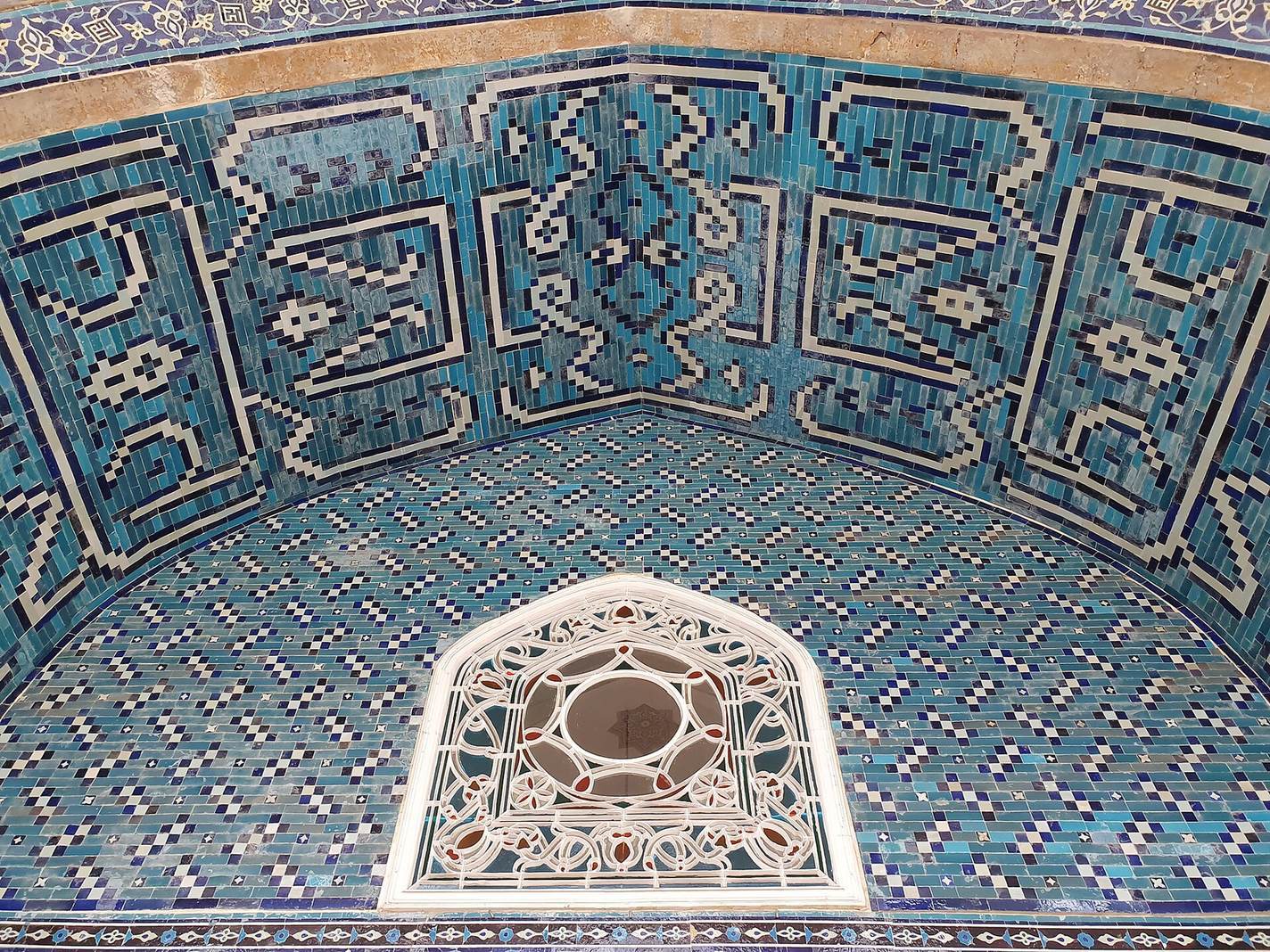
A grilled gate at ground level opens toward stairs and a marble portico supported by 14 columns. The main doorway sits within a green tiled arch and leads through a vestibule into the high, domed central hall. Mosaic-work tiles cover the central recessed area of the façade around the entrance. On the western balcony, opposite the doorway, a recessed space held the sultan’s throne.
Interior rooms and decoration
Behind the central hall are three royal apartments facing Gülhane Park and oriented toward the Bosphorus; the middle apartment has a recessed end. In both wings of the domed hall, vaulted spaces open on one side. Geometric tiles decorated before glazing show Seljuk features in their technique and ornament. Other tiles form blue-and-white hexagons and triangles in the Bursa manner, with floral, leaf, cloud, and abstract designs. Gilding on dark blue, turquoise, and violet grounds is now damaged or flaking, while the white plasterwork follows Persian styles. A corner room contains a fountain with a peacock relief and inscriptions on either side.
The ceramic collection
The collection comprises about 2,000 artifacts associated with Seljuk and Ottoman periods, dating from the 11th to the 20th century. Pottery and tiles are arranged chronologically across the six rooms and central hall, displayed both in cases and within the walls. Much of the collection comes from İznik, Kütahya, and Çanakkale.
Seljuk and early Ottoman ceramics
The first room, to the left of the entrance, contains Seljuk pottery and ceramics dating from the 12th century to the first half of the 14th. The second room displays Miletus ware, a type of medieval Anatolian pottery, from the second half of the 14th and the 15th centuries, alongside early Ottoman pieces decorated with a liquid clay coating.
İznik tiles
Works in the fourth room and central hall include İznik pieces from the mid-17th to the 18th century, as well as coral-red examples dating to the late 15th and early 16th centuries. The central hall also displays blue-and-white and blue-and-turquoise pieces, including finely decorated examples associated with the Golden Horn and Damascus ceramic styles and dated from the 15th to the 19th century.
Later tiles and regional pottery
The fifth room contains 18th- and 19th-century tiles, including an İznik-tile mihrab, a niche indicating the direction of prayer, made with colored glaze and transferred from Ibrahim Beg’s Mosque in Karaman, Central Anatolia. Other tiles came from window pediments of a 16th-century madrasa, or Islamic school, in Istanbul’s Haseki Hürrem Sultan complex. The sixth room displays Kütahya ceramics, including cups, ewers, and jugs from the mid-18th to the 20th century, as well as Çanakkale pottery from the early 20th century.