Hachiman Tsuruichi Shrine: A Shinto Shrine of Water and Irrigation in Nakatsu, Japan
Site at a Glance
- Rating
- 4.2
- Popularity
- Very Low
- Country
- Japan
- Primary era
- Unclassified
- Eras represented
- Unclassified
- Civilizations
- Unclassified
- Site type
- Religious
- Remains
- Sanctuary
On this page7 sections
History
Hachiman Tsuruichi Shrine is a Shinto shrine in Nakatsu, Japan, traditionally founded in spring 564 to protect irrigation and agricultural land. It stands in Aihara, formerly Aihara Village, and is also known as Tsuruichi Shrine and Tsuruichi Hachimangu. Its principal sanctuary uses the nagare-zukuri, or “flowing style,” a shrine form whose roof projects forward to shelter the worship porch. The shrine’s traditions connect its history with water deities, Hachiman worship, and the irrigation system that supported the Nakatsu Plain.
Origins as a Water Shrine
The foundation tradition begins with a local resident who enshrined Hayakitsuhiko-no-Kami and Hayakitsuhime-no-Kami on a sandbank in the Mike River. These male and female deities were associated with waterways and were invoked to protect irrigation. The Mike River was an earlier name for the Yamakuni River, which flows into the plain near the shrine.
A drought followed soon afterward, when the area formed part of the estate of Usa Jingu. A local estate enforcer and steward governed the land and built Fukunaga Castle as his residence. He prayed to Hachiman, his clan deity, and tradition says that the drought ended. In the thirty-fourth year of Emperor Kinmei’s reign, a dream command then led to Hachiman being newly enshrined from Usa on the present hill, where the deity joined the water-related religious tradition.
Transfers and the Oiide Weir
In 977, the two water deities were moved to the hill and enshrined jointly with Hachiman. After the shrine buildings burned, the sanctuary was temporarily transferred to Kawarada, where it was called Idenouchi-no-Miya. It returned to the present site in 1085.
The shrine’s history became closely tied to irrigation in 1135, when a large weir was built across the Takase River. This was another former name for the Yamakuni River and the predecessor of the present Oiide Weir. Tradition holds that Tsurujo-hime and her son Ichitaro became human pillars, meaning that people were sacrificed or symbolically incorporated into a structure to secure its stability or divine protection. Their spirits were later enshrined with Hachiman as guardians of the weir, its channels, and the agricultural benefits enjoyed across the Nakatsu Plain.
The story says that repeated floods had destroyed the weir. Seven local landholders, led by the regional lord, agreed to construct a stronger replacement and decided that a human pillar was necessary. They floated their hakama garments, traditional formal lower garments, in the river, and the lord’s garment sank first. A family document preserving the tradition has a colophon dated 1555.
Records, Names, and Religious Practice
In 1616, Hosokawa Tadaoki became lord of the Nakatsu domain, a feudal territory governed from Nakatsu, and visited the shrine to investigate its history. A descendant of the family associated with the construction of the Oiide Weir compiled an account of the shrine’s origins and the weir’s history and presented it to him.
Before the Meiji period, the shrine was called Hachiman-ichi Shrine. It was renamed Aihara Shrine in February 1872, when it was ranked as a district shrine and took its name from the settlement. In June 1937, it received designation for the state provision of ritual offerings, and it was later given the name Hachiman Tsuruichi Shrine. Its central deity is Hachiman Okami, identified with Emperor Ojin. Hayakitsuhiko-no-Kami and Hayakitsuhime-no-Kami remain principal waterway deities, while Tsurujo-hime and Ichitaro are also enshrined as mother and son.
The two-day flower-parasol procession is held to console Tsurujo-hime and Ichitaro and to pray for a plentiful harvest. Tradition places its beginning in 1164. The bearers of the portable shrine, a temporary carried shrine used to transport a deity during a procession, are said to descend from those who carried the mother and son in a white wooden portable shrine before their sacrifice.
Until the Meiji Restoration, the festival was conducted by four villages. Their processions supplied ten spears, ten firearms, ten bows, and ten decorative halberds, while the domain administration sent an inspecting official for security. The event consequently resembled a heavily guarded procession of a feudal lord. Decorative parasols were added after 1680. Following the Meiji Restoration, fourteen more settlements that benefited from the Oiide irrigation system joined the original four. Nineteen administrative areas participated, with twenty parasols effectively taking part because some communities alternated or divided their participation.
The flower-parasol ritual became a Nakatsu municipal cultural property in 1981 and an Oita Prefectural intangible folk cultural property in 2009. The Yuya family documents associated with the shrine became a Nakatsu municipal tangible cultural property in 2024.
Remains
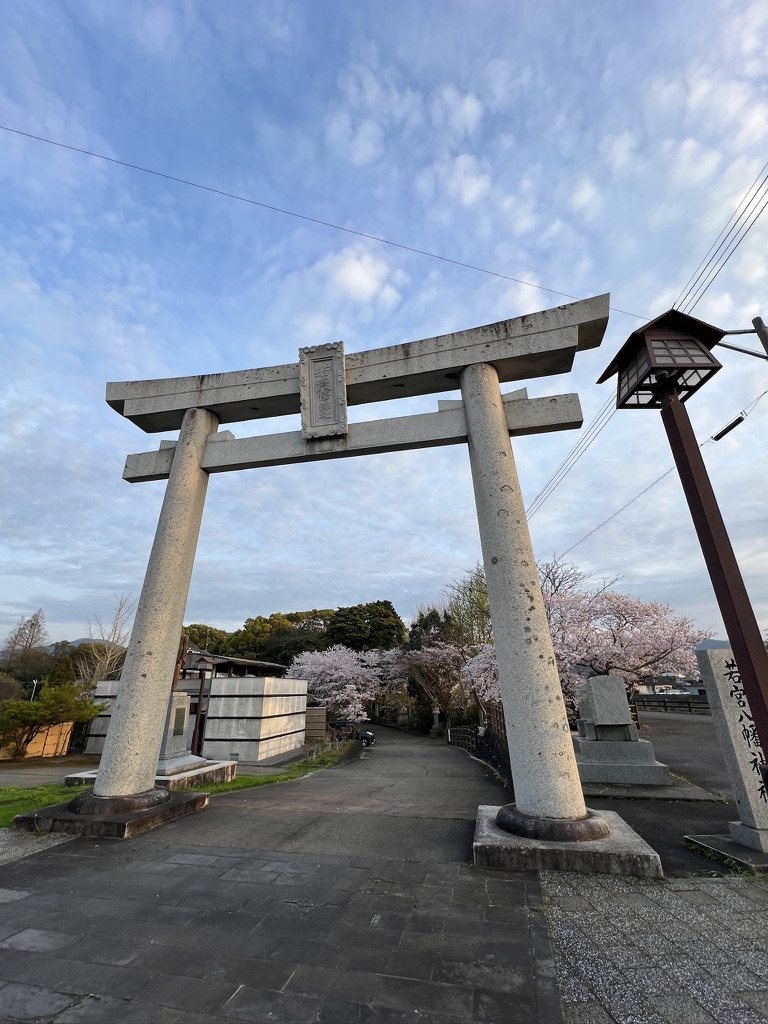
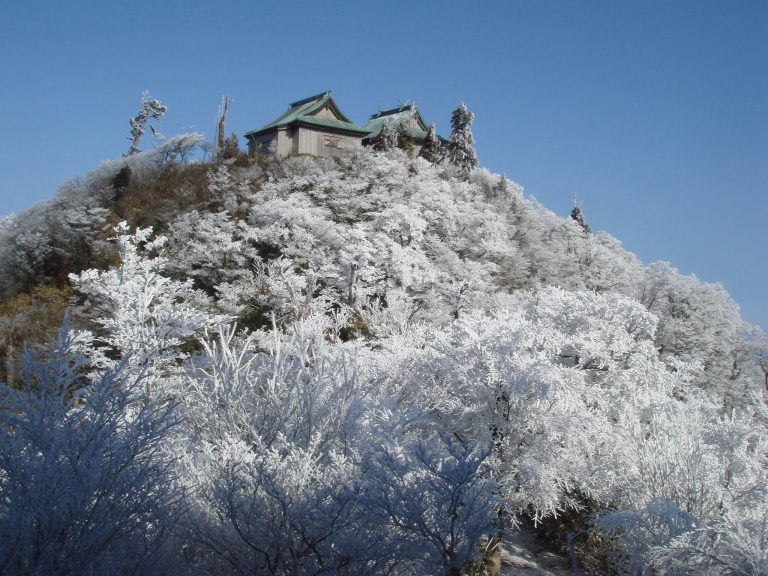
Hachiman Tsuruichi Shrine occupies the summit of the small Sakate-Kuma hill on the right bank of the lower Yamakuni River, where the river enters the Nakatsu Plain, also called the Okidai Plain. The main sanctuary faces north. The worship hall stands lower down at the foot of the hill, so the surviving complex combines an elevated sanctuary with a lower building used for offerings and worship.
Main Sanctuary
The main sanctuary is a three-bay building in nagare-zukuri, the “flowing style” defined by a roof that projects over the front porch. Latticed doors span its three-bay front. Sliding wooden doors occupy the front part of the left side, while wooden walls enclose the remaining sides. A veranda with projecting balustrades surrounds the building, and side screens run along the rear line of columns.
Its gable decoration consists of a rainbow beam and a central strut. The porch columns have diagonal bracket-like supports. These elements form part of the sanctuary’s surviving timber design and distinguish the elevated principal building from the worship hall at the base of the hill.
Worship Hall and Shrine Grounds
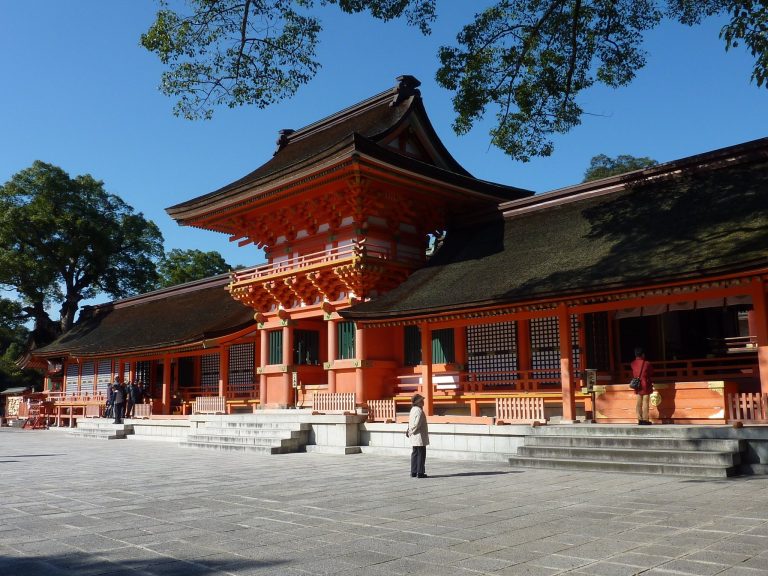
The worship hall, also called the offering hall, is a two-bay-by-one-bay building with a hip-and-gable roof, a gabled entrance end, and a tiled covering. Side wings and a storehouse for the portable shrine are attached to it, creating a configuration resembling a divided worship hall. Its position at the foot of Sakate-Kuma gives the complex a layered arrangement, with the principal sanctuary above and the offering building below.
A stone beside the west side of the worship hall is preserved as the place where Tsurujo-hime and Ichitaro supposedly sat immediately before being incorporated into the weir. The moon seen from this stone was once celebrated as one of eight scenic places associated with the shrine and its surroundings. The other associations were the Seven Cherry Trees, Floating Stone and Young Sweetfish, Three Stones in Summer, Fireflies by the Sacred Tree, Morning Dew on the Weir, Egrets at Kojimagasaki, and Snow on Mount Tsurui.