Anagahayama Kofun Group: Burial Mounds of Japan’s Terminal Kofun Period
Site at a Glance
- Rating
- 3.8
- Popularity
- Very Low
- Country
- Japan
- Primary era
- Medieval
- Eras represented
- Medieval
- Civilizations
- Yamato
- Site type
- Burial
- Remains
- Burial Mound
On this page11 sections
History
Anagahayama Kofun Group is a group of three burial mounds in Japan, built during the terminal Kofun period around the end of the sixth century or the beginning of the seventh century. The Kofun period was the era of Japan’s large monumental burial mounds, many of which contained stone chambers and grave goods. The principal tomb, Anagahayama Kofun No. 1, is associated with a large decorated stone chamber and is the part of the group designated as a National Historic Site of Japan.
The Three Mounds
The mounds lie along a hill in sequence from its foot toward the summit. Anagahayama Kofun No. 2 is lowest, followed by the principal No. 1 mound and then No. 3. Their dates are understood through archaeological evidence, including Sue ware, a high-fired gray pottery made with advanced kiln technology during the Kofun period.
The decoration found at Anagahayama has led to wider historical interpretations. A theory connects the principal tomb with an immigrant clan mentioned in a 702 household register for Buzen Province. The register refers to a settlement in Kamimike District and survives among the Shōsōin documents, the imperial repository at Tōdai-ji in Nara. The proposed connection remains an interpretation rather than a certainty. The group is also associated with the wider distribution of line-carved tombs in Tottori and Shimane and with immigrant groups whose skills and cultural practices influenced ancient Japan.
Archaeology and Protection
Anagahayama Kofun No. 1 was designated a National Historic Site of Japan on September 7, 1939. The designation covers the principal mound and not the smaller No. 2 and No. 3 mounds. Archaeological excavations took place between 1993 and 1995, followed by preservation and site-improvement work from fiscal years 1993 to 1998. The results were brought together in a report published in 1999.
The group’s historical importance rests on the combination of its large megalithic tomb, its carved stone decoration, and the possible relationship between its burial traditions and immigrant communities. These connections place the mounds within the changing religious, social, and technological setting of the final centuries of the Kofun period.
Remains
Principal Mound and Stone Chamber
Mound and Moat
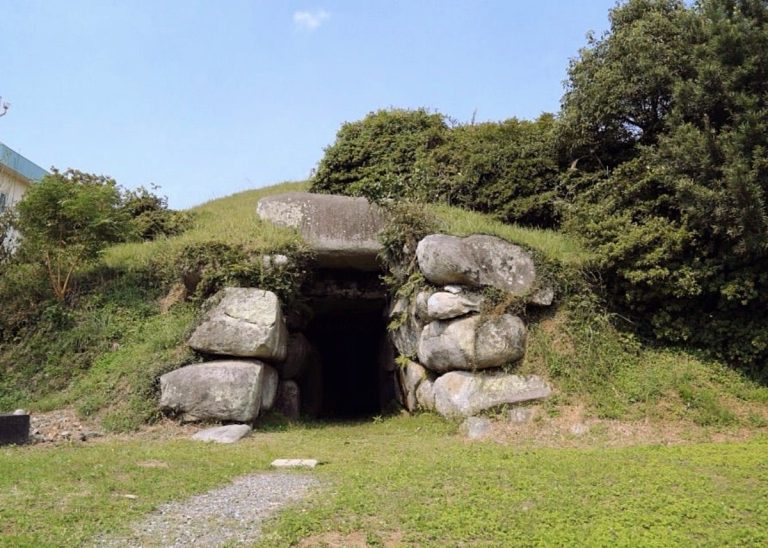
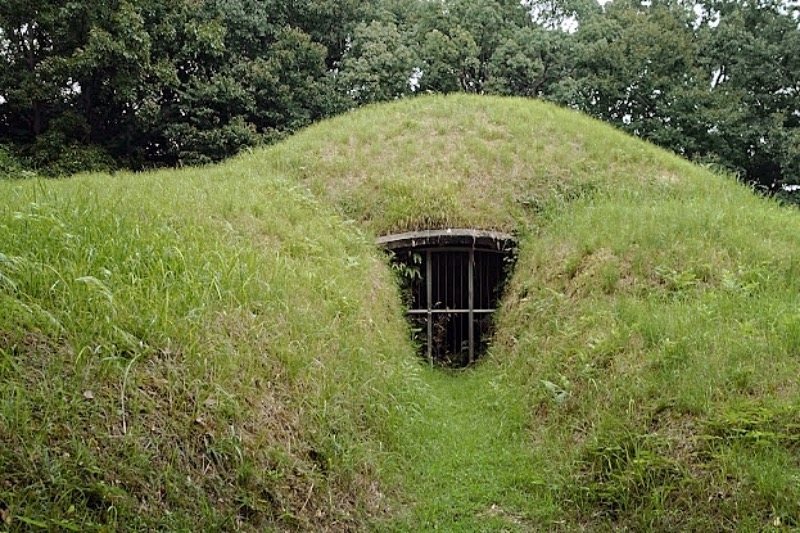
Anagahayama Kofun No. 1 stands on the eastern slope of a hill, on a river terrace above the western bank of the Yamakuni River. The river forms the boundary between Fukuoka and Ōita prefectures. The mound is circular and approximately horseshoe-shaped in plan, measuring about 27 metres from east to west and 30 metres from north to south. Its east side has two construction stages, while the west side has one. A surrounding moat reaches up to 6 metres in width, bringing the overall monument to approximately 33 metres east to west and 42 metres north to south.
Burial Chamber
The burial facility is a large horizontal-passage stone chamber, entered from the side through a passage rather than from above. Massive stones form a double-sleeved plan, in which projecting side sections flank the junction between the passage and burial chamber. The chamber measures 3.2 metres long, 2.4 metres wide, and 2.2 metres high. Its passage is 5.4 metres long and between 1.2 and 1.6 metres wide, while the passage-and-chamber complex measures approximately 10 metres in total.
Line-carved decoration covers the stone surfaces. The motifs include human figures, fish, birds, insects, and leaves. Fish and bird designs on the west wall of the passage and near its entrance face toward the chamber entrance. Leaf patterns appear on both the east and west walls, with their tips pointing downward. The largest leaf is 57 centimetres long, and its veins are also represented.
Excavation inside the chamber recovered beads and Sue ware. Among the pottery was a San’in-style jar with attached vessels and cups. San’in-style pottery is associated with the San’in region of western Japan, while a jar with attached vessels is fitted with smaller vessels or projections.
Smaller Mounds
Anagahayama Kofun No. 2
Anagahayama Kofun No. 2 is a smaller circular mound approximately 10 metres in diameter. It forms part of the line of burial mounds extending up the hill from the lower slope toward the summit.
Anagahayama Kofun No. 3
Anagahayama Kofun No. 3 is a circular mound approximately 19 metres in diameter. Its stone chamber also contains line-carved decoration, linking it materially with the principal tomb and with the broader tradition of decorated burial chambers represented in the region.
Anagahayama Minami Kofun Group
A separate group, the Anagahayama Minami Kofun Group, formerly stood south of the main site in the former village of Ōhira. It contained more than ten mounds. Six were destroyed when an industrial-waste disposal facility was built, while the stone chamber of No. 3 was preserved within the facility grounds.
Excavation in 1983 revealed a line-carved mural in the chamber of Anagahayama Minami No. 3. The mound measures approximately 13 metres in diameter and is surrounded by a moat about 1 metre wide. Its horizontal-entry stone chamber is 5.6 metres long, providing another example of the decorated chamber tradition associated with the Anagahayama area.