Wakamiya Hachiman Shrine: A Historic Shinto Sanctuary in Bungotakada
Site at a Glance
- Rating
- 3.7
- Popularity
- Very Low
- Country
- Japan
- Primary era
- Early Modern
- Eras represented
- Early Modern
- Civilizations
- Tokugawa
- Site type
- Religious
- Remains
- Sanctuary
On this page9 sections
History
Wakamiya Hachiman Shrine is a Shinto shrine in Japan, traditionally founded in December 852 as a branch sanctuary of Usa Shrine in Kunawa District, one of the six districts of the Kunisaki Peninsula. Shinto is Japan’s indigenous religious tradition, centred on reverence for kami, sacred beings or powers associated with nature, ancestors, and mythic history.
Early worship and foundation
Religious activity associated with the site is traced to 718, when Amaterasu, Tamano no Mikoto, and Homutawake no Mikoto were reportedly worshipped through a sacred object said to have appeared in the area of present-day Bungotakada. In 824, an oracle was traditionally said to have been delivered to the mother of Ōgami Unmaro, a resident of the Usa District. The shrine’s foundation in 852 is connected with this oracle and established its relationship with Usa Shrine, a major Hachiman sanctuary in northeastern Kyushu. A branch sanctuary is an affiliated shrine founded separately from its principal sanctuary.
Warfare, revival, and domain patronage
Wakamiya Hachiman Shrine was burned in 1571 by the Christian daimyō Otomo Sorin and his forces. A daimyō was a regional feudal lord in premodern Japan. The shrine was burned again in 1579, when its lands were confiscated by Otomo Yoshimune because it had supported Tahara Chikanori, who had rebelled against the Otomo family.
The shrine was revived during the Bunroku era by Takenaka Shigeyoshi, who became lord of Takada Castle in 1594. In 1669, the lord of Shimabara Domain designated it the principal shrine of Takada. Thereafter, successive domain lords venerated the shrine, and its buildings were rebuilt in 1833 under the patronage of Matsudaira, the domain lord. The Shimabara Domain was a feudal territory whose official warehouse stored and shipped its revenues, including rice.
Modern changes and religious observances
In 1871, the shrine was classified as a village shrine, and in June 1890 it was elevated to prefectural-shrine status. The complex was moved approximately 80 metres east in 1955 during improvements to the Katsura River. Its principal deity is Ōsasagi no Mikoto, identified with Emperor Nintoku. The shrine also enshrines Amaterasu, Tamano no Mikoto, Homutawake no Mikoto, Hayabusawake no Miko, Ohae no Miko, Kohae no Miko, Megatori no Himemiko, Takitsuhime no Mikoto, Takirihime no Mikoto, Ichikishimahime no Mikoto, Amenooshihomimi no Mikoto, Amenohohi no Mikoto, Amatsuhikone no Mikoto, Ikutsuhikone no Mikoto, and Kumanokusubi no Mikoto. The last eight are identified as the Five Male and Three Female Deities.
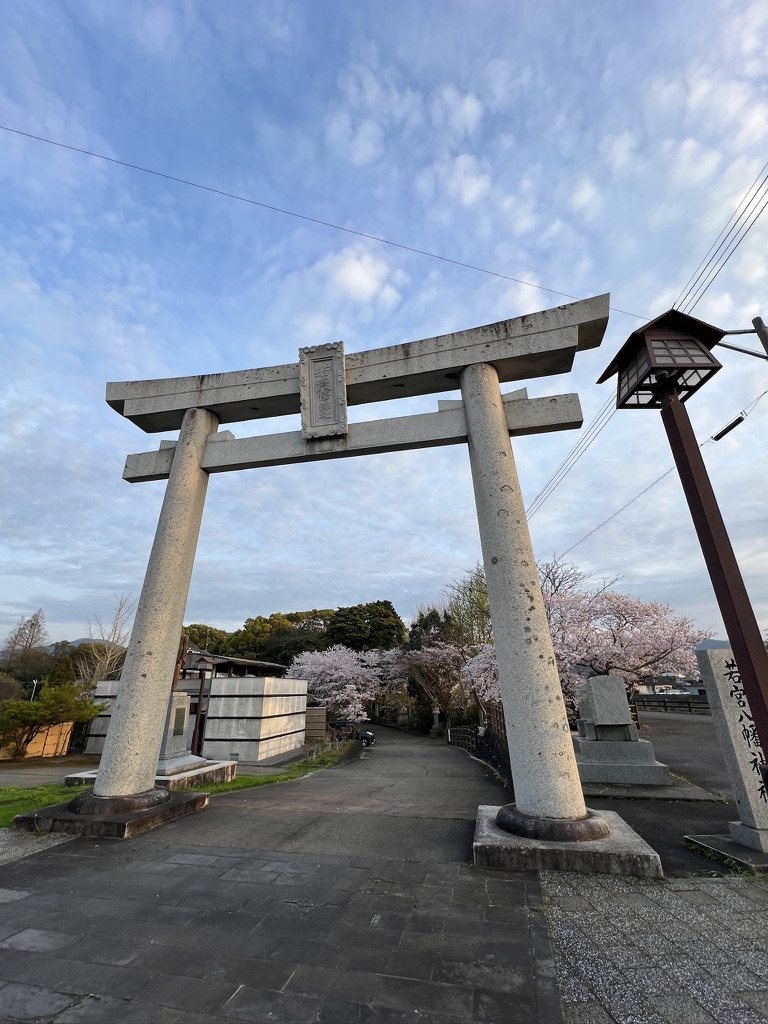
The autumn grand festival is a harvest-thanksgiving observance held in the middle of the tenth lunar month. Its central River-Crossing Ceremony is traditionally said to have begun in 1084 as an ascetic practice. A mikoshi, or portable shrine, is carried from Wakamiya Hachiman Shrine to the Lower Shrine, a temporary shrine in Miyamachi District Two. On Friday afternoon, several dozen men in white clothing carry it through Bungotakada. At the Great Torii beside the right bank of the Otama Bridge, river bearers take over and carry it through the Katsura River with several boats. It remains at the Lower Shrine until Sunday afternoon, when it returns through the river once more. Because the bearers wear minimal clothing, the event is also called the Naked Festival, and local tradition regards it as one of Japan’s three major naked festivals.
Hōran En’ya began in the middle of the Edo period as a rowing-boat ceremony that prayed for the safe voyage of vessels carrying tribute rice to the Shimabara domain and its Osaka warehouse. It is now held on a Sunday in early January. The ceremony was designated a Selected Intangible Folk Cultural Property in 1978, while the stone bridge received designation as an Oita Prefectural Tangible Cultural Property in 1983. The main hall, ceremonial hall, karamon gate, and west gate received tangible-cultural-property designation in 2017.
Remains
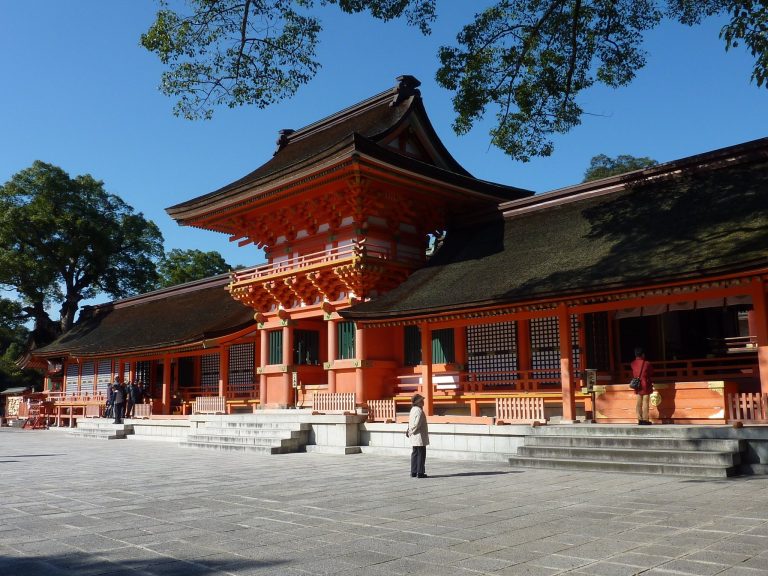
The shrine precinct contains the principal buildings, subsidiary shrines, a stone bridge before the shrine gate, and the river setting used during the River-Crossing Ceremony. The present main hall dates from 1833 and is built in the Nagare-zukuri style, in which the front slope of the roof extends forward to form a covered entrance. The grounds are also known for their hydrangeas.
Buildings and entrance bridge
Main hall and subsidiary shrines
The main hall is a three-bay structure with a roof covered in cypress bark. Its front includes a chidori-hafu, a triangular decorative gable, beneath which projects a mukō-karahafu, a curved-front projecting gable. The precinct’s subsidiary shrines are Awashima, Miyajidake, Inari, Konpira, and Gion. The ceremonial hall, karamon gate, and west gate form other surviving parts of the shrine complex.
Stone bridge
A stone bridge crosses the stream in front of the shrine gate. Built in 1860, it measures 4.07 metres in width and 3 metres in length, with a span of 3.08 metres. Its stone balustrade and arched form are carefully finished. Approximately 15 to 20 stones form the arch, while 16 bordering ring stones are attached to its outer face, giving the bridge the finished character of a sacred approach structure.
River-crossing installation
A large torch is lit in the river during the River-Crossing Ceremony. It measures approximately 16 metres in length and weighs about 5 tonnes, forming a substantial physical element of the shrine’s annual river ritual.