Gyula Castle: A Medieval Fortress in Hungary
Visitor Information
Google Rating: 4.7
Popularity: High
Official Website: gyulavara.hu
Country: Hungary
Civilization: Medieval European, Ottoman
Site type: Military
Remains: Castle
History
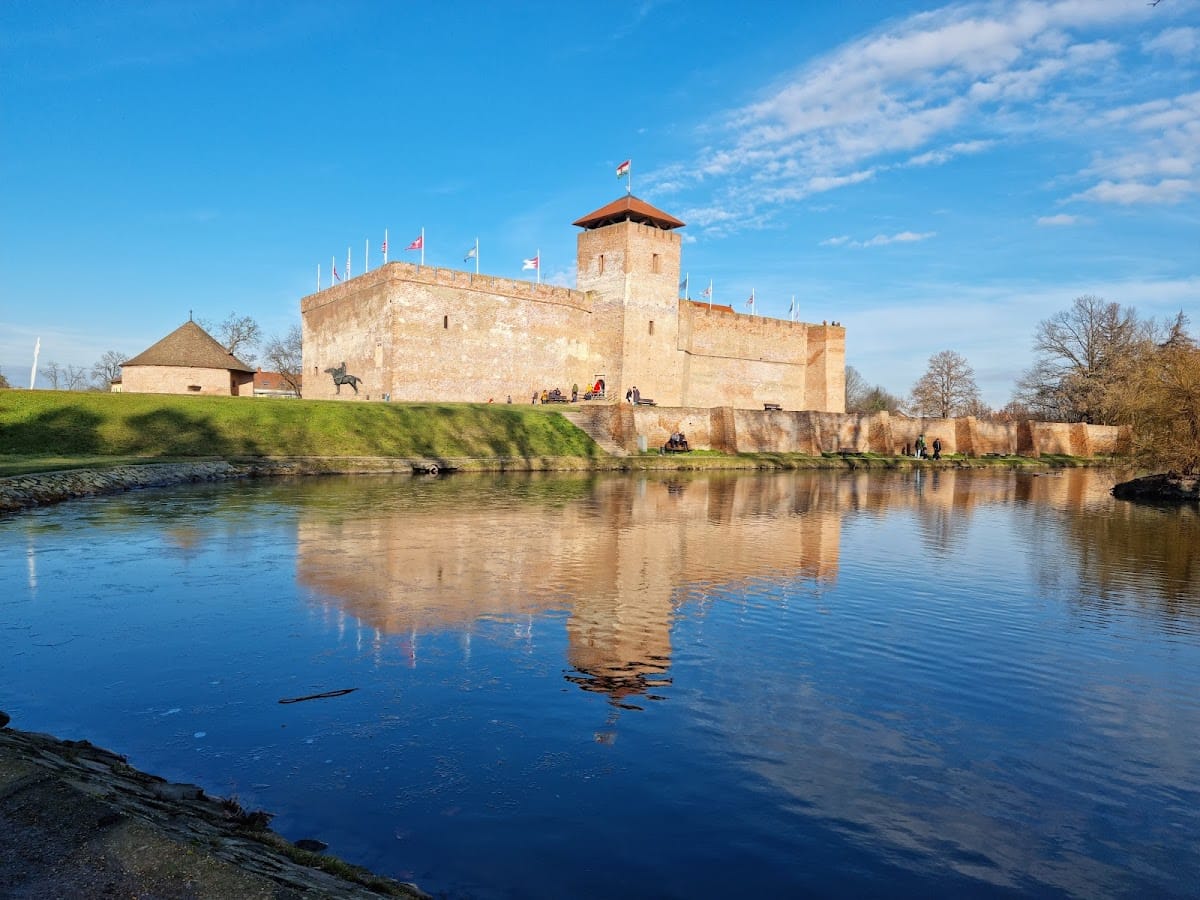
Gyula Castle is a medieval fortress situated in the town of Gyula, Hungary. It was constructed by the Hungarian kingdom during the early 15th century on an island formed by the branches of the Körös River, a location that naturally enhanced its defenses.
The castle’s origins trace back to the early 1400s after King Sigismund of Luxembourg granted the surrounding estate to János Maróti, Ban of Macsó. Starting around 1403, Maróti oversaw the building of the brick fortress on the marshy plain. By 1445, the castle was largely completed, including a chapel which was consecrated that year, reflecting the site’s growing residential and ecclesiastical significance.
Ownership of Gyula Castle changed hands among prominent figures over the following centuries. King Matthias Corvinus gifted the estate to his illegitimate son John Corvinus. After John’s death, the fortress passed to Beatrix Frangepán, John’s widow, who stood out as the only woman to hold the title of ispán, or head of Békés County. Upon her passing, the castle came under the possession of her second husband, George of Brandenburg-Ansbach.
Beginning in the 16th century, Gyula Castle gained strategic importance as a frontier fortress against the advancing Ottoman Empire. Its sturdy defenses allowed it to withstand direct assaults, including a notable siege in 1566 that lasted 63 days, the longest Turkish siege recorded in Hungary. Despite its resilience, the castle eventually surrendered to the Ottomans through a blockade and famine in the same year.
During Ottoman control from 1566 to 1695, Gyula served as the center of a sanjak, an administrative district, within the Temesvar vilayet, or province. The occupiers repaired the fortress for military and governance uses but largely left the structure unchanged, apart from the addition of the Huszár Tower, the sole surviving secular Ottoman building in Hungary.
Habsburg forces reclaimed Gyula Castle in 1695 after a siege. Though its military role diminished afterward, the palace remained intact despite a partial dismantling order issued in 1700. The fortress saw action again during the Rákóczi War of Independence in the early 18th century and later functioned as a prison following the Hungarian revolution of 1848–49, holding several of the 13 Martyrs of Arad.
Archaeological research from 1956 to 1961 revealed much about the castle’s construction phases and history. Since 1964, it has hosted cultural events, with restoration works continuing into the 21st century, including recognition from the International Council on Monuments and Sites (ICOMOS) in 2006 and further renovations as part of Hungary’s National Castle Program starting in 2017.
Remains
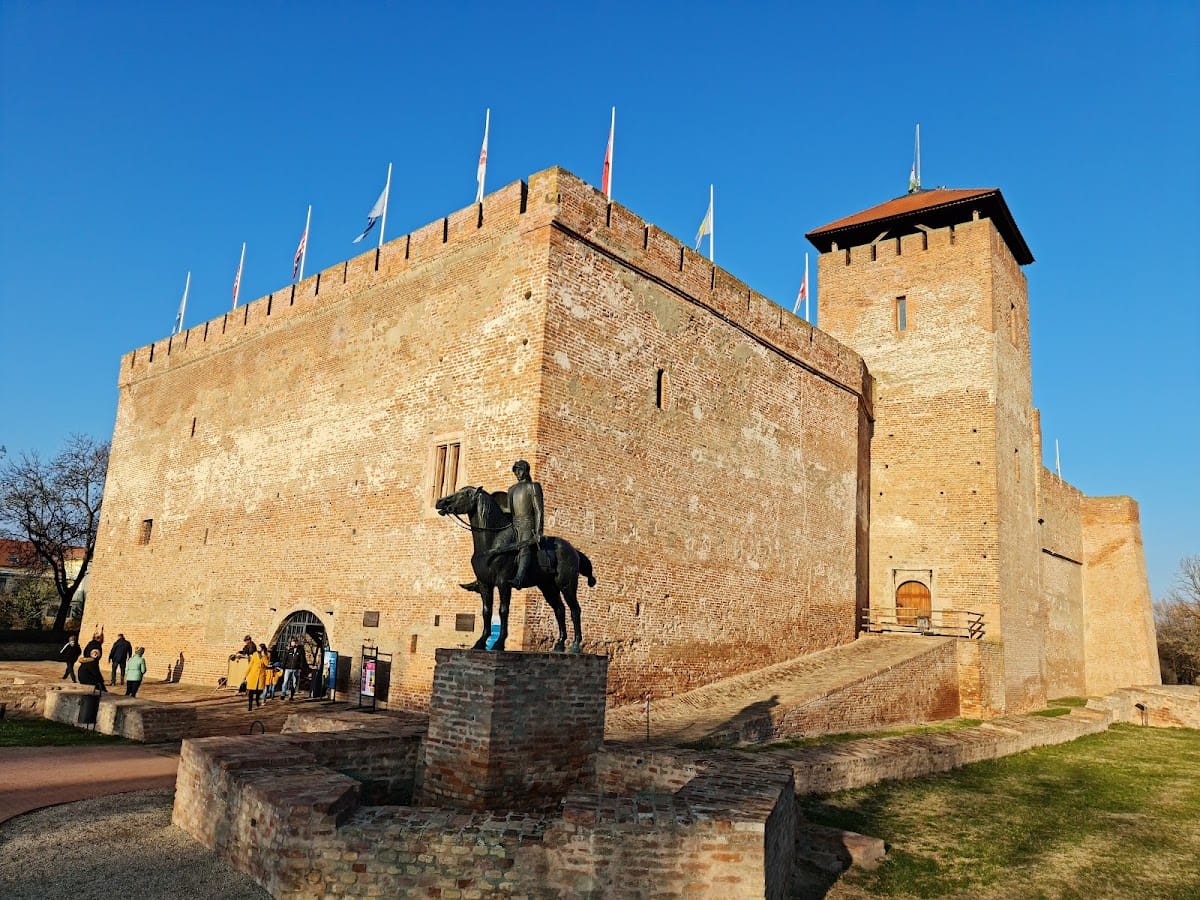
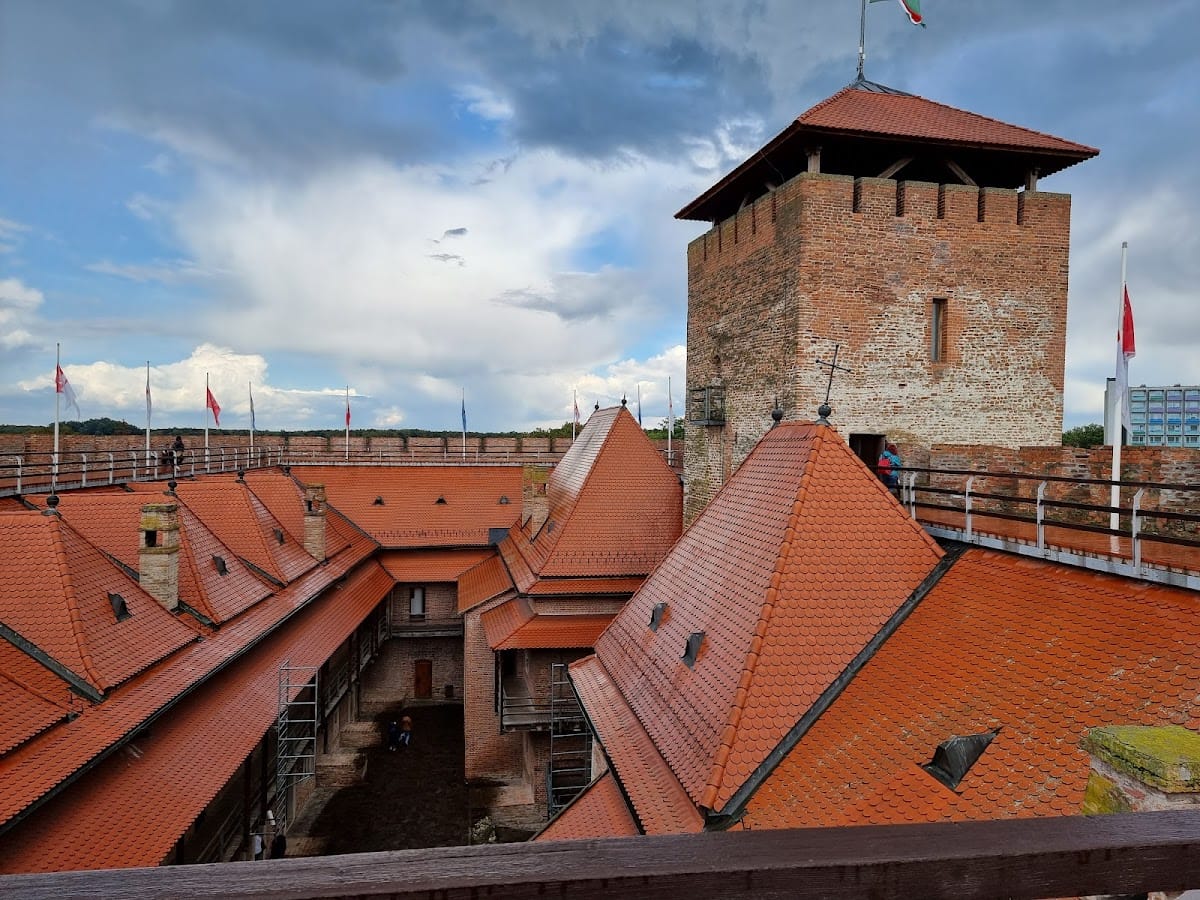
Gyula Castle stands as the only fully preserved Gothic brick fortress on a flat plain in Hungary and Europe. Constructed primarily of locally fired bricks, this choice was dictated by the absence of nearby stone resources. The fortress was developed with walls and towers built simultaneously, a departure from typical castle construction where the keep often appeared first. Among its unique features is a continuous corridor encircling the courtyard at the first-floor level, created by the early 16th century to enable efficient movement and defense.
Prominent in the castle’s layout is a large round cannon tower, known as a rondella, added to the western corner during the early 1500s. This robust tower was designed to accommodate artillery and included embrasures at the attic level, allowing defenders to fire cannons from multiple angles. Its adaptation for gunpowder weaponry reflects the military advancements of the period.
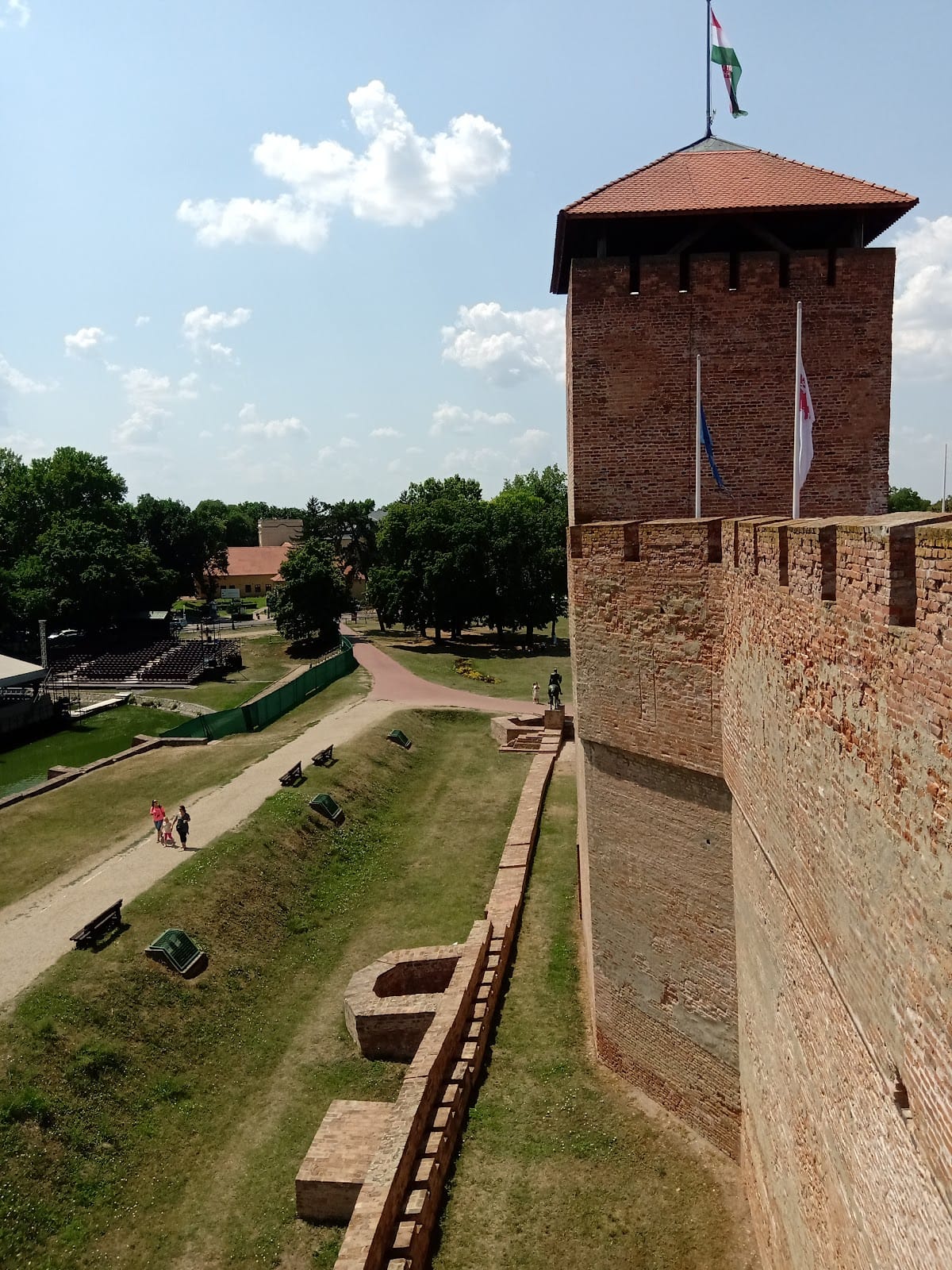
The outer bailey contains the Huszár Tower, a significant remnant from the Ottoman period and the only surviving secular Ottoman structure in Hungary. This tower served as the main entrance to the outer fortification and illustrates the fortress’s layered history under various rulers. The Ottomans repaired the castle but made limited architectural changes beyond this addition.
Within the complex, a chapel consecrated in 1445 remains a central religious structure. The courtyard hosts several buildings added over time, adjusting to the castle’s evolving residential and administrative functions. These included essential spaces such as storerooms, a bakery, a blacksmith’s workshop, pottery facilities, and a dedicated prison area. The interior now features 24 exhibition rooms that present nearly seven centuries of history, including a four-room dungeon exhibiting medieval punitive tools.
Defensive earthworks like ramparts and palisades complemented the castle’s brick walls. Following the 1566 siege, the outer palisade was reconstructed, though with reduced wall thickness compared to earlier fortifications. Inside, the upper floors contain noble apartments and administrative rooms, along with a weapons hall and a knight’s hall used for official receptions and events.
Archaeological excavations in the mid-20th century uncovered multiple construction phases and architectural details that have informed ongoing conservation efforts. The site’s island setting, formed by the Körös River’s branches, served as a natural moat, enhancing its defensive capabilities and contributing to its historical resilience. Today, Gyula Castle remains a well-preserved testament to medieval and early modern fortification techniques and a tangible link to Hungary’s layered past.