Grote Kerk: Haarlem’s Late-Medieval Protestant Parish Church


Site at a Glance
- Rating
- 4.6
- Popularity
- Medium
- Country
- Netherlands
- Primary era
- Medieval
- External website
- Open
- Eras represented
- Medieval, Early Modern, Modern
- Civilizations
- Dutch, Holy Roman Empire
- Site type
- Religious
- Remains
- Cathedral
On this page16 sections
History
Grote Kerk, also known as St.-Bavokerk, is a large late-medieval Gothic church in Haarlem, the Netherlands. Built by successive generations of craftsmen between 1370 and 1520, it stands on the Grote Markt and remains an active Reformed Protestant parish church. Before the Reformation, the sixteenth-century religious transformation that transferred many Western European churches from Catholic to Protestant control, it was a Roman Catholic church dedicated to Saint Bavo, a medieval Christian saint especially associated with Ghent.
Early parish and medieval rebuilding
A Christian parish church stood on the site by the ninth century. It was a wooden daughter church of Velsen, whose foundation is associated with Saint Willibrord in 695. The foundation or first mention of Grote Kerk is dated to 1245, while a church on the site is explicitly recorded by 1307.
The earlier wooden building burned during the fourteenth century. Its Romanesque stone successor was badly damaged by fire in 1370 and was largely repaired, while a new Gothic choir was built at about the same time. The present church emerged through successive building campaigns. The choir was completed around 1400, probably to a design by Master Engelbrecht of Nijmegen. Work on the crossing and transepts began in 1445 under Everaert Spoorwater, an architect from Brabant, and was completed around 1500.
From 1452, a college of paid professional singers served seven daily offices, scheduled services of communal Christian prayer. The church became a chapter church in 1479, meaning that it was served by a formal body of clergy. In 1559, after the Diocese of Haarlem was established, it became the diocese’s cathedral, the principal church of a bishop’s diocese. This cathedral role was brief.
Reformation and Protestant use
The church’s dedication to Saint Bavo was established before 1500. On 29 May 1578, during the Haarlemse Noon on Corpus Christi, Calvinists seized the building. The interior was looted and damaged, and the parish priest was killed. City authorities temporarily closed the church before transferring it to Protestant use.
Most of the church’s art and silver objects were confiscated in 1578. Objects that escaped sale or destruction remained in Haarlem’s municipal collection and later entered the Frans Hals Museum. Haarlem’s Catholics continued worship in clandestine churches, including the St. Franciscus and St. Joseph stations. The latter eventually developed into the Catholic Cathedral of Saint Bavo on Leidsevaart during the nineteenth century.
The Siege of Haarlem in 1572 and 1573, a military campaign during the Dutch Revolt, also entered the church’s traditions. A Spanish cannonball is said to have passed through the wall toward a preacher regarded as an apostate. The ball remains visible in an interior wall, and the episode may have inspired the Dutch expression meaning that “the bullet has passed through the church.”
Fire, burials, and civic functions
Fire remained a recurring concern. Lightning ignited the tower on 22 May 1801. In 1839, the tower guard Martijn Hendrik Kretschman stopped the church employee Jan Drost from trying to set fire to the organ and piano with hot coals. Drost later committed suicide and was buried in the tower.
A high sentry post allowed fire-watchers to signal outbreaks across Haarlem with red flags to guards in the main guardhouse opposite the church. The post continued in use until 1919. During the 1930s, an automatic sprinkler system was installed in the tower and could extinguish fires at a height of 70 metres.
Burials inside the church were permitted until 1831. The people buried there include painters such as Maarten van Heemskerck, Frans Hals, Pieter Jansz. Saenredam, Jacob van Ruysdael, Salomon van Ruysdael, Cornelis Cornelisz. van Haarlem, Floris van Schooten, Salomon de Bray, and Jacob Matham. Other burials include the engineer Jan Adriaanszoon Leeghwater, the clergyman Jacobus Zaffius, the preachers Passchier de Fijne and Jacob van Oudenhoven, the composer Cornelis Padbrué, the merchant and philanthropist Pieter Teyler van der Hulst, the engineer Christiaan Brunings, the politician Cornelis van Lennep, and the writer Willem Bilderdijk, whose burial in 1831 was the last.
Daniel Cajanus, known as a giant, and his dwarf companion Jan Paap were also buried in the church. Local traditions connect stone number 7 near the choir gate with a supposedly growing hand, while another tradition links burials beneath the stone floor with the phrase “Stinking Rich.” Frans Hals was first buried in the grave of his first wife’s grandfather, Nicolaes Ghyblant, and received a separate gravestone in 1962.
Bells, preservation, and continuing use
In 1429, bells from the preceding parish church were placed in a large free-standing wooden belfry behind the choir. The belfry was demolished in 1804 to raise funds for the city. A smaller iron replica was erected on the same site in 1918 by Joh. Enschede.
The church is also associated with the Damiaatjes, two bells traditionally said to have been brought from Damietta during the Fifth Crusade. The recorded historical explanation identifies them instead as a gift made in 1562 by the bell-maker Johannes Dircks of Aalst to Haarlem’s bishop Nicolaas van Nieuwland. Jan Albert de Grave recast them in 1732 and named them Piet and Hein. Their evening ringing commemorates the reported capture of Damietta on 25 August 1219.
The interior suffered major damage during the 1578 iconoclasm, and many stained-glass windows were later lost through neglect. Paintings by Pieter Jansz. Saenredam and the Berckheyde brothers helped guide later attempts to reconstruct the interior and return mourning shields to historically appropriate positions. The Grote Kerk Friends Association was founded in 1975 to support the preservation and restoration of culturally and historically valuable objects in the church.
Grote Kerk became a Rijksmonument, a building or site legally protected by the Netherlands as a monument of national importance, on 27 November 1969 under monument number 19264. It was included in the Netherlands’ “Top 100” of nationally protected monuments in 1990.
Remains
Grote Kerk is a large Brabant Gothic cross-basilica, a basilica-shaped church whose nave and transept form a cross. Its unified Gothic appearance reflects construction by several successive master builders. The building has approximately 1,100 seats, and its surviving structure includes the nave, aisles, choir, transepts, crossing tower, chapels, galleries, vaults, windows, memorials, and musical instruments.
Church structure and tower
Nave and transepts
Godevaert de Bosscher and Steven van Afflighem planned the nave in 1470. The earlier parish church was demolished in 1471, the nave was finished in 1481, and the two aisles followed in 1483. Four canopies over statues were supplied by Andries I Keldermans in 1462, while Matthijs II Keldermans provided stone and stucco for the south portal vaulting in 1490. A large western tower was planned but never built.
The church lacks flying buttresses, exterior arches that transfer the outward pressure of a vault to separate supports, although their springing points remain visible. Intended heavy stone vaults were replaced with lighter wooden vaults, probably because of unstable ground. Another interpretation connects the unusual interior structure with contemporary shipbuilding expertise. A net vault, whose ribs form a net-like pattern, was built over the choir between 1529 and 1531. Jacob Symonsz. provided the nave with a wooden net vault between 1535 and 1538.
Crossing tower
Cornelis de Wael, who also built Utrecht Cathedral, designed the crossing tower in 1502. After his death in 1505, Antoon I Keldermans and his son Rombout II continued the work. The four crossing piers could not support the intended stone tower, which was dismantled between 1514 and 1517.
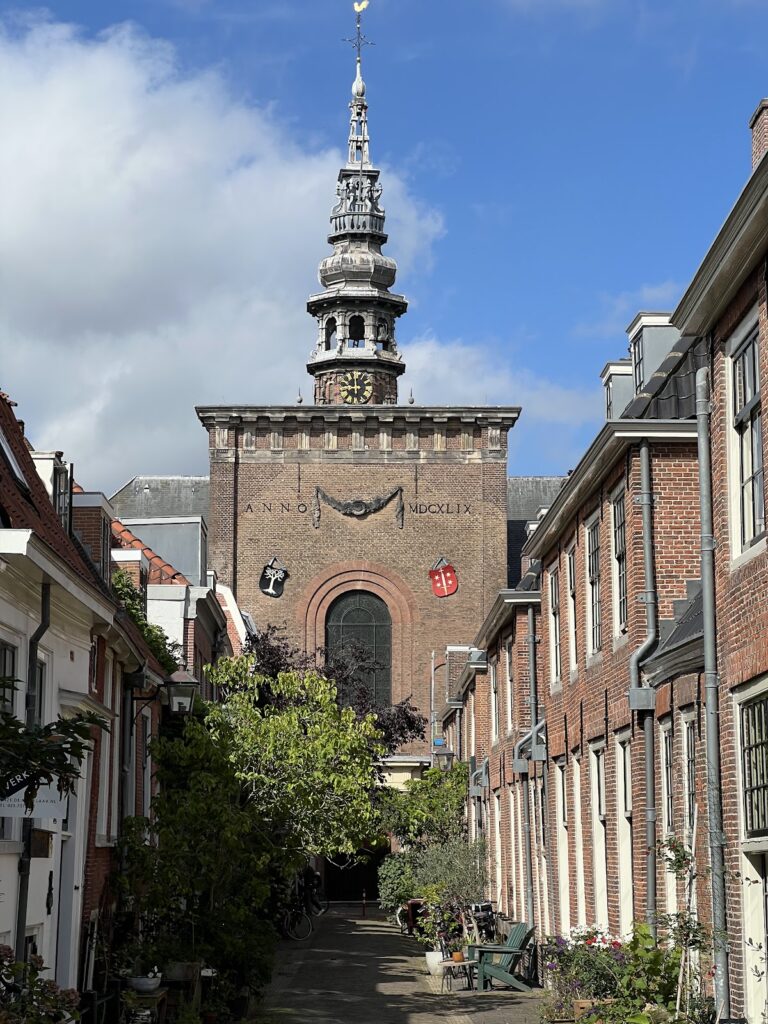
The existing tower is a late-Gothic wooden structure covered with lead and rises approximately 78 metres. It has an open octagonal section crowned by an open onion-shaped top. The design was probably by Michiel Bartssoen, and Jacob Symonsz. van Edam completed the tower between 1518 and 1520.
Interior, burials, and surrounding buildings
Gravestones and furnishings
Approximately 400 gravestones cover the church floor. Many carry house marks or coats of arms, and diamond-shaped family plaques hang on the walls. Burial registers preserve the grave numbers. Frans Hals’s grave lies beneath the choir, while Saenredam’s is in the south choir aisle near the entrance. The interior also contains a seventeenth-century pulpit with Gothic tracery, choir stalls from 1512 with carved decoration, a brass lectern from 1499 shaped as a pelican, and a choir screen with brass tracery.
Before the Reformation, the interior held four confessionals and thirty-two altars in addition to the high altar. Reformed authorities removed them on 6 March 1573. During the late nineteenth century, false battlements were added along the roof edge to give the exterior a more Gothic appearance. The exterior niches had previously lost their statues during the seizure and conversion of the church.
Adjacent buildings
Low buildings abut Grote Kerk. These include the former fish market De Vishal, now used for modern-art exhibitions, and shops built against the former library and sacristy on the south side. Salomon de Bray designed and built the surviving consistory in 1630.
Stained glass and memorials
Historic stained glass survives in altered form. The western window depicting the Wapenvermeerdering, Haarlem’s legend of the “augmentation of the arms,” was dismantled and bricked up when the Müller organ was installed. Barend van Orley’s surviving sketches for the window are held by the Rijksmuseum in Amsterdam.
A surviving window depicts the Damiate legend and was originally presented by Haarlem to Beverwijk in 1679. Other historic Haarlem windows by Willem Thibaut are now in Haarlem City Hall and the Janskerk in Gouda. A Thibaut window made for a church in Bloemendaal is also held in Haarlem City Hall. Windows from demolished or disused churches were installed to compensate for the loss of original colored glass.
The present windows include the Dutch Maiden window, donated in 1877 by the Nederlandsche Maatschappij voor Nijverheid en Handel; Noah by Louis Boermeester, made in 1985; Paradise by Gunhild Kristensen, made in 1957; and Peace and Harmony, a large northern window by Michel van Overbeeke made around 2008 and 2009. Memorial markers identify people associated with Haarlem, including Frans Hals and Pieter Teyler van der Hulst. A plaque for Maarten van Heemskerck is located in the Christmas Chapel.
Organ and bells
Christiaan Müller organ
The Christiaan Müller organ was built in Amsterdam between 1735 and 1738. Jan van Logteren made its wooden case, which is decorated with gilding and stucco. At its completion, the organ was the world’s largest, with roughly sixty voices, 32-foot pedal towers, and approximately 5,000 pipes. The largest pipes are more than ten metres long and about 37 centimetres in diameter, while the smallest are about the size of a pencil.
The organ was altered several times during the nineteenth and twentieth centuries. Marcussen carried out the most extensive modification between 1959 and 1961, followed by further voicing work between 1987 and 2000. Its historical associations include performances by Felix Mendelssohn, George Frideric Handel, and Wolfgang Amadeus Mozart, who played it at the age of ten in 1766. A small choir organ stands at the corner of the choir termination, and the Müller organ continues to be used for worship and concerts.
Tower bells and carillon
The tower’s bourdon, its largest and lowest-pitched bell, is Roeland, cast in 1503 by Geert van Wou of Kampen. It sounds the note A0, weighs approximately 4,900 kilograms, and strikes the hours. A preliminary striking mechanism acquired in 1524 included bells cast in Mechelen by Cornelis Waghevens.
The carillon, a musical instrument made from tuned bells operated by a keyboard and sometimes an automatic drum, began with bells cast by François Hemony in 1662. His brother Pieter Hemony expanded it to 35 bells in 1670. In 1968, Eijsbouts recast 25 bells and enlarged the instrument to a 47-bell concert carillon. It is tuned in meantone temperament based on D-flat 1. The 25 Hemony bells removed during the restoration were installed in the Bakenesser Tower, and further work in 2010 improved the carillon’s playability.
Other tower bells include the Damiaatjes, Piet and Hein, recast by Jan Albert de Grave in 1732; a fairground bell cast by Claude Fremy in 1685; and movable service bells made by François Hemony in 1667 and Eijsbouts in 1965.
Nearby sites