Fort benoorden Spaarndam: A Fort in the Stelling van Amsterdam


Site at a Glance
- Rating
- 4.1
- Popularity
- Very Low
- Country
- Netherlands
- Primary era
- Modern
- External website
- Open
- Eras represented
- Modern
- Civilizations
- Dutch, German
- Site type
- Military
- Remains
- Fort
On this page10 sections
History
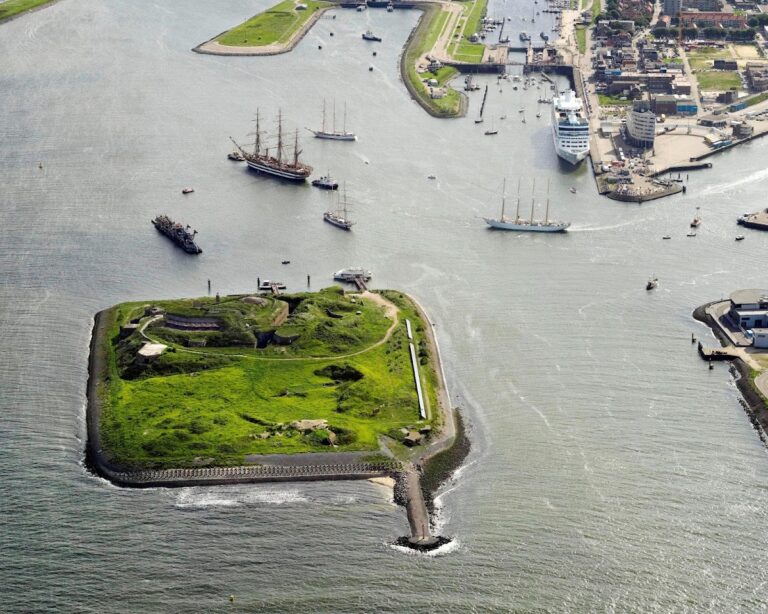
Fort benoorden Spaarndam is a Dutch fort in Velserbroek, Netherlands, built between 1885 and 1901 as part of the Stelling van Amsterdam, a defensive ring that used controlled flooding to obstruct an advancing army. Located north of Spaarndam-West beside Zijkanaal B, it formed part of the ring’s western front and helped defend the remaining routes through the flooded landscape.
Construction and the Positie bij Spaarndam
The fort’s first earthwork was made between 1885 and 1887, at the same time as the earthwork of Fort bezuiden Spaarndam. Work on the bombproof buildings began ten years later, and the fort was completed in 1901. A bombproof building was designed to withstand explosive attack through massive construction and protective earth or concrete covering.
Fort benoorden Spaarndam belonged to the Positie bij Spaarndam, a fortified defensive position within the Stelling van Amsterdam. The position also included Fort bezuiden Spaarndam, a line wall with storage rooms, two secondary batteries, and a western position containing concrete shelters protected against shell fragments. Its purpose was to defend the access routes over the Slaperdijk, Westlaan, and the road along the southern embankment of the Slaperdijk. The surrounding land was intended to be inundated, but between Spaarndam and the dunes only a narrow strip could be flooded, concentrating the defensive task along the usable approaches.
The planned size of Fort benoorden Spaarndam was reduced during its development. The outer banks of the moat nevertheless retained the main outline shown in the original design, including two front-facing gun positions that were never built.
Garrison and wartime changes
The normal garrison consisted of 288 soldiers, commanded by five officers and supported by 16 non-commissioned officers. Its strength changed according to the fort’s role and period. In the event of an attack, 11 additional troops were assigned, bringing the total to 299. A storage shed and a troop shed stood on or beside the fort. The storage shed burned down in 1924 and was not rebuilt, while the foundations of the troop shed were rediscovered in 2006.
On 19 November 1941, German forces demolished the buildings for the fort’s lift-cupola guns and removed their steel for the German war industry. A lift-cupola gun was mounted in a retractable armored cupola that could be raised to fire and lowered for protection.
During the German occupation, the fort became part of the outer searchlight ring of Festung IJmuiden, the German coastal defensive complex centered on IJmuiden during the Second World War. A concrete ramp was built for a searchlight, with a west-facing open position probably intended for a sound-detection device that could supplement the searchlight in fog or cloudy weather. The installation included a masonry shelter for the searchlight, a generator shelter south of the fort, and a separate building for remote-control equipment. No shell casings or other remains of Second World War anti-aircraft artillery have been found at the fort.
Ammunition storage and later conservation
From 1948 until 1970, the fort stored ammunition for the Koninklijke Marine, the Royal Netherlands Navy, and Regiment Van Heutsz. In 1951 it ceased to have a role in national defense and was classified as a fortification of no class. Ammunition arrived from Zijkanaal B by narrow-gauge railway and was taken to the casemate. The storage function ended in 1970, when the ammunition was moved to the mobilization complex in the Munitie-bos area directly in front of the fort.
After closing, the fort remained unused for more than 50 years and deteriorated. A 1995 investigation identified roof repair as an urgent need. Following 15 years of lobbying by volunteers, Noord-Holland Province began work in 2016 to repair the roof, chiefly to protect vulnerable wall paintings. A new protective layer was applied, but the drying of the lime layers beneath it created fresh risks because the lime and painted images could crumble.
Volunteers worked to keep the fort dry and conserve it for a possible educational and museum function. The fort warden cooperated with SRAL, a Dutch institution specializing in the conservation and restoration of cultural heritage, and students from the University of Amsterdam to conserve the paintings. The fort is owned by Staatsbosbeheer, the Dutch state organization that manages public land, has no current function, and is designated a provincial monument.
Remains
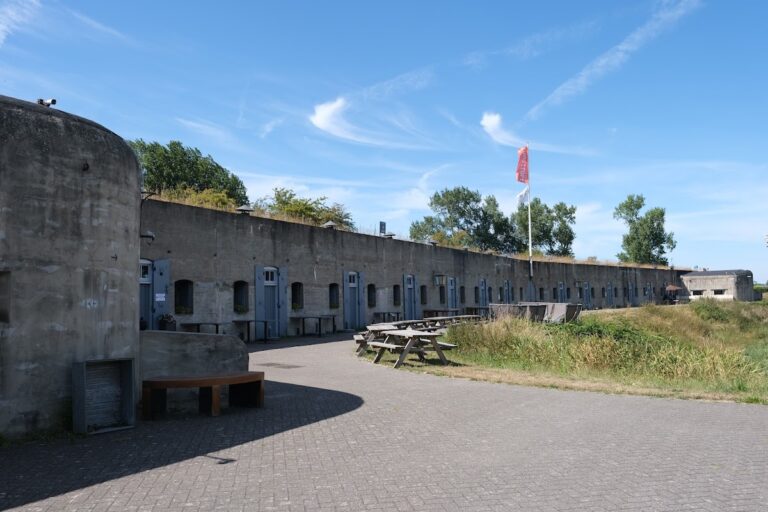
Fort benoorden Spaarndam is an unreinforced-concrete fort surrounded by a broad wet moat. Its outer banks preserve the older planned outline, including the locations of two projected front artillery positions that were never constructed. The surviving remains combine defensive chambers, wartime searchlight structures, a largely intact ammunition railway, and an unusually extensive group of painted wall panels and images.
Defensive structures
Throat casemates
The throat casemates, fortified chambers on the rear side of the fort, held weapons for lateral and rear defense. The southern casemate, directed toward Fort bezuiden Spaarndam, contained two 6-centimeter guns. The northern casemate held two 10-centimeter guns because Fort Zuidwijkermeer lay farther away and the Noordzeekanaal also required defense. Machine guns and rifles protected the throat side, while the flank guns covered approaches toward neighboring forts.
Searchlight installation
The concrete searchlight ramp constructed during the German occupation survives with a masonry shelter at its lower end. The shelter protected the searchlight when it was not in use. South of the fort are a generator shelter, which housed the equipment that powered the searchlight and probably the fort, and a separate building for the remote-control apparatus. A west-facing open emplacement was made for the probable sound-detection device associated with the searchlight system.
Ammunition railway
A narrow-gauge railway for moving ammunition from Zijkanaal B remains largely intact. The surviving track runs from the landing stage to the bridge, then follows the throat wall of the main building toward the right-hand throat casemate. Its turning circle on the throat side, where trolleys could pass one another, is the only missing section. Bank improvements in 2006 almost completely destroyed the ammunition landing stage, which was later rebuilt. The railway also connected the ammunition-storage area in front of the fort with the casemate and landing stage.
Wall paintings
Painted dado panels and distinctive early twentieth-century images were found beneath later lime layers. They include texts, portraits, and cartoons, as well as graffiti from the period of the German occupation. A total of 232 images has been recorded at Fort benoorden Spaarndam and Fort bij Spijkerboor, while smaller numbers are known from other forts.
The paintings were first threatened by leaks through the largely destroyed bitumen roof layer. After most of the leaks were remedied in 2017, the lime layers began to dry, creating another risk that the lime and the painted images would crumble. Their conservation remains closely linked to efforts to keep the concrete fort dry.
Nearby sites