Gropparello Castle: A Medieval Fortress in Italy



Site at a Glance
- Rating
- 4.6
- Popularity
- Medium
- Country
- Italy
- Primary era
- Medieval
- External website
- Open
- Eras represented
- Medieval, Early Modern, Modern
- Civilizations
- Duchy of Milan, Holy Roman Empire, Italian
- Site type
- Military
- Remains
- Castle
On this page13 sections
History
Gropparello Castle is a medieval hilltop fortress in Gropparello, Italy, built around 789 on the site of a Roman castrum, a fortified settlement or military stronghold, dating from the second or third century BC. The earlier fortification defended the road to Veleia. The castle is recognized as Italian national heritage and belongs to the circuit of the Associazione dei Castelli del Ducato di Parma, Piacenza e Pontremoli.
Roman and episcopal origins
In 810, or possibly 780, Charlemagne assigned jurisdiction over the area containing the castle to Giuliano II, bishop of Piacenza. Charlemagne was the Frankish king crowned emperor in 800, whose rule extended across much of western and central Europe. In 840, following a dispute between Piacenza Cathedral Chapter and the bishop’s estate, Bishop Seufredo II assigned the castle to the latter.
The Guelf and Ghibelline conflicts
Gropparello became involved in the medieval struggle between the Guelfs, who generally supported the papacy, and the Ghibellines, who generally supported the Holy Roman Emperor. Local alliances could vary, but the conflict repeatedly affected control of the fortress.
In 1255, Ghibelline forces led by Azzo Guidoboi under Oberto II Pallavicino captured the Guelf fortress after a long siege and demolished its surrounding wall. Internal feuds soon compelled Pallavicino to leave it almost undefended. The Guelfs retook the castle, then restored and strengthened its defenses.
Oberto Pallavicino attacked again in 1260 with 400 soldiers from Piacenza and Cremona. The battle, known as the Battle of the 400 Infantrymen, ended in a Guelf victory supported by men from Castell’Arquato. Pallavicino’s army was almost destroyed. The few survivors were taken to Piacenza and condemned to death by hanging in the Campo della Fiera.
A tradition placed in the final years of the thirteenth century tells of Rosania Fulgosio, the wife of the feudal lord Pietrone da Cagnano. According to the story, she was walled up alive in a room after an alleged affair with Lancillotto Anguissola, who had briefly occupied the fortress while Pietrone was away. The tradition holds that Rosania’s ghost has haunted the castle ever since.
Aristocratic ownership and ducal control
In the early fourteenth century, Bishop Filippo Fulgosio granted the castle to his heirs. When Guelf hegemony in Piacenza ended in 1335, the Fulgosio family withdrew into the fortress.
In 1464, Francesco Sforza, duke of Milan, ended Fulgosio control and granted the castle to Galeazzo Campofregoso in recognition of his service. In 1471, after the castle became part of the dowry of Galeazzo’s niece Lucrezia, ownership passed to Pier Antonio Attendolo da Cotignola.
Between 1503 and 1508, inheritance transferred the castle to Carlo Borri of Milan, Attendolo’s brother-in-law. Borri held an usufruct, the legal right to use and benefit from property owned by someone else, until his death. After Pier Antonio Attendolo rebelled against the French government, the castle passed to Giovanni da Montechino. Fiscal authorities requisitioned it in 1518 when he failed to make the required payments, and in June 1519 it was placed under the custody of G. Antonio De Turchis of Novara.
Carlo Borri won a legal dispute against Gian Giacomo Anguissola, a descendant of Pier Antonio Attendolo, in 1531. The castle remained with Borri’s heirs until 1599, when Camillo Borri transferred it to the Farnese ducal administration. It then came directly under Ranuccio I Farnese, duke of Parma and Piacenza. The Farnese were an Italian ruling family whose territories included those duchies.
Ranuccio I assigned the fortress to Marcantonio Anguissola and granted him the title Count of Gropparello. This established the Gropparello branch of the Anguissola family, a prominent Piacenza lineage. The branch retained the castle until the nineteenth century, when the death of Gaetano Anguissola without heirs brought the family to an end.
Abandonment, restoration, and wartime occupation
After the Anguissola line became extinct, the castle was offered for sale, abandoned for a period, and adapted for rural use. It passed to the Balduzzi family, then to Francesco Segadelli in 1830 and the Vallavanti family in 1845.
Count Ludovico Marazzani Visconti Terzi acquired the castle in 1869 and commissioned its restoration from the architect Camillo Guidotti. The work followed nineteenth-century taste and introduced features associated with the Gothic Revival.
During the Second World War, German troops occupied the castle amid the partisan resistance. Its position on the road linking the Po Valley with the oil wells at Montechino led to the establishment of a local SS garrison there. The SS, or Schutzstaffel, was a major Nazi paramilitary and security organization during the Third Reich.
After the war, the fortress was abandoned again and deteriorated. The Gibelli family acquired it in 1994, converted it into their residence, and began using it for cultural activities, including guided visits and programs for children.
Remains
Rocky setting and defensive layout
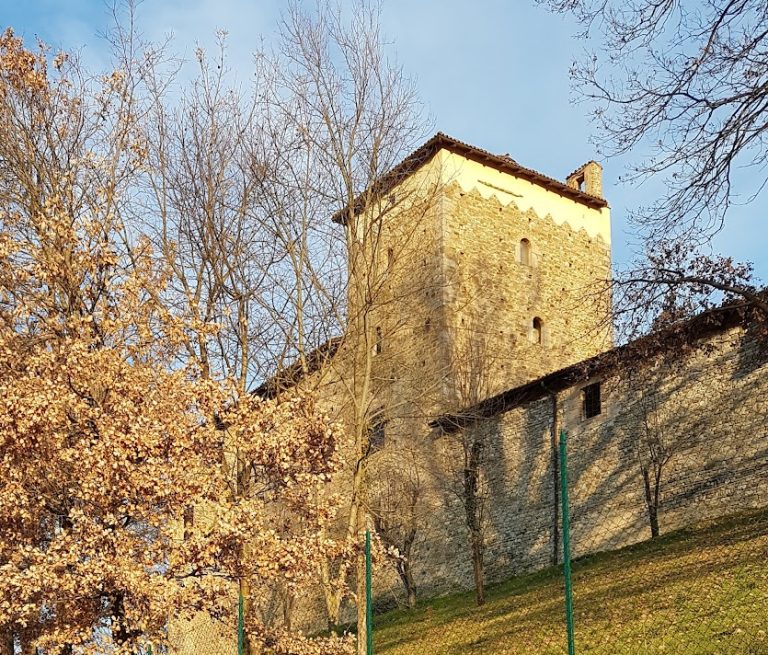
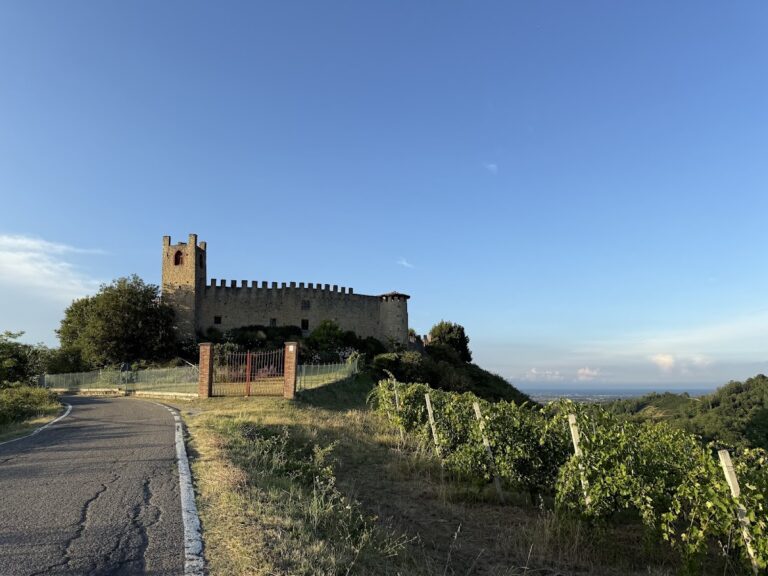
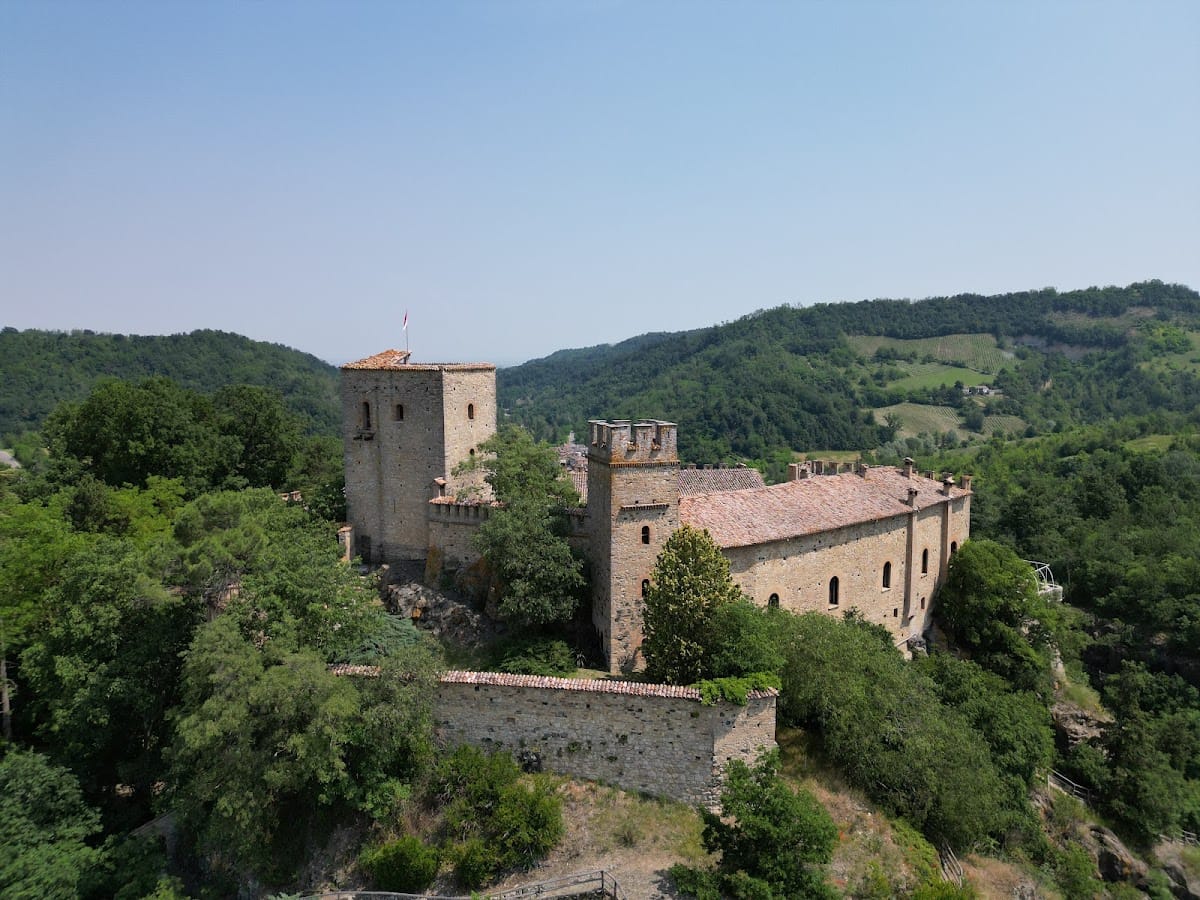
The castle occupies an ophiolitic rocky peak approximately 313 metres above sea level, above a ravine crossed by the Vezzeno stream. Ophiolite is rock derived from ancient oceanic crust and upper mantle. The restored fortress is built in rubble masonry, and its irregular plan follows both successive construction phases and the shape of the rocky ground. The buildings retain the severe architectural character of a defensive complex.
Two circuits of walls enclose the complex. The first surrounds the principal towers and central buildings, while the second contains a large irregular courtyard. A wall-walk, meaning a protected passage along the top of a defensive wall, extends around the entire second circuit.
Towers and entrances
Central keep
At the centre of the castle stands a rectangular keep dating from the eleventh or twelfth century. The principal fortified tower has three storeys and a terrace at the top. That terrace was formerly used to observe the movement of enemy troops.
Square tower and connecting buildings
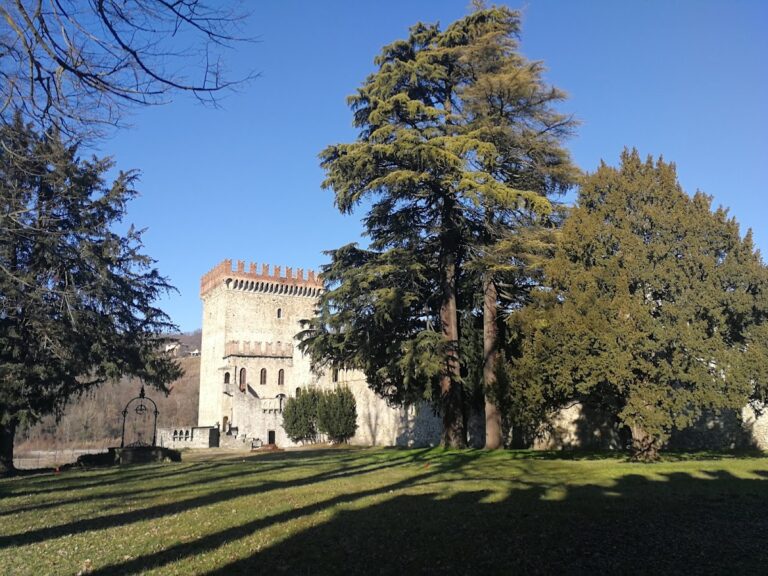
Opposite the keep is a square-based tower crowned with Guelf-style crenellations, battlements traditionally associated with the Guelf faction and formed with square merlons. The square tower and the keep are joined by the central body of the castle. Two further towers rise from this central structure: a large circular tower with projecting defensive structures, and a large entrance tower slightly higher than the curtain wall and equipped with crenellations.
Fortified approaches
Two pointed-arched passages lead through the fortifications. One was reserved for pedestrians, while the other was broad enough for wheeled vehicles. Both originally had drawbridges crossing a dry moat that surrounded the castle on three sides.
Interior rooms and service areas
The principal building received new facades in the fifteenth century and is approached by a staircase with two symmetrical flights. Its first upper floor contains an armoury, dining room, small conversation room, alcove bedroom later converted into a music room, and study.
The dining room preserves a sixteenth-century Italian-style open fireplace. Its decoration draws on classical mythology, with the Rape of Europa especially prominent on the horizontal element above the opening, known as the architrave.
Service spaces occupied both the uppermost floor and the basement. The upper floor contained a granary for food supplies. Beneath the castle, the basement was cut directly into the rock and included the kitchens and an icehouse.
Park and terraced gardens
A park of approximately 20 hectares surrounds the castle. Paths cross small gardens and clearings containing centuries-old trees. Terraced gardens extend from near the Vezzeno stream toward the fortress and include rose gardens and the Museum of the Rising Rose. Its collection contains approximately 1,200 roses representing 125 varieties arranged according to their biological characteristics.