Green Mosque: A Mosque and Shrine Complex in Balkh, Afghanistan
Site at a Glance
- Popularity
- High
- Country
- Afghanistan
- Primary era
- Early Modern
- Eras represented
- Medieval, Early Modern
- Civilizations
- Khanate of Bukhara, Timurid
- Site type
- Religious
- Remains
- Mosque
On this page15 sections
History
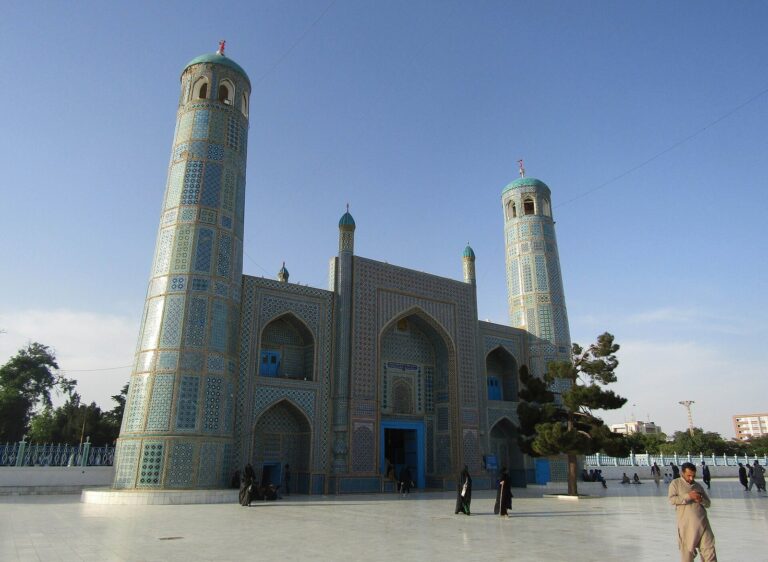
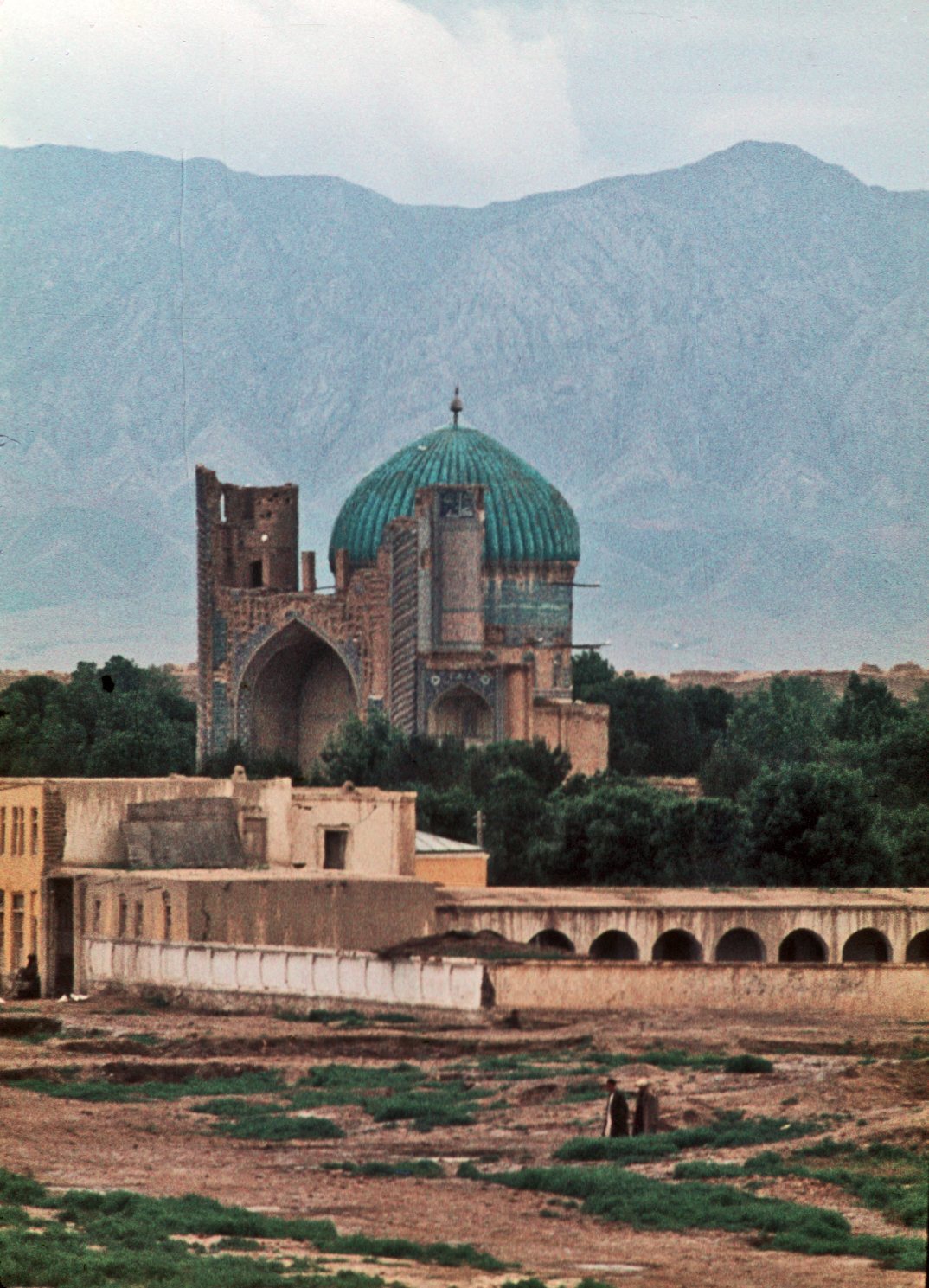
The Green Mosque is a mosque and shrine complex in Balkh, Afghanistan. It is associated with Sunni Islam, the largest branch of Islam, and the Naqshbandi, a Sufi order whose members emphasize spiritual discipline and guidance from a teacher. The complex is also described as a mausoleum, an Islamic school, or a Sufi lodge. Its surviving domed building reflects rebuilding under the Uzbek Shaybanid dynasty, probably in 1596–97.
Foundation and early shrine
Khwaja Abu Nasr Parsa, a Naqshbandi Sufi leader and influential religious authority and political mediator in Balkh, died in 1460 or 1461. A shrine was established a few years later, probably in 1462–63, under the patronage of the Timurid general Mir Sayyid Mazid Bahadur Arghun. Early descriptions associate Mir Mazid with a building and an Islamic school at the shrine. The complex may also have served as a burial place for members of Mir Mazid’s family.
Religious leaders from the Parsa family later repaired and developed the site. Abd al-Hadi is said to have undertaken major work in 1552. His brother Abd al-Wali subsequently repaired the mausoleum and school and established another school nearby. By the mid-sixteenth century, people in the area regarded the complex chiefly as Abu Nasr’s shrine. Pilgrims came there, and some prominent visitors to Balkh sought burial nearby.
Shaybanid rebuilding and religious schools
The surviving domed building belongs to a later rebuilding, probably carried out in 1596–97. Its oldest surviving building inscription, dated 1597–98, names the Shaybanid prince Abd al-Mu’min. He probably sponsored the portal or its decoration and repairs to the mausoleum, and may have intended the building as a tomb for himself and his family.
A group of schools grew around the shrine from the late sixteenth through the late seventeenth century, making the surrounding neighborhood a center of religious education. Abdullah Khan’s Madrasa, also called Madrasa-i Aliya, was completed by February 1584. The Nasr Muhammad Khan Madrasa followed around 1612, and the Allah Yar Bi Qataghan Madrasa was built shortly before 1616. By about 1635, at least five schools stood nearby. Construction of the Subhan Quli Khan Madrasa began in April 1660, and it was completed no earlier than 1686. The endowment for Allah Yar Bi Qataghan’s school provided for two teachers, a preacher, and Quran reciters; Subhan Quli Khan’s endowment also supported an elementary Quran school, a covered market, and a public toilet.
Eight generations of the Parsa family administered the mausoleum for more than two and a half centuries, until the late seventeenth century. Members of the family continued to hold the honorific title Shaykh al-Islam, meaning a leading Islamic religious authority, into the eighteenth century.
Name, alteration, and damage
The name Green Mosque came into use in the nineteenth century, referring to the building’s turquoise tiles. An earthquake late in that century may have partly brought down the dome and both minarets. The dome was repaired before the end of the 1930s, and its decoration was renewed between 1963 and 1966. A southern wing was demolished in the mid-twentieth century.
In the 1930s, a government plan to reshape Balkh as a modern national monument placed the shrine at the center of a proposed radial street plan. Nearby homes were cleared and a municipal park created; the cemetery and its surrounding wall were removed, changing the setting from a religious burial and pilgrimage place to a more open monument. Repairs and façade work took place in 1974–76. In 1975, the Archaeological Survey of India found serious cracks in the outer dome shell and carried out emergency stabilization. After 2002, low domed buildings beside the monument were rebuilt in a modernized form, and decorative work was restored again in 2004.
The Soviet-Afghan War damaged the northern façade and left the building in serious disrepair. An explosion inside the mosque in 2022 destroyed parts of it. The Green Mosque remains in use for worship, and a religious school established there in the mid-1990s continues its educational role. It is recognized as a cultural monument and is described as the largest mosque in Balkh.
Remains
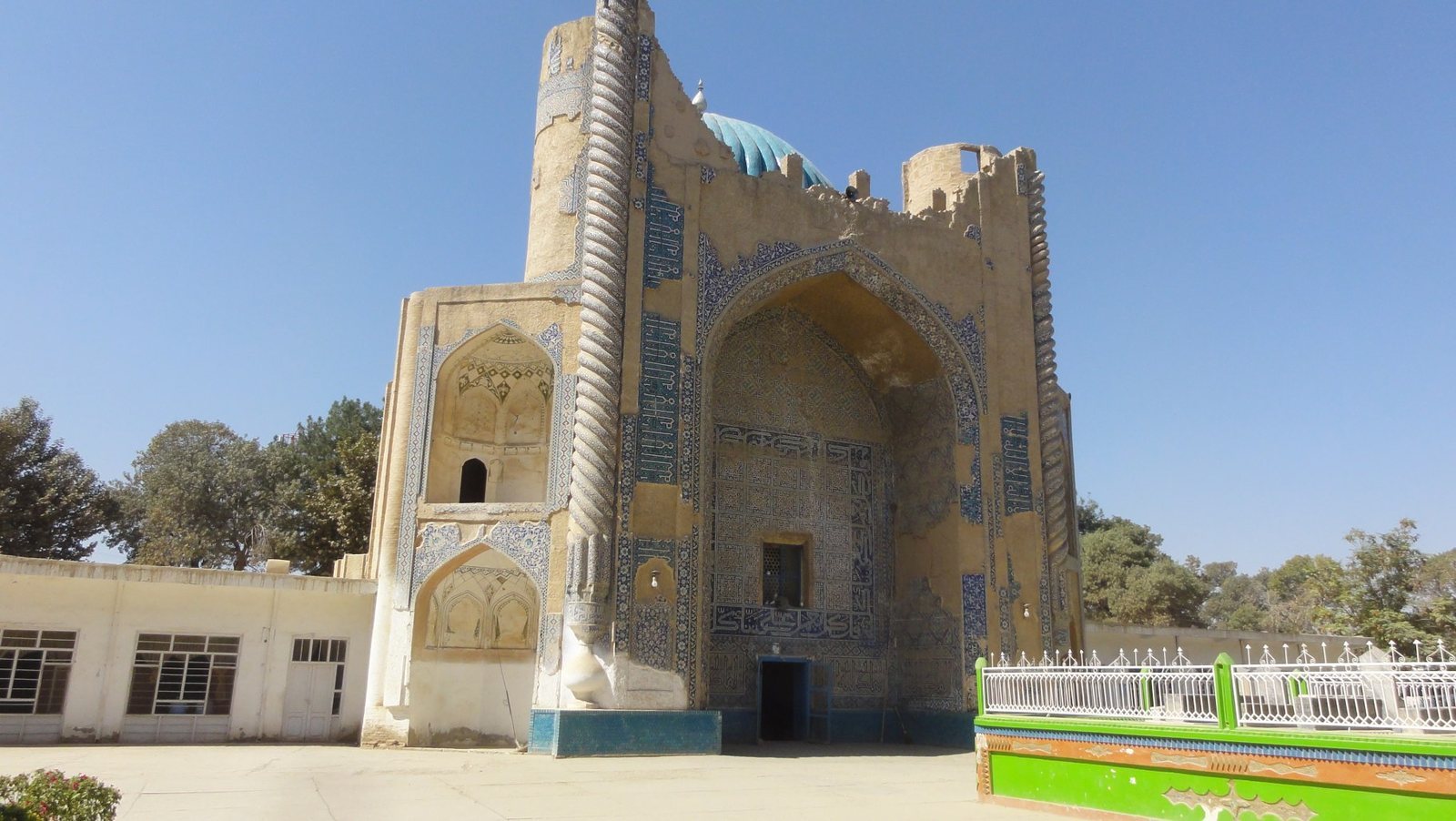
The central building is an irregular, two-story octagon, about 25.30 by 25.00 metres, with its corners cut off. A domed central hall is flanked by rows of single-story domed rooms. On the northeastern side, a projecting entrance faces the park. Above the building, a tall circular drum supports a ribbed dome built with inner and outer shells, reaching about 27 metres high.
Portal and exterior
Entrance portal
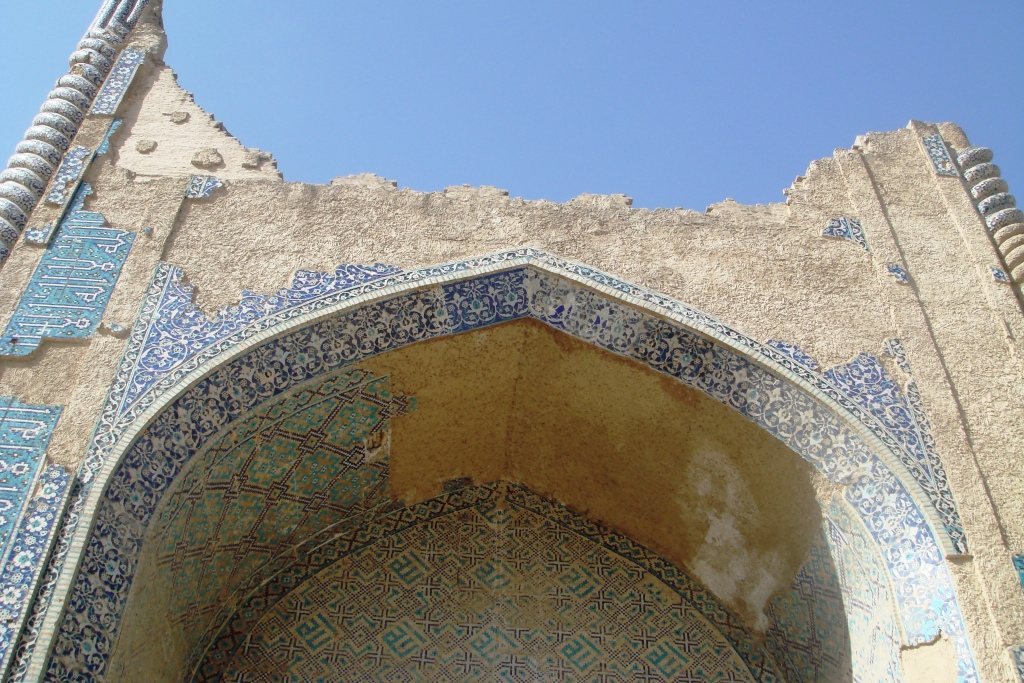
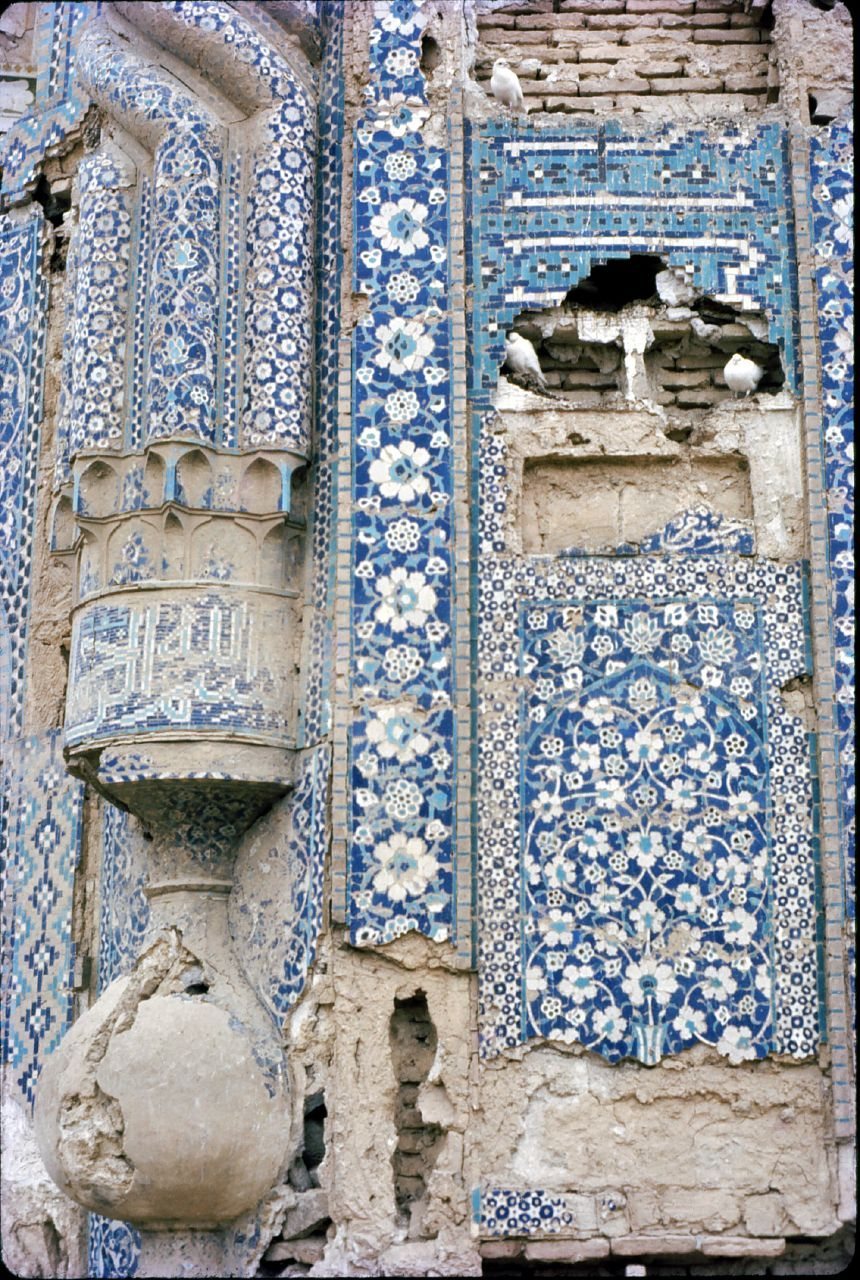
The northeastern portal projects from the main building and centers on an iwan, a vaulted space open on one side, with two-story niches at either side. The portal’s upper part has collapsed. Minaret bases and stumps survive behind its frame, rising slightly above the portal’s upper edge. Twisted columns or piers on bulb-shaped bases frame the entrance; spiral bands of mosaic tile cover them. Stairs in the flanking niches climb about 11 metres to the flat roof and provide access toward the minarets. Pointed-arch niches mark the principal exterior sides, while the narrower sides have paired niches.
Tiles and inscriptions
Turquoise, blue, blue-green, black, and white ceramic decoration covers parts of the façade and dome in geometric and lattice patterns. The tiles were fixed to a grid of bricks laid on edge, a method associated with the loss of large areas of decoration. Two broad bands of Kufic lettering, an angular form of Arabic writing, encircle the drum, with a small frieze of muqarnas, tiered ornamental forms used in niches and transitions, below the dome. A large square panel above the portal doorway bears angular, square-patterned lettering. Floral designs decorate the portal and its framing columns.
Dome and interior
Dome chamber
Sixteen pointed-arch windows encircle the lower part of the drum. Inside, eight screened windows alternate with eight niche crowns filled with tiered ornament, leading up to a 24-ribbed inner dome beneath the higher outer shell. The square dome chamber has a niche in each wall. Its southwestern wall contains the mihrab, a niche indicating the direction of prayer, and marks the qibla, the direction toward Mecca. A small wooden door leads from the northeastern iwan into the chamber, which is covered by a tall umbrella-shaped vault. Mosaics, paintings, and interlaced stucco ornament decorate the interior; floral paintings on the entrance-side structures date to the late nineteenth century.
Side rooms and crypt
Rows of four domed rooms flank the central hall. Beneath the dome chamber, a cross-shaped crypt contains an unnamed tomb that may have been intended for Mir Mazid’s family. A column was added later to support the top of the crypt vault. Abu Nasr is also associated with an unnamed grave on a platform among other graves outside the portal, so the location of his burial remains uncertain.
Madrasas and park setting
Nasr Muhammad Khan Madrasa
The Nasr Muhammad Khan Madrasa stood a few hundred metres west of the mausoleum. Its entrance portal was taller than that of the earlier school. The complex had vaulted spaces, arcades, four teaching rooms, a mosque, sleeping rooms, and a library holding 2,000 works. Turquoise tiles decorated parts of the building.
Subhan Quli Khan Madrasa
East of the mausoleum, the Subhan Quli Khan Madrasa was a two-story school with 75 rooms on each floor and 24 paid staff, including 12 Quran reciters. Its large iwan arch and sections of the two-story outer walls survive. Small blue tile patterns remain partly visible on the arch’s inner surfaces.
Park and burial features
The mosque stands at the edge of a roughly 3.5-hectare city park, which extends northeast from the portal in a circular arrangement. Radial paths lead from a modern concrete fountain at the center, while the ruined iwan of the Subhan Quli Khan Madrasa stands at the far edge. A stone platform outside the mosque holds tombstones associated with other saints. A modern mausoleum in the park contains the tomb of Rabia Balkhi, traditionally regarded as an early Afghan poet.