Great Dolmen of Zambujeiro: A Neolithic Burial Monument in Portugal
Site at a Glance
- Popularity
- Medium
- Country
- Portugal
- Primary era
- Stone Age
- Eras represented
- Stone Age
- Civilizations
- Unclassified
- Site type
- Burial
- Remains
- Tomb
On this page14 sections
History
The Great Dolmen of Zambujeiro is a prehistoric tomb built from upright stones supporting a large covering stone, near Nossa Senhora de Guadalupe in Portugal. It dates broadly to 4000–3000 BC, during the Neolithic, the later Stone Age, when communities in many regions built monumental stone structures. The monument belongs to the megalithic tradition of the Évora region and is linked to the dolmen culture also represented by the Great Dolmen of Comenda da Igreja near Montemor-o-Novo. It is Portugal’s largest megalithic monument and one of the largest megalithic tombs on the Iberian Peninsula.
Neolithic burial and use
The tomb’s chamber was used for burials during the Neolithic. Use for religious rites is possible, but remains uncertain. The monument reflects the technical abilities and social organization of the communities that built it.
Discovery and later study
The monument came to light in 1964 after its covering stone, weighing about 20 tons, was blasted. Archaeologist Henrique Leonor Pina directed excavations the following year, and the methods used drew controversy. The circumstances of discovery allowed distinct archaeological layers to be identified. Blades, beads, and stone axes were assigned to an earlier phase.
Further excavations took place in 1989 and 1990 under archaeologists Carlos Tavares da Silva and Joaquina Soares. Portugal declared the dolmen a National Monument on 22 November 1971 under Decree-Law No. 516/71.
Remains
The monument has an irregular, free-standing plan, with a polygonal chamber and a rectangular corridor forming a structure about 19 metres long. It stands in the parish of Nossa Senhora da Tourega, near Valverde and the Mitra estate, southwest of Évora. The site lies near the Ribeira da Permanca at an elevation of about 225 metres, roughly one kilometre north of the historic Convent of Bom Jesus of Valverde.
Chamber and corridor
Burial chamber
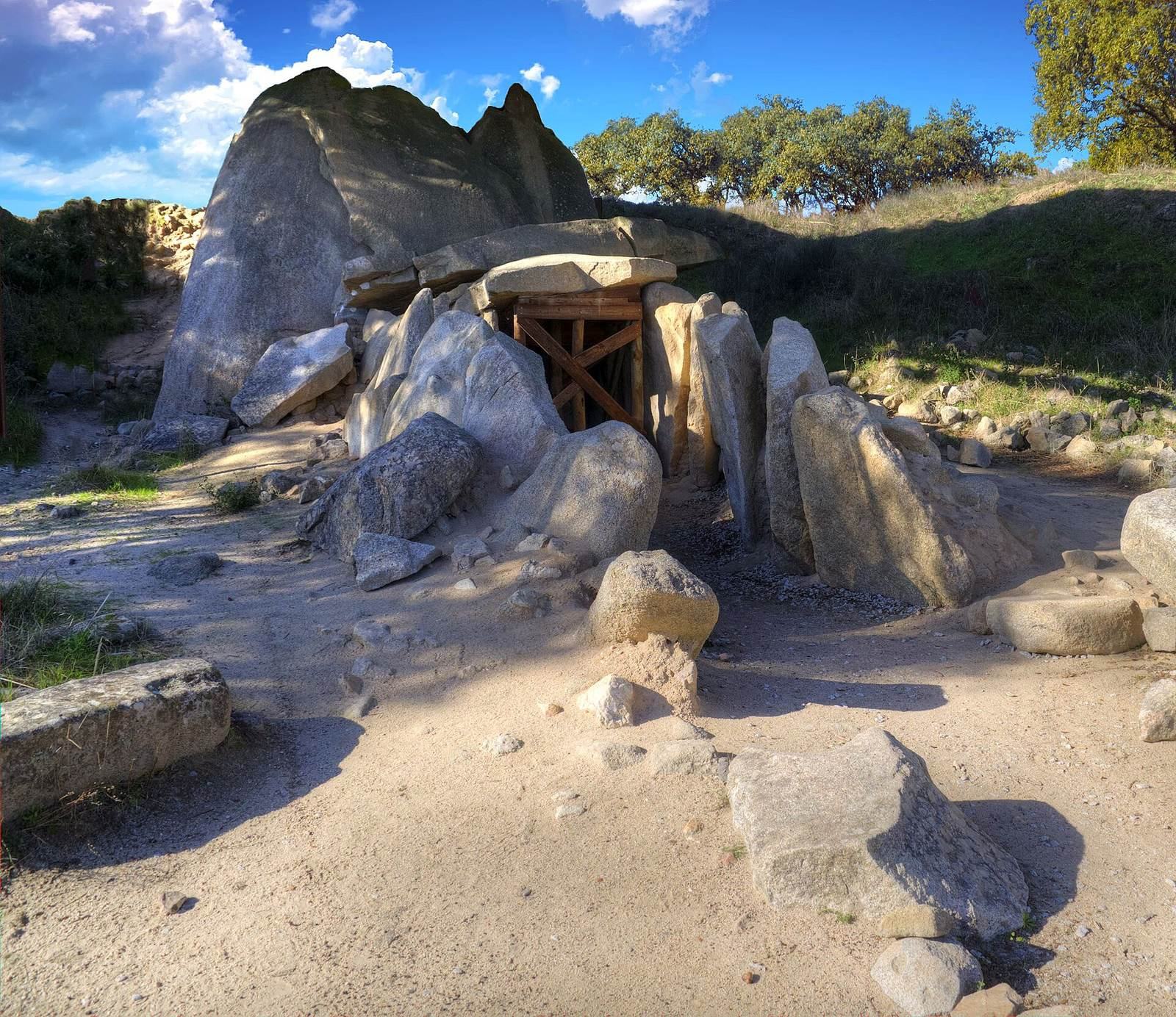
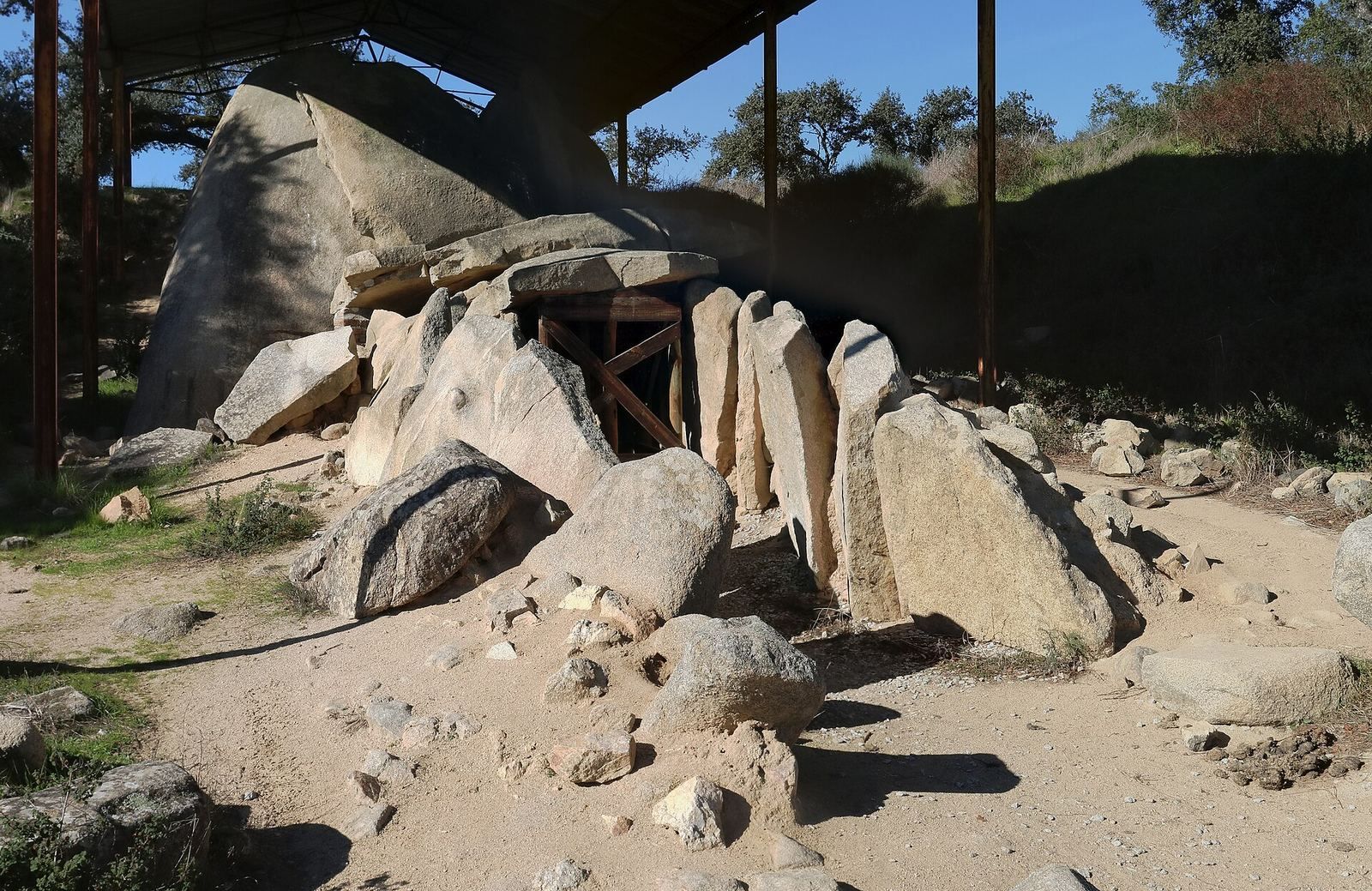
Seven upright stones, each about eight metres high, form the chamber. Its base is approximately five metres wide, and additional upright stones divide the interior into four parts. Large granite slabs covered the chamber.
Corridor and entrance
Stones about two metres high line the corridor, which measures roughly 12 metres long and 1.5 metres wide. Extending beyond the chamber, it forms the monument’s east-facing principal side. The entrance was paved.
Mound and entrance marker
Mound and covering stone
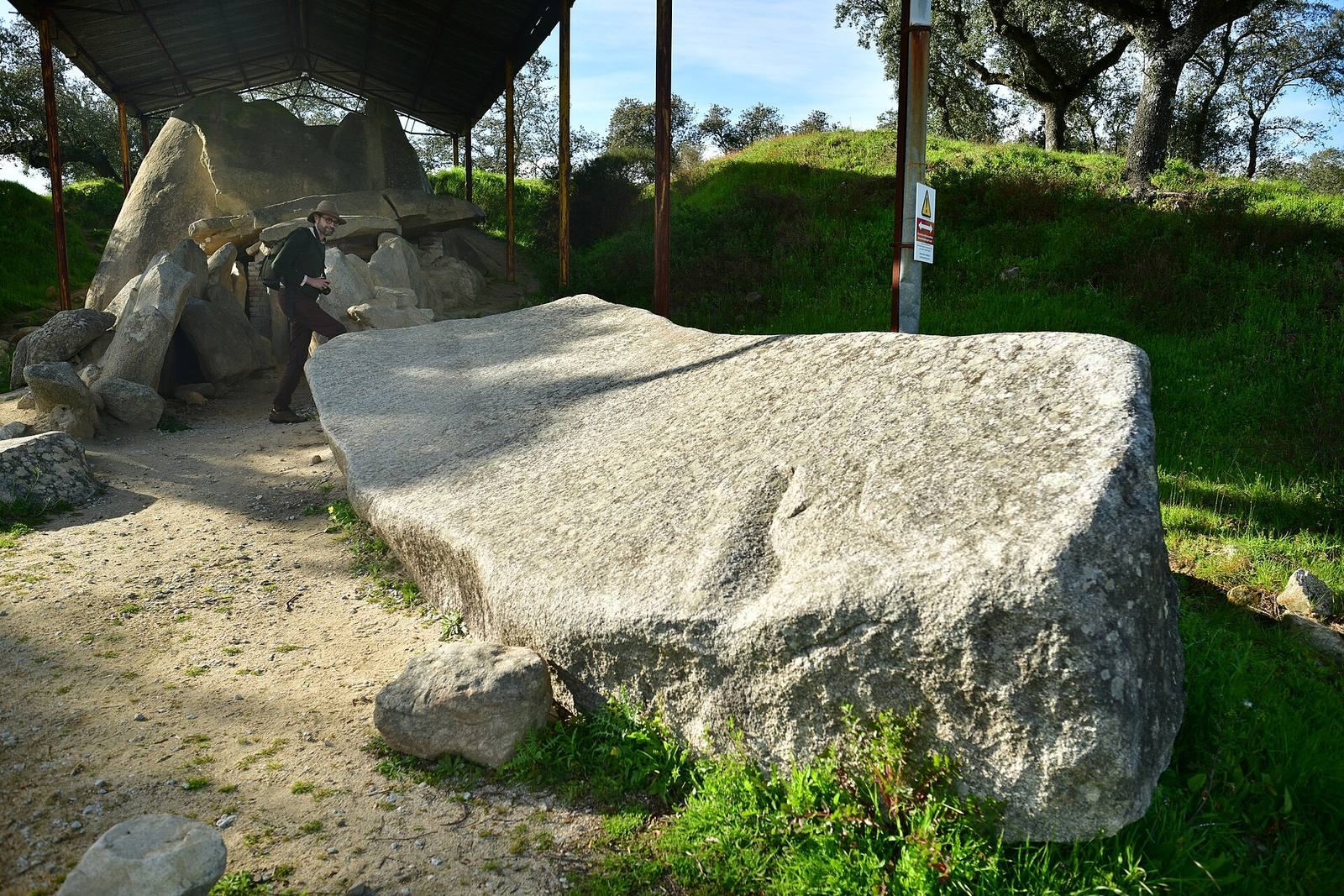
The mound originally stood about six metres high and measured around 70 metres across. It still conceals nearly the entire structure apart from its eastern side, while the supporting stones rise about six metres above ground. A covering slab roughly seven metres wide lies broken on the mound, with a sag along its western edge.
Standing stone
A large menhir, or prehistoric standing stone, once marked the entrance. It bears small dimples and now lies on the ground.
Condition and protection
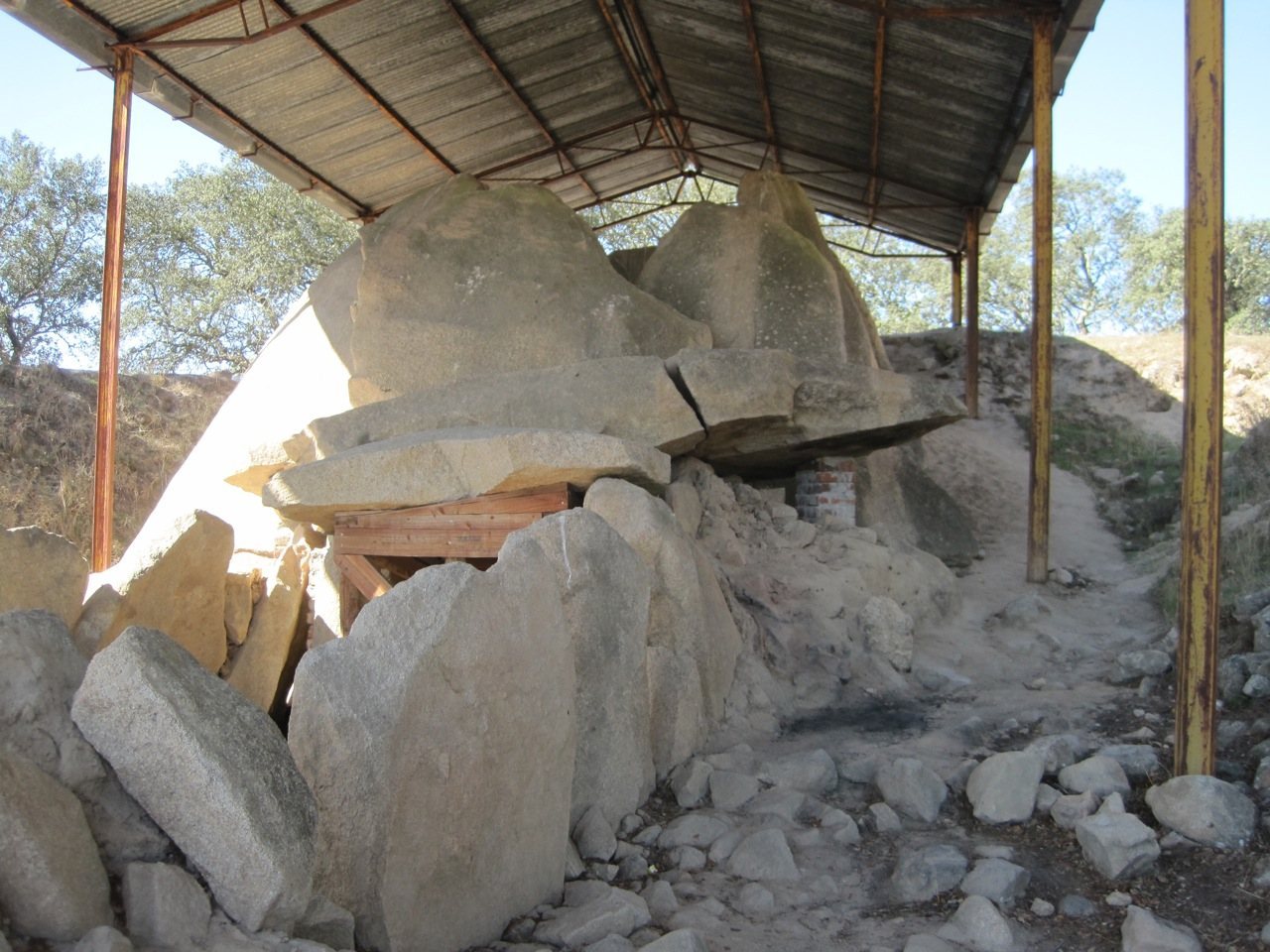
A metal enclosure was erected in 1983 amid concerns about deterioration. By 2019, the upright stones, especially those along the corridor, were exposed almost to their bases, and the structure was considered at risk of collapse. A corrugated-sheet cover protects it from erosion.
Finds and regional comparisons
Excavated objects
The 1965 excavations yielded about 500 beads of varied shapes and materials, nearly 30 stone axes or fragments, and more than 800 blades or blade fragments. Finds also included 40 intact vessels, about 1,800 pottery fragments, 154 carved slate idols and about 1,000 fragments of them, and more than 500 arrowheads. Other objects included slate tablets, necklaces, hooked staff-shaped pieces, copper objects, ceramics, and bowls with pronounced shoulders. The excavated finds are held at the Museu Nacional Frei Manuel do Cenáculo in Évora.
Regional parallels
Similar tomb structures occur in the northern region associated with the Funnelbeaker culture, a Neolithic archaeological culture named for the characteristic shape of some pottery, particularly in Mecklenburg and Sweden. Nearby stones bearing cup-shaped marks have parallels in that region as well as in Britain and France.