Almendres Cromlech: A Prehistoric Standing-Stone Complex in Portugal
Site at a Glance
- Popularity
- Very High
- Country
- Portugal
- Primary era
- Stone Age
- Eras represented
- Stone Age
- Civilizations
- Unclassified
- Site type
- Religious
- Remains
- Sanctuary
On this page10 sections
History
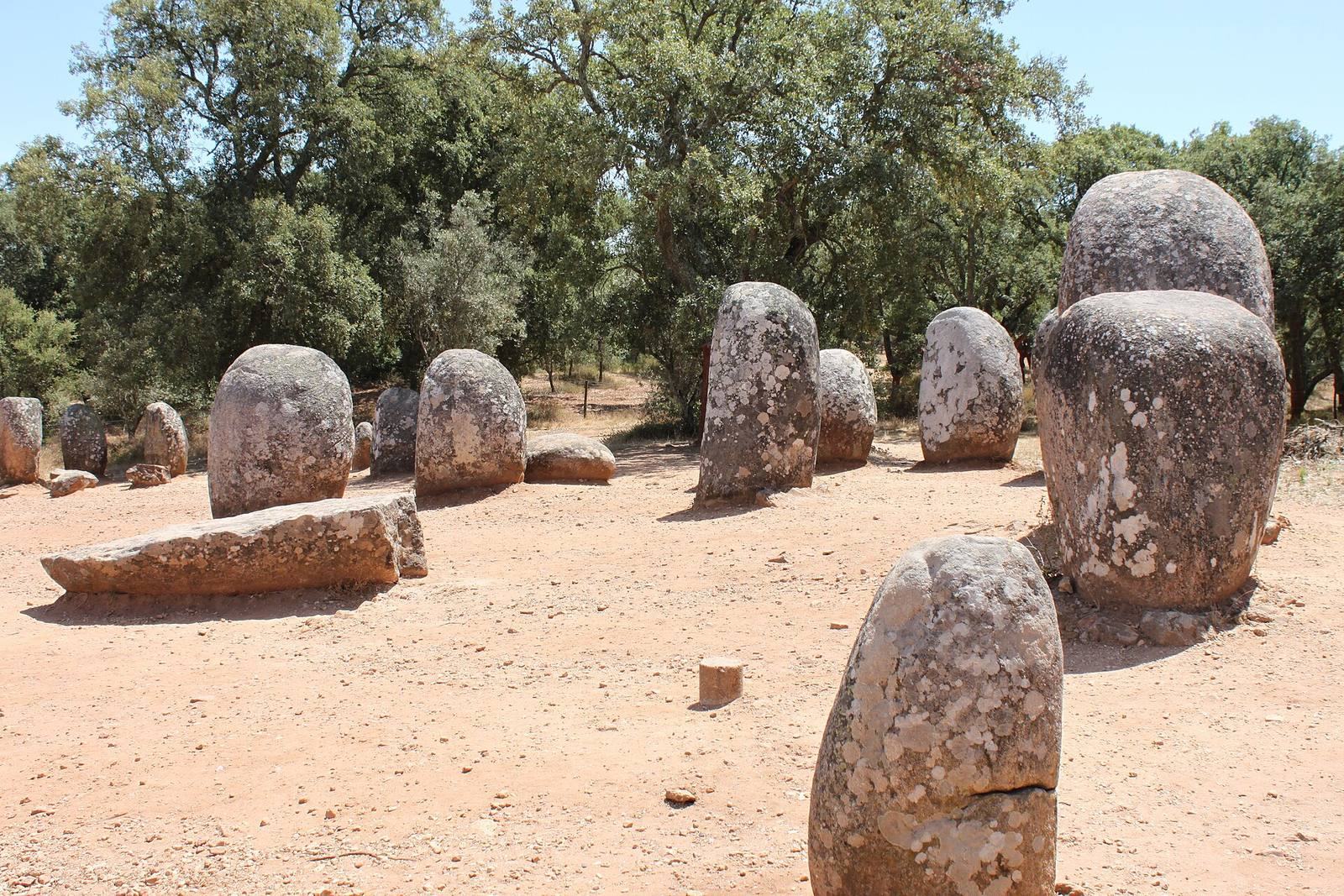
Almendres Cromlech is a prehistoric setting of standing stones about 4.5 km west-southwest of Nossa Senhora de Guadalupe, in Évora municipality, Portugal. Construction began in the sixth millennium BCE, in the Neolithic, a prehistoric period associated with farming and polished stone tools. The complex’s relative chronology reaches into the Chalcolithic, or Copper Age, when copper was used alongside stone. Its stones are generally thought to have been raised by pre-Celtic peoples, before Celtic cultures became established in the region. Almendres is the largest existing group of arranged menhirs, or single upright stones, on the Iberian Peninsula and one of the largest in Europe.
Neolithic development
The complex has three principal phases. Almendres I dates to around 6000 BCE and belongs to the Early Neolithic; Almendres II, around 5000 BCE, to the Middle Neolithic; and Almendres III, around 4000 BCE, to the Late Neolithic. The dates of the stones’ erection are not all settled. They are generally thought to have been raised around 3300 BCE, although some may date as early as 4500 BCE, and the separate periods of erection may have been relatively close together.
Ritual interpretations and local tradition
During the Late Neolithic, earlier structures were altered for social or religious ceremonies. The wider complex may have served a ceremonial or religious purpose, or perhaps functioned as an early astronomical observatory. Other suggested uses include burial, worship, sacrifices, or a simple calendar marking the summer solstice, the year’s longest day. These proposed functions remain uncertain.
Almendres forms part of the prehistoric stone landscape associated with Évora, which also includes the cromlechs of Portela de Mogos and Vale Maria do Meio. A local tradition connects the separate Almendres menhir with a Moorish princess who is said to comb her hair there once a year. Moorish is a broad historical term for Muslim peoples associated with North Africa and the Iberian Peninsula.
Rediscovery and re-erection
Henrique Leonor Pina rediscovered the site in 1966 while conducting fieldwork for geological mapping. Archaeologist Mario Varela Gomes later re-erected stones found standing or fallen, using research and their original bases to guide their placement.
Remains
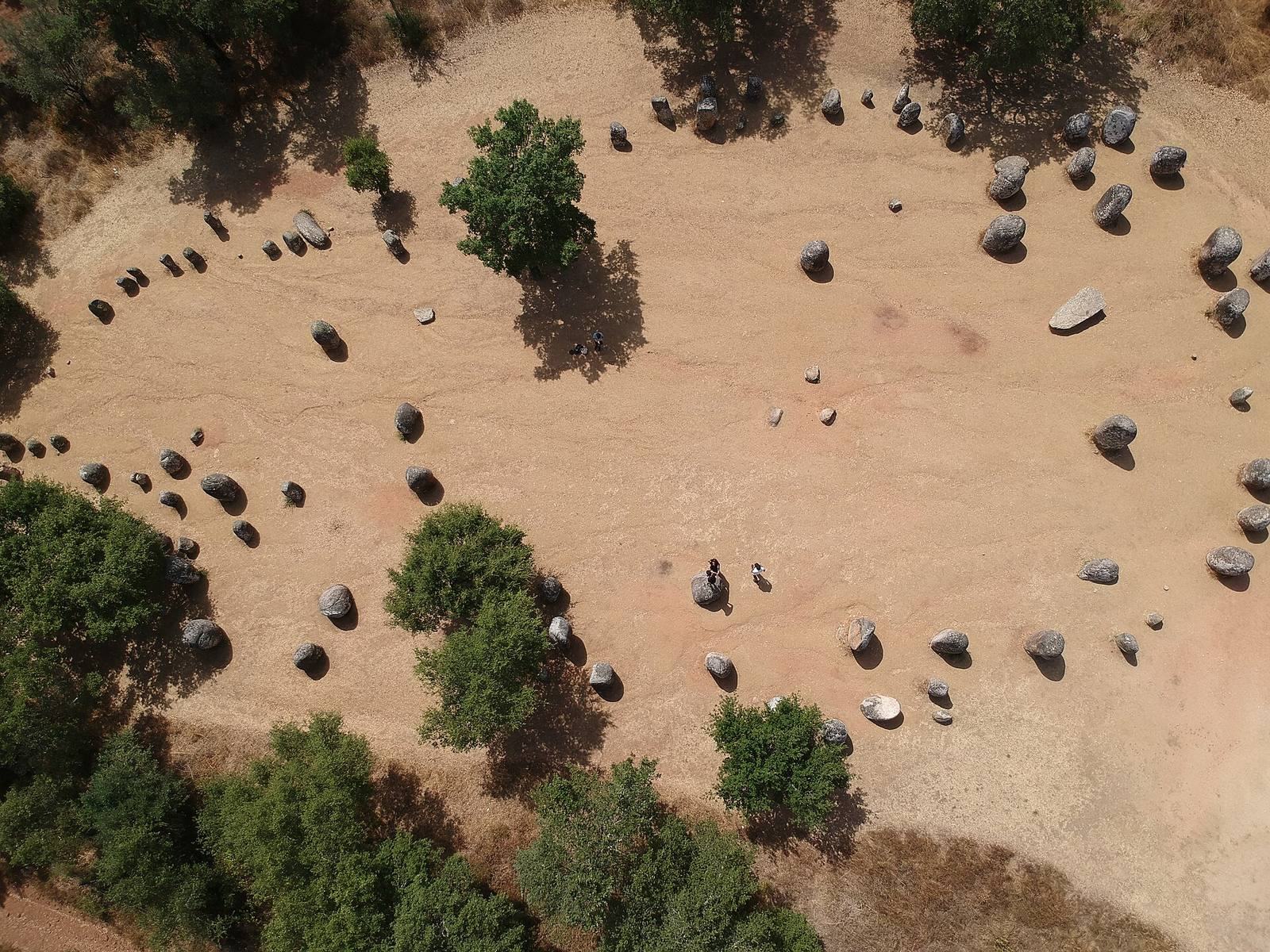
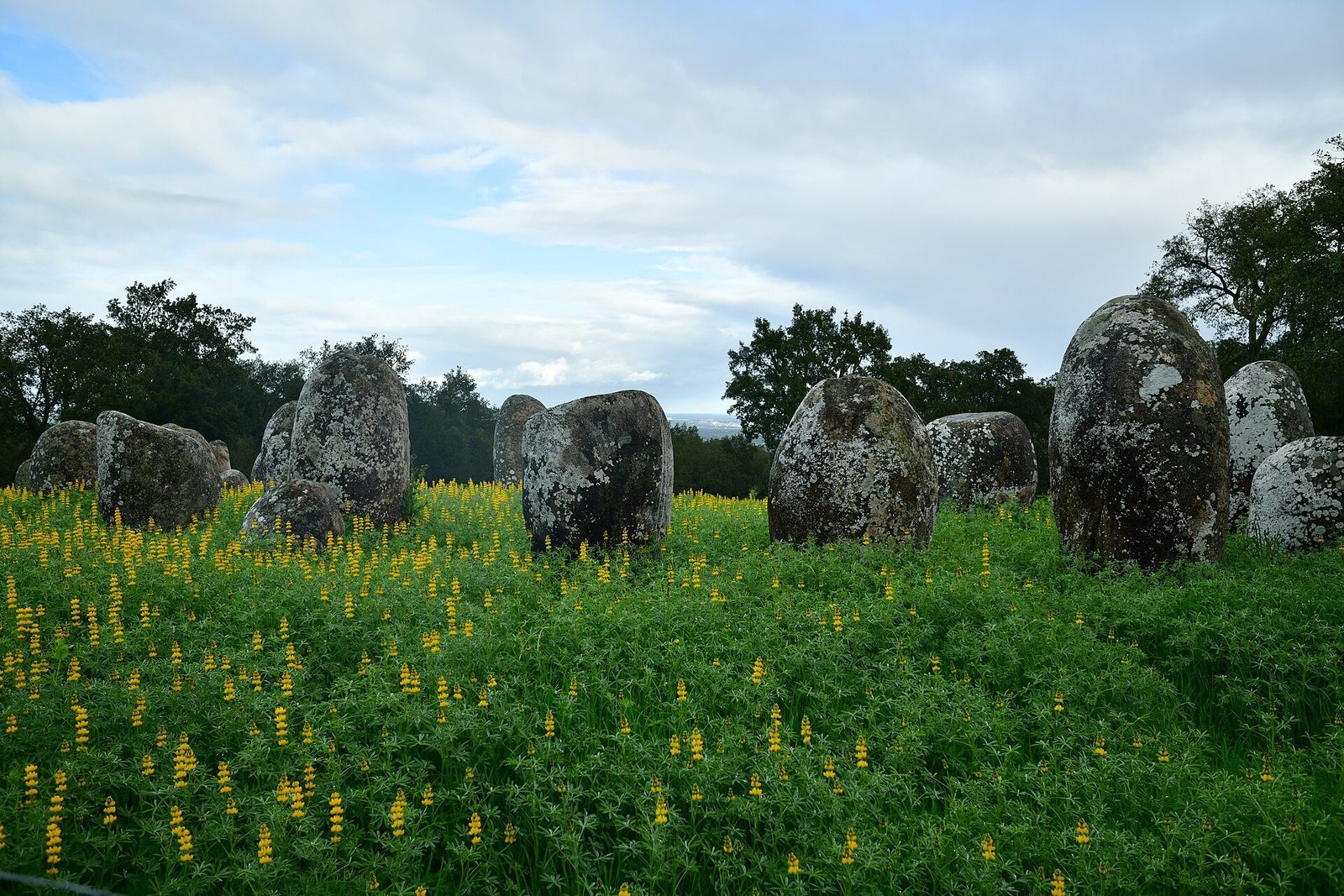
The main complex is a broadly circular arrangement of granite stones grouped in small clusters. It lies on the southwest side of the Almendres Estate at an elevation of about 400 m.
Main stone setting
Layout and phases
About 95 stones occupy an area approximately 70 by 40 m, with the long axis running northwest to southeast. Many are small, while larger rounded or elliptical examples measure about 2.5–3.5 m. The older Early Neolithic structures consist of two or three concentric circles of smaller stones. Middle Neolithic arrangements include two irregular concentric ellipses and larger upright stones. Ninety-two menhirs make up two areas oriented in different directions, associated with the equinoxes, when day and night are roughly equal in length.
Carvings and offerings
Weathering has worn the stones deeply, especially on exposed surfaces, but carved patterns remain visible. About a dozen stones bear designs, including lines and radial forms, with at least two designs on each carved stone. Four stones have only cupules, small deliberately made circular hollows. Stone 48 carries a schematic human-like figure surrounded by circles and accompanied by a hooked-staff motif. Coins, beads, and jewelry are also found at the site as offerings.
Possible astronomical observations
Stone 8 has a flattened top at roughly breast height, with several dimples. It may have been used to observe the spring equinox by placing small stones in the hollows. Similar observations may have been made from Stone 39, near the eastern focal point of the elliptical arrangement.
Separate Almendres menhir
A separate elongated oval stone stands near the eastern edge of the estate, about 1,400 m northeast of the main complex. It is approximately 4.5 m tall and 0.9 m in diameter, and faces sunrise over the Serra de Monfurado, a hill range in Alentejo. A line between the menhir and the main setting points roughly toward sunrise at the winter solstice. The Neolithic stone bears an engraved hooked-staff motif and has also been interpreted as a symbol of male fertility.