Grave of the Monkey: An Etruscan Chamber Tomb at Chiusi
Site at a Glance
- Popularity
- Medium
- Country
- Italy
- Primary era
- Classical
- Eras represented
- Classical
- Civilizations
- Etruscan
- Site type
- Burial
- Remains
- Tomb
On this page14 sections
History
The Grave of the Monkey is a painted Etruscan chamber tomb at Poggio Renzo near Chiusi, Italy, dating to about 480–470 BCE. The Etruscans were an ancient people of central Italy. The tomb belongs to a group of about twenty painted chamber tombs around Chiusi and preserves scenes of games and performances that have close parallels at Tarquinia, another Etruscan city.
The cemetery and its painted tombs
The Poggio Renzo cemetery served Etruscan Chiusi and was used from the Villanovan period, an early Iron Age culture associated with the origins of Etruscan civilization, through the late Hellenistic period. The Hellenistic period followed Alexander the Great’s conquests and saw Greek culture spread widely. The Tomb of Colle Casuccini is another painted chamber tomb in the group at Chiusi.
Wall painting flourished at Chiusi during the first half of the fifth century BCE, then became uncommon. The Tomb of Tassinaia, dated to around the middle of the second century BCE, is an isolated later example. The Grave of the Monkey’s imagery and style have close parallels at Tarquinia, prompting the suggestion that Tarquinian craftspeople worked in the Val di Chiana.
Discovery and early records
Investigation of the Poggio Renzo hill began in 1829, when Pietro Bonci Casuccini identified burial chambers on its southwestern slope near La Pellegrina. Alessandro François discovered the Grave of the Monkey and the nearby Tomb of the Hunt in March 1846. He later investigated the hill and, in 1850, excavated Hellenistic burials at La Pellegrina.
Emil Braun publicized the tomb’s discovery in 1850 using illustrations based on drawings by Giuseppe Angelelli. Angelelli made watercolours of the atrium walls, a plan and section, and details of the rear chamber in 1846. Lithographs followed that year, and engravings appeared in 1850. Carlo Ruspi also drew a plan and section in 1850.
Later copies were made by Alessandro Morani and his workshop in 1907–08, by E. d’Alessandris in 1911–12, and by Augusto Guido Gatti between 1910 and 1916. Gatti’s full-scale copies were the first reproductions of Etruscan paintings exhibited in Florence. Luigi Adriano Milani presented them in 1911 as part of an effort to preserve images of paintings that were deteriorating. A grid on the entrance-wall frieze has raised questions about the method used for some of Gatti’s copies, suggesting that this part may not have been recorded directly from the original. The earliest known photograph of the tomb’s paintings, taken by Romualdo Moscioni, dates to around 1900.
Conservation
The unstable sand beneath the tomb and changes in its microclimate associated with visitors contributed to the paintings’ deterioration. The tomb closed in 1979 to protect them. Temperature and humidity have since been monitored continuously, and restoration followed.
Remains
The underground tomb is cut into sand and arranged around a central atrium with three side chambers in a cross-shaped plan. Its rock-cut beds, painted walls, and decorated ceilings form the principal features of the interior.
Plan and carved interior
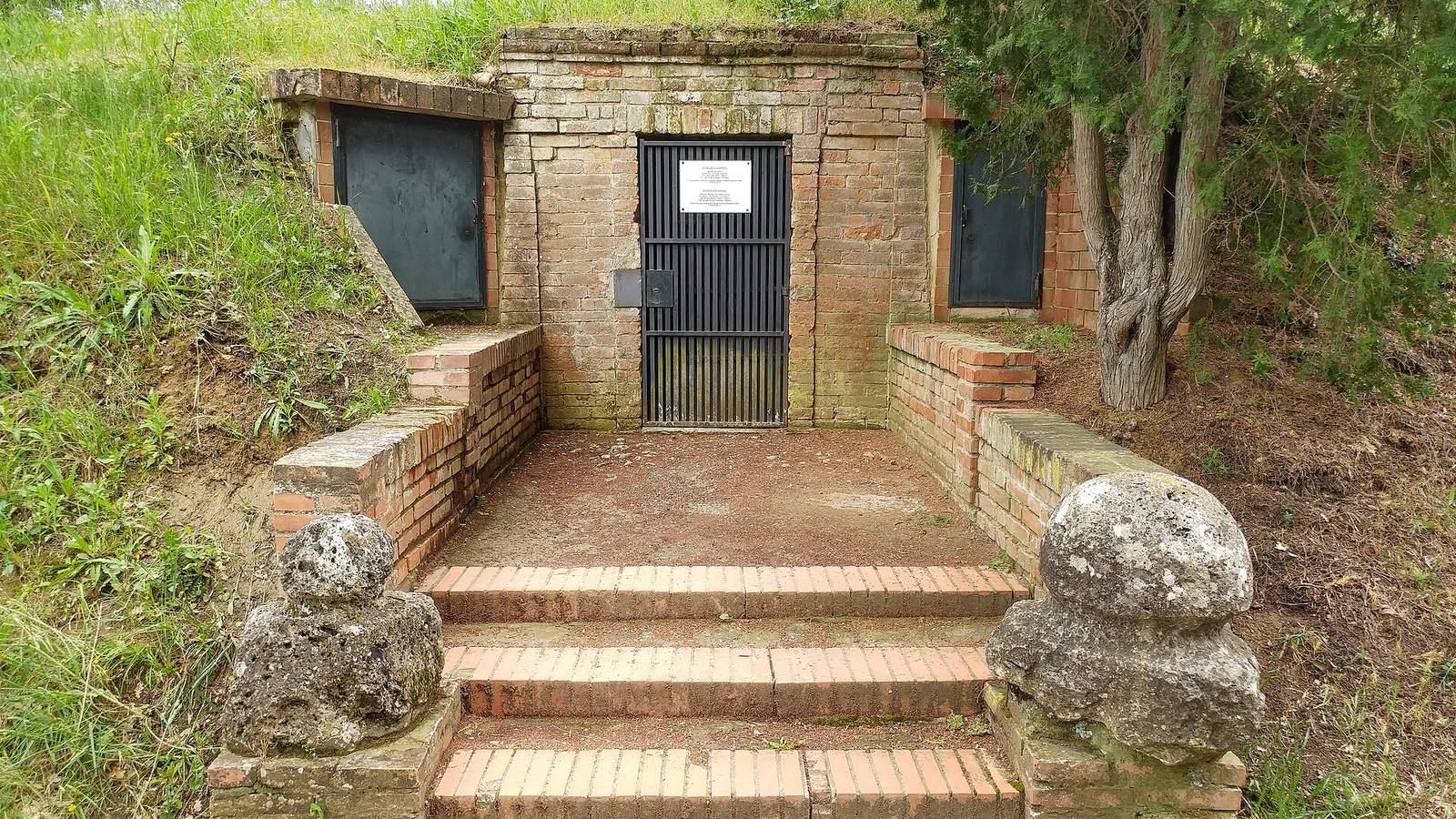
Structure and access
The chambers lie about eight metres below the entrance level, within sand deposited during the Pliocene geological epoch. The tomb covers roughly 100 square metres. Its atrium measures about 4.10 by 5.13 metres and is 3.24 metres high. Three-dimensional modelling from photographs in 2014 showed that the chambers have irregular shapes and are not arranged symmetrically, unlike an earlier plan.
The original stepped entrance passage is buried beneath the road surface, so the stair now used to reach the tomb is not ancient. The chamber doorways had shaped door leaves attached by hinges. The unstable hillside sand has also been linked to the collapse of other tombs at Poggio Renzo.
Funerary furnishings
Each chamber, including the atrium, contains beds cut from the rock in low relief. Their couch-like shapes suited funerary use. A cube-shaped bench in the rear chamber may have served as a surface for grave goods or as an altar for rites connected with the dead.
Painted ceilings
The ceilings have recessed panels arranged to imitate wooden construction, with paint surviving in parts. A female figure or head occupies the centre of the atrium ceiling. A small frontal image of Medusa, a Gorgon often used as a protective figure, decorates a panel moulding there and wears disc-shaped earrings. In the rear chamber, the central panel bears a red rosette surrounded by four green ivy leaves, while a two-winged siren, a mythological being, fills each corner.
These recessed ceilings appear unusually early at Chiusi. They occur in local tombs from the beginning of the fifth century BCE, while deep versions are not found elsewhere in Etruria before the second half of the fourth century BCE. The design has been interpreted as an adaptation of Greek models, perhaps transmitted through the Greek settlements and cultural sphere of southern Italy.
Atrium wall paintings
Painted band and preservation
The atrium’s paintings occupy a narrow strip above a green lower wall band. A simple repeating angular pattern borders the strip below, and a leaf pattern runs along its upper edge. The images were painted over a clay coating laid on smoothed sandstone, using pigments of mineral and plant origin. The frieze continues around all four walls, with scenes crossing the corners.
The colours have faded substantially, and some details are now interpreted partly with the help of early copies. Later examination combined photography across different wavelengths with X-ray fluorescence, an X-ray method for identifying elements in materials. These techniques clarified damaged figures, traces of execution, incisions, and details of the painted support. Analysis identified iron-rich red earth in one figure’s hair and red ochre and red lead in flesh tones.
Races and athletic contests
Near the entrance, four men stand beside a low stool covered with pale cloth edged in red. Each holds a branch, while two also carry a curved trumpet and a lyre. Three chariots race along the adjoining wall, each overtaking the one ahead. A naked boy and a collared dog run beneath the horses, and pinecone-shaped markers indicate the course. Some men may be lictors, attendants associated with public officials and traditionally shown with bundles of rods; here, they may carry plant stems. The trumpet player may be outside the contest.
On the left wall, two bearded men in short tunics patterned with diamonds walk hand in hand, each carrying a palm branch. The rear-wall scenes include a naked youth with a palm branch beside a galloping red horse, then a bearded rider on a black horse with a spear. Two naked wrestlers follow, one lifting the other from the ground. A crowned, long-haired man in blue footwear raises an open hand and holds a rod; he may represent an official signalling the end of a contest. At the far end, a monkey crouches in a shrub with a chain around its neck. The horsemen have also been interpreted as riders leaping between horses.
Performances and ceremonial figures
Athletic scenes continue near the rear-chamber doorway. A naked youth looks back while carrying a branch and an oil flask; beside him, a naked man wearing a headband and belt grips a javelin with both hands. Two bearded boxers, wearing belts and hand guards, face one another across a cloth-covered stool. On the right wall, an armed figure in a crested helmet, body armour, tunic, and leg guards raises a shield and holds a spear. Two double-pipe players accompany him, and a vessel hangs above. The armed figure may be a dancer performing in armour. Nearby, a smaller adult carries a victory palm and a ball or weight tied to a cord. The cord may have been used to increase the force of a throw.
Elsewhere, a horseman in a red cloak appears to separate from his horse, with a second black horse behind him. A crowned man holds a round object in each hand as a youth offers him something. On the entrance wall, a woman in a long red tunic stands on a low platform with an incense burner balanced on her head. A musician in a wide-brimmed hat plays a double pipe in front of her, with a large basket on either side.
Nearby, a veiled woman sits beneath a parasol on a low stool, her feet resting on a footstool with lion-shaped legs. She holds the parasol with both hands. She may represent the tomb’s deceased owner or a noble spectator, and a male figure may also represent a deceased person. Other figures include a pale-draped man, a naked man walking between two dogs with his head turned and arms held back, and a naked youth, with a shrub behind the dogs. The scene has been interpreted either as a target-throwing game or as a performance in which a young man presents a prize to a dancer; neither reading is certain.
Rear-chamber paintings
Two small naked figures in the rear chamber may be servants. One lifts an object with one hand and holds a cup in the other; a second carries a vessel on the right wall. A bearded serpent appears beside the first figure, while a fragment of a red scratched drawing of a small winged horse survives beside the second. The figures may represent attendants serving the dead or cupbearers.