Città della Pieve Co-Cathedral: A Baroque Cathedral Church in Italy


Site at a Glance
- Rating
- 4.5
- Popularity
- Low
- Country
- Italy
- Primary era
- Early Modern
- Eras represented
- Classical, Medieval, Early Modern
- Civilizations
- Papal States, Roman
- Site type
- Religious
- Remains
- Cathedral
On this page7 sections
History
Città della Pieve Co-Cathedral is a Roman Catholic church in Italy, built and completed between the sixteenth and seventeenth centuries and remodeled in the Baroque style during the seventeenth century. Dedicated to Saints Gervasius and Protasius, early Christian martyrs traditionally associated with Milan, it serves as an active co-cathedral of the Archdiocese of Perugia–Città della Pieve. A co-cathedral shares the seat or title of a diocese or archdiocese with another cathedral.
Early Foundations and Medieval Transformation
A church already stood on the site in the fourth or fifth century. It was replaced by a Romanesque building in the eighth century. Romanesque architecture is characterized by massive construction and rounded arches. During the thirteenth century, that building was remodeled in the Gothic style, which commonly uses pointed arches and stronger vertical emphasis.
Cathedral and Co-Cathedral
The present church took shape through construction completed between the sixteenth and seventeenth centuries. Its seventeenth-century Baroque remodeling brought a style known for dynamic composition and richly expressive decoration. The side chapels and bell tower belong to this phase. During the sixteenth century, the church became the cathedral of the Diocese of Città della Pieve, a territorial jurisdiction of the Catholic Church governed by a bishop. In 1986, it became a co-cathedral of the Archdiocese of Perugia–Città della Pieve, an archdiocese being a larger or historically prominent diocese governed by an archbishop.
Damage and Preservation
In 1783, lightning caused a collapse that destroyed part of the apse decoration. A cathedral museum beside the sacristy preserves works connected with the church’s different construction phases, liturgical materials, and the original papal bull establishing the diocese, issued by Pope Clement VIII, who was pope from 1592 to 1605.
Remains
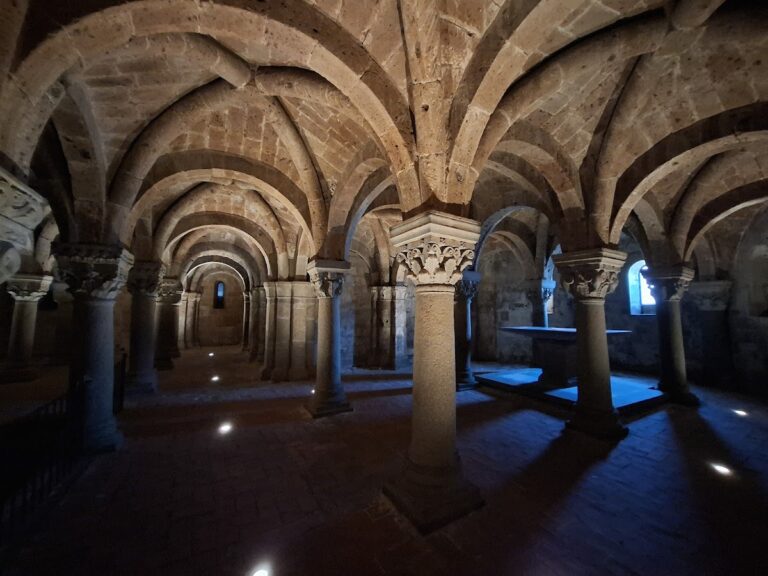
The present church is chiefly shaped by its sixteenth- and seventeenth-century construction and Baroque remodeling, while only a few traces of the earlier fourth- or fifth-century, Romanesque, and Gothic phases survive. Beneath the high altar lies the Gothic crypt, a chamber below the principal worship area used for religious purposes. It was built over the remains of earlier secular buildings dating from the Etruscan–Roman period.
Paintings and Sculpture
The church preserves a group of Renaissance and early Baroque artworks. Perugino painted an early-sixteenth-century Baptism of Christ and the Madonna in Glory among Saints in 1514. Antonio Circignani, known as Il Pomarancio, is represented by the Marriage of the Virgin from 1620, the Madonna of Carmel from 1528, and the apse decoration Celestial Glory from 1598, which was partly destroyed in the 1783 collapse. His painting of the Baptism of Jesus is preserved in the sacristy. Other works include Domenico Alfani’s Madonna and Child among Angels and Saints from 1521, a Madonna among Saints attributed to Giannicola di Paolo, and Salvio Savini’s late-sixteenth-century Madonna Enthroned among Saints. A wooden crucifix dating to 1550 is attributed to Giambologna, a prominent sculptor of the late Italian Renaissance.
Cathedral Museum
The museum beside the sacristy brings together objects associated with the cathedral’s successive building phases and its worship. Its holdings include liturgical materials and the original papal bull that created the Diocese of Città della Pieve, preserving evidence of the church’s institutional history alongside its surviving fabric and artworks.
Nearby sites