Lovrijenac: Dubrovnik’s Fortress of Saint Lawrence


Site at a Glance
- Rating
- 4.6
- Popularity
- Medium
- Country
- Croatia
- Primary era
- Medieval
- External website
- Open
- Eras represented
- Medieval, Early Modern
- Civilizations
- Republic of Ragusa
- Site type
- Military
- Remains
- Fort
On this page7 sections
History
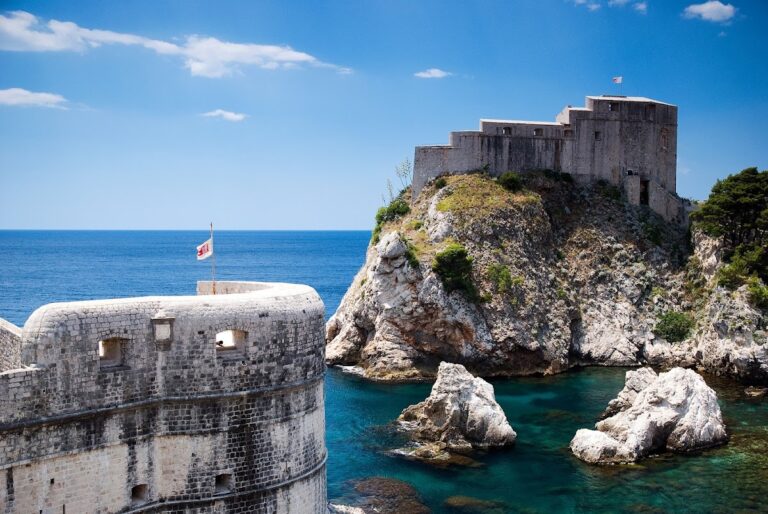
Lovrijenac is a medieval fortress in Croatia, standing outside Dubrovnik’s western city walls, whose development took shape during the fourteenth century. It guarded the city’s approaches from the sea and land and became associated with Dubrovnik’s resistance to Venetian domination.
Origins and Venetian Threat
Local tradition places the fortress’s origins in the early eleventh century, with dates of 1018 or 1038 sometimes assigned to its foundation. According to the tradition, Venice intended to build a stronghold on the same rock to control Dubrovnik. The citizens reportedly constructed their own fortress first, completing it in three months. When Venetian ships arrived carrying soldiers and building materials, the citizens told them to return to Venice.
Lovrijenac appears in the historical record in 1301, when Dubrovnik’s city council appointed its commander. The stronghold continued to develop during the fourteenth century and was rebuilt repeatedly in later periods.
Reconstruction and Military Administration
Major changes were made during the fifteenth and sixteenth centuries. Among the later works were repairs to the defensive parapets by I. K. Zanchi of Pesaro, the municipal builder. The earthquake of 1667 caused further damage, followed by additional repairs during the seventeenth century.
During its military service, Lovrijenac held a garrison of 25 men under a commander chosen from Dubrovnik’s nobility. The commander changed every month. This arrangement helped protect the city against the possibility that the fortress might be used by a rebellious officer to threaten Dubrovnik from within.
Cultural Use and the Fortress Motto
Since the 1950s, Lovrijenac has been a venue for the Dubrovnik Summer Festival, an annual performing-arts event established after the Second World War and known for theatre and music in historic settings. Performances of Shakespeare’s Hamlet have helped make theatrical use an important part of the fortress’s modern cultural identity.
An inscription above the entrance declares that freedom cannot be sold for all the gold in the world. The saying became a motto associated with Dubrovnik. Its origin is variously linked to the fortress’s builder, the Croatian poet, or a fable traditionally attributed to Aesop, the ancient Greek storyteller associated with short moral tales.
Remains
Rock, Terraces, and Defensive Walls
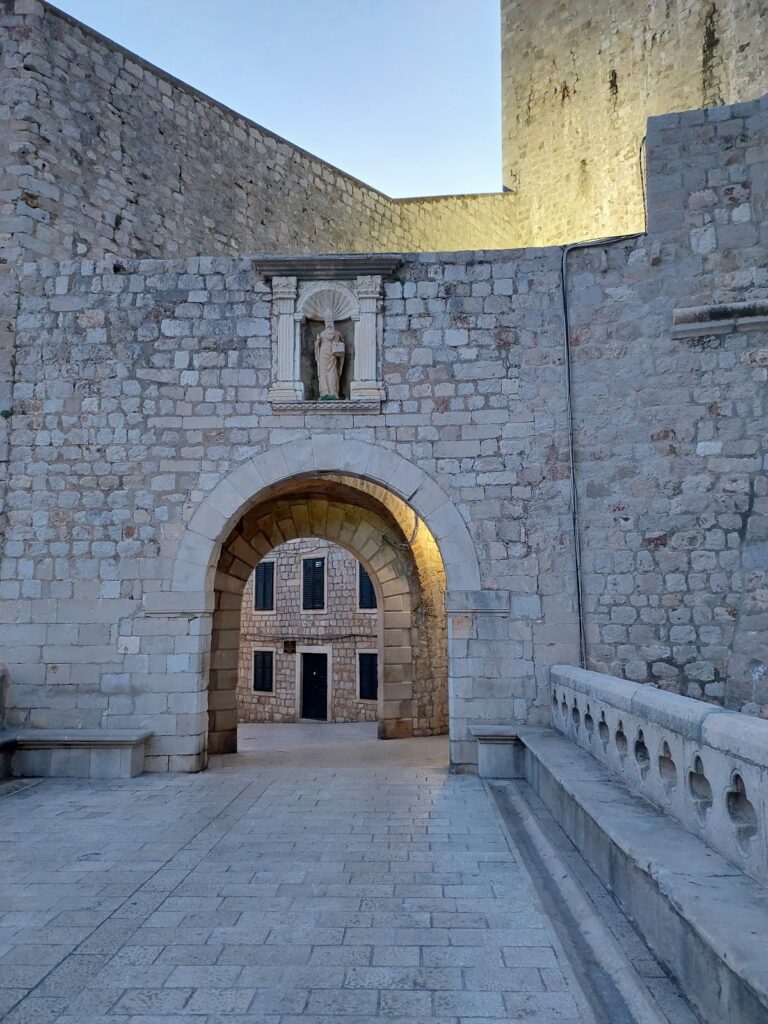
Lovrijenac occupies a steep rock rising 37 metres above the sea outside Dubrovnik’s western walls. Its triangular form follows the uneven shape of the rock, giving it the nickname “the Gibraltar of Dubrovnik.” Three elevated terraces accommodate the changing levels of the site. Each terrace has a parapet, a low defensive wall along its edge, while the broadest platform faces south toward the sea.
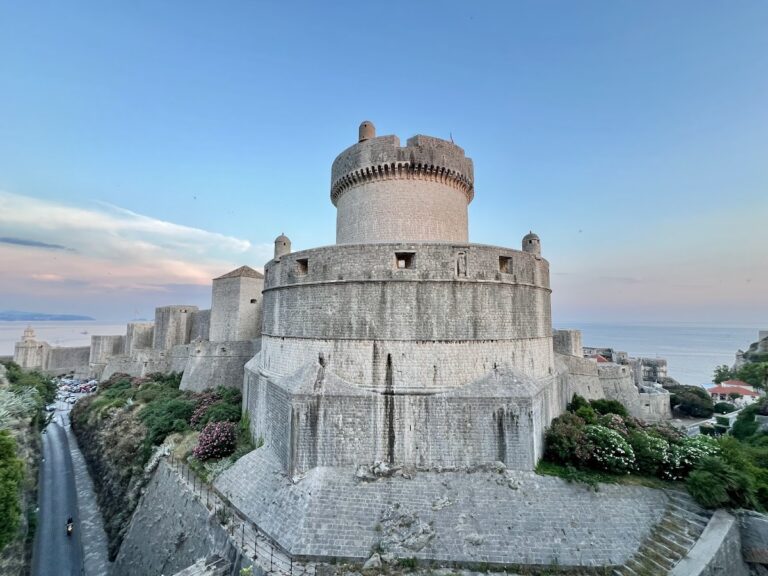
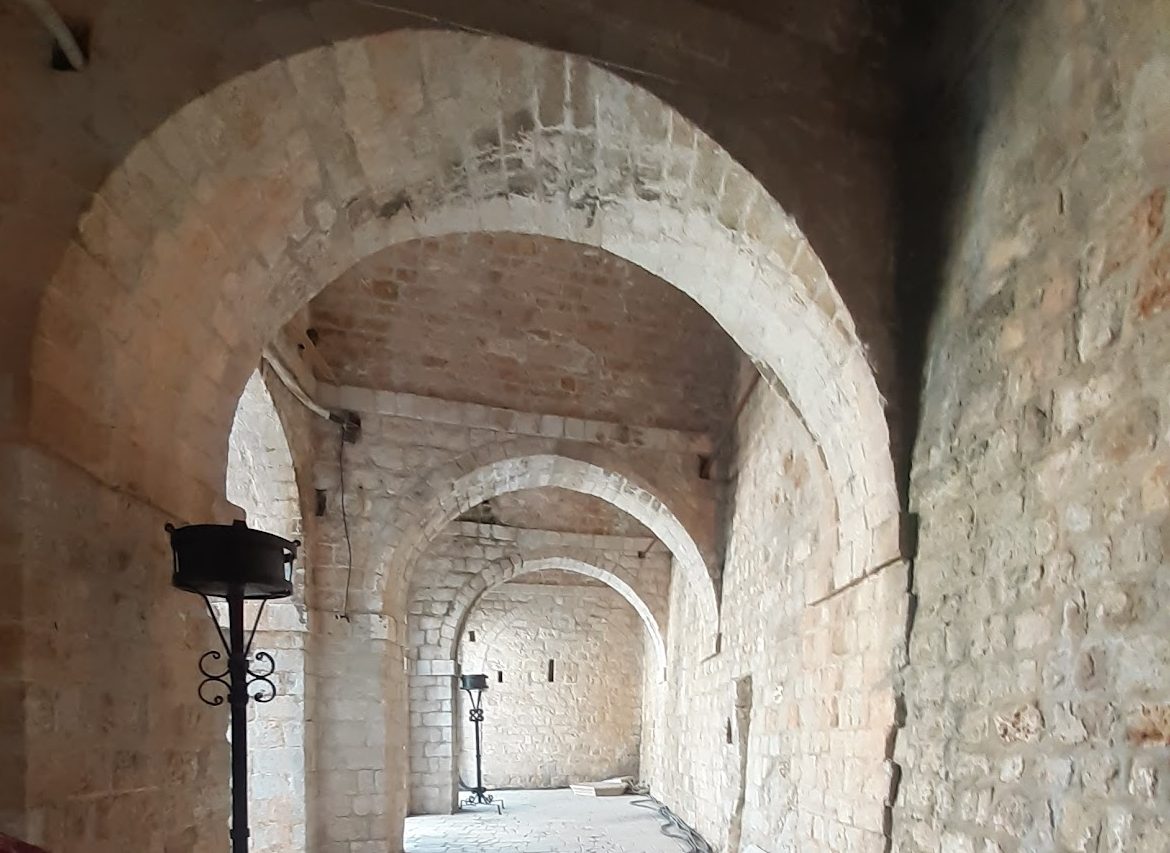
The fortress contains an inner four-sided courtyard with large vaults and strong arches, and two bridges provide access across the rocky approach. The seaward walls, which faced possible enemy fire, reach approximately 12 metres in thickness. The wall toward the city is only about 60 centimetres thick, allowing the Fortress of Bokar opposite Lovrijenac to destroy the stronghold if its commander rebelled. The broadest part of the fortification also faced Bokar and once helped defend the small harbour of Kolorina.
Cannons and the Lost Gušter
Ten large cannons formed part of Lovrijenac’s armament. The largest was Gušter, meaning “the Lizard,” designed and cast in 1537 by the master founder Ivan Rabljanin. It carried elaborate carving and decoration but was never fired.
Gušter was lost in the sea beneath the fortress in the nineteenth century, when Austrian troops were dismantling Lovrijenac’s weapons. The rope securing the cannon broke during its removal and transport, and the cannon has never been recovered.